Health
What's the clearest sign of an airway crisis?
Labored breathing at rest combined with blue or gray gums; either alone warrants an immediate emergency vet visit.

Quick answer
What's the clearest sign of an airway crisis?
Labored breathing at rest combined with blue or gray gums; either alone warrants an immediate emergency vet visit.
Loud, labored breathing that doesn't ease with rest, especially with blue or gray gums, is not a symptom to monitor overnight in an older Labrador; it's a reason to move immediately.
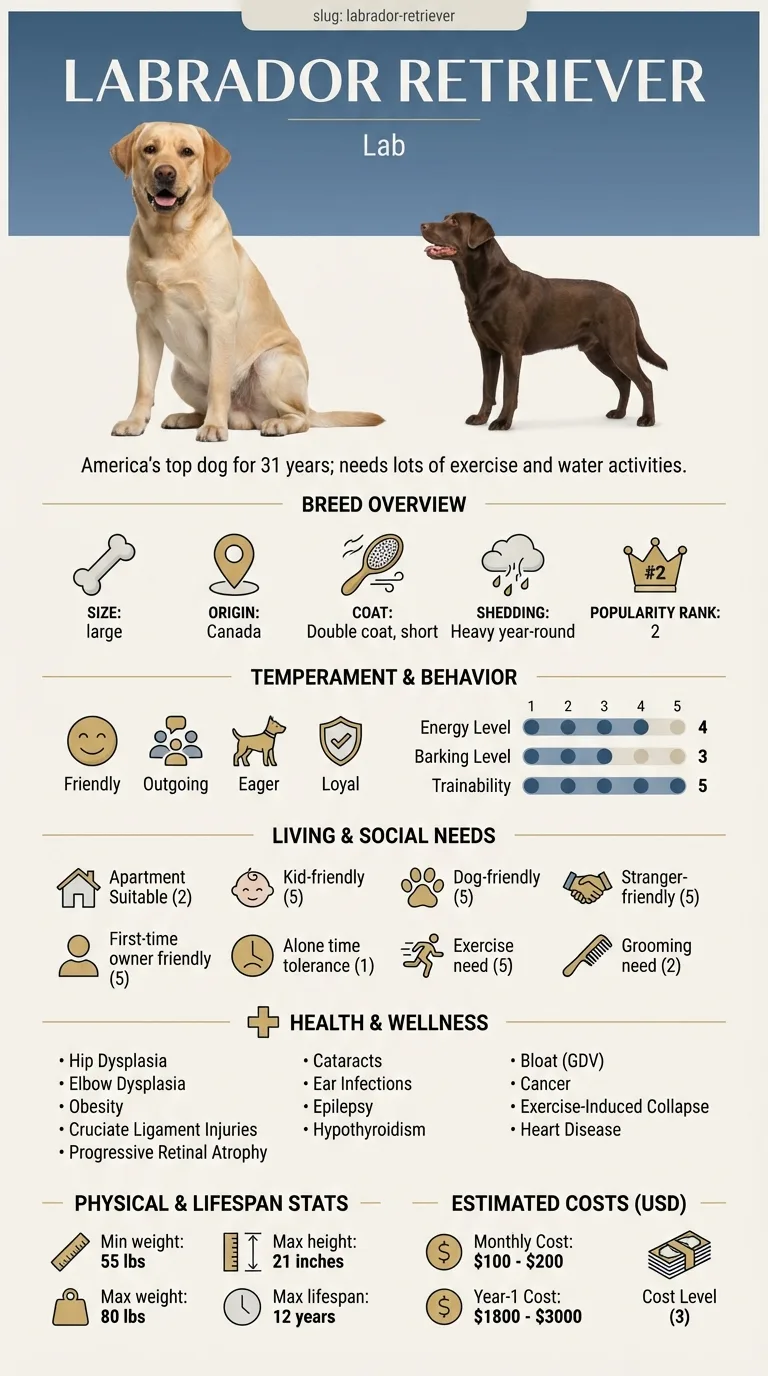
Owners of Labradors already diagnosed with, or showing signs consistent with, geriatric laryngeal paralysis are the ones who most need to know exactly where the line into emergency territory sits, since this condition can progress from manageable to critical faster than its slow overall timeline suggests.
This guide is not medical advice. If your dog shows pain, sudden behavior change, or worsening symptoms, consult a licensed veterinarian.
Some links may be affiliate links. We may earn a commission at no extra cost to you. We only suggest products we believe are helpful for dog owners.
We research and check what we publish, but we do not warrant that any figure, date, price, or statement is accurate, complete, or current, and we accept no liability for any loss, cost, injury, or other harm arising from the use of this site. Use it as one reference among several. You remain responsible for your own decisions and for your dog's care - confirm anything that matters with a licensed veterinarian or another qualified professional before you act on it. Full disclaimer.
While Labrador Retrievers don't have true Brachycephalic Obstructive Airway Syndrome, an older Lab with advanced geriatric laryngeal paralysis can experience a genuine airway crisis that looks similar in urgency: labored breathing at rest, blue or gray gums, and collapse, often triggered suddenly by heat, excitement, or exertion even when the underlying condition has been slow and stable for a long time.
A true crisis episode is uncommon at any single point in time, but becomes a real risk as geriatric laryngeal paralysis advances in an aging Labrador, particularly once resting breathing has already become noticeably labored.
Labradors are disproportionately represented in veterinary literature on geriatric laryngeal paralysis, a progressive nerve condition, not a structural brachycephalic trait. As the airway opening narrows with disease progression, the margin for error during exertion or heat shrinks, setting up the conditions for a sudden crisis in a dog that otherwise seemed stable.
Heat and humidity are the most significant environmental triggers, since affected dogs lose much of their ability to cool efficiently through panting. Excitement, unexpected exertion, and excess body weight all add further strain to an already compromised airway.
Discuss a management and emergency plan with your vet as soon as laryngeal paralysis is diagnosed, before a crisis happens. Treat labored breathing at rest, blue or gray gums, collapse, or an inability to settle as an immediate emergency requiring same-hour care, not a wait-and-see situation.
See all Labrador Retriever health problems, which breeds are prone to brachycephalic obstructive airway syndrome boas, or the full Labrador Retriever breed guide for temperament, exercise needs and ownership costs.
The underlying disease progresses slowly, often over a year or more, but an individual crisis episode can develop within minutes once triggered. Recovery from an acute crisis, if caught in time, typically involves a day or more of hospitalization and oxygen support.
Success is preventing a crisis through proactive heat and weight management, and reacting immediately rather than hesitating if one does occur, since speed of response is the biggest factor an owner controls once symptoms escalate.
These specific signs distinguish a manageable flare from a genuine airway crisis in a dog with advancing laryngeal paralysis:
Geriatric laryngeal paralysis itself typically progresses slowly, over months to years. But once the airway opening narrows past a certain point, a single trigger, heat, excitement, or even moderate exercise, can push a dog from manageable noisy breathing into acute respiratory distress within minutes, since a partially obstructed airway has almost no reserve capacity left. This is exactly why the slow, chronic nature of the underlying disease shouldn't create a false sense of security about how fast an individual crisis episode can develop.

Gus, an eleven-year-old Labrador diagnosed with mild laryngeal paralysis the year before, had been stable on weight management and cooler-weather walks. One unusually warm afternoon, his owner let him play fetch in the yard a bit longer than usual, and within minutes Gus was struggling to breathe, his gums turning a dusky gray. His owner recognized this as the crisis they'd been warned about and got him to the emergency vet within fifteen minutes, where he received oxygen support and sedation to ease his breathing effort. Gus stabilized within a few hours and, after discussion with a veterinary surgeon, underwent airway-widening surgery the following month to reduce the risk of another episode. His owner now tracks temperature and humidity before any outdoor activity without exception.
Key takeaway: A stable, slow-progressing airway condition can still turn into a fast, genuine emergency, and recognizing the specific crisis signs immediately, rather than waiting to see if they pass, is what protects a dog in that moment.
Yes, absolutely. Labored breathing at rest, blue or gray gums, collapse, or an inability to settle are all signs of a genuine airway crisis requiring immediate emergency veterinary care.
Yes, this is one of the more important things to understand about the condition. A single trigger like heat, excitement, or exertion can push a partially narrowed airway into acute obstruction quickly, even if the underlying disease has been slow and stable for a long time.
Get to an emergency vet immediately. Keep your dog as calm and cool as possible during transport, but do not delay travel trying to manage the situation at home; this level of respiratory distress needs immediate professional intervention.
Yes, in dogs with advanced, obstructive laryngeal paralysis, a surgical procedure to permanently widen the airway opening is often recommended after a crisis episode to prevent recurrence.
Yes. Dogs with laryngeal paralysis cool themselves less effectively through panting, so heat and humidity are a genuine, independent trigger for a breathing crisis, separate from exercise or excitement.
Stable cases have breathing noise that's consistent and doesn't happen at rest. Worsening cases show noise increasing at rest, more frequent episodes, or any single episode involving visible distress or gum color changes, all worth an urgent vet call.
Not entirely, but exercise should be shorter, cooler, and closely monitored, with an immediate stop at the first sign of increased effort, rather than pushed through as if nothing has changed.
Labored breathing at rest combined with blue or gray gums; either alone warrants an immediate emergency vet visit.
Yes, heat, excitement, or exertion can tip a previously stable, mildly affected dog into acute crisis quickly, so ongoing vigilance matters even between symptomatic episodes.
Yes, reduced ability to cool through panting makes heat and humidity an independent trigger for a breathing crisis, not just a discomfort issue.
Surgical widening of the airway significantly reduces the risk of future obstructive episodes in advanced cases, though it comes with its own risks your vet will walk through.
An emergency visit for respiratory distress, potentially including oxygen support and sedation, is a significant cost, generally in the several-hundred-to-low-thousands range depending on severity and length of stay.
A one-page prep sheet for this condition: the signs, the questions to ask, what to get priced. Unlocks here.
You get: Vet visit prep sheet
No spam. One-click unsubscribe. See our privacy policy.
Preview page 1 before you decide.