Health
Is sudden back leg weakness an emergency in a Lab?
Yes — this should be evaluated by a vet the same hour, since prompt treatment significantly improves recovery odds for acute disc herniation.

Quick answer
Is sudden back leg weakness an emergency in a Lab?
Yes — this should be evaluated by a vet the same hour, since prompt treatment significantly improves recovery odds for acute disc herniation.
A Lab that yelps once during a jump and then suddenly can't use its back legs isn't having a bad moment that will pass on its own — that's a spinal emergency with a genuinely time-sensitive treatment window.
Owners of active, athletic Labs who witness a sudden collapse or crying-out during play and have to decide, often within the hour, whether this is an emergency worth a middle-of-the-night drive to a specialty hospital.
This guide is not medical advice. If your dog shows pain, sudden behavior change, or worsening symptoms, consult a licensed veterinarian.
Some links may be affiliate links. We may earn a commission at no extra cost to you. We only suggest products we believe are helpful for dog owners.
We research and check what we publish, but we do not warrant that any figure, date, price, or statement is accurate, complete, or current, and we accept no liability for any loss, cost, injury, or other harm arising from the use of this site. Use it as one reference among several. You remain responsible for your own decisions and for your dog's care - confirm anything that matters with a licensed veterinarian or another qualified professional before you act on it. Full disclaimer.
Check this first
In Type I disc herniation, the tough outer layer of a disc (the annulus fibrosus) ruptures suddenly, and the softer inner material (the nucleus pulposus) extrudes into the spinal canal, physically compressing the spinal cord. This is fundamentally different from the slow degeneration pattern more typical of aging large-breed spines — it's an acute mechanical event, often set off by a single hard jump, twist, or fall, and the resulting compression can escalate from mild pain to complete paralysis within hours.
While Type I herniation is classically associated with chondrodystrophic breeds due to their disc composition, it does occur in large breeds like Labradors, usually triggered by a specific traumatic movement rather than developing spontaneously from degeneration alone. The key clinical detail that distinguishes an emergency from a manageable injury is whether the dog retains deep pain sensation in the affected limbs — its presence or absence is one of the single biggest factors in surgical decision-making and prognosis.
Because spinal cord compression can worsen rapidly, the standard advice from veterinary neurologists is that surgical decompression, when indicated, should happen as soon as possible — ideally within 24 hours of losing the ability to walk — since delay measurably worsens the odds of full recovery.
If any of these apply, call your vet or an emergency clinic now. The rest of this page is for the cases that are not an emergency.
Type I intervertebral disc herniation is a sudden, acute spinal emergency where disc material ruptures and compresses the spinal cord within minutes to hours, typically triggered by a specific traumatic movement like a hard jump or twist. While less common in Labradors than in chondrodystrophic breeds, it does occur, and its rapid onset makes it a true time-sensitive emergency distinct from the slower, age-related disc degeneration more typical of large-breed spines.
Type I herniation is significantly less common in Labradors than in breeds specifically predisposed by disc composition, but it's well documented enough as an emergency presentation that veterinary neurologists routinely consider it in any large dog with sudden-onset back leg weakness or paralysis.
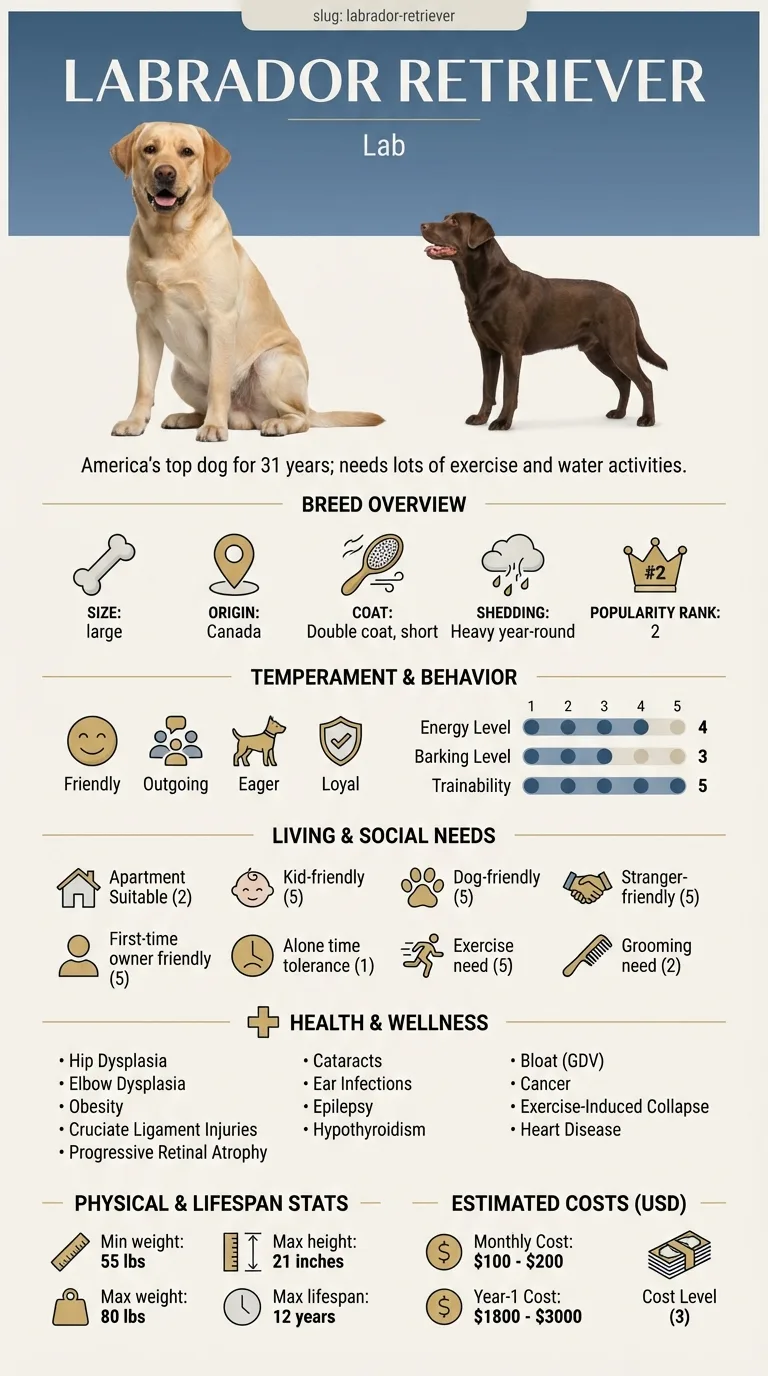
Labradors are a large, muscular, high-drive breed that regularly performs hard jumps and quick directional changes during retrieving and play, which creates the mechanical conditions — sudden force on the spine — that can trigger an acute disc rupture even without the underlying disc abnormality seen in chondrodystrophic breeds. Their 55 to 80 pound body weight adds substantial force to any single traumatic movement compared to a lighter breed.
Hard surfaces, repeated high jumps (off furniture, out of vehicles, over obstacles), and intense unconditioned exercise sessions are the main environmental factors that set up a specific traumatic movement capable of triggering acute herniation.
Treat any sudden yelp followed by reluctance to move, sudden back leg weakness, dragging a paw, or complete inability to stand as an emergency requiring veterinary evaluation the same hour — this is one of the few conditions where genuinely immediate action changes the outcome.
See all Labrador Retriever health problems, which breeds are prone to intervertebral disc disease ivdd type i, or the full Labrador Retriever breed guide for temperament, exercise needs and ownership costs.
This is a true emergency with an urgent evaluation and treatment timeline measured in hours, not days. Post-surgical recovery typically involves several weeks of strict rest followed by a structured rehabilitation program lasting one to three months depending on severity.
For dogs treated promptly with preserved deep pain sensation, success often means a genuine return to normal walking and activity. For more severe cases, success may mean regained functional mobility with some residual deficit — outcomes vary enough that a realistic conversation with your treating neurologist matters more than any general statistic.
The distinction matters because a true Type I event has a treatment window that a muscle strain simply doesn't — here's what separates the two.
Nina's five-year-old Lab, Otis, yelped sharply mid-jump off a lake dock and immediately went limp in his back legs, unable to stand when Nina reached him seconds later. She drove straight to an emergency veterinary hospital rather than waiting to see if he'd 'walk it off.' An MRI confirmed an acute Type I disc herniation, and Otis retained deep pain sensation, which supported a good surgical prognosis. He had decompression surgery within eight hours of the injury and, after six weeks of strict rest followed by structured rehabilitation, regained the ability to walk normally, though his surgeon noted a slightly altered gait that remained stable a year later.
Key takeaway: Acting within hours rather than days genuinely changed Otis's odds — this is one of the few injuries where 'wait and see if it improves overnight' is actively the wrong call.
Type I is a sudden rupture of disc material that acutely compresses the spinal cord, usually triggered by a specific traumatic movement. Type II is the slower, age-related bulging or degeneration more typical of gradual large-breed spinal wear, without the sudden extrusion event.
Yes — it's less common than in chondrodystrophic breeds, but it does occur in Labradors, usually following a specific traumatic movement like a hard jump or awkward landing rather than developing spontaneously.
Extremely urgent. This should be treated as an emergency requiring same-hour veterinary evaluation, since the odds of full recovery are significantly better with prompt treatment, especially surgery within 24 hours if indicated.
It means the spinal cord compression is severe enough to block even deep pain signals, which is the most serious presentation and carries a more guarded prognosis. It still often warrants emergency surgery, since some dogs recover even from this level.
Emergency decompression surgery, often at a specialty or emergency hospital given the urgency, commonly runs $5,000–$10,000 or more, reflecting both the surgical complexity and the after-hours emergency setting.
Many dogs, especially those treated promptly and with preserved deep pain sensation, recover very well. Prognosis worsens with delayed treatment or loss of deep pain sensation, though even some of these more severe cases regain function with surgery and rehabilitation.
Keep the dog as still as possible, avoid encouraging movement, and get to a vet or emergency hospital immediately rather than waiting to see if it resolves — time genuinely matters for this specific type of injury.
Yes — this should be evaluated by a vet the same hour, since prompt treatment significantly improves recovery odds for acute disc herniation.
As fast as possible — surgical decompression within 24 hours, when indicated, gives meaningfully better outcomes than delayed treatment.
Typically $5,000–$10,000 or more given the surgical complexity and emergency setting.
It can happen, though less commonly, usually triggered by a specific traumatic movement rather than occurring spontaneously.
Whether the dog retains deep pain sensation in the affected legs — this is the key factor in prognosis and treatment urgency.
A one-page prep sheet for this condition: the signs, the questions to ask, what to get priced. Unlocks here.
You get: Vet visit prep sheet
No spam. One-click unsubscribe. See our privacy policy.
Preview page 1 before you decide.