Health
Does my Lab have the same heart disease risk as a small dog?
No, the small-breed pattern of chronic mitral valve disease doesn't meaningfully apply to Labradors; this breed's documented risk is different and more generic.

Quick answer
Does my Lab have the same heart disease risk as a small dog?
No, the small-breed pattern of chronic mitral valve disease doesn't meaningfully apply to Labradors; this breed's documented risk is different and more generic.
If you've read that heart disease mainly threatens small, senior dogs, know that a Labrador's cardiac risk profile looks different, split between a less common congenital issue and general age-related changes.
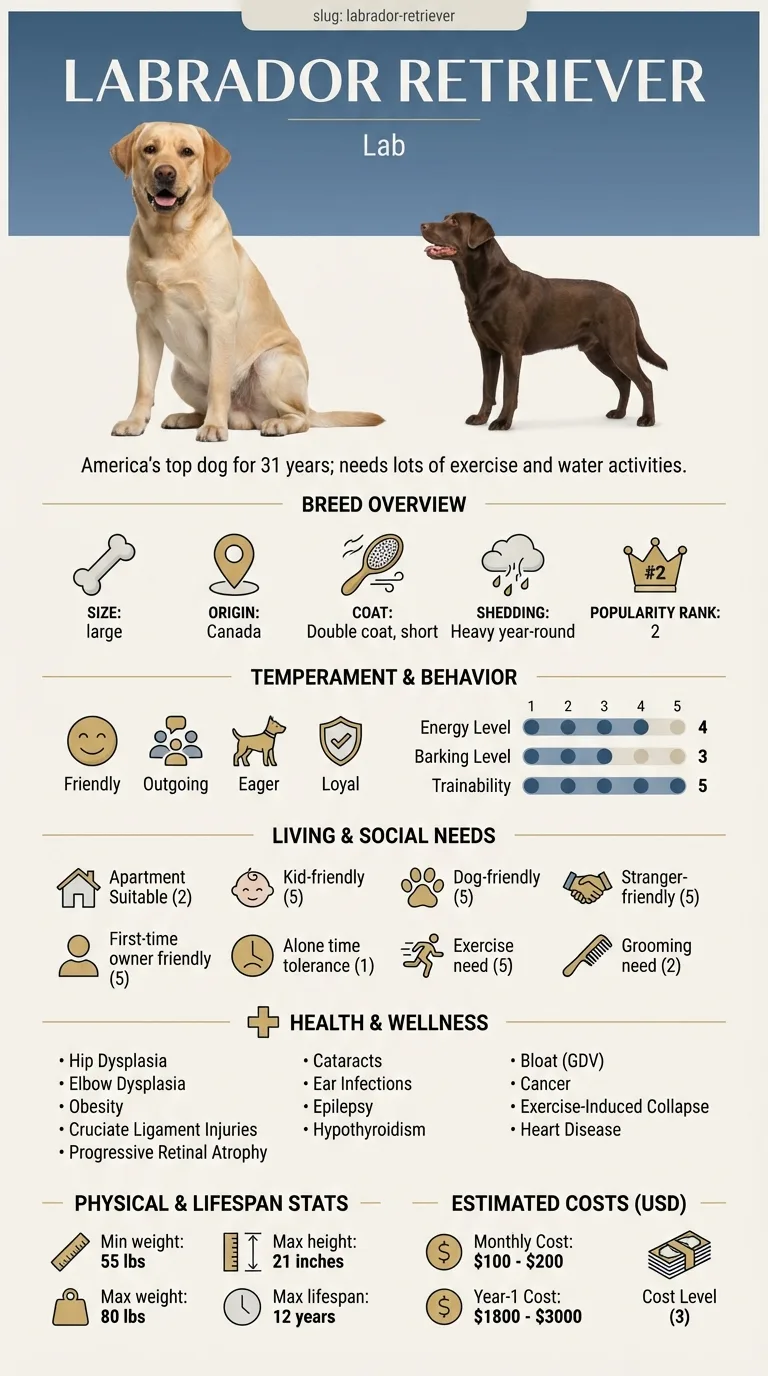
Owners of Labrador puppies going through their first full veterinary exam, and owners of Labradors entering their senior years, are the two groups for whom this breed's actual cardiac risk timeline matters most.
This guide is not medical advice. If your dog shows pain, sudden behavior change, or worsening symptoms, consult a licensed veterinarian.
Some links may be affiliate links. We may earn a commission at no extra cost to you. We only suggest products we believe are helpful for dog owners.
We research and check what we publish, but we do not warrant that any figure, date, price, or statement is accurate, complete, or current, and we accept no liability for any loss, cost, injury, or other harm arising from the use of this site. Use it as one reference among several. You remain responsible for your own decisions and for your dog's care - confirm anything that matters with a licensed veterinarian or another qualified professional before you act on it. Full disclaimer.
Cardiac disease in Labrador Retrievers is documented generically rather than pointing to one dominant inherited condition, and it doesn't follow the small-breed chronic valve disease pattern many owners have heard about. Real risk in this breed splits between an uncommon congenital defect, tricuspid valve dysplasia, typically caught in puppyhood, and general age-related cardiac changes that become more relevant in senior years.
Heart disease is documented as a general health concern for this breed without one dominant named condition, making cardiac risk real but diffuse, most relevant as a puppyhood screening question and, separately, a senior wellness consideration.
Labrador Retrievers don't carry the small-breed genetic predisposition to chronic mitral valve degeneration. Their documented cardiac risk instead centers on tricuspid valve dysplasia, a less common congenital defect appearing in breed case reports, plus the same general age-related cardiac changes seen across most large breeds as they get older.
Obesity, already documented in this breed, increases overall cardiac workload over a dog's lifetime. Consistent exercise within a dog's tolerance and a healthy weight support cardiac health broadly, even though they don't prevent a congenital defect that's present from birth.
Talk to your vet if a puppy exam reveals a heart murmur, or if an adult or senior dog shows reduced exercise tolerance, a new cough, labored breathing, or fainting. Sudden collapse or blue-tinged gums need immediate emergency care.
See all Labrador Retriever health problems, which breeds are prone to cardiac disease, or the full Labrador Retriever breed guide for temperament, exercise needs and ownership costs.
A congenital defect is typically identified within the first few months of life. Age-related cardiac changes, if they occur, generally develop gradually over the senior years and are monitored through routine wellness exams rather than a single diagnostic event.
Success looks like an accurate, breed-appropriate understanding of cardiac risk, catching a congenital issue early if present, and managing age-related changes through routine monitoring, rather than either dismissing heart health or over-worrying based on a pattern that belongs to a different type of dog.
Chronic mitral valve disease, the degenerative heart valve condition responsible for most of the "senior dog heart disease" narrative online, is overwhelmingly a small and toy breed pattern, most classically associated with Cavalier King Charles Spaniels. Labrador Retrievers, as a large breed, don't carry that same documented predisposition. The breed's own health data lists "heart disease" generically rather than pointing to one dominant inherited condition, which is a meaningfully different, and less alarmist, starting point than the small-breed narrative suggests.
In practice, a Labrador's real cardiac risk splits into two distinct categories. The first is congenital: tricuspid valve dysplasia, a birth defect in the valve between the heart's right chambers, does appear in Labrador case reports and is typically caught, if present, during a puppy's early veterinary exams via a heart murmur. The second is simply age-related: like most large breeds, an aging Labrador's heart can develop general changes in function over time, which is why routine senior wellness exams typically include a stethoscope check and sometimes further cardiac screening as a matter of course, not because of one specific named disease.

At Birdie's first puppy exam, her vet heard a soft heart murmur and recommended an echocardiogram rather than assuming it was harmless. The scan confirmed mild tricuspid valve dysplasia, a congenital defect her vet explained does show up in Labrador case reports, though it's not the breed's headline health concern. Because Birdie's case was mild, no treatment was needed, just periodic rechecks to monitor for any progression as she grew. Now six years old, Birdie has lived an entirely normal, active life, with her murmur unchanged at each annual check. Her owner appreciated getting a clear, accurate answer early rather than being left to wonder.
Key takeaway: A heart murmur in a Labrador puppy is worth a proper evaluation rather than assumption in either direction, and many congenital findings in this breed turn out to be manageable or even inconsequential with routine monitoring.
Heart disease is listed generically among this breed's documented health concerns, but without one single dominant inherited condition the way some breeds have. Risk splits between an uncommon congenital valve defect and general age-related changes.
No, that condition is overwhelmingly documented in small and toy breeds, not large breeds like Labradors. A Lab's cardiac risk profile looks meaningfully different from that small-breed pattern.
A congenital malformation of the valve between the heart's right chambers, present from birth. It's the one specific structural heart defect with real documentation in Labrador Retrievers, usually first detected as a murmur during a puppy exam.
Your vet listens for a heart murmur at routine puppy exams; if one is heard, further evaluation like an echocardiogram determines whether it's a structural issue like tricuspid valve dysplasia or an innocent, harmless murmur.
Yes, most vets include a cardiac listening check as part of routine senior wellness exams, since general age-related heart changes become more relevant as dogs get older, regardless of breed.
Reduced exercise tolerance, a new or worsening cough, labored breathing, or fainting are all worth a prompt vet visit rather than being dismissed as normal aging.
It varies widely. Mild cases may cause a lifelong murmur with no real impact on quality of life, while more severe cases can lead to exercise intolerance or fluid buildup requiring ongoing management.
No, the small-breed pattern of chronic mitral valve disease doesn't meaningfully apply to Labradors; this breed's documented risk is different and more generic.
Tricuspid valve dysplasia, a birth defect in the right-side heart valve, is the specific condition with genuine documentation in this breed.
Yes, a stethoscope exam at routine puppy visits is standard and can catch a congenital murmur early if one is present.
A basic listening check is standard at senior wellness visits; further testing like an echocardiogram is added only if a concerning finding comes up.
A full cardiac ultrasound with a veterinary cardiologist typically costs several hundred dollars, more than a basic exam but far less than ongoing treatment for an undiagnosed condition.
A one-page prep sheet for this condition: the signs, the questions to ask, what to get priced. Unlocks here.
You get: Vet visit prep sheet
No spam. One-click unsubscribe. See our privacy policy.
Preview page 1 before you decide.