Health
What does a bunny-hop gait mean in a Lab?
It's a classic sign of hip dysplasia, where both back legs move together instead of independently, especially noticeable going up stairs.

Quick answer
What does a bunny-hop gait mean in a Lab?
It's a classic sign of hip dysplasia, where both back legs move together instead of independently, especially noticeable going up stairs.
Two Labs with identical X-rays can look completely different day to day — one thriving on weight management and physical therapy, another needing surgery — which is why 'hip dysplasia' is really a spectrum, not a single diagnosis.
Owners of large, active young Labs who notice a bunny-hop gait going up stairs, and owners of seniors watching a lifetime favorite activity like fetch become visibly uncomfortable for their dog.
This guide is not medical advice. If your dog shows pain, sudden behavior change, or worsening symptoms, consult a licensed veterinarian.
Some links may be affiliate links. We may earn a commission at no extra cost to you. We only suggest products we believe are helpful for dog owners.
We research and check what we publish, but we do not warrant that any figure, date, price, or statement is accurate, complete, or current, and we accept no liability for any loss, cost, injury, or other harm arising from the use of this site. Use it as one reference among several. You remain responsible for your own decisions and for your dog's care - confirm anything that matters with a licensed veterinarian or another qualified professional before you act on it. Full disclaimer.
Hip dysplasia in Labrador Retrievers is a developmental malformation of the hip joint that causes instability, cartilage wear, and progressive arthritis. Severity ranges from barely noticeable to significantly disabling, and both genetics and puppyhood growth conditions influence how bad a given dog's case becomes, which makes this one of the more manageable large-breed joint conditions when caught early.
Hip dysplasia is one of the more frequently diagnosed orthopedic conditions in large breeds generally, and Labradors are represented often enough in OFA hip evaluation data that responsible breeders routinely screen breeding stock for it before placing puppies.
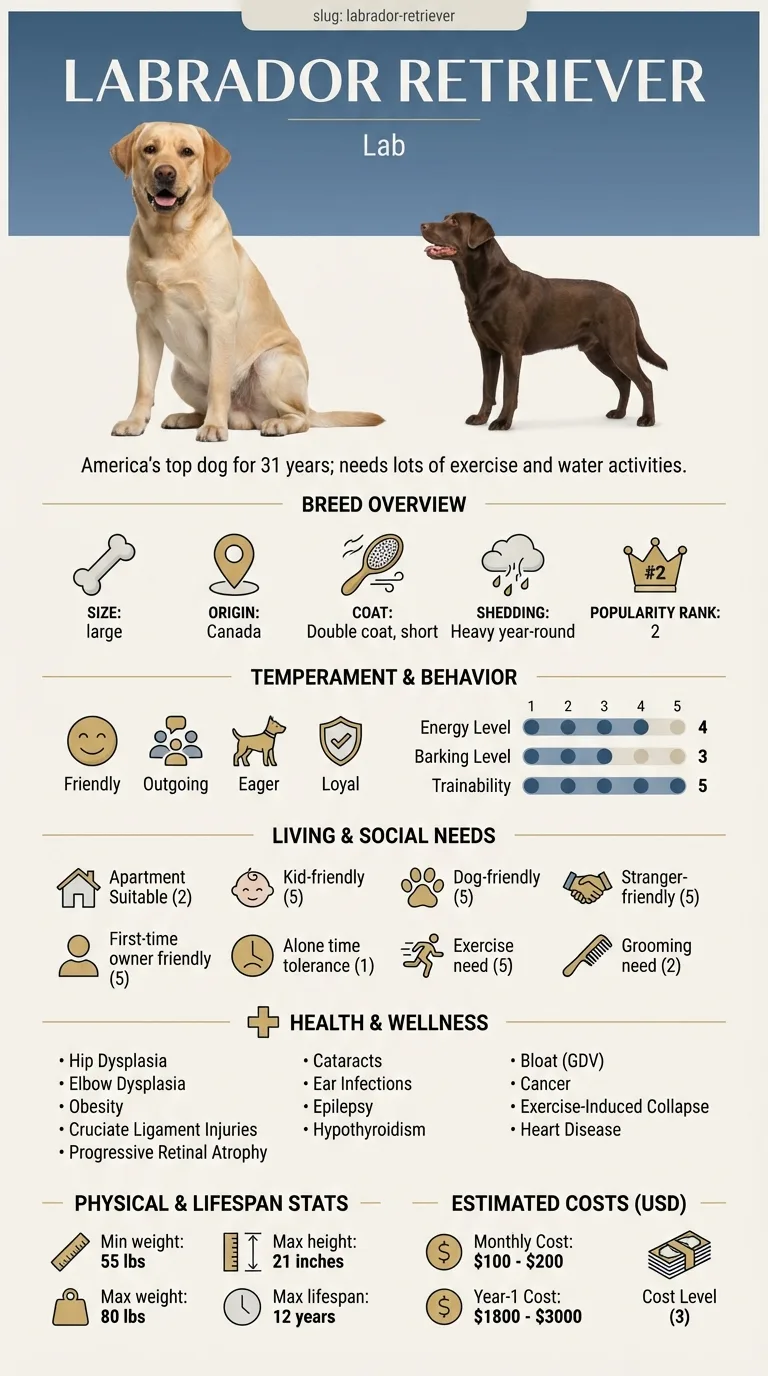
At 55 to 80 pounds with an exercise need rated near the top of the scale, Labradors put substantial repeated load on their hips through retrieving, jumping, and swimming activities they're bred to love, which means any underlying joint laxity gets tested by real-world use more than it would in a smaller, less active breed. Their genetics also carry a documented predisposition, which is why hip scoring of breeding parents is a standard part of responsible Labrador breeding programs.
Rapid puppyhood weight gain from rich food, combined with high-impact activity like jumping off furniture or out of vehicles before the skeleton is mature, can worsen the severity of dysplasia beyond what genetics alone would predict. Adult obesity compounds the problem by adding chronic mechanical stress to a joint that's already working at a disadvantage.
Schedule a vet visit for a persistent bunny-hop gait, reluctance to jump or climb stairs, visible muscle loss in the hindquarters, or stiffness that doesn't improve after warming up — none of these are emergencies, but they're worth investigating rather than assuming your dog will simply grow out of it.
See all Labrador Retriever health problems, which breeds are prone to hip dysplasia, or the full Labrador Retriever breed guide for temperament, exercise needs and ownership costs.
Diagnosis typically involves an X-ray appointment and grading, sometimes with a specialist referral for surgical candidates. Non-surgical management shows improvement in comfort within four to eight weeks of starting weight control and supplements; surgical recovery ranges from eight weeks for less invasive procedures to several months for a full hip replacement.
Success looks different by severity — for a mild case, it means a normal active life with ongoing weight management. For a surgical case, it means restored pain-free mobility, though full athletic performance may not always return to pre-diagnosis levels.
A healthy hip is a ball-and-socket joint where the femoral head sits snugly inside the pelvic socket. In a dysplastic hip, the socket is too shallow, the ball too loose, or both — so instead of smooth rotation, the joint has excess movement and grinding. Over months and years, that instability wears down cartilage and triggers the bone remodeling that shows up on X-ray as osteoarthritis.
This is a developmental condition with a strong genetic component, but it's not purely genetic — a puppy growing too fast on an overly rich diet, or one that did a lot of repetitive high-impact activity like jumping before its growth plates closed, can develop worse dysplasia than its genes alone would predict. This is part of why large-breed puppy food and controlled exercise during the first year matter more for a Lab than for a small breed that matures faster and carries less weight on its joints.
Severity varies enormously. A dog with mild laxity might live a fully normal life with weight management alone. A dog with severe malformation may need a total hip replacement to walk comfortably. Diagnosis and grading require X-rays, ideally evaluated by a specialist through a registry like OFA or PennHIP.

There's no single 'hip dysplasia treatment' — the right path depends heavily on how severe the joint changes are and how old the dog is when diagnosed.
Rachel noticed her ten-month-old Lab, Maple, had started avoiding the stairs to their apartment altogether, taking the longer route through the parking garage ramp instead. An X-ray confirmed moderate hip dysplasia in both hips, with visible looseness in the joint but not yet severe arthritis. Rachel's vet recommended a controlled weight-management plan, a joint supplement, and switching Maple's exercise from jumping games to leash walks and swimming at a local dog pool. Six months later, Maple was back to taking the stairs without hesitation, and her follow-up exam showed stable joint function with no surgery needed so far.
Key takeaway: A young dog avoiding a specific movement, like stairs, is worth investigating even without limping — hip dysplasia often shows up as avoidance behavior well before an obvious limp develops.
A 'bunny hop' gait where both back legs move together, especially going up stairs, reluctance to jump into a car, and stiffness after rest that improves once the dog warms up are the most common early signs owners notice.
It can appear as early as four to twelve months in severe cases, though many dogs don't show visible symptoms until arthritis develops later, sometimes not until middle age or beyond even with underlying joint laxity present since puppyhood.
Not entirely, since there's a genetic component, but choosing a puppy from hip-scored parents, feeding large-breed puppy food, and avoiding excessive jumping or high-impact exercise before growth plates close can meaningfully reduce severity.
A total hip replacement typically runs $3,500–$7,000 per hip, while a triple pelvic osteotomy in a young dog can run $2,000–$4,000 per side. Costs vary significantly by region and specialist.
Many mild to moderate cases are managed successfully without surgery through weight control, joint supplements, controlled exercise, and sometimes prescription pain management, especially when caught and managed early.
Generally yes — swimming and hydrotherapy let a dog build muscle around the joint with minimal impact, which is why many rehabilitation plans for this specific breed lean heavily on water-based exercise.
X-rays are the standard diagnostic tool, ideally evaluated through a formal grading system like OFA or PennHIP, which gives a more precise severity assessment than a general practitioner's read of a single film.
The underlying joint laxity is generally stable once a dog is skeletally mature, but the arthritis it causes is progressive and tends to worsen gradually over years without management, particularly if weight and activity aren't controlled.
It's a classic sign of hip dysplasia, where both back legs move together instead of independently, especially noticeable going up stairs.
Typically $3,500–$7,000 per hip, depending on region and specialist.
Yes — a lean body weight is one of the single biggest factors in joint comfort for a dysplastic hip, regardless of surgical status.
It's wise to limit repetitive jumping and hard impact until growth plates close, generally around 12 to 18 months, to reduce joint stress during development.
The underlying joint shape isn't reversible, but pain and mobility can often be managed very effectively, and in severe cases surgery can restore near-normal function.
A one-page prep sheet for this condition: the signs, the questions to ask, what to get priced. Unlocks here.
You get: Vet visit prep sheet
No spam. One-click unsubscribe. See our privacy policy.
Preview page 1 before you decide.