Health
What grade of heart murmur is dangerous in a Lab?
Grade III and above generally prompts a cardiology referral, though even lower grades warrant follow-up if paired with symptoms like coughing or fatigue.

Quick answer
What grade of heart murmur is dangerous in a Lab?
Grade III and above generally prompts a cardiology referral, though even lower grades warrant follow-up if paired with symptoms like coughing or fatigue.
Murmurs are graded I through VI by loudness, and in a Labrador the grade matters far more than the fact that a murmur exists at all.
New puppy owners hearing the word for the first time, and owners of adult dogs who assumed a clean bill of health at the last visit meant nothing had changed since.
This guide is not medical advice. If your dog shows pain, sudden behavior change, or worsening symptoms, consult a licensed veterinarian.
Some links may be affiliate links. We may earn a commission at no extra cost to you. We only suggest products we believe are helpful for dog owners.
We research and check what we publish, but we do not warrant that any figure, date, price, or statement is accurate, complete, or current, and we accept no liability for any loss, cost, injury, or other harm arising from the use of this site. Use it as one reference among several. You remain responsible for your own decisions and for your dog's care - confirm anything that matters with a licensed veterinarian or another qualified professional before you act on it. Full disclaimer.
A heart murmur in a Labrador Retriever is a physical exam finding, not a standalone disease — turbulent blood flow that a vet can hear through a stethoscope. It can point to something as minor as a puppy's developing cardiovascular system or as significant as valve degeneration or a congenital defect, and the grade, location, and age of the dog all shape what it likely means.
Murmurs are one of the most frequently noted incidental findings at routine Labrador wellness exams, particularly in puppies and in dogs past seven or eight years old. Most are graded low and simply monitored rather than treated.
A Labrador's larger chest cavity and higher blood volume compared to small breeds can make turbulent flow more audible in general, and their long 10 to 12 year lifespan means more years for age-related valve wear to develop. Their sporting-dog build also means owners often notice reduced retrieving stamina before they notice any other sign something has changed.
Obesity and chronic under-exercise add strain to a heart already dealing with any degree of valve turbulence, which can make an existing mild murmur's downstream effects worse over time even if the murmur grade itself doesn't change.
Book a same-week visit for any newly discovered murmur in an adult or senior dog, and go the same day if a murmur is accompanied by coughing, fainting, labored breathing, or sudden lethargy — those combinations can indicate the heart is no longer compensating well.
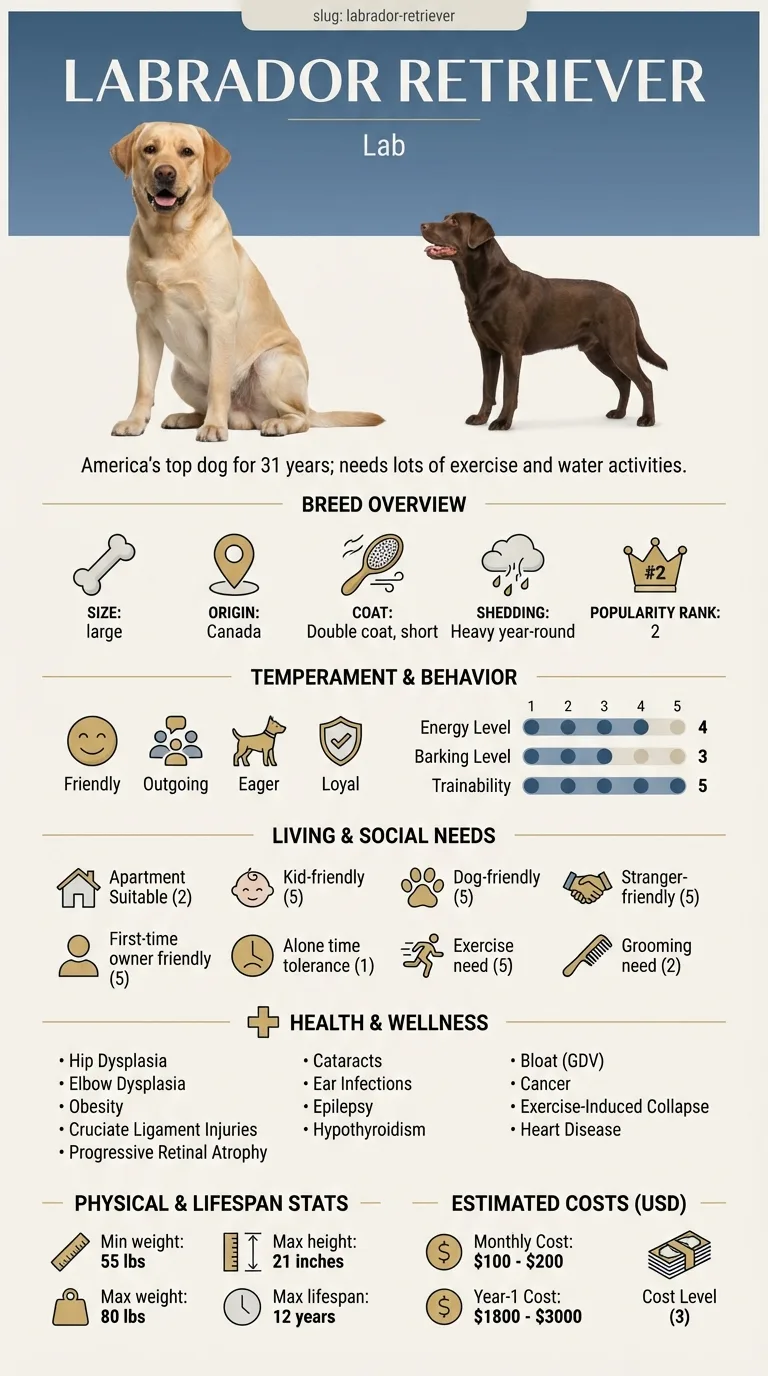
See all Labrador Retriever health problems, which breeds are prone to heart murmurs, or the full Labrador Retriever breed guide for temperament, exercise needs and ownership costs.
A newly found murmur typically means a recheck in a few weeks to a few months, or an echocardiogram sooner if the grade or symptoms warrant it. Puppy murmurs are usually reassessed at the next scheduled vaccine visit.
For most low-grade murmurs, success simply means confirming the grade stays stable over successive visits. For murmurs tied to a real diagnosis, success means a managed condition rather than the murmur itself disappearing — the sound is a symptom, not the disease to be cured.
Vets grade a murmur on a scale from I to VI based purely on how loud it is through a stethoscope. A grade I is barely audible and only found with a quiet room and a careful listen. A grade VI is loud enough to feel as a vibration through the chest wall with your hand. It's tempting to treat the grade as a severity score, but that's not quite right — a loud murmur from a relatively minor cause can sound scarier than a soft murmur from something more serious.
What actually matters more than grade is location and timing. A murmur heard loudest over the left side of the chest during the heart's contraction phase points toward the mitral valve. One heard on the right, or during the heart's relaxation phase, points somewhere else entirely. This is why your vet's next question after finding a murmur is rarely 'how loud' and almost always 'where, and when in the heartbeat.'
In puppies specifically, a soft murmur under grade III that disappears by six months old is usually an 'innocent' or physiologic murmur — a normal finding in a fast-growing puppy's cardiovascular system, not a defect.

The next step depends on a combination of grade, age, and whether any other symptoms are present — here's the general decision pattern.
When Priya brought her Lab puppy, Otis, in for his twelve-week vaccines, the vet paused mid-exam and listened a second time. A soft grade II murmur, heard best over the left side of his chest. Priya braced for bad news, but her vet explained it was most likely an innocent murmur common in fast-growing puppies and asked her to come back in six weeks rather than referring her out immediately. At the sixteen-week visit, the murmur was gone. Otis has had a clean cardiac exam at every visit since. Priya still mentions it to every new vet he sees, just so it's on record that it happened and resolved.
Key takeaway: Not every murmur is the start of a long medical story — many puppy murmurs are a normal, temporary finding, and a short recheck window rather than an immediate cardiology referral is often the right first step.
It means your vet heard turbulent blood flow through a stethoscope. That can come from something as minor as a puppy's still-developing cardiovascular system or as significant as valve disease — the grade, location, and your dog's age all factor into what it likely means.
Usually not urgent on its own. A grade II murmur without other symptoms is often just monitored at the next routine visit, though your vet may still recommend an echocardiogram if your dog is a senior or has other risk factors.
Many mild puppy murmurs, called innocent or physiologic murmurs, do resolve on their own by around six months of age as the cardiovascular system finishes developing. Your vet will typically recheck at each vaccine visit to confirm it's fading rather than persisting.
An echocardiogram is the definitive test — it lets a cardiologist see the heart's structure and blood flow directly rather than inferring it from sound alone. Chest X-rays and blood pressure measurements are sometimes added depending on findings.
It depends entirely on the cause and severity, which is exactly why an echocardiogram matters before making that call. A mild, stable murmur often comes with no restriction; a murmur linked to a structural defect usually does.
A cardiology consult with echocardiogram typically runs $300–$600, depending on your region and whether additional imaging or bloodwork is needed.
A new murmur in an adult dog is worth taking seriously, since it wasn't there before and adult-onset murmurs are less often 'innocent' than puppy murmurs are. It's a reasonable trigger for a vet visit within the week, not an emergency-room trip unless paired with collapse or breathing distress.
Grade III and above generally prompts a cardiology referral, though even lower grades warrant follow-up if paired with symptoms like coughing or fatigue.
Most vets listen for one at every puppy vaccine visit as a standard part of the physical exam.
Typically $300–$600 depending on region and whether additional testing is included.
Yes — many soft murmurs in puppies are innocent and resolve by around six months without any treatment.
Grade measures loudness; location tells your vet which valve or chamber is likely involved, which matters more for diagnosis than loudness alone.
A one-page prep sheet for this condition: the signs, the questions to ask, what to get priced. Unlocks here.
You get: Vet visit prep sheet
No spam. One-click unsubscribe. See our privacy policy.
Preview page 1 before you decide.