Health
Should new snoring in a GSP be investigated?
Yes. This breed has no structural reason to breathe noisily, so a change in sound is a finding rather than a quirk.

Quick answer
Should new snoring in a GSP be investigated?
Yes. This breed has no structural reason to breathe noisily, so a change in sound is a finding rather than a quirk.
Your pointer used to sleep silently and now sounds like a blocked drain. That change is the symptom, and the list of things that cause it is short and mostly fixable.
Owners who have noticed a change in the sound of their dog's breathing, bark or panting, particularly in dogs over seven. Also anyone whose dog came back from a walk in tall cover snorting and pawing at its face.
This guide is not medical advice. If your dog shows pain, sudden behavior change, or worsening symptoms, consult a licensed veterinarian.
Some links may be affiliate links. We may earn a commission at no extra cost to you. We only suggest products we believe are helpful for dog owners.
We research and check what we publish, but we do not warrant that any figure, date, price, or statement is accurate, complete, or current, and we accept no liability for any loss, cost, injury, or other harm arising from the use of this site. Use it as one reference among several. You remain responsible for your own decisions and for your dog's care - confirm anything that matters with a licensed veterinarian or another qualified professional before you act on it. Full disclaimer.
Noisy breathing and snoring in a German Shorthaired Pointer are acquired rather than inherited, because the breed's long muzzle and open nostrils are built for silent, high-volume airflow. The causes range from a grass seed in a nostril to laryngeal paralysis in an older dog, and the pattern of the noise usually points at which one.
Airway noise is not a breed characteristic and does not appear among the German Shorthaired Pointer's documented health issues. Laryngeal paralysis is a recognised problem of older large-breed dogs generally, and nasal foreign bodies are an occupational hazard for any dog that works cover. Neither is expected, and both are worth knowing about.
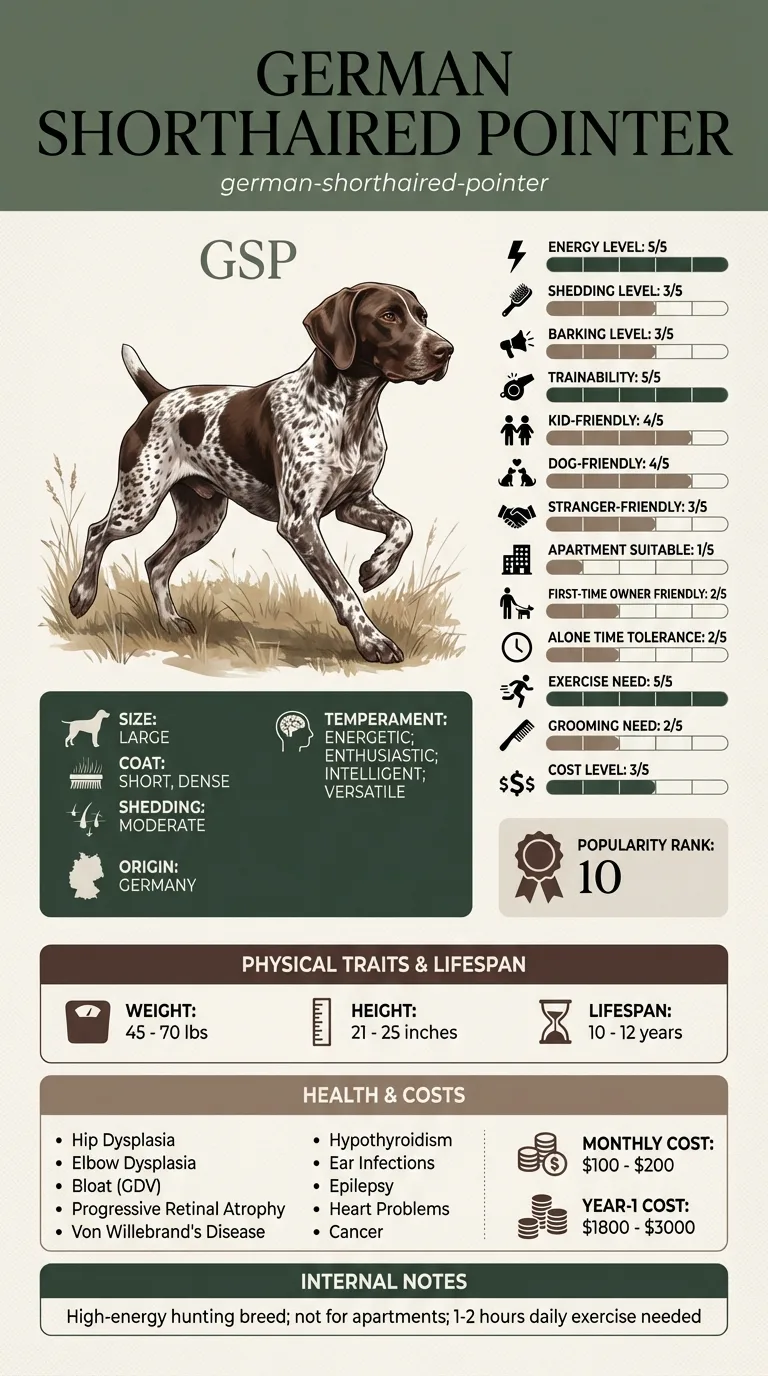
The breed's relevant characteristics are what it does rather than how it is shaped. A German Shorthaired Pointer hunts with its nose at ground level in tall vegetation, which is the single most effective way for a dog to inhale a grass awn. Its life is built around sustained hard exercise, rated five out of five, which means any narrowing of the airway shows up sooner and matters more than it would in a sedentary breed. And because dogs cool by moving air across the airway, an obstruction in a GSP compromises both breathing and temperature control at once.
Season and setting shape the risk. Late summer and autumn are peak grass-awn months, and dogs working cut stubble and seeding grasses are most exposed. Warm, humid weather turns a mild airway narrowing into a visible problem because the dog must move much more air to cool itself. Off-season weight gain, collars that press on the throat during pulling, and dental care that has been deferred for years all contribute quietly.
Book an appointment for any new or worsening snoring, for a hoarse or changed bark, for noise or discharge from one nostril, or for repeated sneezing fits after a walk in cover. Go to an emergency clinic immediately for harsh noisy breathing with obvious distress, gums that are pale, grey or blue, a dog that cannot settle and stands with its neck stretched out and elbows turned out, collapse, or noisy breathing that has appeared and worsened within hours. An airway that is narrowing swells further with every panicked breath, and in warm weather that can become critical in minutes rather than hours.
See all German Shorthaired Pointer health problems, which breeds are prone to brachycephalic obstructive airway syndrome boas, or the full German Shorthaired Pointer breed guide for temperament, exercise needs and ownership costs.
A nasal foreign body is usually removed under sedation and the noise stops the same day. Weight-related noise improves over two to four months of controlled weight loss. Laryngeal paralysis is progressive and not curable; managed cases can be comfortable for a long time, and surgery gives most dogs immediate relief from the obstruction with a permanent change in how they must be managed afterwards.
A dog that breathes silently at rest again, and where that is not achievable, one that has a named diagnosis, a harness instead of a collar, a summer routine built around heat avoidance, and an owner who knows exactly which signs mean an emergency rather than a wait.
Because there is no anatomical explanation built into the breed, the causes are acquired. These are the ones that turn up most often, and each has a distinctive pattern.
Laryngeal paralysis deserves separate attention because it is the cause most likely to be dismissed as ageing and the one with the highest stakes.
The larynx is a set of cartilages at the top of the windpipe. Muscles pull them open on every breath, and when a dog is working hard they open wide to let large volumes of air through. In laryngeal paralysis the nerve supplying those muscles fails, usually gradually and usually in older large-breed dogs. The cartilages stop opening properly, so the airway narrows exactly when the dog needs it widest.
The pattern is characteristic. Owners describe a hoarse or lost bark, a harsh rasp on breathing in rather than out, and a dog that struggles noticeably on hot days or after excitement while seeming fine at rest in a cool room. Because a German Shorthaired Pointer's whole life is hard exercise and its cooling depends on moving air across its airway, this condition is unusually dangerous in the breed: the dog cannot cool itself properly, and the harder it breathes the more the tissues swell and the narrower the gap becomes.
That cycle is how an affected dog goes from noisy to a genuine respiratory crisis on a warm day, sometimes very quickly.

If you think your German Shorthaired Pointer has German Shorthaired Pointer BOAS, the plan is three steps: write down what you have seen and when it started, book a veterinary appointment rather than waiting for the next flare, and take video of the sign before you go — the thing you are worried about rarely happens in the consulting room.
What the visit should produce is a diagnosis and a written plan: what is being ruled out, how often it is monitored, and which signs mean you come back sooner. Ask what the treatment costs across a year rather than per visit, because that is the number that decides whether you are managing German Shorthaired Pointer BOAS or reacting to it.
Between appointments keep a short log — dates, what you saw, what changed. For German Shorthaired Pointer BOAS in German Shorthaired Pointers it is usually what separates a clear pattern from a guess.
Bram's owner mentioned it almost as an aside at a routine appointment: his bark had gone gravelly over the past year, and he had started making a rasping sound coming up the hill on hot days. He was still hunting, still keen, and she had assumed it was age. The vet asked her to walk him briskly up the practice car park. He came back with a harsh, sawing noise on every inhalation that had not been there at rest. Sedated examination showed the left side of his larynx barely opening. Bram was managed conservatively at first: down to a harness, a lean weight, and no work at all above mild temperatures. After a summer in which he twice frightened her by struggling to recover, he had surgery. He is now ten, works short cool-weather days, and has not had another crisis. Her only regret is the year she spent calling it age.
Key takeaway: The bark was the first sign, a full year before the breathing was. In a large-breed dog getting older, a changed voice is not a cosmetic detail, and it is the cheapest thing in the world to mention at a routine visit.
Occasional soft snoring in a deeply asleep dog lying in an awkward position is usually nothing. Consistent snoring, snoring that has appeared recently, or any noise while the dog is awake is not normal for a long-muzzled breed and should be examined.
It is a rapid series of snorting inhalations, often alarming to watch, that resolves within a minute. It happens in all breeds and is usually harmless. What is not harmless is a similar noise that keeps recurring for days, which suggests something is genuinely in the nose.
Very possibly. The same nerve controls the muscles that open the larynx and the ones that produce voice, so a hoarse, weak or altered bark is one of the earliest signs of laryngeal paralysis. It is worth mentioning even if nothing else has changed.
Sometimes entirely, if excess weight is the cause. Fat around the throat and neck narrows the airway, and a heavy dog also breathes harder for the same work. It is the intervention worth doing regardless of what else is found.
By watching the larynx move under light sedation, since the problem is functional rather than something visible on an x-ray. Your vet will usually also check for the underlying nerve and muscle conditions it can accompany, and look for related swallowing problems.
Yes. Mild cases are managed with weight control, heat avoidance and strict avoidance of neck collars in favour of a harness. More severe cases are treated surgically to hold one side of the larynx open, which relieves the obstruction but brings its own trade-offs your vet will explain.
Yes. This breed has no structural reason to breathe noisily, so a change in sound is a finding rather than a quirk.
Harsh noisy inhalation with distress, blue or grey gums, or a dog standing with neck extended unable to settle. That is an emergency, especially in warm weather.
For any dog with airway noise, switch to a well-fitted harness. Pressure on the throat from a collar makes a narrowed airway measurably worse.
An exam and dental check are modest. Sedated laryngeal examination or nasal imaging is a larger one-off cost, usually settling the question definitively.
A one-page prep sheet for this condition: the signs, the questions to ask, what to get priced. Unlocks here.
You get: Vet visit prep sheet
No spam. One-click unsubscribe. See our privacy policy.
Preview page 1 before you decide.
Early access list
The free prep sheet covers the same-day warning signs, a symptom log and the questions to ask. We are considering a fuller kit that adds a cost worksheet for the usual tests and treatments (US price ranges with their sources) and a plain-English guide to ways of covering the bill. It is not built yet; this list tells us whether it is worth building.
One email, no spam, unsubscribe anytime. Information only, not veterinary advice.