Living
Which is the better overall choice?
The Lab suits households that want an all-around easy, outgoing dog. The Welsh Springer is a reasonable alternative for those who want a somewhat smaller sporting dog and value a longer expected lifespan.

Quick answer
Which is the better overall choice?
The Lab suits households that want an all-around easy, outgoing dog. The Welsh Springer is a reasonable alternative for those who want a somewhat smaller sporting dog and value a longer expected lifespan.
Labrador Retriever or Welsh Springer Spaniel? On paper they differ most on good for first-time owners, and on the scales Labrador Retriever is the heavier at 55–80 lbs. Here is how the two compare on everything that shapes an ordinary week.
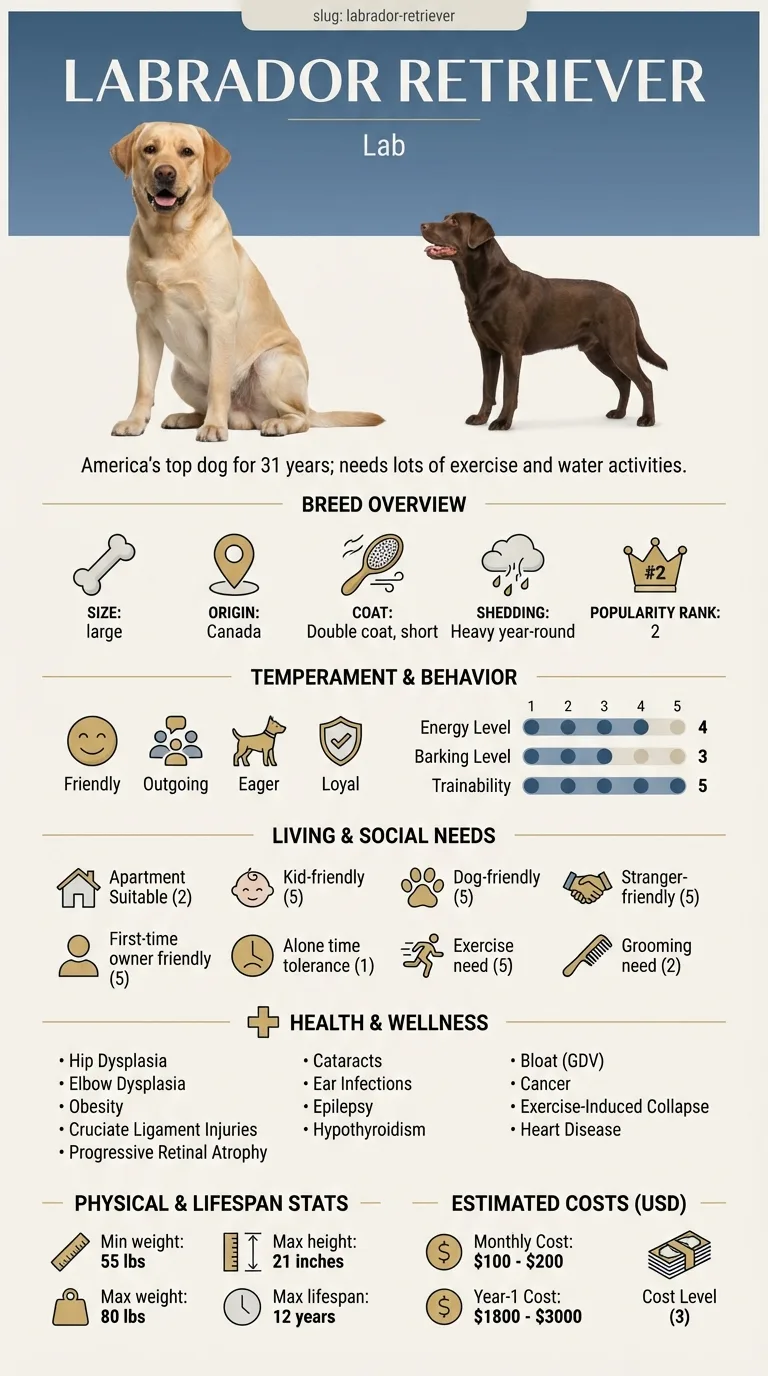
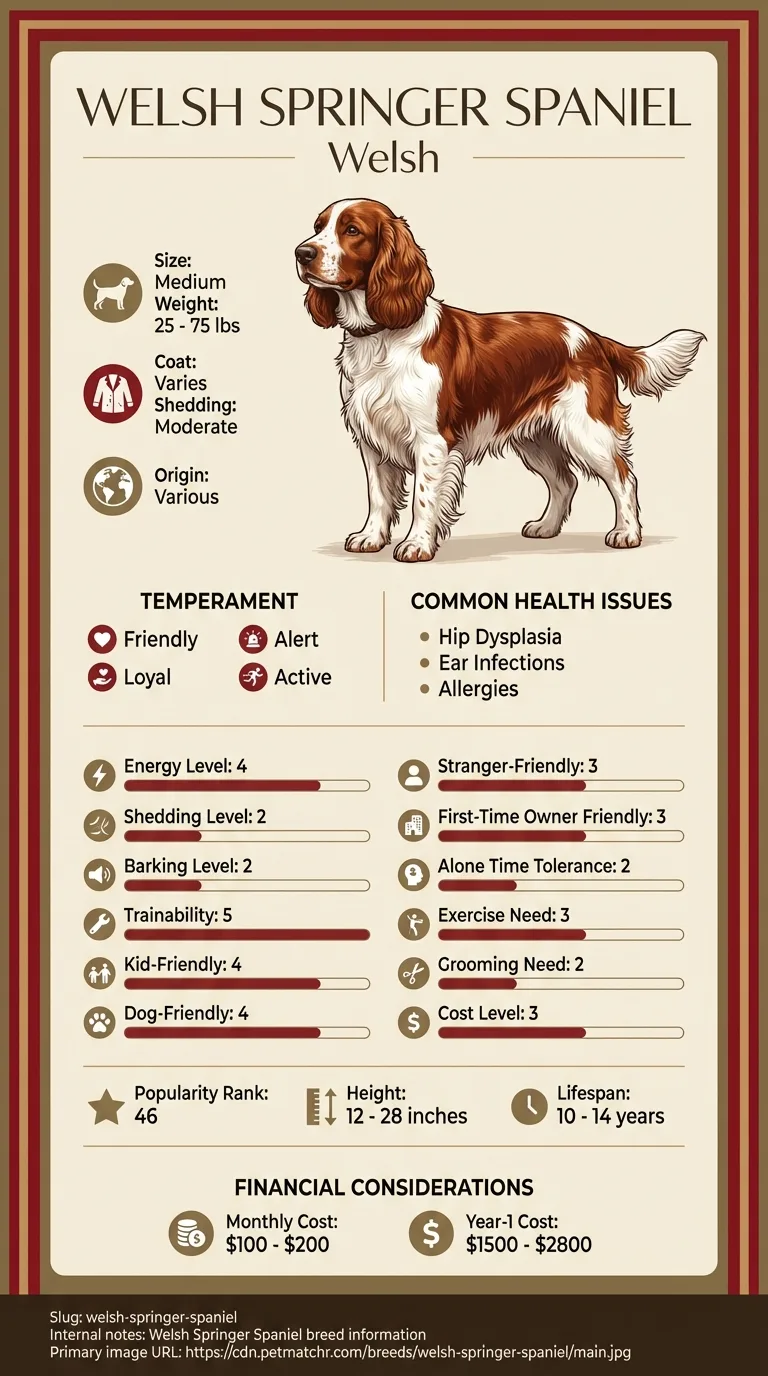
This is for someone already down to Labrador Retriever and Welsh Springer Spaniel and deciding between them. For this pair the decision usually turns on good for first-time owners and friendly to strangers, so those are covered first and in most detail. Both rate 2/5 for flats, so housing does not settle this one. Breed history is left out; what follows is what you will actually live with.
Between Labrador Retriever and Welsh Springer Spaniel, good for first-time owners is what separates them, and Labrador Retriever is the lower-effort dog of the two to keep.
Choose Labrador Retriever if this is your first dog, you do not want a standing grooming appointment and there are young children at home.
Choose Welsh Springer Spaniel if shedding is a problem in your house, your walking routine is modest and a smaller dog suits your car, your home or your back.
| Feature | labrador retriever | welsh springer spaniel | Winner |
|---|---|---|---|
| Size class | large | medium | Equal |
| Weight | 55–80 lbs | 35–55 lbs | Equal |
| Height | 21–24 in | 17–19 in | Equal |
| Lifespan | 10–12 years | 12–15 years | welsh springer spaniel |
| Exercise need | Very high (5/5) | High (4/5) | welsh springer spaniel |
| Grooming need | Low (2/5) | Moderate (3/5) | labrador retriever |
| Shedding | High (4/5) | Moderate (3/5) | welsh springer spaniel |
| Energy level | High (4/5) | High (4/5) | Equal |
| Barking | Moderate (3/5) | Moderate (3/5) | Equal |
| Apartment suitability | Low (2/5) | Low (2/5) | Equal |
| Good for first-time owners | Very high (5/5) | Moderate (3/5) | labrador retriever |
| Tolerates being alone | Very low (1/5) | Low (2/5) | welsh springer spaniel |
| Trainability | Very high (5/5) | High (4/5) | labrador retriever |
| Good with kids | Very high (5/5) | High (4/5) | labrador retriever |
| Good with other dogs | Very high (5/5) | High (4/5) | labrador retriever |
| Friendly to strangers | Very high (5/5) | Moderate (3/5) | labrador retriever |
| Cost level | Moderate (3/5) | Moderate (3/5) | Equal |
| Coat | Double coat, short | Medium, straight and water-resistant | Equal |
| Origin | Canada | Various | Equal |
| Typical monthly cost | $100–$200 | $100–$200 | Equal |
| Typical first-year cost | $1,800–$3,000 | $1,400–$2,900 | Equal |
The Lab is the bigger dog by a clear margin, 55 to 80 pounds and 21 to 24 inches tall, against the Welsh Springer's 35 to 55 pounds and 17 to 19 inches. Both are athletic, well-proportioned sporting breeds rather than stocky ones, but the size gap alone puts them in different categories for car space, crate size, and how much dog you're feeding twice a day.
Exercise need runs high for both, 5 out of 5 for the Lab, 4 out of 5 for the Welsh Springer, and energy level ties at 4 out of 5 apiece. This is a pairing where the difference is a matter of degree, not kind: both dogs want daily vigorous activity, and neither will thrive as a once-around-the-block breed. Field work, long hikes, or a serious fetch habit will suit either one well.
The Lab needs less coat upkeep (2 out of 5) but sheds more (4 out of 5); the Welsh Springer asks slightly more grooming time (3 out of 5) in exchange for somewhat less shedding (3 out of 5). Its medium, water-resistant coat needs regular brushing to avoid matting, particularly around the ears and feathering, but the payoff is a bit less hair left behind.
Both breeds tie here, a low 2 out of 5 for apartment suitability, and a moderate 3 out of 5 for barking. Neither is naturally built for small-space living given their exercise needs, so this comparison won't help you pick based on apartment fit; you'll need a real yard or a serious walking routine for either dog. Alone-time tolerance is also unhelpful for deciding, since both dogs handle solitude only marginally differently.
The Lab holds a modest edge in both trainability (5 out of 5 versus 4) and first-timer suitability (5 out of 5 versus a moderate 3). The Welsh Springer is still a capable, biddable breed, this isn't a wide gap like some sporting-versus-independent comparisons, but new owners will likely find the Lab's more universally eager temperament a bit more forgiving day to day.
The Lab wins across kids, other dogs, and strangers, though the margins are modest rather than dramatic: 5 versus 4 with kids and other dogs, and a wider 5 versus 3 with strangers. The Welsh Springer's temperament is described as reserved with strangers specifically, so expect more caution from this breed around unfamiliar visitors even as it stays warm with its own family.
The Welsh Springer is the longer-lived breed here, typically reaching 12 to 15 years against the Lab's 10 to 12, a real gap of two to three years. Its documented health list is notably shorter too: hip dysplasia, ear infections, epilepsy, glaucoma, and hypothyroidism, five conditions against the Lab's thirteen, which include bloat, cancer, and heart disease. That shorter list doesn't mean risk-free, but it does mean fewer conditions to screen for up front.
Both breeds land at a moderate 3 out of 5 cost rating and share the same $100 to $200 monthly range. First-year costs run a touch lower for the Welsh Springer ($1,400-$2,900) than the Lab ($1,800-$3,000), a modest gap that likely reflects the size difference more than anything breed-specific. Whichever you pick, plan for a comparable ongoing budget once the first year settles down.
Labrador Retriever weighs 55–80 lbs and lives 10–12 years; Welsh Springer Spaniel weighs 35–55 lbs and lives 12–15 years. The two diverge most on good for first-time owners and friendly to strangers. They are level on apartment suitability, barking and cost level, so those cannot decide it. The comparison marks an easier option only where one exists. Facts like weight and country of origin are not scored. Both dogs are rated from the same dataset, which is what makes the numbers comparable with each other even though any individual dog sits somewhere inside its breed's range.

The Lab is meaningfully bigger, 55 to 80 pounds versus the Welsh Springer's 35 to 55, with several inches of height difference too.
Both shed at a moderate-to-high level, though the Lab edges slightly higher (4 out of 5 versus 3). Neither is a low-shed breed.
The Lab is the stronger pick for a first-timer, rated 5 out of 5 against the Welsh Springer's moderate 3 out of 5, though the gap here is smaller than in many Lab comparisons.
Neither breed suits an apartment well, both tie at a low 2 out of 5. High exercise needs on both sides make a yard or regular off-leash access more important than square footage.
Both share the same $100-$200 monthly range and a moderate 3 out of 5 overall cost rating. Cost won't meaningfully separate these two.
Hip dysplasia and hypothyroidism appear on both lists. Beyond that, the Lab's profile is considerably longer and includes bloat and cancer, while the Welsh Springer's list stays shorter and more contained.
The Lab, clearly, rating 5 out of 5 against the Welsh Springer's 3 out of 5. The Welsh Springer's temperament profile lists 'reserved with strangers' directly, so this isn't incidental.
The Lab suits households that want an all-around easy, outgoing dog. The Welsh Springer is a reasonable alternative for those who want a somewhat smaller sporting dog and value a longer expected lifespan.
Both run $100 to $200 a month, tied at a moderate 3 out of 5, cost isn't a differentiator here.
Plenty either way, 5 out of 5 for the Lab, 4 out of 5 for the Welsh Springer. Both need daily vigorous activity.
The Welsh Springer, typically 12 to 15 years against the Lab's 10 to 12, a solid two-to-three-year edge.
Secure checkout on Stripe. We never see your card.
7-day money-back guarantee. Instant access.
Health information here is general and is not veterinary advice. If your dog shows pain, sudden behaviour change, or worsening symptoms, consult a licensed veterinarian.
Some links on this site are affiliate links. We may earn a commission at no extra cost to you, and we only suggest products we believe are helpful for dog owners.
We research and check what we publish, but we do not warrant that any figure, date, price, or statement is accurate, complete, or current, and we accept no liability for any loss, cost, injury, or other harm arising from the use of this site. Use it as one reference among several. You remain responsible for your own decisions and for your dog's care - confirm anything that matters with a licensed veterinarian or another qualified professional before you act on it. Full disclaimer.
Match your lifestyle to the right dog.
Take quizNot sure which breed is right for you? Take our 2-minute quiz to find out.
Take the quiz