Health
What's the biggest arthritis risk factor for a Lab?
A prior history of hip dysplasia, elbow dysplasia, or cruciate injury, combined with excess body weight, are the two biggest documented drivers in this breed.

Quick answer
What's the biggest arthritis risk factor for a Lab?
A prior history of hip dysplasia, elbow dysplasia, or cruciate injury, combined with excess body weight, are the two biggest documented drivers in this breed.
Watching a once-tireless retriever hesitate at the stairs is one of the harder parts of Labrador ownership, and understanding why it's happening changes how you manage it.
Owners of Labradors in their senior years, or younger dogs with a documented history of hip dysplasia, elbow dysplasia, or a cruciate ligament repair, are the ones who deal with this most directly, since those conditions are the main setup for arthritis in this breed.
This guide is not medical advice. If your dog shows pain, sudden behavior change, or worsening symptoms, consult a licensed veterinarian.
Some links may be affiliate links. We may earn a commission at no extra cost to you. We only suggest products we believe are helpful for dog owners.
We research and check what we publish, but we do not warrant that any figure, date, price, or statement is accurate, complete, or current, and we accept no liability for any loss, cost, injury, or other harm arising from the use of this site. Use it as one reference among several. You remain responsible for your own decisions and for your dog's care - confirm anything that matters with a licensed veterinarian or another qualified professional before you act on it. Full disclaimer.
Arthritis in a Labrador Retriever is the gradual, degenerative wear of joint cartilage, and in this breed it's rarely a condition that appears out of nowhere. It's overwhelmingly a downstream effect of hip dysplasia, elbow dysplasia, cruciate ligament injuries, or years of carrying extra weight, all of which are separately documented risks for this breed. The stiffness, slower rising, and reduced enthusiasm for jumping or long walks that owners notice are the visible result of joints that have been under mechanical strain for years.
Very common by a Labrador's senior years, largely because the breed carries three separate documented joint-risk conditions that each independently raise arthritis odds. A structurally sound, consistently lean Lab is the exception with meaningfully lower risk, not the rule.
Hip dysplasia, elbow dysplasia, and cruciate ligament injuries are all separately documented health concerns in this breed, and each one creates joint instability or uneven cartilage wear that predictably progresses to arthritis over years. Obesity, also well documented in Labradors, compounds every one of these by adding mechanical load to joints that are already working at a disadvantage.
Years of repeated high-impact activity, like jumping hard into water off a dock or repeatedly leaping for a thrown ball on hard ground, accelerates wear on joints with any underlying instability. A home environment with a lot of stairs or slippery hard flooring also adds strain to an already compromised joint.
See your vet if you notice consistent morning stiffness that doesn't warm out of within the first ten minutes of movement, a limp that persists beyond a day or two, or a clear drop in willingness to do activities your dog used to enjoy. These changes warrant an exam and likely X-rays rather than assuming it's simply old age.
See all Labrador Retriever health problems, which breeds are prone to arthritis, or the full Labrador Retriever breed guide for temperament, exercise needs and ownership costs.
Arthritis is a lifelong, progressive condition; there's no timeline to "recovery." Most owners see meaningful improvement in comfort and mobility within four to six weeks of starting a combined weight management, supplement, and low-impact exercise plan, with ongoing maintenance needed indefinitely.
Success is a dog that moves comfortably through normal daily life, rising easily, walking without a persistent limp, and still enjoying modified versions of favorite activities, not a return to its younger, unrestricted mobility.
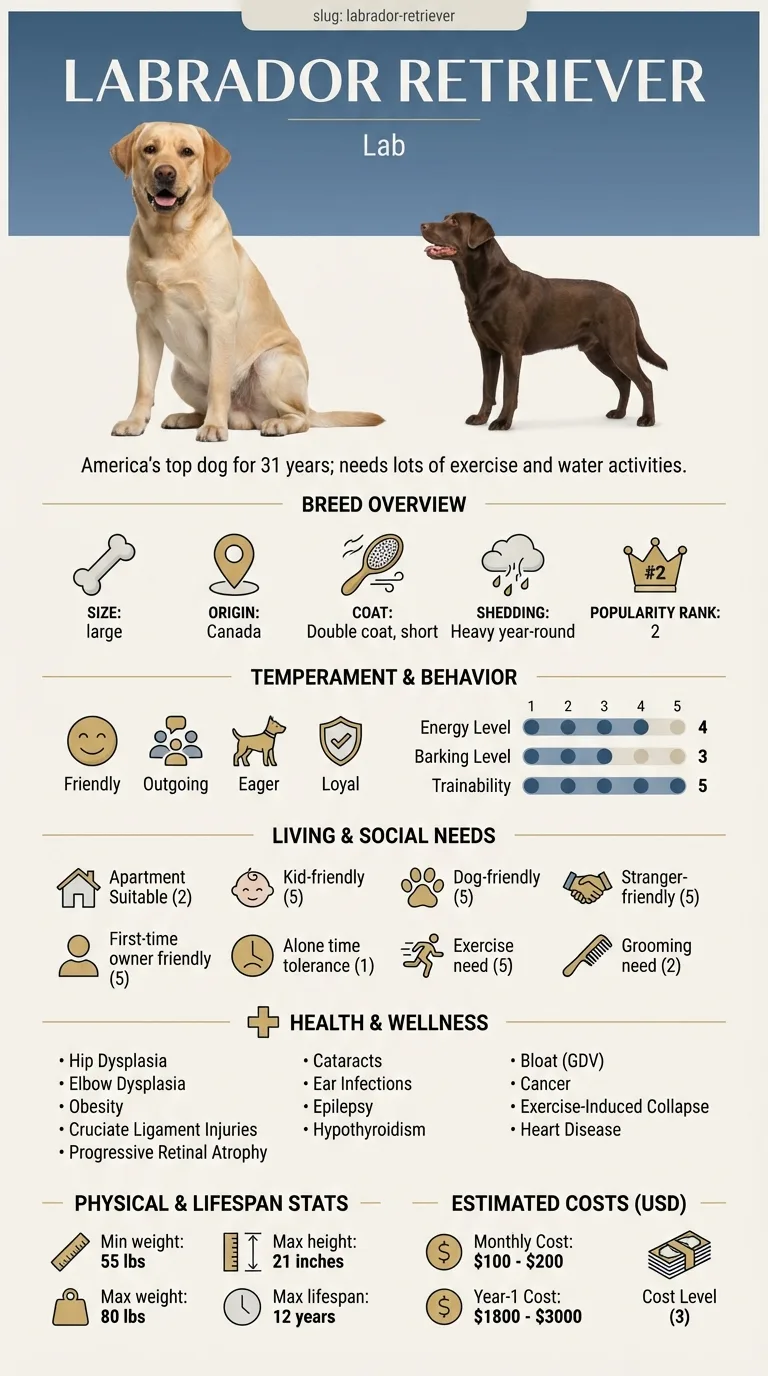
Labrador Retrievers carry three separate, well-documented joint risks: hip dysplasia, elbow dysplasia, and cruciate ligament injuries. Each of these creates joint instability or abnormal wear patterns, and each is a well-established pathway to osteoarthritis over time. Add the breed's equally well-documented tendency toward obesity, which multiplies the mechanical load on every joint with every extra pound, and you have a breed where arthritis is less a mystery of aging and more a predictable consequence of the joint conditions already on its health record. A Lab that develops arthritis with no history of any of these factors is the exception, not the rule.
Because obesity is such a consistently documented issue for this breed, weight is also the single most controllable factor in how much arthritis actually limits a Lab's daily life. Research across large breeds has repeatedly shown that dogs kept lean develop arthritis later and less severely than littermates carrying extra weight, even with identical joint conformation. For a breed this food-motivated and this prone to weight gain, keeping a dog lean isn't a minor lifestyle nicety, it's arguably the most effective arthritis management tool available before medication ever enters the picture.

Sable, an eight-year-old Labrador with mild hip dysplasia diagnosed at eighteen months, had always managed fine until her owner noticed she was taking longer each morning to get up and was reluctant to jump into the car. An X-ray confirmed moderate arthritis in both hips. Rather than accepting this as simply old age, Sable's vet built a plan: a ten-pound weight loss over three months, a daily joint supplement, a car ramp, and swapping her twice-daily fetch sessions for a mix of shorter walks and pool time at a local dog rehab facility. Within six weeks, Sable was rising more easily and had regained enough comfort to enjoy short swims again, though her owner accepted that hard ball-chasing on pavement was permanently off the table.
Key takeaway: Arthritis tied to an already-documented joint condition responds well to a structured weight and low-impact activity plan, even though the underlying joint damage itself never fully goes away.
It varies widely depending on underlying joint health. A Lab with hip or elbow dysplasia can show early arthritic changes by four or five years old, while a structurally sound, lean dog might not show noticeable stiffness until eight or nine.
Not inevitable, but common, largely because hip dysplasia, elbow dysplasia, and cruciate injuries are all well-documented in this breed and each raises arthritis risk substantially. A structurally sound, lean dog has meaningfully lower odds.
Hesitation before jumping into the car or onto furniture, slower to rise after resting, a subtle limp that warms out of after a few minutes of walking, and reduced enthusiasm for long walks or swims it used to love.
No, the joint damage itself doesn't reverse. Management focuses on slowing progression, reducing pain and inflammation, and preserving mobility and quality of life for as long as possible.
Yes, substantially. Reducing mechanical load on already-compromised joints is one of the most effective, and most controllable, interventions available, often producing visible improvement within weeks of reaching a healthier weight.
Weight management, joint supplements, prescription anti-inflammatory medication when needed, physical therapy or controlled swimming, and in more advanced cases, additional pain management options a vet tailors to the individual dog.
No, complete rest usually makes things worse. The goal is shifting to lower-impact activity like controlled leash walks or swimming rather than stopping movement altogether, which a vet or canine physical therapist can help calibrate.
A prior history of hip dysplasia, elbow dysplasia, or cruciate injury, combined with excess body weight, are the two biggest documented drivers in this breed.
Yes, swimming provides low-impact cardiovascular and muscle-maintaining exercise without loading the joints the way walking on hard surfaces does, and this breed generally takes to it easily.
Ongoing glucosamine and omega-3 joint supplements typically run a modest monthly cost, though prescription-strength anti-inflammatory medication adds more if a vet determines it's needed.
Yes, if it has underlying hip or elbow dysplasia or had a cruciate repair early in life, arthritic changes can begin well before what most owners think of as "old age."
A supportive orthopedic bed reduces pressure on sore joints during rest and is a reasonable, low-cost addition to a broader management plan, though it's not a substitute for weight control or medical treatment.
A one-page prep sheet for this condition: the signs, the questions to ask, what to get priced. Unlocks here.
You get: Vet visit prep sheet
No spam. One-click unsubscribe. See our privacy policy.
Preview page 1 before you decide.
Early access list
The free prep sheet covers the same-day warning signs, a symptom log and the questions to ask. We are considering a fuller kit that adds a cost worksheet for the usual tests and treatments (US price ranges with their sources) and a plain-English guide to ways of covering the bill. It is not built yet; this list tells us whether it is worth building.
One email, no spam, unsubscribe anytime. Information only, not veterinary advice.