Health
What's the real GI risk for this breed beyond bloat?
Foreign body ingestion and dietary indiscretion, both tied to this breed's strong food drive and willingness to eat almost anything.

Quick answer
What's the real GI risk for this breed beyond bloat?
Foreign body ingestion and dietary indiscretion, both tied to this breed's strong food drive and willingness to eat almost anything.
Your Lab's stomach trouble is more likely to be a sock, a rock, or too many table scraps than anything exotic, and that's exactly why this breed's GI risk profile looks different from most.
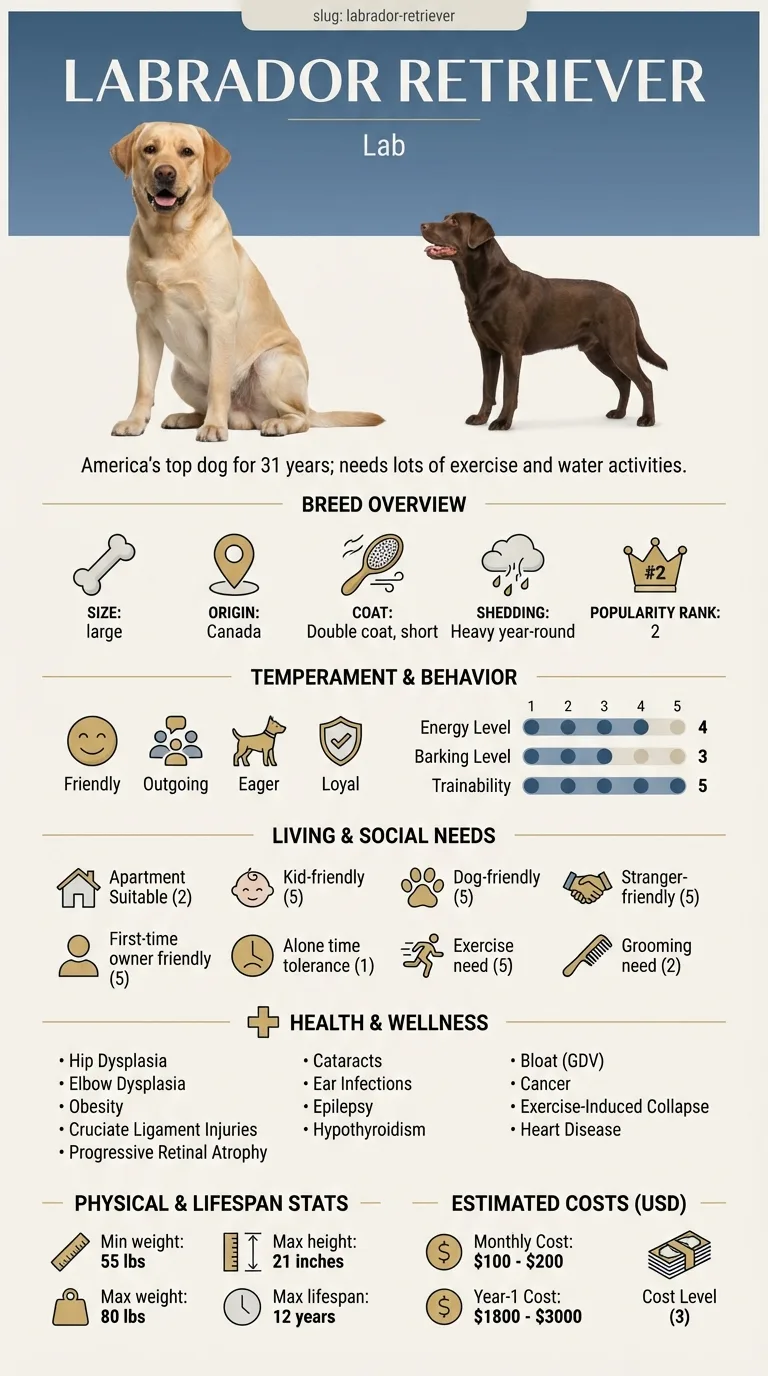
Owners of young, food-motivated Labradors that scavenge, counter-surf, or show interest in non-food objects are the ones most likely to encounter this breed's everyday, indiscretion-driven gastrointestinal problems.
This guide is not medical advice. If your dog shows pain, sudden behavior change, or worsening symptoms, consult a licensed veterinarian.
Some links may be affiliate links. We may earn a commission at no extra cost to you. We only suggest products we believe are helpful for dog owners.
We research and check what we publish, but we do not warrant that any figure, date, price, or statement is accurate, complete, or current, and we accept no liability for any loss, cost, injury, or other harm arising from the use of this site. Use it as one reference among several. You remain responsible for your own decisions and for your dog's care - confirm anything that matters with a licensed veterinarian or another qualified professional before you act on it. Full disclaimer.
Beyond bloat, the everyday gastrointestinal risks most relevant to Labrador Retrievers stem directly from this breed's famous food motivation and willingness to eat almost anything: foreign body ingestion, swallowing objects that create a dangerous intestinal obstruction, and dietary indiscretion, eating spoiled food or rich scraps that can trigger vomiting, diarrhea, or pancreatitis. These are consistently among the most common reasons Labradors need emergency veterinary care.
Foreign body ingestion and dietary indiscretion are consistently among the most common reasons this breed needs emergency veterinary care, directly reflecting its well-documented food drive and behavioral tendency to investigate the world mouth-first.
Labrador Retrievers' well-documented food motivation and oral exploration instinct are the direct behavioral drivers behind both foreign body ingestion and dietary indiscretion, making these among the most consistently reported gastrointestinal risks for this specific breed, distinct from any inherited digestive disease.
Easy access to small objects, unsecured garbage, counter-accessible food, and a household culture of sharing table scraps all directly raise the odds of a GI incident in a breed this motivated by food and prone to indiscriminate eating.
See your vet urgently for persistent vomiting, inability to keep food or water down, lethargy, or abdominal pain, especially if you know or suspect your dog swallowed something it shouldn't have. Don't wait to see if an object passes on its own if symptoms are present.
See all Labrador Retriever health problems, which breeds are prone to gastrointestinal disorders, or the full Labrador Retriever breed guide for temperament, exercise needs and ownership costs.
Mild dietary indiscretion typically resolves within a day or two with supportive care. A suspected foreign body needs same-day evaluation, and if surgery is required, recovery typically takes two to three weeks of restricted activity.
Success looks like preventing most incidents through training and a secured environment, and reacting quickly when something does get swallowed, rather than assuming this breed's food-driven habits will simply resolve on their own with age.
Labrador Retrievers are famously willing to swallow objects that have no business being eaten, socks, small toys, corn cobs, rocks, and all manner of household items, driven by the same strong food motivation and oral exploration instinct documented throughout this breed's temperament profile. A swallowed object that can't pass through the digestive tract creates a genuine emergency, an intestinal obstruction, with symptoms including persistent vomiting, lethargy, abdominal pain, and inability to keep food down. This isn't a rare fluke for this breed; foreign body ingestion is one of the most consistently reported reasons Labradors end up in emergency surgery, directly tied to the breed's well-known indiscriminate eating habits.
Beyond swallowing non-food objects, this breed's food drive also means Labradors are prone to what vets call dietary indiscretion, eating spoiled food, excessive fatty scraps, or garbage, which commonly causes acute vomiting and diarrhea. A more serious downstream risk is pancreatitis, inflammation of the pancreas often triggered by a sudden high-fat meal, which this breed's tendency toward begging, counter-surfing, and eating table scraps makes a genuinely relevant concern. Combined with this breed's well-documented obesity risk, which independently raises pancreatitis susceptibility, diet-related GI problems are arguably this breed's most common real-world stomach issue, well ahead of any exotic disease process.

Gus, a ten-month-old Labrador known for his enthusiasm around laundry, started vomiting repeatedly one evening and refused his dinner entirely, uncharacteristic for a dog who never turned down food. His owner, noticing a sock missing from the hamper, suspected the worst and took him to the emergency vet immediately. X-rays confirmed a sock lodged in his small intestine, requiring surgery to remove it before it caused further damage. Gus recovered fully over three weeks, and his owner has since invested seriously in "leave it" and "drop it" training, along with a lidded hamper, changes she wishes she'd made before this expensive, frightening lesson in just how literally this breed's food-first reputation applies.
Key takeaway: Foreign body ingestion is one of this breed's most common, practical health risks, directly tied to its famous willingness to eat almost anything, and proactive training and household management are genuinely protective.
Foreign body ingestion and dietary indiscretion, eating something it shouldn't or overeating rich, fatty food, are the most common everyday gastrointestinal issues in this breed, distinct from and far more frequent than bloat.
This breed's well-documented food motivation and oral exploration drive make it more likely than many breeds to investigate and swallow non-food objects, a genuine behavioral trait rather than a training failure alone.
Persistent vomiting, inability to keep food or water down, lethargy, abdominal pain or a hunched posture, and reduced or absent bowel movements are the key signs warranting an urgent vet visit.
It's a realistic risk given this breed's tendency toward begging, counter-surfing, and its well-documented obesity risk, both of which are established contributing factors to pancreatitis in dogs generally.
Vomiting, abdominal pain, reduced appetite, lethargy, and sometimes diarrhea, often following a fatty meal, table scraps, or a garbage-eating incident.
X-rays or an ultrasound typically identify an obstruction, sometimes followed by surgery to remove the object if it hasn't passed on its own and is causing a blockage.
Yes, a reliable "leave it" and "drop it" cue, well within reach given how trainable this breed is, meaningfully reduces both foreign body ingestion and scavenging-driven dietary indiscretion.
Foreign body ingestion and dietary indiscretion, both tied to this breed's strong food drive and willingness to eat almost anything.
Not always, some objects pass on their own, but persistent vomiting, lethargy, or abdominal pain after a suspected ingestion needs prompt veterinary evaluation.
Yes, a sudden high-fat meal is a well-established trigger for pancreatitis, making table scraps a genuine, not just a minor, risk for this breed.
It's a significant abdominal surgery, generally costing a few thousand dollars including imaging, the procedure, and hospitalization.
Yes, a reliable "leave it" and "drop it" cue, which this highly trainable breed learns well, meaningfully reduces both foreign body ingestion and dietary indiscretion risk.
A one-page prep sheet for this condition: the signs, the questions to ask, what to get priced. Unlocks here.
You get: Vet visit prep sheet
No spam. One-click unsubscribe. See our privacy policy.
Preview page 1 before you decide.