Health
What is the clearest sign to act on?
Waking repeatedly through the night with a gasp or a snort. That is the airway closing and the dog waking to reopen it.

Quick answer
What is the clearest sign to act on?
Waking repeatedly through the night with a gasp or a snort. That is the airway closing and the dog waking to reopen it.
A dog that sleeps sitting up, or props its chin on the edge of the bed, is not being eccentric. It has found the position in which it can breathe.
Owners who have been told snoring is just part of owning a Boston, people whose dog seems tired all day for no clear reason, and anyone gathering evidence for a serious conversation about airway surgery.
This guide is not medical advice. If your dog shows pain, sudden behavior change, or worsening symptoms, consult a licensed veterinarian.
Some links may be affiliate links. We may earn a commission at no extra cost to you. We only suggest products we believe are helpful for dog owners.
We research and check what we publish, but we do not warrant that any figure, date, price, or statement is accurate, complete, or current, and we accept no liability for any loss, cost, injury, or other harm arising from the use of this site. Use it as one reference among several. You remain responsible for your own decisions and for your dog's care - confirm anything that matters with a licensed veterinarian or another qualified professional before you act on it. Full disclaimer.
Obstructive airway disease in Boston Terriers is most revealing during sleep, when relaxed throat muscles allow a narrowed airway to narrow further. Loud snoring, unusual sleeping postures, restlessness and waking to gasp are all markers of severity, and they are freely available to owners without any equipment. Poor sleep in turn produces daytime tiredness, reduced activity and weight gain, which worsen the obstruction that caused it.
Snoring is close to universal in the breed and severe sleep disruption is not. Brachycephalic airway syndrome heads the Boston Terrier's documented health list, and sleep observation is one of the more sensitive ways to work out where an individual dog falls within that range.
A soft palate sized for a longer skull hangs across the airway entrance, and during sleep it drops further as muscle tone falls. Narrow nostrils add resistance at the other end of the same passage. Because the Boston is a moderately shortened breed rather than an extreme one, many individuals snore without ever suffering meaningful sleep disruption - while others in the same breed wake dozens of times a night, and the two look identical from the outside during the day.
Room temperature is the factor owners most often overlook: a warm bedroom raises breathing effort all night. Bedding that lets a dog sink into it removes the raised edge many short-faced dogs use to prop the chin. Airborne irritants - dust, smoke, strong sprays, high pollen - congest the nasal passages and add resistance at the front of an already compromised airway.
Book an assessment if your dog wakes repeatedly through the night to gasp or snort, sleeps sitting up or propped, snores loudly enough to be heard from another room, or has become noticeably flatter and less playful over months. Treat it as an emergency at any hour if breathing becomes frantic and does not settle with rest and cool air, if the gums are blue, grey or brick red, or if the dog collapses. Take your video clips to the appointment - they carry more weight than any description, because the dog will be alert and stressed in the consulting room rather than asleep.
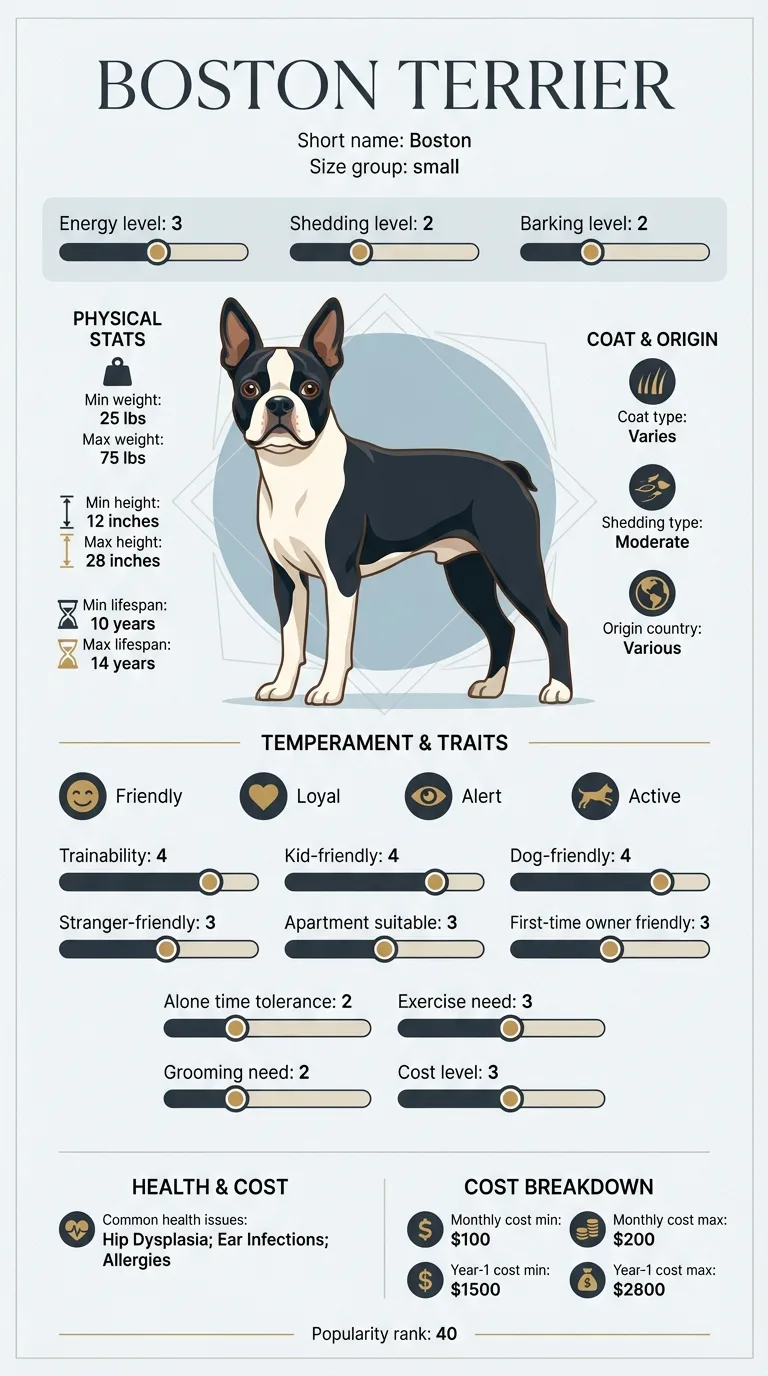
See all Boston Terrier health problems, which breeds are prone to brachycephalic obstructive airway syndrome boas, or the full Boston Terrier breed guide for temperament, exercise needs and ownership costs.
Environmental changes - cooler room, bolstered bed - can alter night-time noise within days. Weight loss shows over two to three months. Where palate surgery is performed, owners typically report quieter, more settled nights within four to six weeks of recovery. Snoring rarely disappears entirely; the arousals are what should stop.
A dog that sleeps flat on its side through most of the night, repositions occasionally rather than constantly, does not wake gasping, and is bright and playful during the day rather than perpetually dozing.
Position is information. Dogs adopt postures that reduce airway resistance without knowing why, and those postures are among the most reliable severity markers an owner can observe at home.
Fragmented sleep has consequences that owners rarely connect to breathing. A dog waking repeatedly to reopen its airway is not reaching or holding restorative sleep, and it accumulates a deficit that shows up as daytime sleepiness, reduced tolerance for handling, a shorter fuse with other dogs, and less enthusiasm for activity.
This matters especially in a breed described as lively and comical. When a Boston becomes noticeably flat, owners tend to look for a medical cause somewhere other than the throat, or write it off as maturing out of puppyhood. Sleep-related obstruction belongs on the list of explanations.
There is a compounding element too. Poor sleep and daytime lethargy reduce activity; reduced activity contributes to weight gain; weight gain narrows the throat further and worsens the obstruction that started it. The loop runs quietly for years, and weight is usually the place it can be broken without surgery.

If you think your Boston has brachycephalic obstructive airway syndrome (boas), the plan is three steps: write down what you have seen and when it started, book a veterinary appointment rather than waiting for the next flare, and take video of the behaviour or symptom before you go — the thing you are worried about rarely happens in the consulting room. Screening in the parents covers brachycephalic airway syndrome (boas), patellar luxation, cataracts.
What the vet visit should produce is a diagnosis and a written plan, not just reassurance: what is being ruled out, what the monitoring interval is, and which signs mean you come back sooner. Ask what the treatment costs across a year rather than per visit, because that is the number that decides whether you are managing this condition or reacting to it.
Between appointments, keep a short log — dates, what you saw, what changed. It is the single most useful thing an owner brings to a follow-up, and for brachycephalic obstructive airway syndrome (boas) it is often what separates a clear pattern from a guess.
Nadia had always described her Boston, Ziggy, as a lazy dog. He slept most of the day, ignored his toys, and had never been much interested in walks past the end of the road. He also snored so loudly that guests commented on it. Her vet asked her to do something simple: sit with a notebook for one hour while Ziggy slept in the evening, and mark every time he moved or woke. She counted nineteen. The airway examination found a long soft palate and thickened, everted saccules. After surgery and recovery, Nadia repeated the exercise. Four in an hour. Within two months the dog she had thought was lazy was carrying toys around the house at eight years old.
Key takeaway: A tired, unenthusiastic short-faced dog may not have a personality - it may have a sleep debt. Count the wake-ups before you decide which.
Snoring is the sound of tissue vibrating in a partly obstructed airway, so it is always evidence of obstruction. Whether it is a problem depends on severity: quiet, occasional noise in a dog that exercises freely and sleeps soundly is a long way from a dog waking to gasp.
Two videos - one of your dog asleep for a couple of minutes, one of it breathing immediately after brief exercise and then again four minutes later. Add a note of usual sleeping position and how many times a night it repositions.
Not in a way it can tell you. Dogs adapt around obstruction by slowing down, choosing cooler spots and sleeping in particular postures, and owners often mistake all of that for personality.
In dogs where the palate is a major contributor, yes - improved sleep is one of the changes owners report most often after palate surgery. The extent depends on which components are affected, which requires examination under sedation to determine.
A bed with a firm bolster the dog can rest its chin on suits many short-faced dogs, because they choose that position anyway. Keep the room cool and well ventilated, since warmth increases breathing effort overnight.
Usually yes. Warm nights, heated rooms in winter and high pollen periods all increase nasal congestion and airway effort, so a dog's night-time noise can vary considerably through the year.
It is a common habit in short-faced dogs and it does hold the tongue base forward. It is worth mentioning to your vet as an observation rather than treating as a solution.
Waking repeatedly through the night with a gasp or a snort. That is the airway closing and the dog waking to reopen it.
Often substantially. Fat around the throat narrows the airway, so in a mildly affected dog weight loss can transform the nights without any surgery.
Cool, ventilated, away from radiators, with a firm bolster to rest the chin on. Warmth is the environmental factor that most affects night-time breathing.
The examination that identifies which airway components are involved requires sedation, so it carries an anaesthetic cost. Ask for an estimate covering assessment and possible surgery in the same visit.
A one-page prep sheet for this condition: the signs, the questions to ask, what to get priced. Unlocks here.
You get: Vet visit prep sheet
No spam. One-click unsubscribe. See our privacy policy.
Preview page 1 before you decide.