Health
Is my Lab's back shaped like a Dachshund's?
No, Labradors have a normal, proportionate spine and leg length with no documented chondrodystrophic trait, so that specific back-problem mechanism doesn't apply to this breed.

Quick answer
Is my Lab's back shaped like a Dachshund's?
No, Labradors have a normal, proportionate spine and leg length with no documented chondrodystrophic trait, so that specific back-problem mechanism doesn't apply to this breed.
If you've read that your Lab's back trouble comes from a long spine and short legs, that description belongs to a different kind of dog, and it's worth knowing what's really going on instead.
Owners of active, working, or field-trial Labradors that do a lot of hard water entries, repeated jumping, or long days of retrieving are the ones most likely to see genuine back strain, since the mechanism here is activity and impact, not body shape.
This guide is not medical advice. If your dog shows pain, sudden behavior change, or worsening symptoms, consult a licensed veterinarian.
Some links may be affiliate links. We may earn a commission at no extra cost to you. We only suggest products we believe are helpful for dog owners.
We research and check what we publish, but we do not warrant that any figure, date, price, or statement is accurate, complete, or current, and we accept no liability for any loss, cost, injury, or other harm arising from the use of this site. Use it as one reference among several. You remain responsible for your own decisions and for your dog's care - confirm anything that matters with a licensed veterinarian or another qualified professional before you act on it. Full disclaimer.
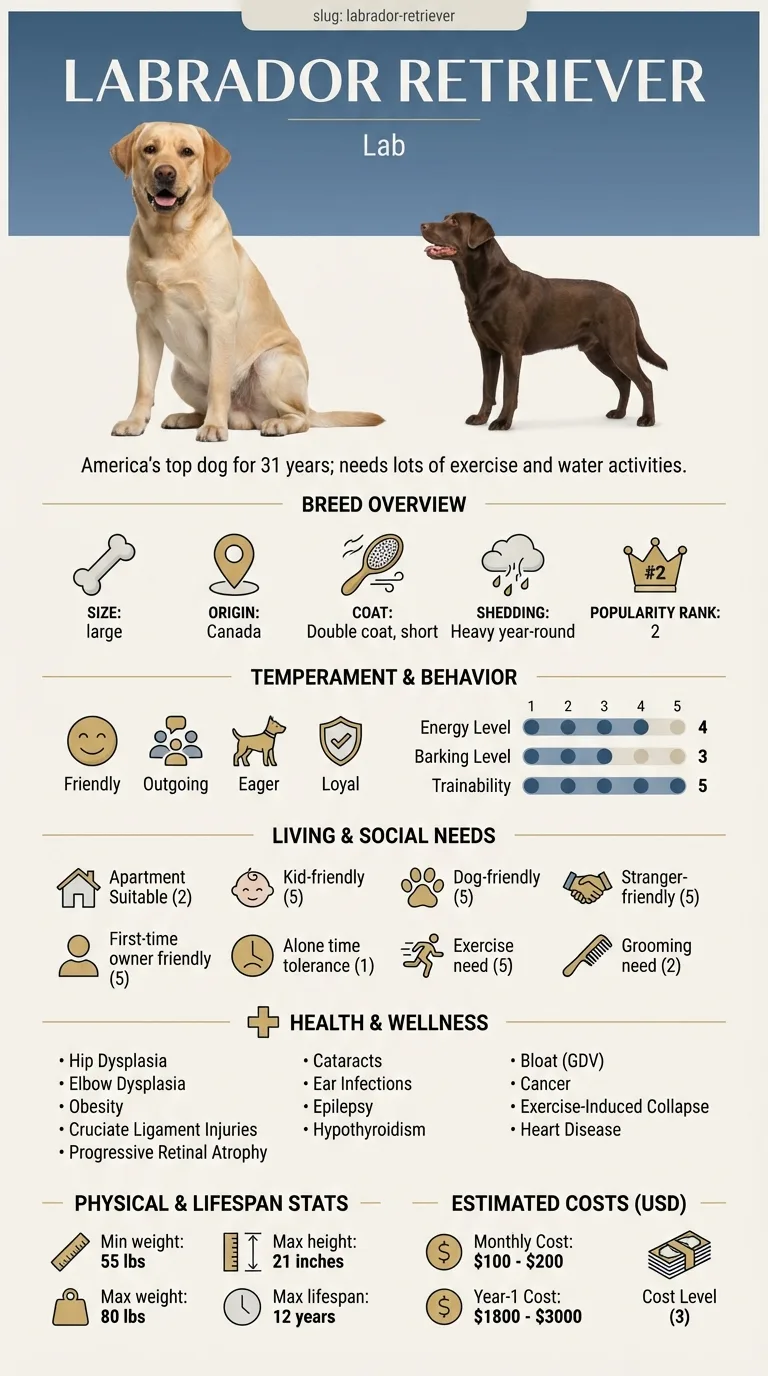
Back problems in a Labrador Retriever are typically mechanical, arising from repeated hard impact, jumping, and twisting during retrieves and play rather than from any conformational trait. Unlike chondrodystrophic breeds with a long spine and short legs, Labradors have a normal, proportionate build, so the common generic explanation for canine back pain doesn't fit this breed. Real Labrador back strain builds cumulatively from years of high-drive physical activity, often worsened by excess weight.
Genuine back strain is a realistic concern for highly active or working Labradors given the cumulative impact involved, though it isn't documented as a hallmark breed condition the way hip dysplasia or ear infections are. Most cases are activity-related rather than an inherited structural problem.
Labrador Retrievers have a normal, well-proportioned spine and leg length, so they don't carry the chondrodystrophic trait that predisposes some breeds to early disc-related back problems. What this breed does carry, well documented, is a high exercise drive and a strong retrieving instinct, both of which lead to years of repeated, high-impact physical activity that can gradually strain the back's muscles and supporting structures.
A lifestyle heavy on dock jumping, hard-surface fetch, or rough play with other dogs increases cumulative mechanical load on the spine. Carrying excess weight, common in this food-motivated breed, adds further strain to every jump and landing.
See your vet if your Labrador shows a reluctance to jump that lasts more than a day or two, sensitivity when you touch along its spine, an arched or hunched posture, or any weakness in the hind legs. Sudden hind-limb weakness or an inability to rise needs same-day attention, not a wait-and-see approach.
See all Labrador Retriever health problems, which breeds are prone to back problems, or the full Labrador Retriever breed guide for temperament, exercise needs and ownership costs.
Mild muscle strain typically improves within one to two weeks of rest and activity modification. More significant strain or early disc involvement can take four to eight weeks of a structured, vet-guided recovery plan before returning to full activity.
Success looks like a return to comfortable, confident movement, jumping and retrieving without hesitation or visible discomfort, achieved by addressing the actual activity-driven cause rather than assuming the dog will simply "grow out of it."
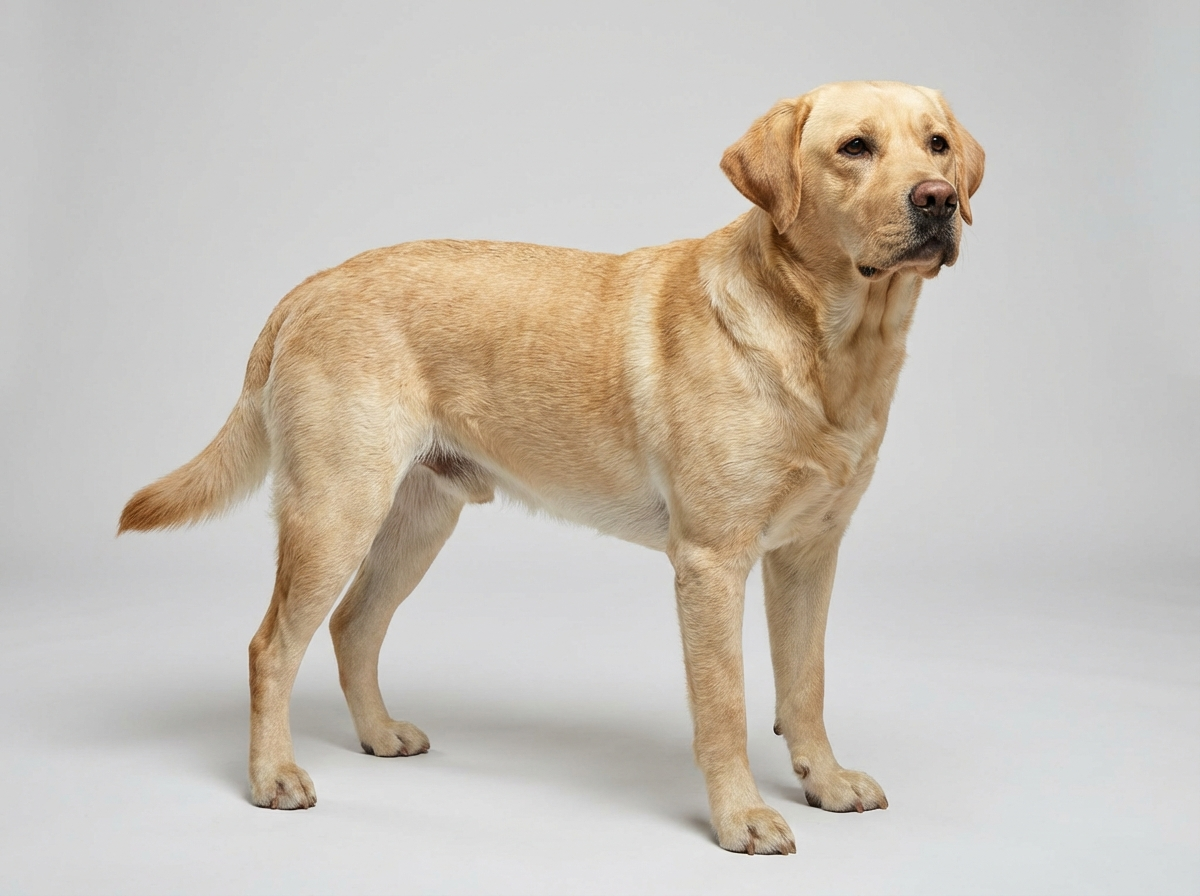
The long-spine-and-short-legs explanation for back problems describes chondrodystrophic breeds, Dachshunds, Corgis, Basset Hounds, whose skeletal proportions and a specific gene variant change disc structure and make early disc degeneration common. Labrador Retrievers have none of that: this is a well-proportioned, moderately built, athletic breed with a normal spine-to-leg ratio and no documented chondrodystrophic trait. A generic description that assumes otherwise simply doesn't apply here, and treating a Lab's back like a Dachshund's back would mean focusing on the wrong risk factors entirely.
In this breed, back problems are overwhelmingly mechanical and activity-driven rather than conformational. A Lab that repeatedly launches off a dock, twists hard mid-retrieve, or plays rough with other large dogs is loading its spine and the supporting soft tissue with real, repeated impact. Add years of this pattern, especially if the dog is carrying extra weight, and you get muscle strain, soft tissue inflammation, and in some individual dogs, age-related disc degeneration that has nothing to do with the breed's proportions and everything to do with cumulative wear from a genuinely demanding, high-drive lifestyle.

Ranger, a six-year-old field-trial Labrador who'd spent years launching off a tall dock into the lake without a second thought, suddenly started hesitating at the edge and yelped once when he landed awkwardly. His owner assumed it was simply an old-dog thing until the vet found tenderness along his lower spine and diagnosed mechanical strain from years of high-impact water entries, not disc disease. A structured plan followed: two weeks of rest, then a gradual return to activity with a ramp installed at the dock and shorter, more controlled retrieving sessions. Ranger was back to swimming confidently within a month, though his owner now limits full-force dock jumps to occasional rather than daily.
Key takeaway: Back strain in an active Labrador is usually a mechanical, activity-driven problem rather than a structural one, and it responds well to rest, moderation, and a gradual return to activity.
No. That description applies to chondrodystrophic breeds like Dachshunds and Corgis. Labradors have a normal, well-proportioned build with no documented short-legged or long-spine trait, so that mechanism for back problems doesn't apply to this breed.
Repeated hard impact from jumping, twisting during retrieves, rough play, and cumulative wear over years of high-drive activity are the main real drivers, sometimes compounded by excess weight adding extra load.
A reluctance to jump, an arched or tense-looking back, sensitivity when touched along the spine, a subtle limp or stiffness after activity, or reduced enthusiasm for the water entries and retrieves it used to love.
It occurs, but it's a slower, age-related process in this breed rather than the sudden, early-onset disc rupture pattern seen in chondrodystrophic breeds. Genuine disc disease is covered in more depth as its own topic for this breed.
Yes. Extra weight adds mechanical load to the spine and supporting muscles during every jump and twist, which is part of why weight management matters as much for back health as it does for joints.
Not necessarily, but moderating repeated hard, high-impact entries, especially off tall docks, and building general core strength through controlled exercise can meaningfully reduce cumulative strain over a dog's lifetime.
A physical exam checking for pain response along the spine, combined with X-rays or, for more complex cases, an MRI, helps a vet distinguish muscle strain from disc involvement or another underlying cause.
No, Labradors have a normal, proportionate spine and leg length with no documented chondrodystrophic trait, so that specific back-problem mechanism doesn't apply to this breed.
Repeated hard jumps and twisting retrieves over years, especially combined with extra body weight, are the main real drivers of back strain in this breed.
Mild muscle strain often improves with rest and activity modification within a week or two, but persistent or worsening symptoms need veterinary evaluation rather than waiting it out.
A basic exam and X-rays are a moderate cost; advanced imaging like an MRI for suspected disc involvement is considerably more, so ask your vet what level of workup your dog's symptoms actually warrant.
Building controlled retrieve habits and moderating repetitive high-impact jumps, rather than eliminating activity altogether, helps protect the back over a working or field-active Lab's lifetime.
A one-page prep sheet for this condition: the signs, the questions to ask, what to get priced. Unlocks here.
You get: Vet visit prep sheet
No spam. One-click unsubscribe. See our privacy policy.
Preview page 1 before you decide.