Health
Is IVDD only a problem for Dachshund-type breeds?
No — large breeds like Labradors get it too, typically through slower age-related degeneration rather than sudden young-dog herniation.

Quick answer
Is IVDD only a problem for Dachshund-type breeds?
No — large breeds like Labradors get it too, typically through slower age-related degeneration rather than sudden young-dog herniation.
In a large, muscular breed like a Lab, the spinal discs degenerate gradually with age rather than herniating suddenly in a young dog, which means the warning signs look more like stiffness and reluctance to jump than a dramatic sudden collapse.
Owners of middle-aged and senior Labs noticing new reluctance to jump into the car or up onto furniture, easily mistaken for simple arthritis rather than a spinal issue.
This guide is not medical advice. If your dog shows pain, sudden behavior change, or worsening symptoms, consult a licensed veterinarian.
Some links may be affiliate links. We may earn a commission at no extra cost to you. We only suggest products we believe are helpful for dog owners.
We research and check what we publish, but we do not warrant that any figure, date, price, or statement is accurate, complete, or current, and we accept no liability for any loss, cost, injury, or other harm arising from the use of this site. Use it as one reference among several. You remain responsible for your own decisions and for your dog's care - confirm anything that matters with a licensed veterinarian or another qualified professional before you act on it. Full disclaimer.
Intervertebral disc disease in Labrador Retrievers most commonly develops as a gradual, age-related degeneration of the spinal discs rather than the sudden severe herniation more typical of short-legged breeds. It causes pain and, in more advanced cases, weakness or paralysis, but the slower progression in this breed means early signs are often subtle enough to be mistaken for general stiffness or arthritis.
IVDD is less frequently diagnosed in large, normally-proportioned breeds like Labradors than in short-legged breeds specifically bred with disc-prone conformation, but it's common enough in aging large dogs that vets routinely consider it when a senior Lab shows new reluctance to jump or climb.
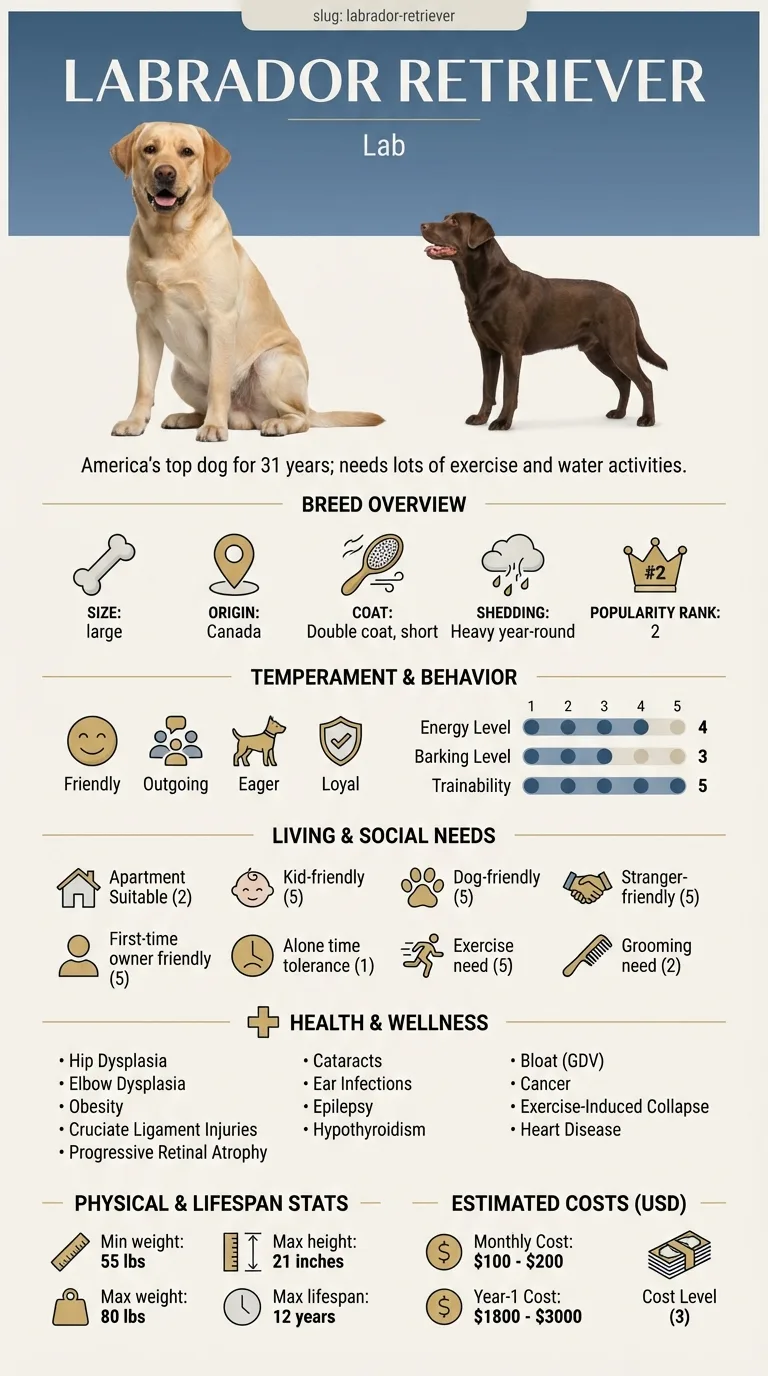
At 55 to 80 pounds with a 10 to 12 year lifespan, Labradors carry substantial body weight on their spine for over a decade, and their high exercise drive means repeated jumping and hard landings across a lifetime of retrieving and play — both of which contribute to gradual disc wear distinct from the genetic disc abnormality seen in chondrodystrophic breeds.
Chronic obesity is one of the more significant environmental contributors, adding constant extra load to the spine regardless of activity level. Repetitive high-impact activities like jumping off furniture, out of vehicles, or over obstacles without conditioning can accelerate disc wear over years of cumulative stress.
See a vet promptly for reluctance to jump, a hunched back, yelping when picked up, or any wobbliness in the back legs — and seek emergency care immediately for sudden inability to walk or use the back legs, since this can indicate a severe disc event requiring urgent evaluation.
See all Labrador Retriever health problems, which breeds are prone to intervertebral disc disease ivdd, or the full Labrador Retriever breed guide for temperament, exercise needs and ownership costs.
Lower-grade cases managed with strict rest often show improvement within two to four weeks, though full recovery of activity level can take several months. Surgical cases typically involve weeks of restricted activity followed by a longer structured rehabilitation program.
Success for a mild case looks like a return to normal daily activity with ongoing weight and activity management to prevent recurrence. For more severe cases, success means restored functional mobility, which may not always mean a full return to pre-diagnosis athletic activity.
Intervertebral discs act as cushions between the vertebrae, absorbing shock during normal movement. In chondrodystrophic breeds bred for short legs, the discs themselves have an abnormal composition that predisposes them to sudden, often severe herniation, sometimes in dogs as young as two or three. In large, normally-proportioned breeds like Labradors, disc disease more typically follows a gradual, age-related degeneration pattern, where discs slowly lose their cushioning capacity over years rather than rupturing suddenly.
This gradual form still causes real pain and can still progress to nerve compression and mobility loss, but the presentation is usually slower to develop and easier to catch early: a subtle reluctance to jump, a slightly hunched back, a change in how the dog carries its tail, or a reduced willingness to be picked up around the middle. Because this pattern develops over months, it's easy for owners to attribute early signs to general stiffness or aging rather than a specific spinal issue.
Diagnosis in a large breed typically starts with a neurological exam to localize the problem, followed by imaging — X-rays can suggest disc changes, but an MRI or CT gives a much clearer picture of exactly which disc and how severely it's affecting the spinal cord, which matters for deciding between medical management and surgery.

Vets use a five-point grading scale to describe severity, and the grade at diagnosis strongly shapes whether medical management or surgery is the right first step.
Frank's nine-year-old Lab, Chief, had started arching his back slightly and stopped jumping onto the tailgate of Frank's truck, a favorite spot he'd used for years. Frank assumed it was simple arthritis and gave him an over-the-counter joint supplement for a month with no real improvement. A vet visit found spinal pain on palpation, and an MRI confirmed moderate disc degeneration at two levels without significant nerve compression yet. Chief was started on strict rest, anti-inflammatory medication, and a structured rehabilitation plan. Ten weeks later he was moving comfortably again, now with a permanent ramp for the truck and a leaner target weight to reduce future strain.
Key takeaway: A subtle posture change like an arched back, combined with avoiding a specific jump the dog used to do easily, is worth a spinal exam rather than assuming it's ordinary joint stiffness.
Yes, though typically through a slower, age-related degeneration pattern rather than the sudden severe herniation seen more often in short-legged breeds like Dachshunds. It usually shows up in middle-aged to senior Labs rather than young adults.
Reluctance to jump onto furniture or into a car, a hunched back, reduced tail wagging or a tucked tail, and sensitivity when picked up around the middle are common early signs, often mistaken for general arthritis.
A neurological exam first localizes which part of the spine is likely affected, followed by imaging — X-rays can hint at disc changes, but MRI or CT gives a definitive view of severity and exact location, which guides treatment decisions.
No — lower-grade cases with pain but normal or mildly affected walking are often managed successfully with strict rest, anti-inflammatory medication, and controlled rehabilitation. Higher-grade cases with significant weakness or paralysis are more likely to need surgery.
Spinal surgery for IVDD commonly runs $4,000–$10,000 depending on region, specialist, and severity, plus follow-up rehabilitation costs.
Recovery odds depend heavily on the grade at diagnosis and how quickly treatment started. Lower grades with prompt treatment often recover very well; higher grades, especially with loss of deep pain sensation, carry a more guarded prognosis even with surgery.
Avoid encouraging jumping, rough play, or stairs until you've seen a vet, and don't give human pain medication, which can be dangerous for dogs and can mask worsening symptoms.
No — large breeds like Labradors get it too, typically through slower age-related degeneration rather than sudden young-dog herniation.
Reluctance to jump into the car or onto furniture is often the first noticeable change.
Typically $4,000–$10,000 depending on region, specialist, and severity.
Yes, for lower-grade cases with pain but preserved walking ability, strict rest and medication are often the first approach.
Yes — this is the most severe grade and the surgical window to preserve function is time-critical, requiring an immediate vet visit.
A one-page prep sheet for this condition: the signs, the questions to ask, what to get priced. Unlocks here.
You get: Vet visit prep sheet
No spam. One-click unsubscribe. See our privacy policy.
Preview page 1 before you decide.