Health
Is BOAS a real risk for Weimaraners?
No, it's documented in flat-faced breeds like Bulldogs and Pugs, not in the long-muzzled Weimaraner.

Quick answer
Is BOAS a real risk for Weimaraners?
No, it's documented in flat-faced breeds like Bulldogs and Pugs, not in the long-muzzled Weimaraner.
BOAS sounds like it could describe any dog that ever snores or pants hard after a run, but it's a specific anatomical condition tied to a skull shape the Weimaraner simply doesn't have.
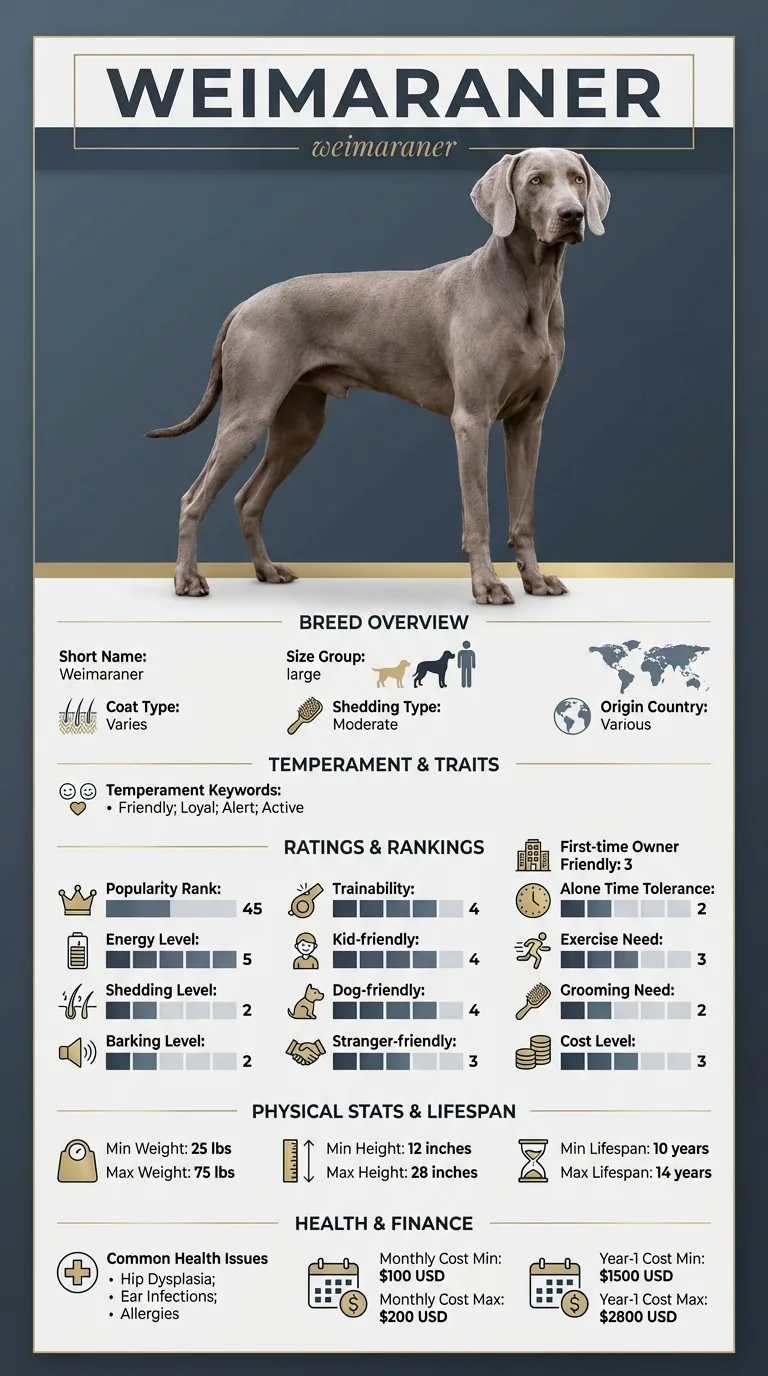
Owners who've read general dog health round-ups mentioning BOAS and want to know whether their Weimaraner's post-exercise panting or occasional snoring is actually a sign of it are the audience for this page.
This guide is not medical advice. If your dog shows pain, sudden behavior change, or worsening symptoms, consult a licensed veterinarian.
Some links may be affiliate links. We may earn a commission at no extra cost to you. We only suggest products we believe are helpful for dog owners.
We research and check what we publish, but we do not warrant that any figure, date, price, or statement is accurate, complete, or current, and we accept no liability for any loss, cost, injury, or other harm arising from the use of this site. Use it as one reference among several. You remain responsible for your own decisions and for your dog's care - confirm anything that matters with a licensed veterinarian or another qualified professional before you act on it. Full disclaimer.
Brachycephalic Obstructive Airway Syndrome is a well-characterized condition in flat-faced breeds like Bulldogs, Pugs, and French Bulldogs, not established in the long-muzzled Weimaraner. For a Weimaraner showing signs of labored breathing, bloat (GDV), heat stress, or anxiety-driven panting are far more likely and far more relevant explanations to investigate.
BOAS is common within the specific flat-faced breeds where it's documented, affecting a large share of dogs with the most extreme skull shortening, but it is not recognized as occurring in Weimaraners at all, making it essentially irrelevant to this breed's actual health picture.
BOAS results from generations of breeding toward a shortened skull, which crowds the soft palate, nasal passages, and throat tissue into too little space; the Weimaraner's breeding history as a long-muzzled versatile hunting dog moved in the opposite anatomical direction. No genetic or structural driver for BOAS has been identified in this breed.
Because BOAS isn't relevant to Weimaraner anatomy, there are no environmental triggers to manage for it in this breed. The environmental factors actually worth managing are heat exposure during exercise and the separation stress that can trigger this breed's genuine anxiety tendencies.
See a vet immediately for a distended or bloated-looking abdomen, unproductive retching, collapse, or blue-tinged gums, since these point to bloat or another real emergency rather than an airway structure issue. Any breathing pattern that seems abnormal for your individual dog is worth a call, even though BOAS itself isn't the likely explanation.
BOAS terminology has become common shorthand for 'a dog that breathes loudly,' which sends owners of long-muzzled breeds down the wrong research path. Avoid these mistakes.
See all Weimaraner health problems, which breeds are prone to brachycephalic obstructive airway syndrome boas, or the full Weimaraner breed guide for temperament, exercise needs and ownership costs.
Because BOAS isn't relevant to this breed, there's no meaningful timeline to track for it. What's worth tracking instead is how quickly your Weimaraner's panting settles after exercise or heat exposure, which should be a matter of minutes, not a persistent pattern.
Success here means redirecting research energy toward the Weimaraner's actual documented risks, bloat, hip dysplasia, Von Willebrand disease, and separation anxiety, rather than chasing a flat-faced-breed condition that doesn't apply. Recognizing the real emergency signs for this breed is more protective than monitoring for a condition it doesn't develop.
A Weimaraner that seems to be struggling to breathe deserves a vet visit, but the likely cause looks nothing like BOAS. Labored breathing paired with a swollen abdomen, unproductive retching, or restlessness after a large meal is the classic picture of bloat (GDV), a genuine emergency for this deep-chested breed. That combination needs immediate emergency veterinary care, not an airway workup.
Heavy panting on a hot day is also common in this energetic, thin-coated breed and usually resolves with shade, water, and rest. Separation anxiety, another condition this breed is genuinely prone to, can also produce rapid panting and restlessness that owners sometimes mistake for a breathing disorder. A vet can quickly distinguish normal exertion or anxiety-driven panting from an actual medical emergency.
The practical takeaway mirrors other breed-mismatch topics: don't ignore a dog that seems to be in real distress, but expect the workup to focus on causes that are actually documented in this breed.

BOAS develops because breeding for a shortened skull compresses soft palate, nasal passages, and airway tissue into less space than they need. The Weimaraner was bred as a versatile hunting dog, and that job selected for a long, open muzzle that supports scenting and stamina, the opposite anatomical direction from a flat-faced dog.
Veterinary literature on BOAS specifically describes breeds like the Bulldog, Pug, French Bulldog, Boston Terrier, and Cavalier King Charles Spaniel, all with a shortened skull ratio the Weimaraner doesn't share. A long-muzzled sporting breed like this one simply doesn't have the anatomical starting point the condition requires.

After his Weimaraner Scout came in from a hard afternoon of fetch breathing heavily, Marcus in Boise found an article listing BOAS symptoms and worried Scout might have an airway problem. His vet explained that Scout's long muzzle and open airway put him well outside the flat-faced breeds where BOAS occurs, and that heavy panting after vigorous exercise in a sporting breed like this is expected. The vet used the visit to walk Marcus through the signs of bloat instead, since Scout's deep chest put him at genuine risk for that condition. Marcus left with a clear picture of what actually needed watching: a bloated abdomen and retching, not panting after playtime.
Key takeaway: A condition documented in flat-faced breeds isn't a realistic concern for a long-muzzled Weimaraner; recognizing the signs of bloat (GDV) is the far more protective habit for this breed.
No. BOAS is documented in flat-faced breeds like Bulldogs, Pugs, and French Bulldogs, and the Weimaraner's long muzzle and mesocephalic skull shape don't produce the airway crowding the condition requires.
This is a high-energy sporting breed with a short coat, so vigorous panting is the normal way it cools down after a run rather than a sign of airway obstruction; if panting comes with a distended belly or retching, seek emergency care for possible bloat instead.
Occasional snoring during deep sleep happens in dogs of many head shapes and isn't a BOAS indicator, since BOAS-pattern noisy breathing specifically comes from the soft-tissue crowding of a shortened skull this breed doesn't have.
Bloat (GDV) is the real emergency for this deep-chested breed, and it can look like breathing distress when it's actually abdominal distension, unproductive retching, and restlessness after eating; it requires immediate emergency veterinary care.
No, their heat sensitivity comes from a thin single coat and high activity drive rather than any airway anatomy, so managing exercise timing and heat exposure addresses it more directly than any airway-related precaution would.
Bloat (GDV), hip dysplasia, hypertrophic osteodystrophy, Von Willebrand disease, and separation anxiety are the conditions genuinely established in this breed, and they're a far more useful research focus than a flat-faced-breed airway condition.
Yes. Any dog with visibly labored breathing, blue-tinged gums, or collapse needs prompt veterinary attention, and in this breed the vet will likely focus on causes like bloat, heat stress, or anxiety rather than an airway structure problem.
No, it's documented in flat-faced breeds like Bulldogs and Pugs, not in the long-muzzled Weimaraner.
Vigorous panting after exercise or in heat is normal cooling for this energetic, thin-coated breed, not an airway problem.
Bloat (GDV) is the genuine emergency to watch for in this deep-chested breed, and it needs immediate veterinary care.
No, since it isn't a documented condition in this breed, the real cost considerations are bloat surgery and care for hip or clotting-disorder issues.
Training won't change normal exertion panting, but it can help manage the restlessness that comes from this breed's genuine separation anxiety tendency.
A one-page prep sheet for this condition: the signs, the questions to ask, what to get priced. Unlocks here.
You get: Vet visit prep sheet
No spam. One-click unsubscribe. See our privacy policy.
Preview page 1 before you decide.