Health
Is facial swelling in a Lab always an emergency?
Not always, but any swelling that spreads quickly, involves the throat, or comes with labored breathing needs same-day emergency care rather than a wait-and-see approach.

Quick answer
Is facial swelling in a Lab always an emergency?
Not always, but any swelling that spreads quickly, involves the throat, or comes with labored breathing needs same-day emergency care rather than a wait-and-see approach.
One minute your Lab is romping through the yard, the next its muzzle is swollen and it's pawing at its face. Knowing what's a passing irritation and what's a true reaction changes what you do next.
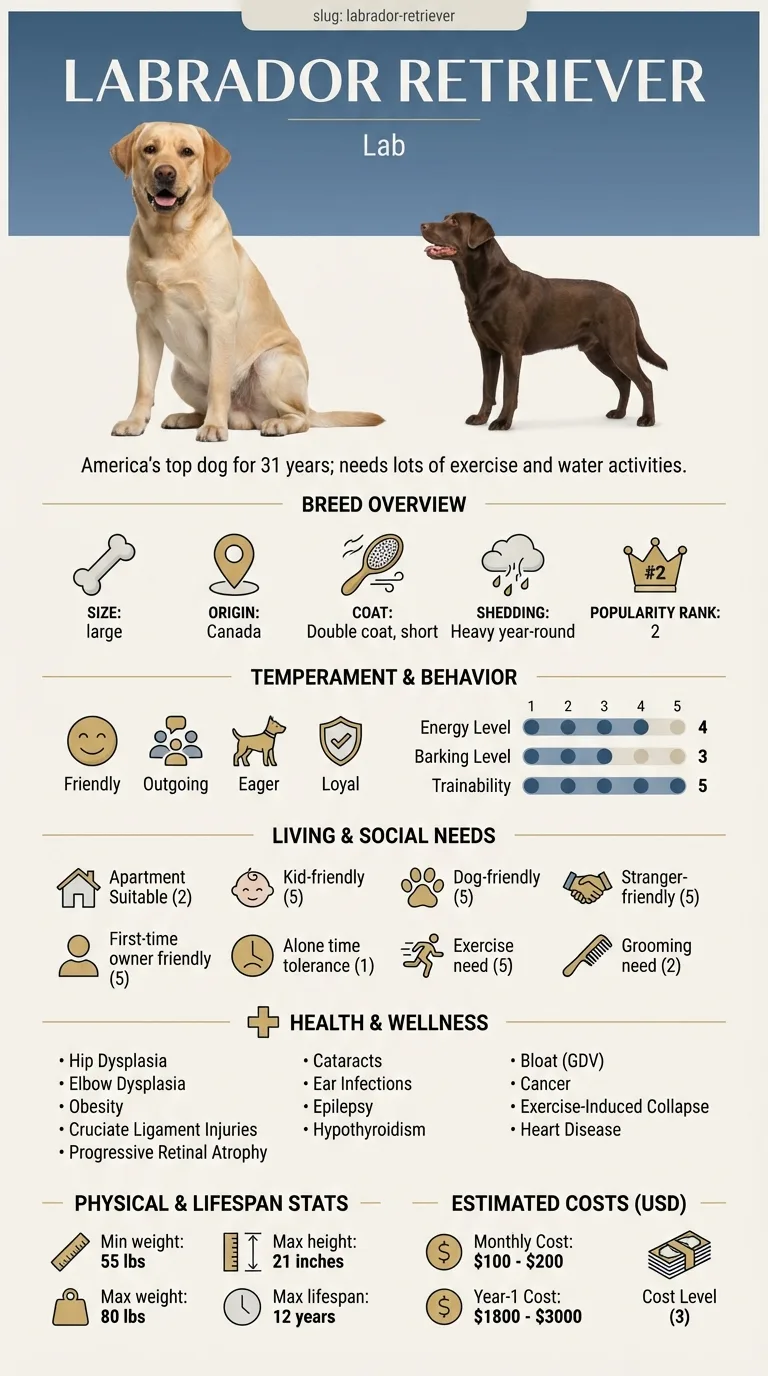
Owners of a young, active Labrador that spends real time outdoors, at the lake, or scavenging on walks face this most often, since exposure to stings, plants, and unfamiliar food scraps tracks with how much ground the dog covers.
This guide is not medical advice. If your dog shows pain, sudden behavior change, or worsening symptoms, consult a licensed veterinarian.
Some links may be affiliate links. We may earn a commission at no extra cost to you. We only suggest products we believe are helpful for dog owners.
We research and check what we publish, but we do not warrant that any figure, date, price, or statement is accurate, complete, or current, and we accept no liability for any loss, cost, injury, or other harm arising from the use of this site. Use it as one reference among several. You remain responsible for your own decisions and for your dog's care - confirm anything that matters with a licensed veterinarian or another qualified professional before you act on it. Full disclaimer.
An allergic reaction in a Labrador Retriever is the immune system overreacting to a trigger it treats as a threat, most often an insect sting, an unfamiliar food, or contact with a plant met on a walk. It shows up fast, over minutes to a couple of hours, as facial swelling, hives, intense itching, or vomiting. Most cases are mild and self-limiting once the trigger is gone, but a reaction that spreads to the throat or causes breathing trouble is a genuine emergency.
Breed health records don't flag Labradors as having an unusually reactive immune system, so this isn't a hallmark condition the way joint or eye problems are. What's genuinely common is exposure: a breed this food-motivated and outdoors-oriented simply encounters more potential triggers than a less active, less mouthy dog, which is why owners report reactions fairly often even without a true breed predisposition.
There's no strong evidence Labrador Retrievers carry a genetically oversensitive immune system compared to other breeds. What does drive real-world risk is behavior that's well documented in this breed: high food motivation, a tendency to investigate the world mouth-first, and an outdoors-and-water lifestyle that puts the dog in contact with stinging insects and unfamiliar plants more often than a more sedentary breed.
Exposure is the real driver here. Off-leash time in grass and brush, lake and pond visits, and a household that shares food or treats freely all raise the odds of an unplanned encounter. Households near flowering gardens or with a lot of outdoor bee activity in summer see more sting-related reactions specifically.
Call your vet or an emergency line the same day if you see facial or muzzle swelling, hives spreading across the body, vomiting shortly after a new exposure, or any sign of labored breathing. Swelling that involves the throat or breathing difficulty of any kind is a genuine emergency, not a wait-and-see situation.
See all Labrador Retriever health problems, which breeds are prone to allergic reactions, or the full Labrador Retriever breed guide for temperament, exercise needs and ownership costs.
A mild reaction typically resolves within 12 to 24 hours with veterinary-guided antihistamine treatment. A dog that needed emergency intervention for a severe reaction is usually back to normal within a few days, with the vet's guidance on avoiding the specific trigger going forward.
Success is identifying the trigger clearly enough to avoid a repeat, not eliminating all future risk. A dog that had one sting reaction and never repeats it because you now recognize the early swelling and manage exposure is a realistic, achievable outcome.
Labrador Retrievers are not flagged in breed health data as having an unusually reactive immune system, so the honest starting point is that most acute allergic reactions in this breed are opportunity-driven rather than genetic. A Lab's food motivation and willingness to put almost anything in its mouth (the same drive behind the breed's well-documented tendency toward obesity) means it meets more novel proteins, insect stings, and plant contact than a more reserved breed might. Wasp and bee stings picked up while nosing through the yard, a new treat or table scrap, and contact with unfamiliar plants during a hike are the most common real-world causes. The reaction itself, hives, facial swelling, or in rare cases full anaphylaxis, follows the same biology in any breed; what changes with a Labrador is simply the frequency of exposure.
It helps to separate a one-off allergic reaction from ongoing environmental or food allergies (a different, more chronic pattern covered in its own guide). A reaction comes on within minutes to a couple of hours of exposure: swelling around the face and eyes, raised welts across the body, sudden intense itching, or vomiting. A chronic allergy builds over days or weeks as low-grade skin and ear irritation. If your Lab's face has puffed up after a walk or a new snack, you are almost certainly looking at an acute reaction, not the slow-burn allergy pattern, and it should be handled on a different timeline.

Otis, a two-year-old Labrador with a well-earned reputation for eating anything that held still, came in from the backyard one July afternoon with a lopsided, swollen face and was pawing frantically at his muzzle. His owner had seen him digging near the fence line minutes earlier. The emergency vet confirmed a wasp sting reaction, gave an injectable antihistamine, and kept him for two hours of observation since the swelling had reached close to his eyes. By evening the swelling was down by half, and by the next morning Otis was back to his usual self, minus any interest in that corner of the yard. His owner now keeps a look-out for wasp activity near the fence each summer and waits to see any early puffiness rather than assuming it will pass on its own.
Key takeaway: A fast-appearing facial swelling after outdoor time is worth same-day veterinary attention, and most single reactions resolve completely once the trigger is identified and treated.
Facial swelling around the muzzle and eyes, raised hive-like bumps across the body, sudden and intense itching, or vomiting shortly after exposure to something new. Symptoms usually appear within minutes to two hours of contact with the trigger.
There's no strong breed-specific data showing Labradors have a more reactive immune system. What raises their real-world exposure is behavior: this is a food-driven, outdoors-loving breed that investigates everything with its mouth and nose, so it simply meets more stings, plants, and novel foods.
A single sting usually causes local swelling and discomfort that settles within a day. It becomes dangerous if the swelling spreads to the throat or face broadly, or if your dog was stung inside the mouth, since airway swelling can follow quickly.
Yes, though true food-triggered anaphylaxis is uncommon. A new protein source, a rich treat, or something scavenged on a walk is a more likely everyday cause of facial swelling or hives than an established diet.
Mild hives and facial swelling from antihistamine-responsive reactions typically improve within 12 to 24 hours with veterinary treatment. Without treatment, mild cases can still resolve on their own within a day, but a vet visit shortens the discomfort and rules out a worsening trend.
Do not dose your dog on your own. Contact your vet or an emergency line first; they can confirm whether an antihistamine is appropriate and at what amount for your specific dog, and they need to know if symptoms are progressing.
Keep an eye on where your dog noses around outside, rinse the mouth and face after they've been rooting in brush, and introduce any new food or treat one at a time so you can trace a reaction back to its source.
Not always, but any swelling that spreads quickly, involves the throat, or comes with labored breathing needs same-day emergency care rather than a wait-and-see approach.
Insect stings picked up during outdoor play and scavenged food or treats are the two most common everyday triggers, simply because of how much time this breed spends investigating its environment.
Not necessarily. A single reaction to a specific trigger doesn't predict a chronic allergy pattern; many dogs have one isolated reaction and never repeat it once the trigger is avoided.
A straightforward vet visit for antihistamine treatment and observation is typically a low three-figure cost; a reaction severe enough to need overnight monitoring runs higher.
A reliable "leave it" cue, taught early given how trainable this breed is, meaningfully cuts down on scavenged food and unwanted mouth contact with stinging insects.
A one-page prep sheet for this condition: the signs, the questions to ask, what to get priced. Unlocks here.
You get: Vet visit prep sheet
No spam. One-click unsubscribe. See our privacy policy.
Preview page 1 before you decide.