Behavior
Why are Labradors prone to separation anxiety?
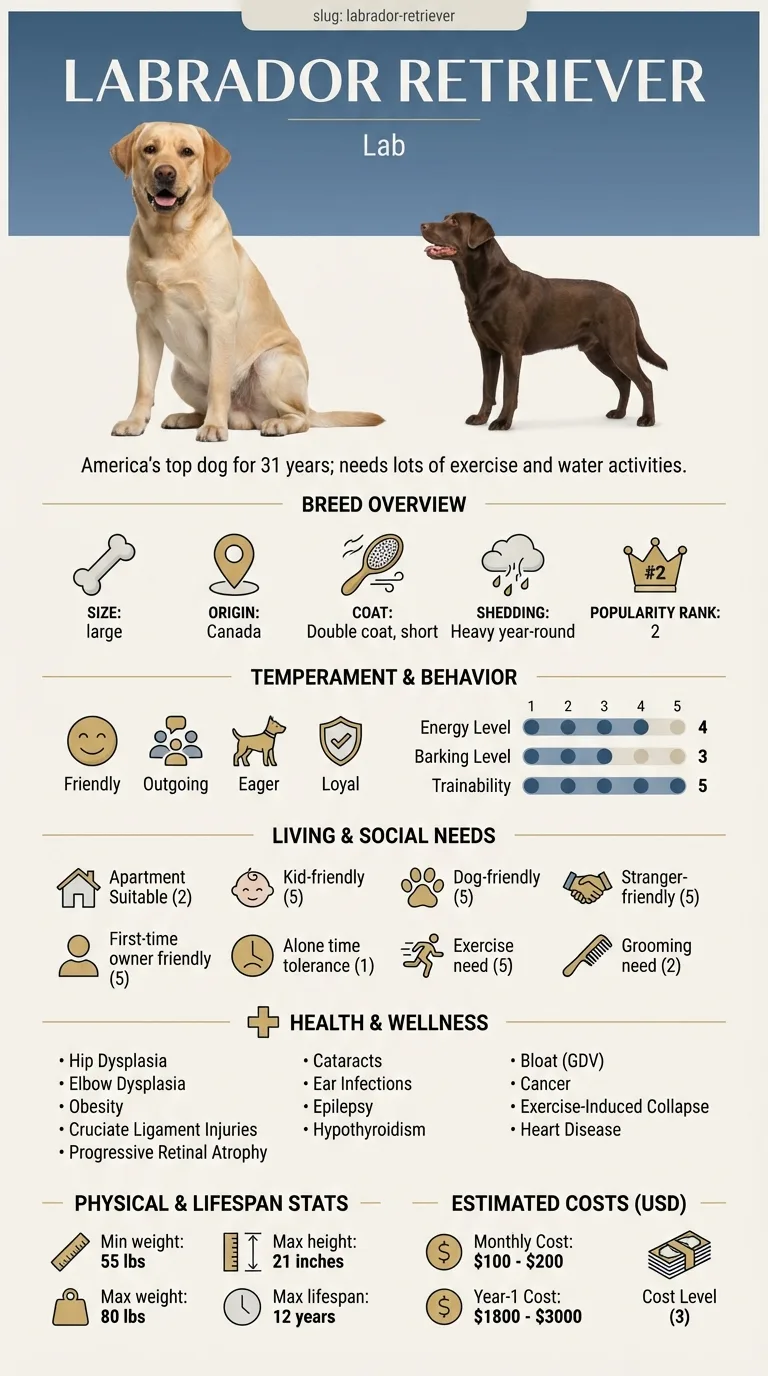
They're bred for close partnership with people, and this breed rates toward the low end of alone-time tolerance as a result.

Quick answer
Why are Labradors prone to separation anxiety?
They're bred for close partnership with people, and this breed rates toward the low end of alone-time tolerance as a result.
A Lab destroying a door frame or howling for an hour isn't necessarily poorly trained — it may be a dog whose entire genetic and temperamental design points toward closeness with people, thrown into an absence its instincts don't have a good answer for.
New owners whose Lab seems perfectly calm and confident with people around but falls apart the moment the door closes, and owners returning to an office job after a stretch of working from home with their dog constantly nearby.
This guide is not medical advice. If your dog shows pain, sudden behavior change, or worsening symptoms, consult a licensed veterinarian.
Some links may be affiliate links. We may earn a commission at no extra cost to you. We only suggest products we believe are helpful for dog owners.
We research and check what we publish, but we do not warrant that any figure, date, price, or statement is accurate, complete, or current, and we accept no liability for any loss, cost, injury, or other harm arising from the use of this site. Use it as one reference among several. You remain responsible for your own decisions and for your dog's care - confirm anything that matters with a licensed veterinarian or another qualified professional before you act on it. Full disclaimer.
Separation anxiety in Labrador Retrievers stems largely from this breed's deep temperamental orientation toward close human partnership, reflected in its notably low alone-time tolerance rating. Left unaddressed, it produces genuine distress behaviors like destructive chewing, prolonged vocalization, and house-soiling, but this breed's high trainability also makes it particularly responsive to a structured, gradual desensitization approach.
Separation anxiety is a frequently reported behavioral concern in Labrador Retrievers specifically, consistent with the breed's documented low rating on alone-time tolerance, making it one of the more predictable behavioral challenges for new owners of this breed to plan for proactively.
Labradors are rated near the bottom of typical alone-time tolerance scales among popular breeds, reflecting generations of breeding for close working partnership with a human handler rather than independent operation. Combined with a trainability and eagerness-to-please rating near the top of the scale, this breed is both prone to isolation distress and, fortunately, highly responsive to structured behavioral intervention.
A sudden change in an owner's schedule, insufficient exercise before departures, and an emotionally charged departure or return routine are the main environmental factors that can intensify separation-related distress on top of the underlying breed temperament.
A trainer experienced specifically in separation anxiety protocols, rather than general obedience training, is well worth involving for a structured desensitization plan, particularly for moderate to severe cases where a DIY approach isn't showing steady progress.
Consult your vet if separation-related distress is severe, if your dog shows signs of self-injury from attempting to escape, or if you suspect medication alongside behavioral training might help — a vet or veterinary behaviorist can also help rule out any underlying medical cause contributing to the behavior.
See all Labrador Retriever health problems, which breeds are prone to separation anxiety, or the full Labrador Retriever breed guide for temperament, exercise needs and ownership costs.
A structured desensitization plan typically shows initial progress within two to four weeks of consistent practice, with more significant improvement over two to three months for moderate cases. Severe cases can take longer and sometimes benefit from combining medication with behavioral training.
Success means a dog that can be left alone for realistic, needed durations without significant distress — not necessarily a dog that's thrilled about solo time, but one that can settle and cope calmly, which is a genuinely achievable goal for most Labs given consistent, patient training.
Labrador Retrievers are rated toward the very low end of alone-time tolerance among popular breeds, which reflects centuries of selective breeding for a dog that works in close partnership with a human handler — originally retrieving downed waterfowl right alongside a hunter, and more broadly bred for exceptional trainability and eagerness to please. That orientation toward partnership doesn't switch off just because the context has shifted from hunting to modern pet ownership.
This shows up practically as a dog that's rarely content simply existing in a room without a person, and one whose stress response to isolation can be intense: destructive chewing, prolonged vocalization, house-soiling despite being otherwise reliably trained, or frantic escape attempts at doors and windows. Because Labs are also highly food and toy motivated, and highly trainable, this same temperament that makes separation genuinely hard also makes them very responsive to a structured desensitization plan, once the underlying anxiety, not just the resulting behavior, is actually being addressed.
It's worth distinguishing true separation anxiety, which specifically involves distress tied to the owner's absence, from boredom-driven destructive behavior, which can look similar but stems from insufficient physical or mental exercise rather than isolation distress itself — the two require different management approaches, and getting the distinction right matters for choosing an effective plan.

Given how responsive this breed is to structured training, a gradual, systematic desensitization plan tends to work better than either punishment or simply avoiding departures altogether.
When Jenna returned to her office job after eighteen months of working from home, her Lab, Remy, began destroying door frames and howling within minutes of her leaving, something that had never been an issue before given how much time they'd spent together. A trainer specializing in separation anxiety helped Jenna start with departures lasting only ten seconds, building up gradually over six weeks. Jenna also stopped making a big deal of her departures and started leaving Remy with a frozen food puzzle reserved only for alone time. By week eight, Remy could handle a full workday alone, settling calmly after an initial adjustment period, confirmed by the webcam Jenna had set up to monitor his progress.
Key takeaway: A sudden increase in alone time after a long period of near-constant togetherness is a predictable trigger for this specific breed, and a slow, structured rebuild of tolerance works far better than expecting a dog to simply adjust on its own.
This breed is rated toward the low end of alone-time tolerance, reflecting generations of breeding for close partnership with a human handler. That deep orientation toward human company makes isolation genuinely stressful for many Labs, not simply a behavioral quirk.
True separation anxiety involves distress specifically tied to your absence — often starting within minutes of you leaving — while boredom-driven destruction tends to build more gradually and can happen even when you're home but not engaging with the dog. A webcam recording your departures can help distinguish the two.
Destructive chewing focused on exits like doors and windows, prolonged howling or barking, house-soiling despite reliable house-training, and frantic escape attempts are the classic signs, typically starting soon after the owner leaves.
A structured desensitization plan typically takes several weeks to a few months of consistent, gradual practice, though severity and individual dog temperament affect the exact timeline significantly.
This can help some dogs but isn't a guaranteed fix, since true separation anxiety is specifically about the owner's absence, not simply about being alone — some dogs with separation anxiety remain anxious even with another dog present.
Yes, in more severe cases, your vet may recommend anti-anxiety medication alongside behavioral training, which can make a dog more receptive to the desensitization process rather than replacing it entirely.
It depends on the individual dog — some feel more secure in a properly crate-trained den-like space, while others with separation anxiety can panic more in confinement. This should be assessed carefully rather than assumed to help universally.
They're bred for close partnership with people, and this breed rates toward the low end of alone-time tolerance as a result.
Separation anxiety is distress specifically tied to the owner's absence; boredom-driven destruction can happen even when the owner is home but not engaging.
Typically several weeks to a few months of consistent, gradual desensitization practice.
No — keeping departures and returns low-key and unemotional helps avoid heightening the anxiety around the transition itself.
Yes, in more severe cases, alongside behavioral training rather than as a replacement for it.
Behaviour changes often start with pain. The prep sheet for this page covers what to rule out, and what to ask.
You get: Vet visit prep sheet
No spam. One-click unsubscribe. See our privacy policy.
Preview page 1 before you decide.