Health
What actually causes breathing distress in Brittanys during exercise?
Heat stress from overexertion in a high-drive dog that won't self-limit, not a structural airway problem like BOAS.

Quick answer
What actually causes breathing distress in Brittanys during exercise?
Heat stress from overexertion in a high-drive dog that won't self-limit, not a structural airway problem like BOAS.
A Brittany won't quit working because it's too hot. That's exactly what makes heat stress dangerous in this breed: the dog's drive outlasts its own safety margin.
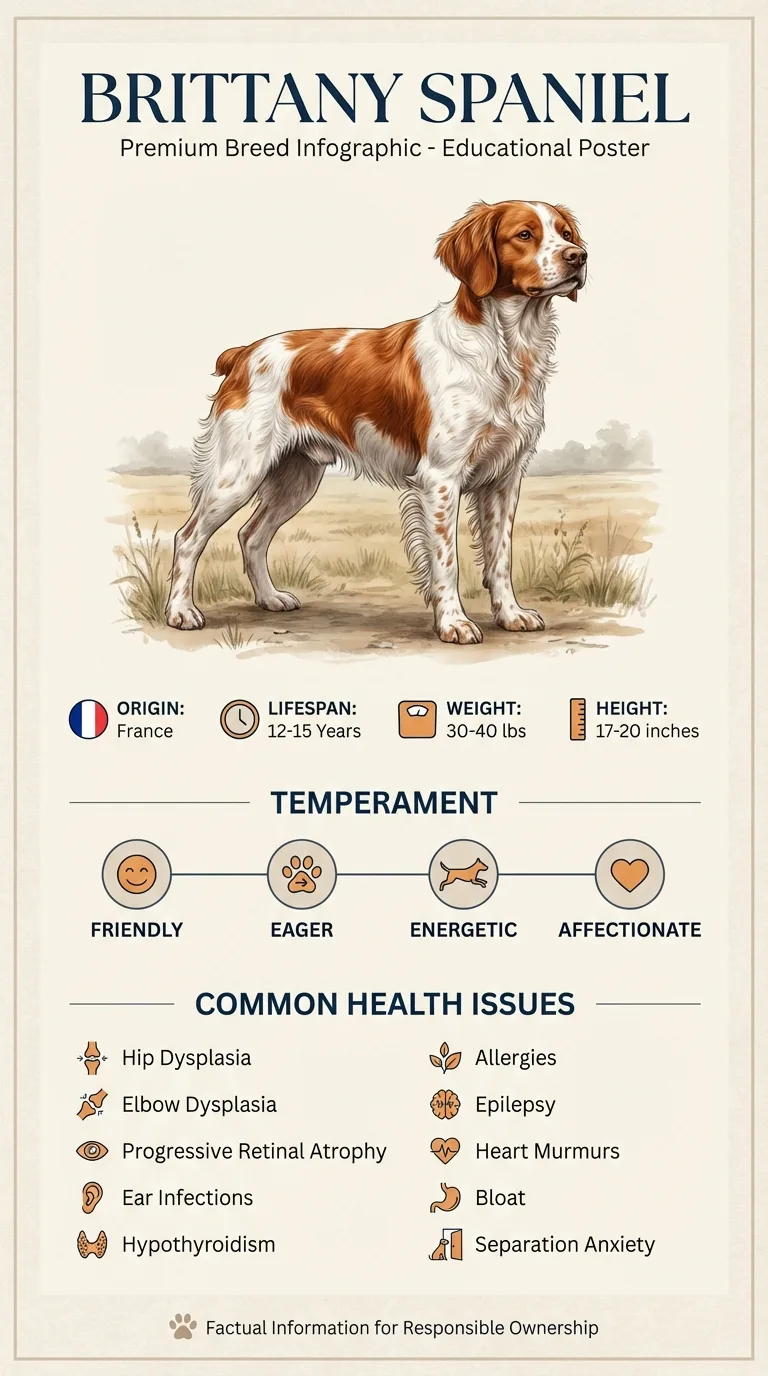
This is most relevant to owners who hunt, run field trials, or do intense fetch and training sessions with their Brittany during warm months, especially with a dog whose enthusiasm makes it hard to tell when it's had enough.
This guide is not medical advice. If your dog shows pain, sudden behavior change, or worsening symptoms, consult a licensed veterinarian.
Some links may be affiliate links. We may earn a commission at no extra cost to you. We only suggest products we believe are helpful for dog owners.
We research and check what we publish, but we do not warrant that any figure, date, price, or statement is accurate, complete, or current, and we accept no liability for any loss, cost, injury, or other harm arising from the use of this site. Use it as one reference among several. You remain responsible for your own decisions and for your dog's care - confirm anything that matters with a licensed veterinarian or another qualified professional before you act on it. Full disclaimer.
The breathing distress owners sometimes associate with a BOAS label in this breed isn't structural, since Brittanys don't have flat-faced airway anatomy. What's actually happening is heat stress driven by this breed's documented high energy and exercise need, a working dog that keeps pushing past a safe exertion level, especially in warm, humid conditions.
Heat-related distress isn't a documented statistic the way a genetic disease might be, but given this breed's high activity drive and its common use for warm-season field work, mild heat stress episodes are a realistic and fairly common occurrence for active owners who don't build in deliberate breaks.
This breed's documented high energy level and exercise need reflect a dog bred to work fields for extended periods, and that same drive means many Brittanys won't voluntarily stop or slow down as body temperature rises, unlike a lower-drive breed that self-paces more naturally.
Warm temperatures, high humidity, direct sun exposure without shade breaks, and sustained hard activity without scheduled rest all combine to overwhelm a panting dog's cooling capacity, regardless of breed, but they matter more for a dog whose owner also has to actively manage its exertion level.
Contact your vet if your dog's panting doesn't settle within several minutes of a full rest break in shade, or if you notice glassy eyes, drooling, or stumbling. Collapse, vomiting, disorientation, or an unresponsive dog is a heatstroke emergency: begin active cooling and get to a vet immediately, do not wait to see if it improves on its own.
See all Brittany health problems, which breeds are prone to brachycephalic obstructive airway syndrome boas, or the full Brittany breed guide for temperament, exercise needs and ownership costs.
Mild heat stress typically resolves within thirty minutes of rest, shade, and water once activity stops. Heatstroke, once it progresses to collapse or disorientation, requires immediate emergency treatment and a recovery period that your vet will guide based on severity.
Success looks like a season with zero heat emergencies, achieved through scheduled breaks and pacing rather than relying on your dog to tell you when it's had enough, since this breed often won't.
A Brittany's documented energy level and exercise need sit at the high end of the scale, and this breed was developed specifically to work fields for hours at a stretch. That combination of stamina and drive means a Brittany is genuinely more likely than a lower-energy breed to keep pushing well past the point where a less motivated dog would simply stop and rest.
Dogs cool themselves primarily through panting, and panting becomes less effective as air temperature and humidity climb. A dog that won't self-regulate its effort in those conditions can tip from heavy, normal panting into genuine heat exhaustion faster than its owner expects, especially mid-hunt when attention is on the birds, not the dog.
The progression from fine to dangerous can happen faster than expected in a dog that won't stop itself.

If you think your Brittany has brachycephalic obstructive airway syndrome (boas), the plan is three steps: write down what you have seen and when it started, book a veterinary appointment rather than waiting for the next flare, and take video of the behaviour or symptom before you go — the thing you are worried about rarely happens in the consulting room. Screening in the parents covers hip dysplasia, elbow dysplasia, progressive retinal atrophy.
What the vet visit should produce is a diagnosis and a written plan, not just reassurance: what is being ruled out, what the monitoring interval is, and which signs mean you come back sooner. Ask what the treatment costs across a year rather than per visit, because that is the number that decides whether you are managing this condition or reacting to it.
Between appointments, keep a short log — dates, what you saw, what changed. It is the single most useful thing an owner brings to a follow-up, and for brachycephalic obstructive airway syndrome (boas) it is often what separates a clear pattern from a guess.
Derek had planned a full afternoon of retrieving drills with Sable, his three-year-old Brittany, on an unusually warm early-fall day. Sable, true to form, kept bringing back every bumper with full enthusiasm, showing no obvious sign of slowing down through the first forty-five minutes. It wasn't until Derek called a water break that he noticed her panting wasn't settling the way it normally did, and her gums looked a little brighter red than usual. He stopped the session entirely, moved her into the shade of his truck with the AC running, and offered small sips of water rather than letting her gulp. Within fifteen minutes she was breathing more normally, but the scare was enough that Derek now sets a hard timer for water and shade breaks every twenty minutes during warm-weather sessions, regardless of how eager Sable still looks.
Key takeaway: A driven Brittany's enthusiasm is not a reliable signal that it's fine. Scheduled breaks based on time and conditions, not the dog's visible willingness to keep working, are what actually prevent heat stress from progressing.
No, mechanically it's different. BOAS is a structural airway restriction. What affects Brittanys is heat stress from overexertion, where the dog's cooling system simply can't keep up with how hard and long it's working, especially in heat and humidity.
High drive and strong work ethic, prized traits in this breed for field work, mean many Brittanys will keep pushing through fatigue and rising body temperature rather than self-limiting the way a lower-energy dog might.
It can progress from heavy panting to a genuine emergency within twenty to thirty minutes of sustained hard exercise in hot, humid conditions, faster in dogs that are out of condition or carrying extra weight.
Move your dog to shade or air conditioning immediately, offer small amounts of cool (not ice-cold) water, and begin transporting to the nearest vet right away. Heatstroke is a true emergency and needs professional treatment even if the dog seems to improve slightly with initial cooling.
Schedule hard activity for cooler parts of the day, build in mandatory water and shade breaks on a timer rather than waiting for the dog to show distress, and know your individual dog's early warning signs before the season starts.
The moderate, wavy coat isn't a major heat-trapping factor on its own the way a very thick double coat can be, but keeping it well-groomed and free of matting supports normal airflow to the skin during hot weather.
Heat stress from overexertion in a high-drive dog that won't self-limit, not a structural airway problem like BOAS.
Panting that doesn't slow down within a few minutes of a full rest break in shade is the first real warning sign.
Emergency treatment for heatstroke, including IV fluids and monitoring, can be a significant cost, making prevention through scheduled breaks far cheaper and safer.
Yes, teaching a reliable break-and-rest cue lets you control pacing during a hunt instead of relying on the dog to self-limit, which this breed often won't do.
Peak midday heat and high humidity are the riskiest windows; shifting hard activity to early morning or evening reduces risk substantially.
A one-page prep sheet for this condition: the signs, the questions to ask, what to get priced. Unlocks here.
You get: Vet visit prep sheet
No spam. One-click unsubscribe. See our privacy policy.
See a sample page before you decide.
Early access list
The free prep sheet covers the same-day warning signs, a symptom log and the questions to ask. We are considering a fuller kit that adds a cost worksheet for the usual tests and treatments (US price ranges with their sources) and a plain-English guide to ways of covering the bill. It is not built yet; this list tells us whether it is worth building.
One email, no spam, unsubscribe anytime. Information only, not veterinary advice.