Health
What is the classic sign of a liver shunt?
Neurological dullness, staring or wobbliness appearing one to three hours after a meal, then resolving.

Quick answer
What is the classic sign of a liver shunt?
Neurological dullness, staring or wobbliness appearing one to three hours after a meal, then resolving.
A puppy that becomes vacant, wobbly or pressed against a wall an hour after eating is not being odd. That pattern, tied to mealtimes, is the signature of a shunt.
Owners of small-breed puppies who are smaller than their littermates and slow to thrive, and owners whose dog reacted badly to an anaesthetic and were told the liver might be the reason.
This guide is not medical advice. If your dog shows pain, sudden behavior change, or worsening symptoms, consult a licensed veterinarian.
Some links may be affiliate links. We may earn a commission at no extra cost to you. We only suggest products we believe are helpful for dog owners.
A portosystemic shunt is a plumbing fault rather than a disease of liver tissue. An abnormal vessel diverts gut blood around the liver, so compounds that should be filtered reach the brain and the rest of the body. It typically presents in young small-breed dogs as poor growth combined with neurological episodes that follow meals, and it is one of the more genuinely correctable conditions in this age group.
Congenital shunts are uncommon overall but well recognised in small-breed juvenile medicine, and they concentrate heavily in a handful of toy and terrier breeds. The Bichon Frise is not one of the breeds where the condition is documented as a concern. Its relevance here is as a differential for a small-breed puppy that is not growing properly, where missing it costs the dog a treatable window.
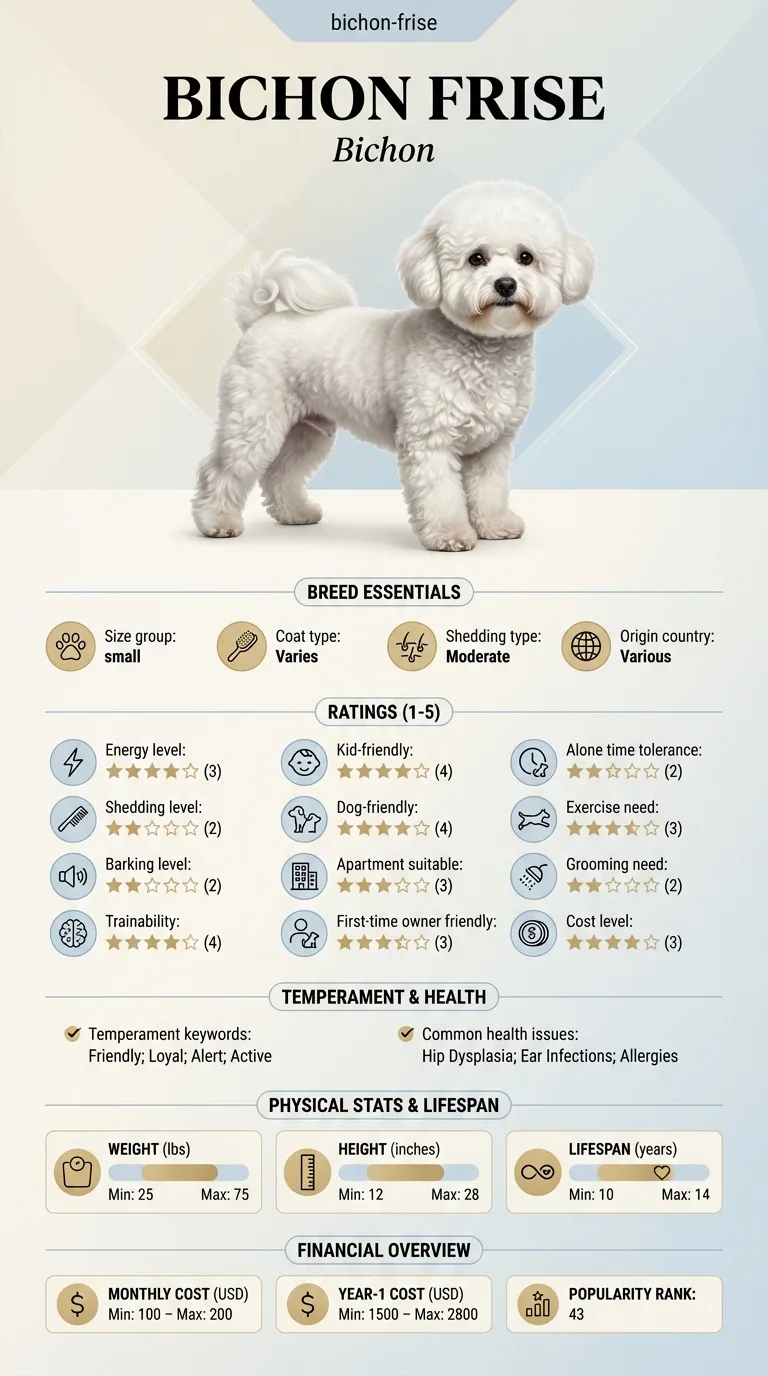
Small body size is the shared feature of the breeds where congenital shunts cluster, and the Bichon Frise falls in that size band at 12 to 18 pounds. Beyond size, there is no documented Bichon predisposition, and inventing one would misrepresent the evidence. The breed's own list of concerns runs to skin allergies, patellar luxation, bladder stones, cataracts and dental disease. The bladder stone entry is the one point of genuine overlap, since shunted dogs form a particular stone type of their own.
The abnormal vessel is present from birth and no household factor creates it. Diet, however, strongly modulates how bad the signs are: a high protein load produces more of the compounds the liver is failing to filter. Meal timing and portion size therefore change how a dog feels hour to hour. Constipation and dehydration also raise ammonia absorption, which is why the management plan attends to both.
Seizures, collapse, blindness that comes and goes, persistent head pressing against walls or furniture, or a dog that cannot be roused properly are emergencies and need veterinary attention immediately. Straining to urinate with nothing produced is also urgent, given the stone risk. Book within days for a puppy that is failing to grow, that seems dull or disoriented after meals, that vomits repeatedly, or that recovered unusually slowly from a sedation. Mention any suspicion of liver involvement before any anaesthetic is scheduled.
See all Bichon Frise health problems, which breeds are prone to liver shunts, or the full Bichon Frise breed guide for temperament, exercise needs and ownership costs.
Diagnosis usually takes a few weeks from first suspicion to imaging. Surgical closure is often staged, with the vessel narrowed gradually over months rather than tied off at once, so the liver can adapt. Dogs managed medically stabilise within days to weeks of starting diet and medication and then continue indefinitely.
A dog that grows to a normal size for the breed, has no post-meal episodes, tolerates anaesthesia normally, and either needs no medication after surgery or is stable on a consistent regime. For a puppy diagnosed early, success is a genuinely normal life expectancy.
The clue that separates a shunt from almost anything else is timing. Digesting a meal releases a wave of protein breakdown products, including ammonia, into the portal blood. In a normal dog these are processed by the liver within minutes. In a shunted dog they travel unfiltered to the brain.
The result is a cluster of neurological signs appearing one to three hours after eating and easing again several hours later. Owners describe a puppy that goes blank, stares, circles, presses its head against furniture, becomes wobbly, or in more severe cases has a seizure. Between episodes the dog can seem entirely normal, which is exactly why the problem gets dismissed.
Second-tier signs are less dramatic and easier to miss. Shunted dogs are often the runt: smaller than littermates, slow to gain, with a poor coat. Many drink and urinate more than expected. Some develop a particular type of urinary stone, because the compounds the liver should have processed end up crystallising in urine instead.
An adverse reaction to sedation or anaesthesia is another classic presentation. Drugs that the liver normally clears hang around far longer, so a routine neuter turns into a puppy that will not wake up properly.

Ordinary blood work hints at the problem but does not prove it. The pathway usually runs in this order.
Nico was the smallest of his litter and stayed that way. His owner Aisha noticed he became strangely quiet each evening, sometimes standing with his forehead against the skirting board, and assumed he was simply tired after a long day. The pattern only became obvious when she started writing down times. The episodes began roughly ninety minutes after his evening meal, every time. Her vet ran a bile acid test on that description alone. It came back markedly abnormal, imaging found a single vessel outside the liver, and Nico had it closed surgically at seven months. He gained two pounds in the following three months and the evening episodes stopped entirely.
Key takeaway: The diagnosis lived in the timing, not the symptom. Writing down when odd behaviour happens turns a vague worry into a testable question.
Congenital shunts are recognised in a number of small breeds, particularly the Yorkshire Terrier and Maltese. The Bichon Frise is not among the breeds most cited for it, and it does not appear on the breed's documented health list. It remains worth considering in any small-breed puppy failing to thrive.
Congenital shunts usually declare themselves in the first year, often within the first few months as the puppy starts eating more protein. Milder cases can go unrecognised into adulthood and only surface when an anaesthetic or an illness exposes the reduced liver function.
Not quite. The liver tissue in a shunted dog is often structurally sound but underdeveloped, because it has been starved of the blood flow that stimulates its growth. That distinction matters, because correcting the blood flow can allow the liver to grow and function properly.
Surgical closure of an abnormal vessel outside the liver has good outcomes in many dogs, and some go on to need no long-term medication. Shunts inside the liver are technically harder and results are more variable. Some dogs are managed medically instead, with diet and medication controlling the toxin load.
Typically a diet formulated to reduce the protein load reaching the circulation, plus prescribed medication to limit ammonia production and absorption in the gut. It controls signs rather than correcting the anatomy, and it is a lifelong regime rather than a course.
No. Congenital shunts have a heritable component in affected breeds, and a diagnosis is worth reporting back to the breeder even though it is an uncomfortable conversation. It is information that protects future litters.
Neurological dullness, staring or wobbliness appearing one to three hours after a meal, then resolving.
Poor growth has many causes, but persistent failure to thrive in a small-breed puppy justifies a bile acid test.
Advanced imaging plus specialist surgery is one of the larger bills in small animal medicine, with lifelong diet costs if managed medically.
Many can after successful surgery. Medically managed dogs live well too, but need a strictly controlled diet and routine.
Always. Reduced liver function changes how drugs are cleared, and the anaesthetic protocol needs adjusting accordingly.
A one-page prep sheet for this condition: the signs, the questions to ask, what to get priced. Unlocks here.
You get: Vet visit prep sheet
No spam. One-click unsubscribe. See our privacy policy.
Preview page 1 before you decide.