Health
What is the difference between IVDD Type I and Type II?
Type I bursts suddenly and is an emergency. Type II bulges slowly over months and presents as gradual weakness.

Quick answer
What is the difference between IVDD Type I and Type II?
Type I bursts suddenly and is an emergency. Type II bulges slowly over months and presents as gradual weakness.
Type I is not a condition you manage over months. It is a clock. The interval between the dog losing function and reaching a surgeon is the single strongest predictor of whether it walks again.
Anyone whose small dog has just gone from normal to unable to stand, and owners of Bichons who want to know what this diagnosis would actually involve if it ever happened to them.
This guide is not medical advice. If your dog shows pain, sudden behavior change, or worsening symptoms, consult a licensed veterinarian.
Some links may be affiliate links. We may earn a commission at no extra cost to you. We only suggest products we believe are helpful for dog owners.
We research and check what we publish, but we do not warrant that any figure, date, price, or statement is accurate, complete, or current, and we accept no liability for any loss, cost, injury, or other harm arising from the use of this site. Use it as one reference among several. You remain responsible for your own decisions and for your dog's care - confirm anything that matters with a licensed veterinarian or another qualified professional before you act on it. Full disclaimer.
Type I disc herniation is one of the few genuinely time-critical orthopaedic emergencies in small animal practice. It presents as sudden severe pain or sudden hind-limb failure in a dog that was normal that morning. For a Bichon Frise owner the value of understanding it is preparedness rather than expectation, because the breed is not predisposed and the response depends entirely on acting fast if it ever happens.
Among dwarfed long-backed breeds this accounts for a substantial share of all spinal emergencies, and specialist hospitals see it constantly. Across breeds without that skeletal trait it is uncommon, and the Bichon Frise sits in the uncommon group. Most Bichon owners will never encounter it, which is exactly why the signs are easy to miss when they do appear.
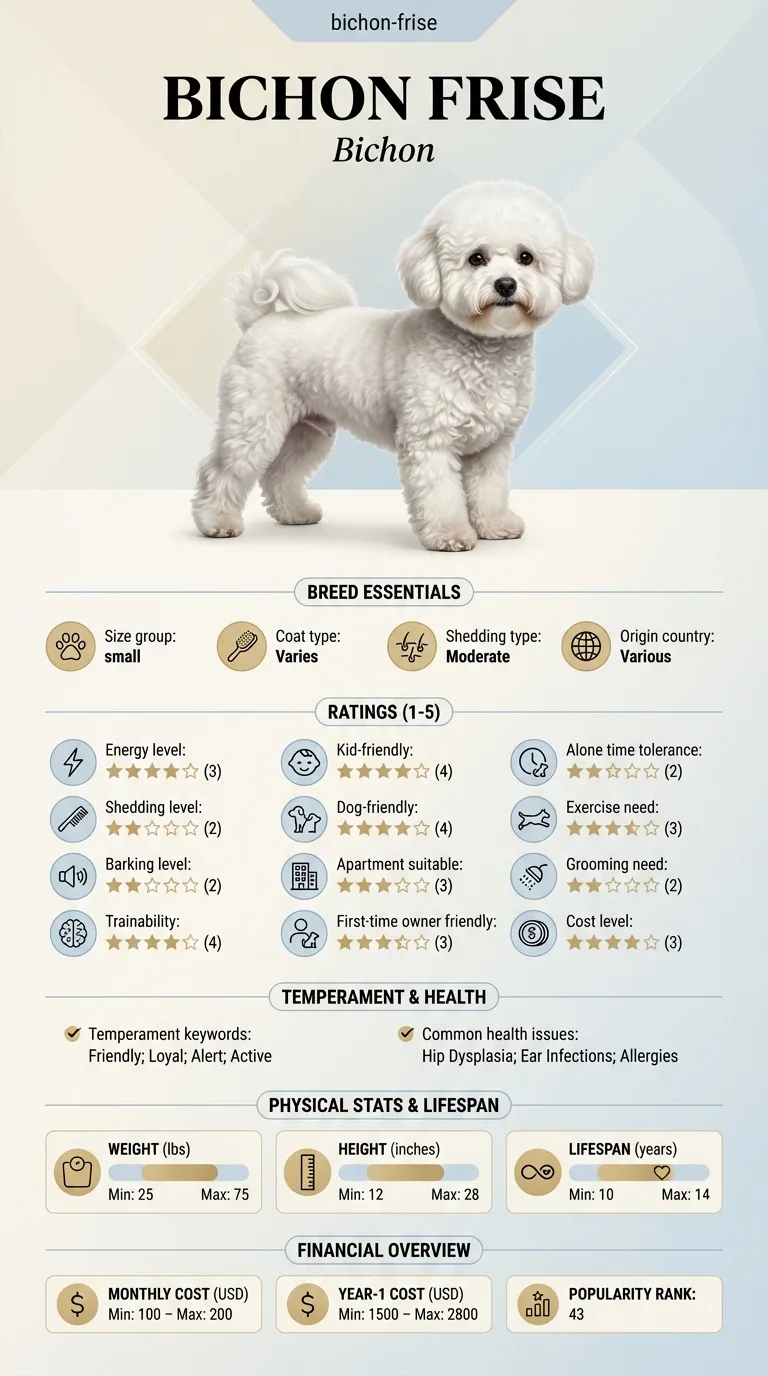
The mechanism that drives Type I is early mineralisation of the disc's soft centre, which turns a shock absorber into something closer to a stone. That process is tied to the cartilage development variant carried by breeds bred for short legs. The Bichon Frise, at nine to twelve inches with proportionate limbs and a compact square frame, does not carry that pattern, and disc disease is absent from its recognised health concerns. Its 12 to 18 pound weight also means less force passes through the spine during ordinary movement.
For any dog, the physical setup of the home determines how much sudden loading the spine experiences. Repeated landings from high furniture, uncarpeted floors that cause slips, and stairs taken at speed all contribute. Excitement is an underrated factor: a dog that launches off a bed at a doorbell generates far more force than one that walks down a ramp, and Bichons are a notably enthusiastic breed at the front door.
Go immediately, at any hour, for hind legs that suddenly cannot bear weight, paws that knuckle over or drag, a wobbling uncoordinated gait, inability to urinate, or a dog screaming when touched or moved. These are emergencies where the delay itself worsens the outcome. Same-day attention is also warranted for a suddenly hunched, trembling dog that will not settle, even if it is still walking. Do not give human pain medication while you wait, and do not encourage the dog to walk to see how bad it is.
See all Bichon Frise health problems, which breeds are prone to intervertebral disc disease ivdd type i, or the full Bichon Frise breed guide for temperament, exercise needs and ownership costs.
Decisions happen in hours. Surgery, when indicated, is usually the same day or the next. Confinement then runs four to six weeks, and structured rehabilitation two to four months. Owners consistently underestimate the confinement phase, which is the hardest part of the whole process to deliver properly.
A dog walking unaided, continent, and free of pain, even if it is slower or less agile than before. In a breed like the Bichon, the more realistic definition of success is that the emergency never occurs and the household simply has the habits and phone numbers in place.
The numbering is not a severity scale. It describes two different failure mechanisms with different speeds, different age profiles and different treatment logic.
If your dog suddenly cannot use its hind legs, the goal is to prevent further movement of the injured segment while you get to help.
Keep the dog still. Do not encourage it to walk to test whether it can. Carry it as a single unit with one hand supporting the chest and the other under the hindquarters so the spine stays level, or slide a rigid tray or board underneath and lift that. A small dog like a Bichon is easy to move badly precisely because it is light enough to scoop up with one arm.
Phone ahead. A practice that knows a suspected spinal case is arriving can prepare and, crucially, can tell you whether to come to them or to drive straight to a referral centre with imaging and a surgeon available. Losing two hours at a practice that then refers you is time the spinal cord does not get back.
Do not give any human painkiller. Several are toxic to dogs, and some anti-inflammatory drugs complicate the steroid decisions a specialist may need to make.
One piece of information will be asked for immediately: can the dog feel its toes. Do not test this by pinching hard yourself, but do note whether the dog reacts to its feet being touched, and whether it has urinated normally.

After a friend's Dachshund went through spinal surgery, Rachel decided to prepare rather than worry. She saved her nearest twenty-four hour referral hospital's number, moved a rigid baking tray to the front of a low cupboard, and put a step beside the bed her Bichon, Alfie, used. Alfie never had a spinal problem. What did happen, at eleven, was that he slipped badly on the kitchen tiles and could not get up for several minutes. Rachel slid him onto the tray, carried him to the car flat, and had him assessed within forty minutes. It turned out to be a soft tissue strain and he was fine in a week. She has kept the tray where it is.
Key takeaway: Preparation for a spinal emergency costs almost nothing and is useful in every scenario where a small dog suddenly cannot get up, whatever the eventual diagnosis.
It can, but it is not a breed where this is expected. Type I is overwhelmingly a disease of dogs carrying the dwarfing cartilage trait, which produces early disc mineralisation. The Bichon has normal limb proportions and the condition is absent from its documented health list.
For a dog that has lost the ability to walk, surgical decompression is generally regarded as most effective within the first day or so, and sooner is better throughout that window. For a dog that has lost deep pain sensation, the urgency is measured in hours.
Expect several weeks of confinement followed by a structured rehabilitation programme lasting a few months. Bladder management is often part of early aftercare. Many dogs regain good function, but full return to previous athleticism is not guaranteed.
No. Dogs with pain but no neurological deficit are frequently managed with strict confinement and veterinary pain control, and many do well. The decision hinges on how much function has been lost, which is a neurological examination finding rather than an owner judgement.
Yes. Other discs in the same spine can extrude later, particularly in breeds where the underlying mineralisation affects many discs at once. In a non-predisposed breed like the Bichon, a second unrelated event is less likely but not impossible.
Say so at the clinic straight away rather than declining silently. Conservative management is a legitimate path for some cases, and a vet who knows the constraint can plan around it. Withholding that information usually leads to worse decisions for the dog.
Type I bursts suddenly and is an emergency. Type II bulges slowly over months and presents as gradual weakness.
Support chest and hindquarters together so the back stays level, or lift the dog on a rigid board or tray.
Yes. Advanced imaging plus surgery and hospitalisation at a referral centre is one of the largest bills in small animal practice.
Almost certainly, for several weeks. Set it up in a room the family uses so confinement does not also mean isolation.
Replace physical activity with licking mats, scent games and short training in place, which tire a dog without movement.
A one-page prep sheet for this condition: the signs, the questions to ask, what to get priced. Unlocks here.
You get: Vet visit prep sheet
No spam. One-click unsubscribe. See our privacy policy.
Preview page 1 before you decide.