Living
Bichon Frise or Great Dane for a first-time owner?
Bichon Frise, rated high (4/5) versus the Great Dane's low (2/5).

Quick answer
Bichon Frise or Great Dane for a first-time owner?
Bichon Frise, rated high (4/5) versus the Great Dane's low (2/5).
Bichon Frise or Great Dane? On paper they differ most on grooming need, and on the scales Great Dane is the heavier at 110–175 lbs. Here is how the two compare on everything that shapes an ordinary week.
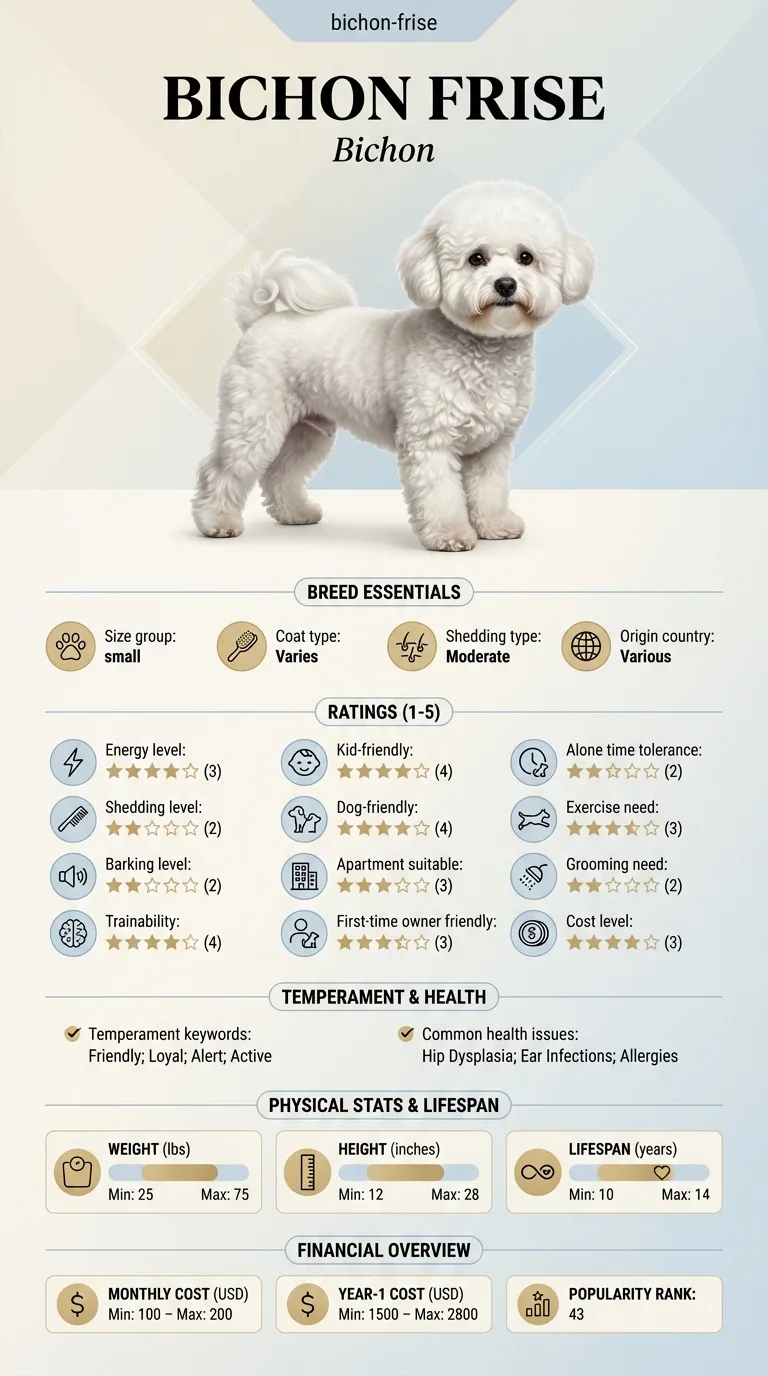
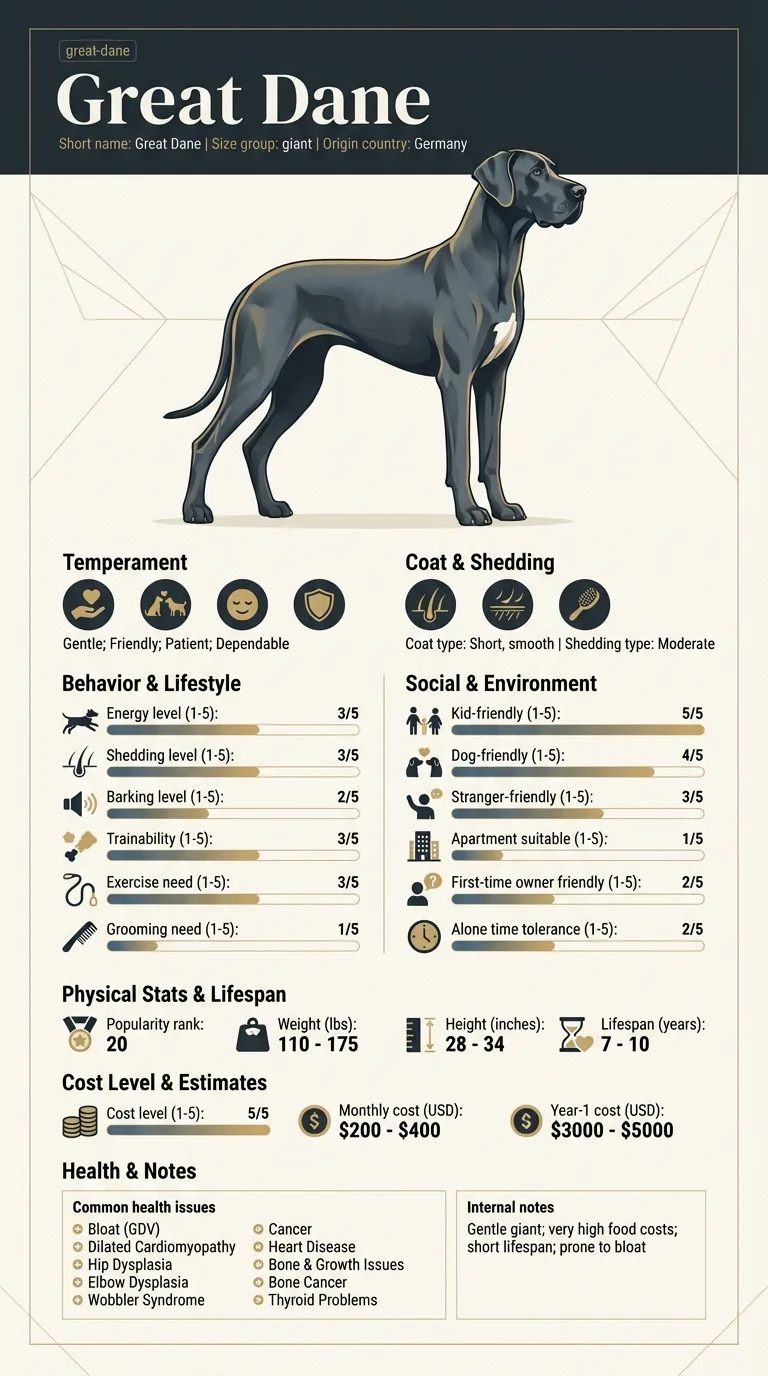
This is for someone already down to Bichon Frise and Great Dane and deciding between them. For this pair the decision usually turns on grooming need and apartment suitability, so those are covered first and in most detail. Anyone choosing from a flat has a clear answer here: Bichon Frise rates 5/5 against 1/5. Breed history is left out; what follows is what you will actually live with.
Between Bichon Frise and Great Dane, grooming need is what separates them, and Bichon Frise is the lower-effort dog of the two to keep.
Choose Bichon Frise if you are in a flat or a smaller home, this is your first dog and shedding is a problem in your house.
Choose Great Dane if you do not want a standing grooming appointment, there are young children at home and you want a dog that can keep up with an active routine.
| Feature | bichon frise | great dane | Winner |
|---|---|---|---|
| Size class | small | giant | Equal |
| Weight | 12–18 lbs | 110–175 lbs | Equal |
| Height | 9–12 in | 28–34 in | Equal |
| Lifespan | 14–15 years | 7–10 years | bichon frise |
| Exercise need | Low (2/5) | Moderate (3/5) | bichon frise |
| Grooming need | Very high (5/5) | Very low (1/5) | great dane |
| Shedding | Very low (1/5) | Moderate (3/5) | bichon frise |
| Energy level | Moderate (3/5) | Moderate (3/5) | Equal |
| Barking | Moderate (3/5) | Low (2/5) | great dane |
| Apartment suitability | Very high (5/5) | Very low (1/5) | bichon frise |
| Good for first-time owners | High (4/5) | Low (2/5) | bichon frise |
| Tolerates being alone | Low (2/5) | Low (2/5) | Equal |
| Trainability | Moderate (3/5) | Moderate (3/5) | Equal |
| Good with kids | High (4/5) | Very high (5/5) | great dane |
| Good with other dogs | High (4/5) | High (4/5) | Equal |
| Friendly to strangers | High (4/5) | Moderate (3/5) | bichon frise |
| Cost level | Moderate (3/5) | Very high (5/5) | bichon frise |
| Coat | Curly, dense double coat | Short, smooth | Equal |
| Origin | Various | Germany | Equal |
| Typical monthly cost | $80–$150 | $200–$400 | Equal |
| Typical first-year cost | $1,100–$2,300 | $3,000–$5,000 | Equal |
Few comparisons on this site feature a gap this dramatic: the Great Dane stands 28-34 inches and weighs 110-175 lbs, against the Bichon Frise's 9-12 inches and 12-18 lbs; the Dane can outweigh the Bichon by a factor of ten. This is a genuine giant breed, one of the tallest dogs recognized, next to one of the smallest popular companion breeds. Practical consequences follow immediately: furniture, car size, doorway clearance, and even the size of food and water bowls all need reconsidering with a Great Dane in a way they simply don't with a Bichon.
Despite its size, the Great Dane's exercise need rates only moderate (3/5), and its energy level ties with the Bichon at moderate (3/5); giant breeds are often surprisingly low-key indoors, more interested in lounging than running. The Bichon's exercise need rates lower still at low (2/5). This is a case where size doesn't predict activity level: a Great Dane's real exercise needs are closer to a Bichon's than most people expect, though its size means even moderate exercise, like a daily walk, takes more physical effort to manage on a leash than walking a 15 lb dog.
Coat care flips dramatically in the Dane's favor: very low (1/5) grooming for its short, smooth coat versus the Bichon's very high (5/5) demands from a curly double coat requiring regular trims. Shedding tells a different story, though; the Dane sheds at a moderate (3/5) level, more than the Bichon's very low (1/5), just spread across a much larger body surface. In practical terms, a Great Dane needs almost no styling but leaves noticeably more hair around a home than its low shedding number alone might suggest, given how much more coat area it's shedding from.
Both breeds carry a very low (1/5) apartment suitability rating for the Great Dane against the Bichon's very high (5/5), but for different reasons than energy alone. A Great Dane simply takes up enormous physical space; even a calm, moderate-energy giant breed needs room to turn around, stretch out, and move without constantly bumping into furniture or people. Barking favors the Dane, rated low (2/5) versus the Bichon's moderate (3/5); when a Great Dane does bark, it's memorably loud, but it does so less often. Both breeds share the same low (2/5) tolerance for being left alone.
Trainability ties at moderate (3/5) for both breeds, so neither has a decisive edge in how readily it picks up commands. Where they differ sharply is first-time-owner suitability: the Bichon rates high (4/5) while the Great Dane rates low (2/5), reflecting the real challenge of managing a 100+ lb dog's leash manners, jumping habits, and sheer physical strength as a puppy grows into its full size. A Great Dane puppy that isn't well-managed during its growth phase can become genuinely difficult to handle, which is why experienced owners are typically recommended for this breed.
The Great Dane rates very high (5/5) with kids, a step above the Bichon's high (4/5); this breed's famous gentle-giant reputation holds up in the data, often nicknamed a nanny dog for its patience with children despite its size. Both breeds tie at high (4/5) with other dogs. Friendliness to strangers favors the Bichon, high (4/5) versus the Dane's moderate (3/5); a Great Dane's imposing size alone can make it seem standoffish to visitors even when its temperament is genuinely friendly, so early socialization matters more for managing first impressions than for correcting actual aggression.
This is where the Great Dane's size becomes a real liability: its lifespan of just 7-10 years is markedly shorter than the Bichon's 14-15, and giant breeds are especially prone to bloat (GDV), a life-threatening emergency that tops the Dane's ten-condition health list alongside dilated cardiomyopathy, wobbler syndrome (a spinal condition), and bone cancer. The Bichon's five conditions, skin allergies, patellar luxation, bladder stones, cataracts, dental disease, are far less life-threatening by comparison. Great Dane owners should learn bloat's warning signs before bringing a puppy home and discuss preventive gastropexy surgery with their vet.
Cost differences here are the largest in this batch: the Dane rates very high (5/5) on cost level versus the Bichon's moderate (3/5), with monthly spending of $200-400 against $80-150, and first-year costs of $3,000-5,000 versus $1,100-2,300. Food alone for a 110-175 lb dog is substantial, and giant-breed-specific veterinary needs, from bloat surgery risk to joint support, add up further. Even basics like a crate, bed, and car harness cost more at Great Dane scale. Anyone drawn to this breed should budget at least double what a Bichon would cost in year one.
Bichon Frise weighs 12–18 lbs and lives 14–15 years; Great Dane weighs 110–175 lbs and lives 7–10 years. The two diverge most on grooming need, apartment suitability and shedding and 2 other rated axes. They are level on tolerates being alone, good with other dogs and energy level, so those cannot decide it. The comparison marks an easier option only where one exists. Facts like weight and country of origin are not scored. Both dogs are rated from the same dataset, which is what makes the numbers comparable with each other even though any individual dog sits somewhere inside its breed's range.

Often, yes; its exercise need rates only moderate (3/5) and its energy level ties with the Bichon Frise at moderate (3/5), so a Great Dane's real day-to-day activity needs are closer to a small breed's than most people assume.
Giant breeds generally live shorter lives, and the Dane's 7-10 year average reflects a health list topped by bloat (GDV), dilated cardiomyopathy, and bone cancer, all conditions size-related stress on the body contributes to.
Yes, rated very high (5/5), a step above even the Bichon Frise's high (4/5) rating, and the breed has a long-standing reputation for gentle patience with children.
Expect $3,000-5,000, versus $1,100-2,300 for a Bichon Frise; food volume and giant-breed veterinary care are the main drivers.
Bloat (GDV) is a life-threatening stomach emergency that disproportionately affects deep-chested large and giant breeds like the Great Dane; it tops the breed's health list and owners should know the warning signs and discuss preventive surgery with a vet.
It's rated very low (1/5) on apartment suitability versus the Bichon's very high (5/5); even a calm giant breed needs substantial physical space to move comfortably.
The Great Dane, rated moderate (3/5) versus the Bichon's very low (1/5), though it needs far less grooming maintenance overall thanks to its short coat.
Bichon Frise, rated high (4/5) versus the Great Dane's low (2/5).
The Bichon Frise by a wide margin, 14-15 years versus the Great Dane's 7-10.
The Great Dane, rated very low (1/5) versus the Bichon's very high (5/5).
The Great Dane, roughly $3,000-5,000 in year one versus $1,100-2,300 for the Bichon.
Secure checkout on Stripe. We never see your card.
7-day money-back guarantee. Instant access.
Health information here is general and is not veterinary advice. If your dog shows pain, sudden behaviour change, or worsening symptoms, consult a licensed veterinarian.
Some links on this site are affiliate links. We may earn a commission at no extra cost to you, and we only suggest products we believe are helpful for dog owners.
We research and check what we publish, but we do not warrant that any figure, date, price, or statement is accurate, complete, or current, and we accept no liability for any loss, cost, injury, or other harm arising from the use of this site. Use it as one reference among several. You remain responsible for your own decisions and for your dog's care - confirm anything that matters with a licensed veterinarian or another qualified professional before you act on it. Full disclaimer.
Match your lifestyle to the right dog.
Take quizNot sure which breed is right for you? Take our 2-minute quiz to find out.
Take the quiz