Behavior
Which barks less?
The Bichon Frise, Moderate (3/5) versus the Schnauzer's High (4/5).

Quick answer
Which barks less?
The Bichon Frise, Moderate (3/5) versus the Schnauzer's High (4/5).
Bichon Frise or Miniature Schnauzer? On paper they differ most on exercise need, and on the scales Miniature Schnauzer is the heavier at 11–20 lbs. Here is how the two compare on everything that shapes an ordinary week.
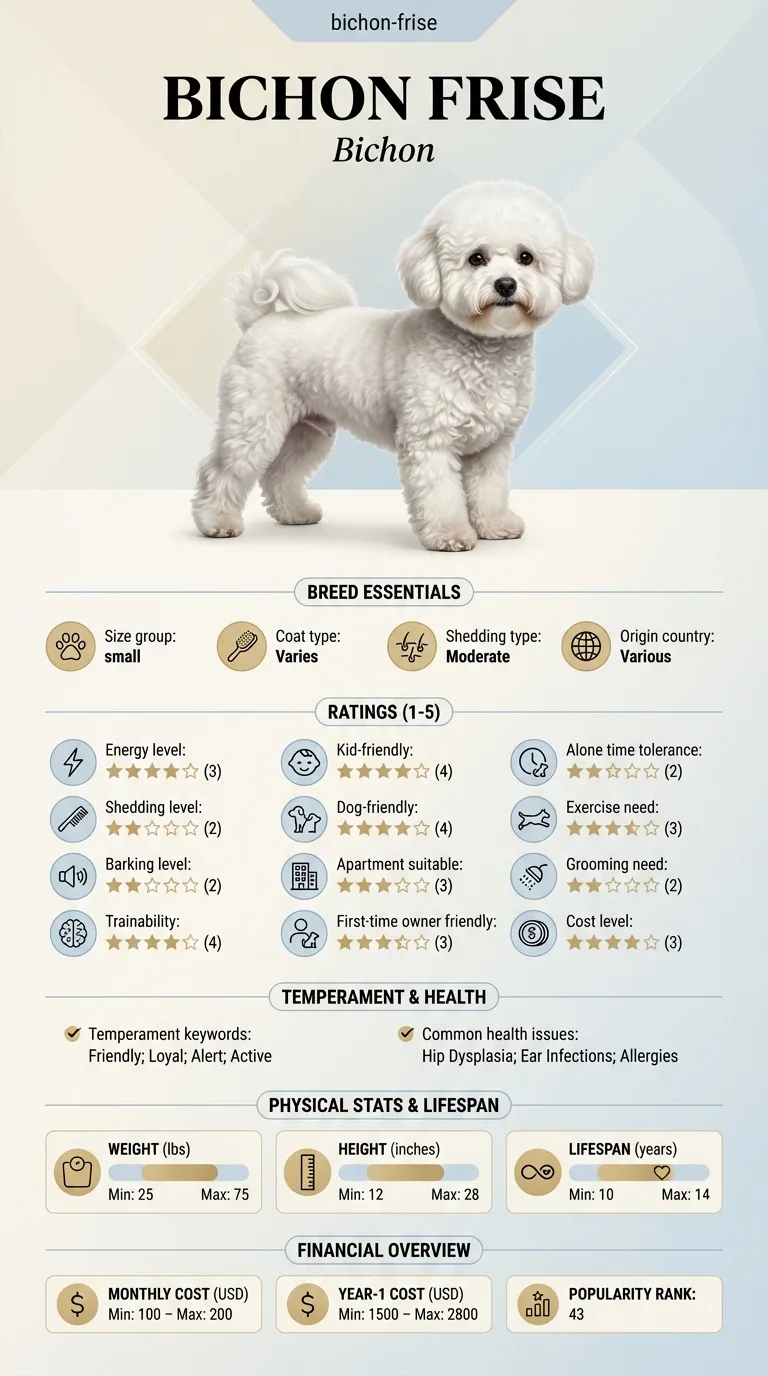
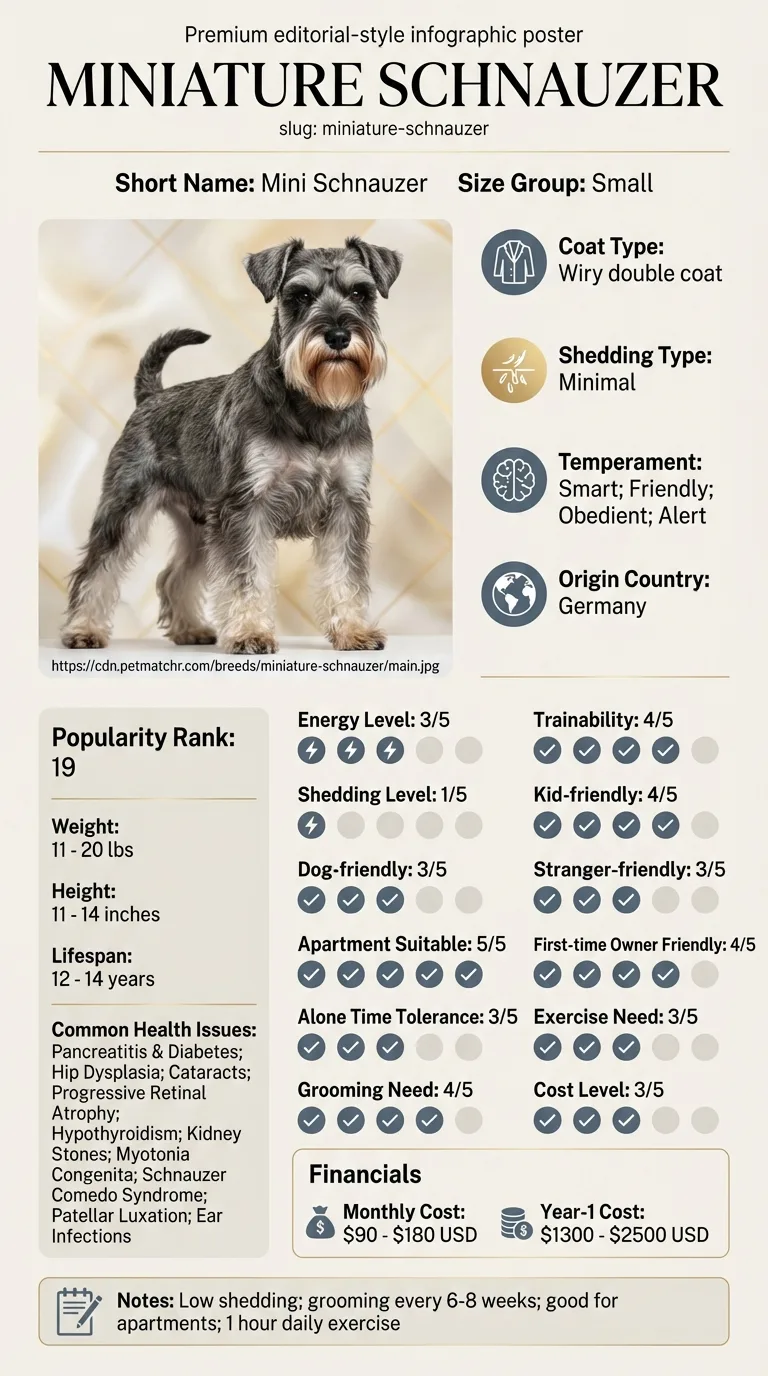
This is for someone already down to Bichon Frise and Miniature Schnauzer and deciding between them. Because the two are so evenly matched, the page works through every axis rather than leading with one. Both rate 5/5 for flats, so housing does not settle this one. It is written for the decision rather than the breed history.
Between Bichon Frise and Miniature Schnauzer, they are closer than most pairings, and the choice comes down to temperament, and Miniature Schnauzer is the lower-effort dog of the two to keep.
Choose Bichon Frise if your walking routine is modest, you already have another dog and a smaller dog suits your car, your home or your back.
Choose Miniature Schnauzer if you do not want a standing grooming appointment, the dog will be alone during the working day and you want a dog that picks up training quickly.
| Feature | bichon frise | miniature schnauzer | Winner |
|---|---|---|---|
| Size class | small | small | Equal |
| Weight | 12–18 lbs | 11–20 lbs | Equal |
| Height | 9–12 in | 11–14 in | Equal |
| Lifespan | 14–15 years | 12–14 years | bichon frise |
| Exercise need | Low (2/5) | Moderate (3/5) | bichon frise |
| Grooming need | Very high (5/5) | High (4/5) | miniature schnauzer |
| Shedding | Very low (1/5) | Very low (1/5) | Equal |
| Energy level | Moderate (3/5) | Moderate (3/5) | Equal |
| Barking | Moderate (3/5) | High (4/5) | bichon frise |
| Apartment suitability | Very high (5/5) | Very high (5/5) | Equal |
| Good for first-time owners | High (4/5) | High (4/5) | Equal |
| Tolerates being alone | Low (2/5) | Moderate (3/5) | miniature schnauzer |
| Trainability | Moderate (3/5) | High (4/5) | miniature schnauzer |
| Good with kids | High (4/5) | High (4/5) | Equal |
| Good with other dogs | High (4/5) | Moderate (3/5) | bichon frise |
| Friendly to strangers | High (4/5) | Moderate (3/5) | bichon frise |
| Cost level | Moderate (3/5) | Moderate (3/5) | Equal |
| Coat | Curly, dense double coat | Wiry double coat | Equal |
| Origin | Various | Germany | Equal |
| Typical monthly cost | $80–$150 | $90–$180 | Equal |
| Typical first-year cost | $1,100–$2,300 | $1,300–$2,500 | Equal |
Weight ranges actually overlap here — a Bichon Frise runs 12–18 lbs while a Miniature Schnauzer spans 11–20 lbs — so a big Schnauzer and a small Bichon could weigh about the same. Height tells a slightly different story: the Schnauzer's 11–14 inch frame sits a bit taller and more square than the Bichon's 9–12 inch, fluffier profile. Both are firmly in the small size class, and neither will strain a leash arm or dominate a small living room. The real visual distinction owners notice isn't mass, it's shape — the Schnauzer's wiry, bearded look next to the Bichon's rounded powder-puff silhouette.
Exercise need is one of the clearer splits on this comparison: the Bichon Frise rates Low (2/5) while the Miniature Schnauzer rates Moderate (3/5), meaning the Schnauzer generally wants a bit more structured walking or yard time to stay settled. Energy level ties at Moderate (3/5) for both, so neither breed is a couch potato, but the Schnauzer's terrier ancestry tends to show up as busier, more purposeful movement — digging, patrolling, chasing — versus the Bichon's more playful, attention-seeking bounce. A Schnauzer left under-exercised is more likely to channel that energy into barking or mischief than a similarly under-exercised Bichon.
Shedding is a dead heat — both breeds rate Very Low (1/5), making them popular picks among allergy-conscious households. Grooming effort is close but not identical: the Bichon Frise edges into Very High (5/5) territory thanks to its dense curly double coat, while the Miniature Schnauzer sits at High (4/5), needing regular hand-stripping or clipping to maintain its wiry texture and signature beard and eyebrows. In practice, both breeds are professional-groomer regulars every four to six weeks, and skipping sessions leads to matting on the Bichon and an overgrown, scruffy look on the Schnauzer rather than loose fur drifting across the floor.
Both breeds tie at Very High (5/5) for apartment suitability, so square footage isn't the deciding factor between them. Noise is where they part ways: the Miniature Schnauzer rates High (4/5) on barking, a step up from the Bichon Frise's Moderate (3/5), and Schnauzers are known for sounding an alarm at every hallway noise or delivery knock — a real consideration for thin-walled buildings. Alone time also favors the Schnauzer slightly, Moderate (3/5) tolerance versus the Bichon's Low (2/5), meaning a Bichon left solo for a full workday is more likely to develop anxious habits than a Schnauzer in the same situation.
Both breeds are rated High (4/5) for first-time owners, so neither should intimidate a newcomer to dog ownership. Trainability is where the Miniature Schnauzer pulls ahead, High (4/5) against the Bichon Frise's Moderate (3/5) — consistent with the Schnauzer's Smart, Obedient, Alert temperament tags versus the Bichon's more free-spirited Playful, Curious profile. In practice this often means the Schnauzer picks up commands and routines faster, while the Bichon needs more patience and repetition, particularly around distractions. Neither is a difficult breed to live with, but an owner who wants a quick study for obedience work will likely find the Schnauzer more responsive.
Kids are a tie, both breeds rated High (4/5), so families with children can reasonably consider either. The Bichon Frise pulls ahead with other dogs (High 4/5 vs Moderate 3/5) and with strangers (High 4/5 vs Moderate 3/5), reflecting its outgoing Cheerful, Affectionate nature against the Schnauzer's more Alert, watchful temperament — a trait that makes the Schnauzer a better natural watchdog but a slightly more reserved greeter. Households that host frequently or run a multi-dog home may find the Bichon's easy sociability the smoother fit, while a Schnauzer's Friendly-but-Alert combination suits owners who want a dog to notice when someone's at the door.
The Bichon Frise's 14–15 year lifespan edges out the Miniature Schnauzer's 12–14 years, and the Schnauzer's health list is notably longer and more breed-specific: pancreatitis and diabetes, hip dysplasia, cataracts, progressive retinal atrophy, hypothyroidism, kidney stones, myotonia congenita, Schnauzer comedo syndrome, patellar luxation, and ear infections. That pancreatitis and diabetes risk in particular means Schnauzer owners need to be strict about fatty table scraps, a dietary discipline the Bichon (facing skin allergies, patellar luxation, bladder stones, cataracts, and dental disease) doesn't share to the same degree. Both breeds carry patellar luxation and cataracts risk, so joint and eye checks are worthwhile screening items for either.
Cost levels tie at Moderate (3/5) for both breeds, and the dollar ranges sit close together too — $80–$150 monthly for the Bichon Frise versus $90–$180 for the Miniature Schnauzer, with first-year totals of roughly $1,100–$2,300 against $1,300–$2,500. The modest premium on the Schnauzer side likely reflects its longer health-issue list, which can mean more diagnostic visits over a lifetime, plus the hand-stripping or specialty clipping some owners choose to preserve its wiry coat texture. Neither breed carries the budget-breaking costs associated with giant breeds; this comparison is really about a $20–$30 monthly difference rather than a fundamentally different financial commitment.
Bichon Frise weighs 12–18 lbs and lives 14–15 years; Miniature Schnauzer weighs 11–20 lbs and lives 12–14 years. No rated axis separates them by more than a single point, which makes this one of the closer pairings on the site. They are level on apartment suitability, cost level and energy level, so those cannot decide it. In the table, a "winner" means easier for an ordinary household — not better. Size, coat and origin are recorded without a verdict. Because both breeds are scored the same way, the gaps are reliable even where the absolute numbers are rough.

The Miniature Schnauzer, rated High (4/5) trainability versus the Bichon's Moderate (3/5). Its Smart, Obedient, Alert temperament tends to make commands stick faster.
Yes. Schnauzers rate High (4/5) on barking against the Bichon's Moderate (3/5), largely due to their alert, watchdog-leaning temperament.
It's a tie — both the Bichon Frise and Miniature Schnauzer rate Very Low (1/5) on shedding despite very different coat textures.
Not necessarily. The Schnauzer's tracked health list is longer, including pancreatitis, diabetes, and kidney stones, though the Bichon has a slightly longer average lifespan (14–15 years versus 12–14).
The Miniature Schnauzer, rated Moderate (3/5) tolerance for being alone versus the Bichon Frise's Low (2/5).
Roughly, since overall cost level ties at Moderate (3/5), though the Bichon's Very High (5/5) grooming need edges out the Schnauzer's High (4/5).
The Bichon Frise, rated High (4/5) versus the Miniature Schnauzer's Moderate (3/5).
The Bichon Frise, Moderate (3/5) versus the Schnauzer's High (4/5).
The Miniature Schnauzer, rated High (4/5) trainability.
The Bichon Frise, 14–15 years versus 12–14 for the Schnauzer.
The Miniature Schnauzer, $90–$180 versus the Bichon's $80–$150.
Secure checkout on Stripe. We never see your card.
7-day money-back guarantee. Instant access.
Health information here is general and is not veterinary advice. If your dog shows pain, sudden behaviour change, or worsening symptoms, consult a licensed veterinarian.
Some links on this site are affiliate links. We may earn a commission at no extra cost to you, and we only suggest products we believe are helpful for dog owners.
We research and check what we publish, but we do not warrant that any figure, date, price, or statement is accurate, complete, or current, and we accept no liability for any loss, cost, injury, or other harm arising from the use of this site. Use it as one reference among several. You remain responsible for your own decisions and for your dog's care - confirm anything that matters with a licensed veterinarian or another qualified professional before you act on it. Full disclaimer.
Match your lifestyle to the right dog.
Take quizNot sure which breed is right for you? Take our 2-minute quiz to find out.
Take the quiz