Living
Which is better for apartments?
The Bichon Frise, rated Very High (5/5) apartment suitability versus the Mastiff's Low (2/5).

Quick answer
Which is better for apartments?
The Bichon Frise, rated Very High (5/5) apartment suitability versus the Mastiff's Low (2/5).
Bichon Frise or Mastiff (English Mastiff)? On paper they differ most on grooming need, and on the scales Mastiff (English Mastiff) is the heavier at 120–250 lbs. Here is how the two compare on everything that shapes an ordinary week.
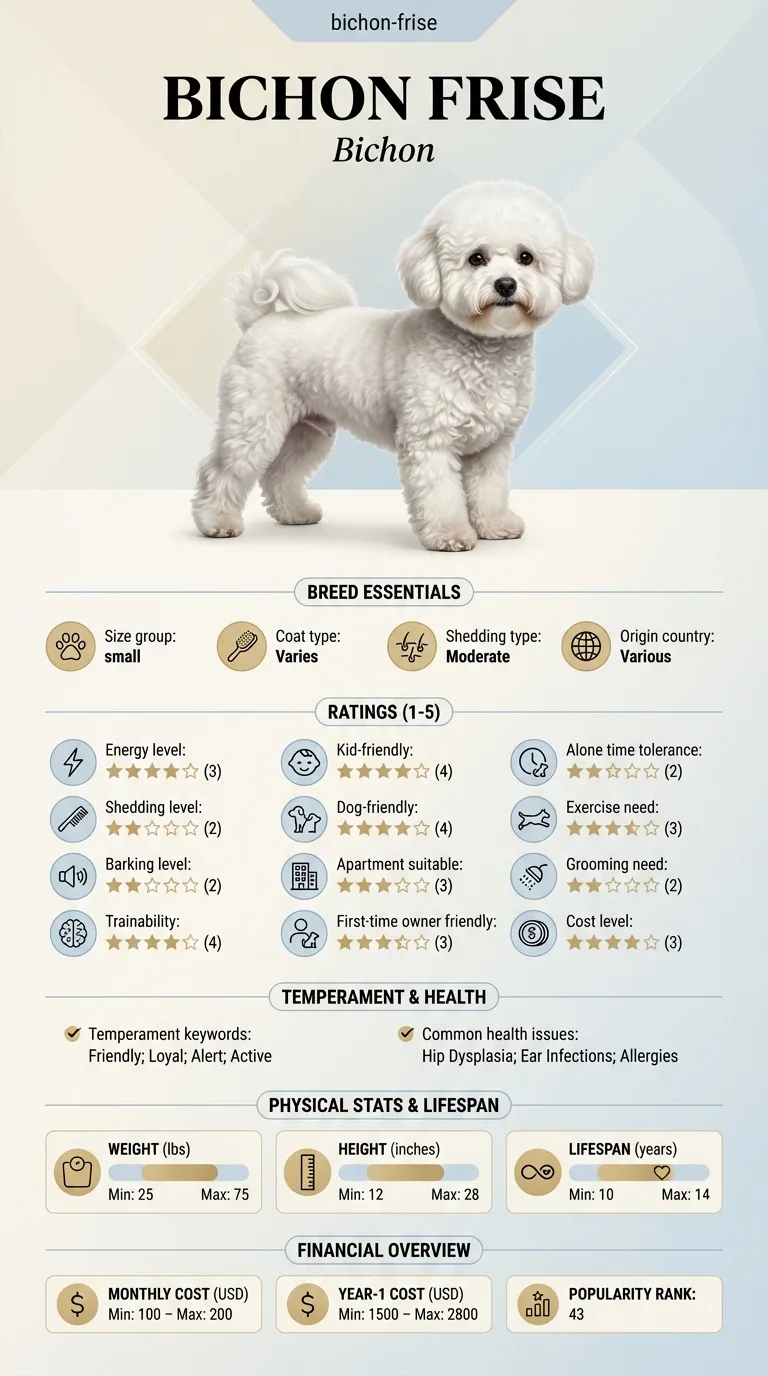
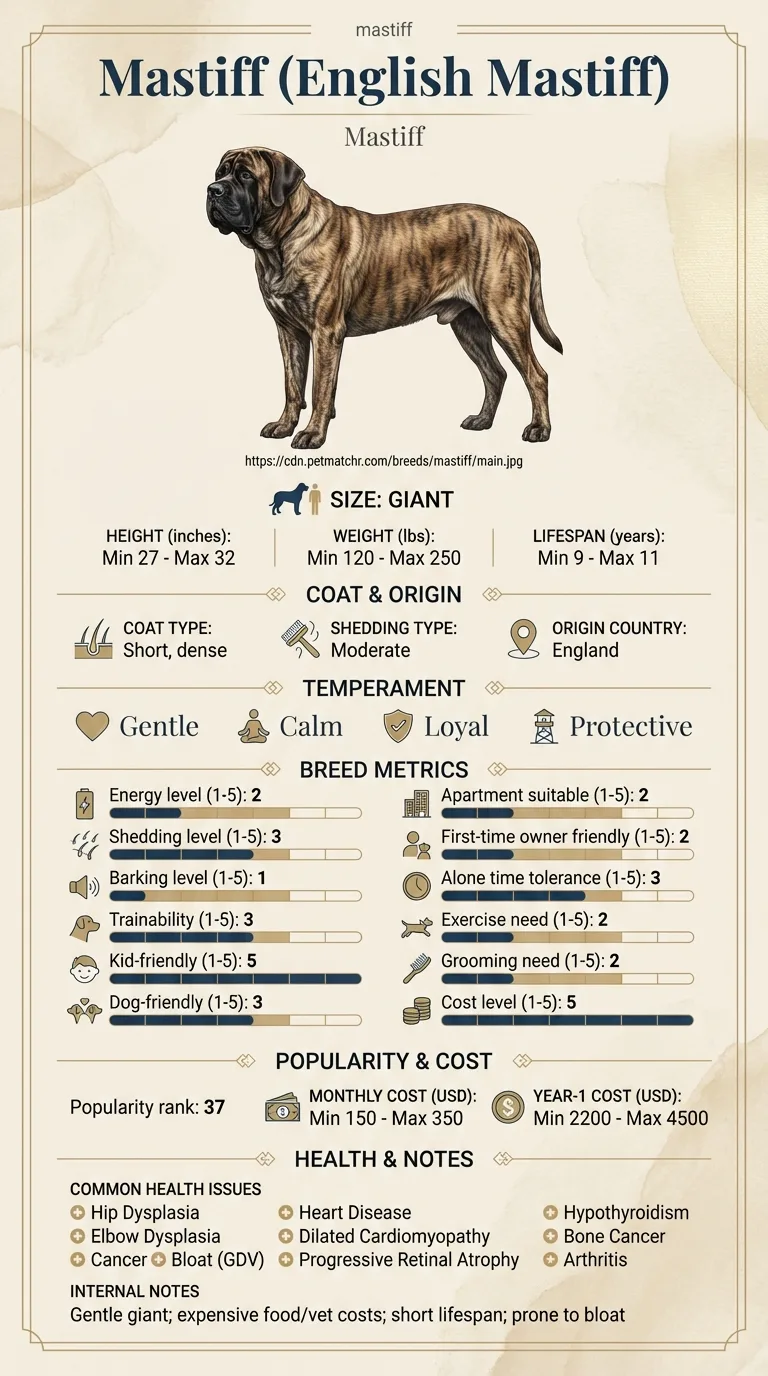
This is for someone already down to Bichon Frise and Mastiff (English Mastiff) and deciding between them. For this pair the decision usually turns on grooming need and apartment suitability, so those are covered first and in most detail. Anyone choosing from a flat has a clear answer here: Bichon Frise rates 5/5 against 2/5. Breed history is left out; what follows is what you will actually live with.
Between Bichon Frise and Mastiff (English Mastiff), grooming need is what separates them, and Bichon Frise is the lower-effort dog of the two to keep.
Choose Bichon Frise if you are in a flat or a smaller home, this is your first dog and shedding is a problem in your house.
Choose Mastiff (English Mastiff) if you do not want a standing grooming appointment, the dog will be alone during the working day and there are young children at home.
| Feature | bichon frise | mastiff | Winner |
|---|---|---|---|
| Size class | small | giant | Equal |
| Weight | 12–18 lbs | 120–250 lbs | Equal |
| Height | 9–12 in | 27–32 in | Equal |
| Lifespan | 14–15 years | 9–11 years | bichon frise |
| Exercise need | Low (2/5) | Low (2/5) | Equal |
| Grooming need | Very high (5/5) | Low (2/5) | mastiff |
| Shedding | Very low (1/5) | Moderate (3/5) | bichon frise |
| Energy level | Moderate (3/5) | Low (2/5) | Equal |
| Barking | Moderate (3/5) | Very low (1/5) | mastiff |
| Apartment suitability | Very high (5/5) | Low (2/5) | bichon frise |
| Good for first-time owners | High (4/5) | Low (2/5) | bichon frise |
| Tolerates being alone | Low (2/5) | Moderate (3/5) | mastiff |
| Trainability | Moderate (3/5) | Moderate (3/5) | Equal |
| Good with kids | High (4/5) | Very high (5/5) | mastiff |
| Good with other dogs | High (4/5) | Moderate (3/5) | bichon frise |
| Friendly to strangers | High (4/5) | Moderate (3/5) | bichon frise |
| Cost level | Moderate (3/5) | Very high (5/5) | bichon frise |
| Coat | Curly, dense double coat | Short, dense | Equal |
| Origin | Various | England | Equal |
| Typical monthly cost | $80–$150 | $150–$350 | Equal |
| Typical first-year cost | $1,100–$2,300 | $2,200–$4,500 | Equal |
The gap here is about as extreme as this site tracks: a Bichon Frise tops out around 18 lbs and 12 inches at the shoulder, while an English Mastiff routinely reaches 120–250 lbs and 27–32 inches, placing it in the giant category outright. Anyone picturing these two side by side should think toy-sized companion versus a dog that can rival a person in height when standing on hind legs. That size difference cascades into everything from doorway clearance to how much floor space a dog bed needs, and it means feeding, medicating, and even lifting an injured dog onto a vet table follow completely different playbooks.
Both breeds are scored Low (2/5) on exercise need, which surprises people who assume a 200-lb dog needs marathon mileage — Mastiffs are famously low-drive once past puppyhood, content with a couple of short walks. Where they diverge is energy level: the Bichon Frise sits at Moderate (3/5), staying playful and bouncy indoors, while the Mastiff's Low (2/5) energy shows up as a dog that would rather flop across the sofa than fetch. A Bichon's exercise needs are easy to meet in a hallway; a Mastiff's low drive is a blessing given its size, but joint issues like hip and elbow dysplasia mean exercise should stay gentle regardless.
Grooming demands flip the expected size correlation on its head. The Bichon Frise carries a curly, dense double coat that needs brushing several times a week plus regular trims to avoid matting, earning a Very High (5/5) grooming score despite shedding almost nothing (1/5). The Mastiff's short, dense coat needs only a weekly brush, rating Low (2/5) on grooming, but it sheds at a Moderate (3/5) clip and drools enough that many owners keep a towel within reach. So the small dog is the higher-maintenance one at the brush, while the giant leaves more hair — and slobber — around the house.
A Bichon Frise scores Very High (5/5) for apartment living and stays fairly vocal at Moderate (3/5) barking, so a thin-walled unit can work but neighbors may hear the occasional outburst. The Mastiff is the opposite on both counts: Low (2/5) apartment suitability simply because of its bulk, paired with Very Low (1/5) barking that makes it a surprisingly quiet giant once settled. Alone time flips things again — the Bichon's Low (2/5) tolerance for solitude means it's prone to separation anxiety, while the Mastiff's Moderate (3/5) rating suggests it copes better left alone, provided there's enough room for it to stretch out.
Trainability scores tie at Moderate (3/5) for both breeds, but the practical experience of training them differs enormously because of scale. A stubborn Bichon Frise is an inconvenience; a stubborn 200-lb Mastiff that decides not to move is a genuine physical challenge, which is likely why the Mastiff rates only Low (2/5) for first-time owners against the Bichon's High (4/5). Mastiffs are also described as Protective, so early socialization and confident leash handling matter more than raw obedience drilling. A first-time owner drawn to the Mastiff's Gentle, Calm reputation should still budget for professional training support given the size stakes involved.
With children, the Mastiff actually edges out the Bichon Frise, Very High (5/5) versus High (4/5), reflecting the breed's famously Gentle and Loyal nature around family — though supervision matters simply because of its size relative to a toddler. The Bichon pulls ahead with other dogs (High 4/5 vs Moderate 3/5) and strangers (High 4/5 vs Moderate 3/5), consistent with its Cheerful, Affectionate temperament versus the Mastiff's more Protective streak, which can make it reserved with unfamiliar visitors. A household that entertains often may find the Bichon's open friendliness easier to manage than a watchful giant breed at the door.
The Bichon Frise's 14–15 year lifespan is nearly 40% longer than the Mastiff's 9–11 years, a gap typical of small-versus-giant comparisons but still stark on paper. The Bichon's health watch list — skin allergies, patellar luxation, bladder stones, cataracts, dental disease — is manageable and rarely life-shortening. The Mastiff's list is longer and heavier: hip and elbow dysplasia, cancer, bloat (GDV), heart disease, dilated cardiomyopathy, progressive retinal atrophy, hypothyroidism, bone cancer, and arthritis. Bloat in particular is an emergency risk unique to deep-chested giants like the Mastiff, and cancer rates run high in the breed, so prospective owners should budget for orthopedic and cardiac screening that a Bichon owner simply won't need.
Monthly costs run $80–$150 for a Bichon Frise against $150–$350 for a Mastiff, and first-year costs tell the same story: roughly $1,100–$2,300 versus $2,200–$4,500. That gap comes from food volume alone — a 200-lb dog eats several times what an 18-lb dog does — plus larger doses for medication, bigger everything from crates to orthopedic beds, and higher spay/neuter and anesthesia costs at the vet. The Bichon rates Moderate (3/5) on overall cost while the Mastiff rates Very High (5/5), and that gap tends to widen with age as the Mastiff's shorter lifespan concentrates cancer and joint-related veterinary bills into fewer years.
Bichon Frise weighs 12–18 lbs and lives 14–15 years; Mastiff (English Mastiff) weighs 120–250 lbs and lives 9–11 years. The two diverge most on grooming need, apartment suitability and shedding and 3 other rated axes. They are level on exercise need and trainability, so those cannot decide it. The comparison marks an easier option only where one exists. Facts like weight and country of origin are not scored. Both dogs are rated from the same dataset, which is what makes the numbers comparable with each other even though any individual dog sits somewhere inside its breed's range.

Only with very different amounts of space. The Bichon rates Very High (5/5) for apartment living, while the Mastiff rates Low (2/5) simply because of its 120–250 lb frame. A Mastiff needs real room to stretch out comfortably.
The Mastiff sheds more, rated Moderate (3/5) versus the Bichon's Very Low (1/5). The Bichon's curly coat traps loose hair instead of releasing it, though that comes with a much higher grooming workload.
It's rated Low (2/5) for first-time owners against the Bichon's High (4/5). A Mastiff's size makes basic handling mistakes higher-stakes, so first-timers often do better starting with an experienced trainer's support.
No — Mastiffs are the quieter breed here, rated Very Low (1/5) on barking versus the Bichon's Moderate (3/5). Their size does the intimidating; their voice rarely needs to.
The Bichon Frise lives 14–15 years on average against the Mastiff's 9–11. A shorter lifespan combined with the Mastiff's Very High (5/5) cost rating means veterinary and food expenses concentrate into fewer years.
Both score well, but the Mastiff edges ahead at Very High (5/5) versus the Bichon's High (4/5), thanks to its Gentle, Loyal temperament — though its size still calls for supervision around small children.
Roughly double: $150–$350 monthly for a Mastiff versus $80–$150 for a Bichon Frise, with first-year totals of about $2,200–$4,500 versus $1,100–$2,300.
The Bichon Frise, rated Very High (5/5) apartment suitability versus the Mastiff's Low (2/5).
The Bichon Frise, Moderate (3/5) versus the Mastiff's Very Low (1/5).
The Mastiff, rated Low (2/5) grooming need against the Bichon's Very High (5/5).
The Bichon Frise, rated High (4/5) versus Low (2/5) for the Mastiff.
Secure checkout on Stripe. We never see your card.
7-day money-back guarantee. Instant access.
Health information here is general and is not veterinary advice. If your dog shows pain, sudden behaviour change, or worsening symptoms, consult a licensed veterinarian.
Some links on this site are affiliate links. We may earn a commission at no extra cost to you, and we only suggest products we believe are helpful for dog owners.
We research and check what we publish, but we do not warrant that any figure, date, price, or statement is accurate, complete, or current, and we accept no liability for any loss, cost, injury, or other harm arising from the use of this site. Use it as one reference among several. You remain responsible for your own decisions and for your dog's care - confirm anything that matters with a licensed veterinarian or another qualified professional before you act on it. Full disclaimer.
Match your lifestyle to the right dog.
Take quizNot sure which breed is right for you? Take our 2-minute quiz to find out.
Take the quiz