Health
Do Bichon Frises get true GDV?
It is rare, since the deep, narrow chest conformation linked to true stomach twisting is not this breed's build. Feeding-related gas distension is a separate, more common, and more manageable issue.

Quick answer
Do Bichon Frises get true GDV?
It is rare, since the deep, narrow chest conformation linked to true stomach twisting is not this breed's build. Feeding-related gas distension is a separate, more common, and more manageable issue.
A Bichon's body shape is not the reason to worry about bloat. What a Bichon eats, how fast, and what happens right after is.
This affects multi-dog households where a Bichon competes for food, owners who free-feed or offer one large meal a day, and anyone who has watched their dog empty a bowl in under thirty seconds and wondered if that habit is actually a problem.
This guide is not medical advice. If your dog shows pain, sudden behavior change, or worsening symptoms, consult a licensed veterinarian.
Some links may be affiliate links. We may earn a commission at no extra cost to you. We only suggest products we believe are helpful for dog owners.
We research and check what we publish, but we do not warrant that any figure, date, price, or statement is accurate, complete, or current, and we accept no liability for any loss, cost, injury, or other harm arising from the use of this site. Use it as one reference among several. You remain responsible for your own decisions and for your dog's care - confirm anything that matters with a licensed veterinarian or another qualified professional before you act on it. Full disclaimer.
This page focuses on the feeding and mealtime behaviors that contribute to stomach gas and distension in the Bichon Frise, rather than the chest-conformation risk that drives true GDV in large, deep-chested breeds. That anatomical risk factor does not apply to this breed's compact build, but gulping, single large meals, and post-meal activity still matter for comfort and, in rare cases, for true emergencies.
Mild, feeding-related stomach distension and discomfort is common in dogs generally and not unique to this breed. True volvulus remains rare in the Bichon Frise specifically, because the anatomical predisposition seen in large, deep-chested breeds is not part of this breed's build.
The Bichon Frise's documented small size and compact build mean it lacks the deep, narrow chest conformation that gives a stomach room to physically rotate in larger breeds. What the breed does share with every dog, regardless of size, is the basic physiology of aerophagia from fast eating and the practical effect of meal size and frequency on stomach fullness.
Multi-dog households with shared or simultaneous feeding, free-feeding setups that encourage rushed eating, and habitually large single meals all increase gas buildup and stomach distension independent of any breed-specific anatomical factor.
Talk to a vet about recurring bloating, gassiness, or discomfort after meals even if it seems mild, since a pattern is worth investigating rather than normalizing. Treat a hard, visibly distended abdomen, unproductive retching, restlessness, or collapse as a same-day emergency regardless of how unlikely true volvulus is thought to be in this breed.
See all Bichon Frise health problems, which breeds are prone to gastric dilatation volvulus gdvbloat, or the full Bichon Frise breed guide for temperament, exercise needs and ownership costs.
Feeding changes like slow-feed bowls and split meals typically show a reduction in gulping and mealtime gassiness within one to two weeks of consistent use.
Success looks like calmer, slower mealtimes and less post-meal discomfort or gas, not the elimination of every possible digestive variation, which remains a normal part of owning any dog.
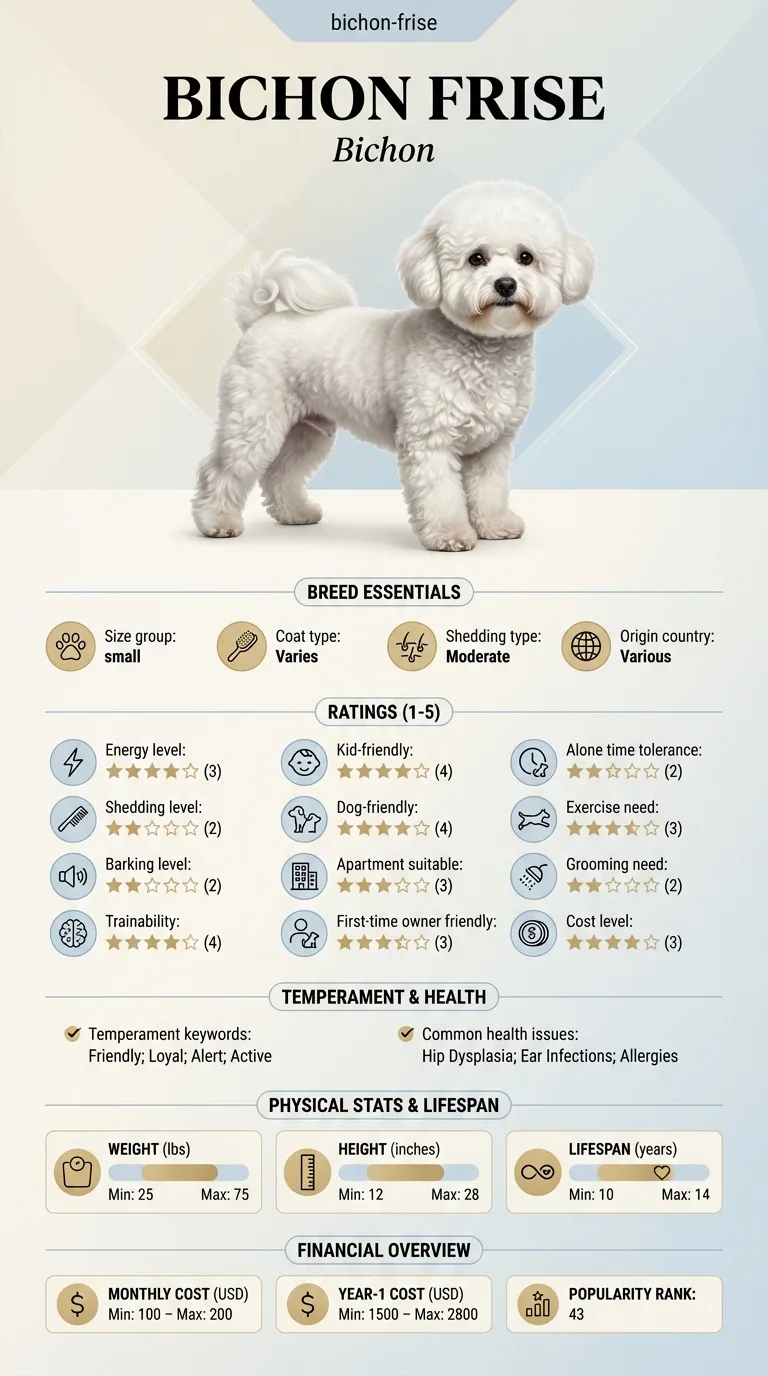
True gastric dilatation-volvulus, where the stomach fills with gas and then physically rotates on itself, happens overwhelmingly in large and giant breeds with a deep, narrow chest that leaves the stomach room to twist. A Bichon Frise, at 12 to 18 pounds with a compact small-breed build, does not share that chest geometry, and it would be misleading to frame this breed's risk the same way it is framed for a Great Dane or a Weimaraner. That said, ruling out the anatomical predisposition does not mean the underlying feeding behaviors that contribute to gas buildup and stomach distension stop mattering. They are simply a smaller piece of a smaller overall risk, not a nonexistent one.
Fast eating pulls air down along with food, a process called aerophagia, and it is the single most modifiable contributor to stomach distension in any dog. In multi-dog households, competitive eating around a shared feeding time makes gulping worse, since a dog racing to finish before a housemate takes the bowl swallows far more air than one eating at a relaxed pace alone.
A distended, gas-filled stomach from gulping is uncomfortable and can cause real vomiting and pain even without ever progressing to a twist. That distinction matters: simple bloat from air swallowing is common, self-limiting, and manageable through feeding changes, while true volvulus is a rare surgical emergency. Slowing down eating addresses the common, manageable end of that spectrum directly.

A single large daily meal fills the stomach more fully than the same total food split across two or three sittings, and a fuller stomach has more capacity to distend further if any gas builds on top of it. For a small dog, the practical fix is straightforward and low-cost: splitting the same daily food total into two or three smaller meals reduces how full the stomach gets at any one time, without changing overall calorie intake or requiring special equipment.
Winston shared a home with a larger, food-motivated Labrador, and mealtimes had turned into a race. He finished his bowl in under a minute, often followed by loud stomach noises, occasional retching, and a visibly rounded belly for an hour afterward. His owner assumed this was just how Winston ate and worried more about the Labrador's manners than Winston's pace. A vet visit for an unrelated issue brought up the gulping as worth addressing on its own, unprompted by any emergency. Separating the two dogs at mealtime and switching Winston to a slow-feed bowl stretched his eating time to several minutes. The stomach noises and post-meal bloated look both disappeared within the first week.
Key takeaway: In a small breed without the anatomical predisposition to true volvulus, mealtime gulping is still a real, fixable source of discomfort, and it is often driven by household feeding dynamics rather than the dog's own preference.
The anatomical predisposition seen in deep-chested large breeds does not apply to this compact small-breed build, so true volvulus is rare. Feeding habits like gulping and large single meals still carry a smaller but real contribution to stomach distension in any dog.
Fast eating causes aerophagia, air swallowed along with food, which distends the stomach and can cause discomfort and vomiting. This is common bloat rather than true volvulus, and it is directly addressed by slowing down how the dog eats.
Splitting the same total daily food into two or three smaller meals keeps the stomach less full at any one time, which is a simple, low-cost way to reduce distension risk without changing overall calorie intake.
A slow-feed bowl with raised ridges, spreading food across a flat mat, or separating competing dogs at mealtime all reduce gulping. The goal is removing the incentive to race, not restricting how much food the dog gets.
Yes, competitive eating around a shared mealtime encourages gulping in every dog present, since each one is racing to finish before a housemate can take the bowl. Feeding dogs separately removes that pressure.
Simple bloat is a gas-filled, uncomfortable stomach that is common and typically resolves with feeding changes. GDV is the stomach physically twisting on itself, cutting off blood supply, which is rare in this breed but a true surgical emergency when it occurs.
Vigorous activity right after a full meal is generally worth avoiding in any dog, since a full, potentially gas-filled stomach moving around adds unnecessary strain, even though this breed's overall structural risk for a full twist is low.
It is rare, since the deep, narrow chest conformation linked to true stomach twisting is not this breed's build. Feeding-related gas distension is a separate, more common, and more manageable issue.
A slow-feed bowl or spreading food on a flat surface removes the incentive to gulp, directly reducing the air swallowed along with each bite.
Splitting the same daily food total into two or three smaller meals rather than one large one keeps the stomach less full at any given time.
Avoiding vigorous exercise right after a full meal is a sensible precaution for any dog, reducing strain on a stomach that may be temporarily distended with food or air.
Mild fullness after a meal is normal, but a hard, visibly distended belly paired with retching, restlessness, or an inability to vomit anything up needs same-day veterinary attention.
A one-page prep sheet for this condition: the signs, the questions to ask, what to get priced. Unlocks here.
You get: Vet visit prep sheet
No spam. One-click unsubscribe. See our privacy policy.
Preview page 1 before you decide.