Health
Are Bichon Frises anesthesia-sensitive as a breed?
No documented breed-specific drug sensitivity exists for Bichons. The real risks come from small body size, repeat dental procedures and advanced age.

Quick answer
Are Bichon Frises anesthesia-sensitive as a breed?
No documented breed-specific drug sensitivity exists for Bichons. The real risks come from small body size, repeat dental procedures and advanced age.
Your Bichon is unlikely to have a breed-specific reaction to anesthetic drugs, yet it faces more anesthetics over a lifetime than most dogs its size, for reasons that trace straight back to its teeth.
This page is for owners who have just been told their Bichon needs a dental under general anesthetic and have gone looking for reasons to say no. It is also for owners of dogs aged eleven and up who are weighing a procedure against their dog's age.
This guide is not medical advice. If your dog shows pain, sudden behavior change, or worsening symptoms, consult a licensed veterinarian.
Some links may be affiliate links. We may earn a commission at no extra cost to you. We only suggest products we believe are helpful for dog owners.
We research and check what we publish, but we do not warrant that any figure, date, price, or statement is accurate, complete, or current, and we accept no liability for any loss, cost, injury, or other harm arising from the use of this site. Use it as one reference among several. You remain responsible for your own decisions and for your dog's care - confirm anything that matters with a licensed veterinarian or another qualified professional before you act on it. Full disclaimer.
Anesthetic sensitivity means a dog handles anesthetic drugs differently from the average patient, needing lower doses or waking abnormally slowly. It is a documented breed trait in sighthounds and in some herding lines. It is not documented in the Bichon Frise. What the Bichon does face is frequent anesthesia driven by dental disease, plus the ordinary physiological vulnerabilities of a small dog and an aging one.
Serious anesthetic complications in healthy dogs at well-equipped practices are rare. Risk rises with age, with undiagnosed heart or kidney disease, and with long procedures. Because the Bichon Frise combines a long lifespan with dental disease that keeps bringing it back to theatre, a typical owner will make this decision several times.
The connection between this breed and anesthesia runs through the mouth rather than through the liver. Dental disease is documented in the Bichon Frise, and small-breed jaws crowd a standard set of teeth into a short arcade, which favours plaque retention and periodontal breakdown. Every episode of that disease that needs treatment needs anesthesia. Cataracts and patellar luxation, both also documented for the breed, add further surgical events. Meanwhile the breed's fourteen to fifteen year lifespan means a real share of those procedures happen in geriatric patients whose kidneys, liver and heart have less reserve.
Owner-side factors shape outcomes more than most people realise. Households that never brush teeth need more extractions and therefore longer procedures. Overfeeding a dog with an exercise need of only two out of five produces an overweight patient, and excess weight complicates dosing, breathing and recovery. Fasting a small dog far longer than instructed lowers blood sugar before the anesthetic even begins. And skipping annual exams means abnormalities are found on the morning of surgery rather than months earlier.
Discuss anesthetic planning at the appointment, not at drop-off, and raise any history of fainting, exercise reluctance, coughing, breathing changes or a previously noted heart murmur, because those change the plan. After a procedure, call the clinic if your Bichon cannot stand by the following morning, vomits repeatedly, has pale, white or blue-tinged gums, breathes with visible effort, has a swollen or bleeding surgical site, or seems to be in pain that the prescribed relief is not touching. Collapse, seizures or unresponsiveness after going home are emergencies and need immediate attention rather than a wait-and-see.
See all Bichon Frise health problems, which breeds are prone to anesthesia sensitivity, or the full Bichon Frise breed guide for temperament, exercise needs and ownership costs.
Most Bichons are alert but woozy the evening of a procedure and close to themselves within twenty-four to forty-eight hours. Appetite may lag a day. After extractions, expect soft food for one to two weeks and a genuine improvement in mood once a painful mouth stops hurting, often more noticeable than owners predict. Full return to normal play after orthopaedic surgery is measured in months, not days.
Success is a boring day. Your dog goes in, the monitoring is uneventful, the temperature holds, recovery is quiet, and you take home a slightly groggy Bichon that evening. Over a lifetime, success is fewer procedures than average because you brushed the teeth, and a well-informed decision each time one is needed. It is not avoiding anesthesia altogether, which usually means leaving painful disease untreated.
Dental disease is one of the five health problems most associated with the Bichon Frise. Small dogs carry a full complement of teeth in a shortened jaw, crowding creates places plaque can sit undisturbed, and periodontal disease follows.
A proper dental assessment and cleaning in a dog cannot be done awake. Probing every tooth, taking intraoral radiographs and extracting a diseased root all require full general anesthesia and a protected airway. So the practical consequence of the breed's dental tendency is repeated anesthesia.
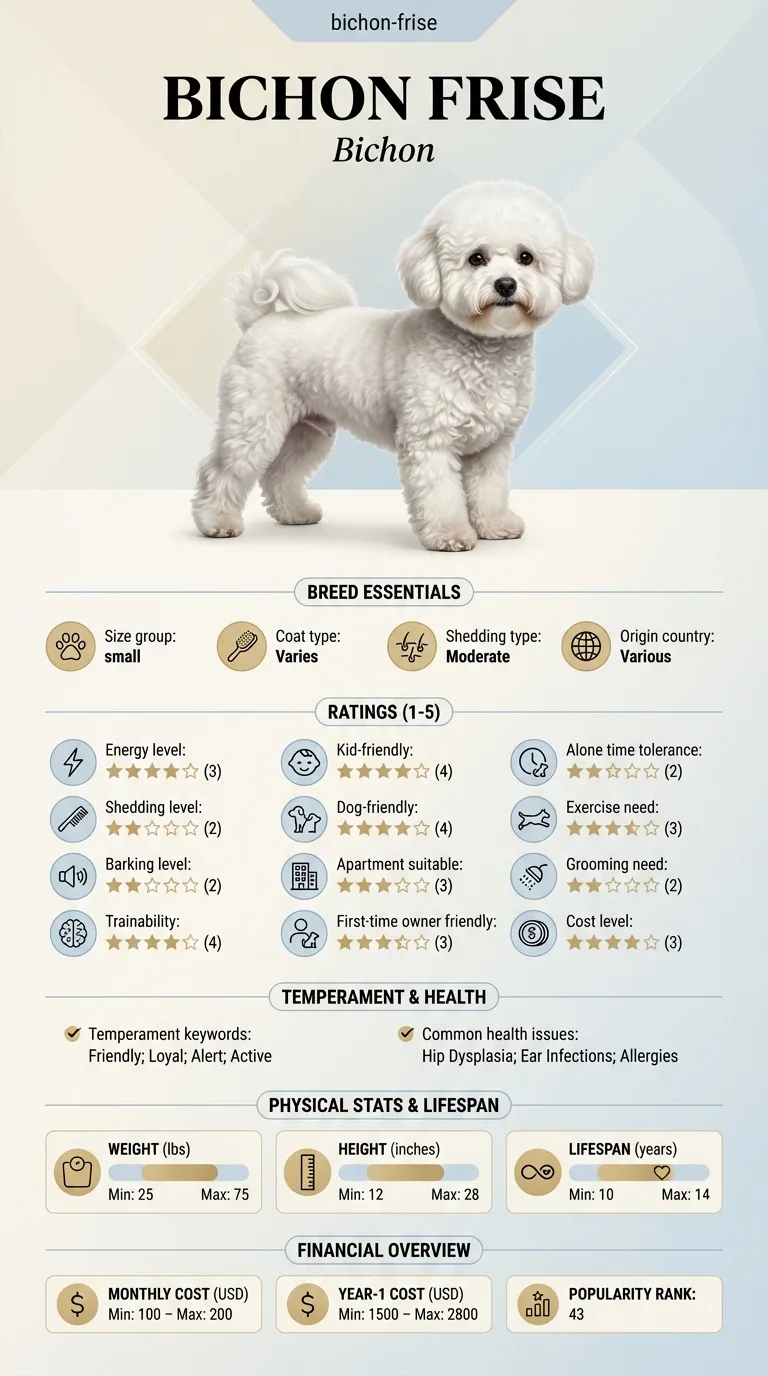
Now add the lifespan. Bichon Frises typically live fourteen to fifteen years. A dog needing a dental every eighteen months to two years from middle age onward may see six or more anesthetics across its life, several of them in old age.
That is the real anesthetic story for this breed. Not an unusual reaction to a drug, but an unusually high number of exposures, concentrated in the years when the patient is least robust.
Anesthetic risk in a Bichon is mostly physics and physiology rather than pharmacology. A well-run clinic manages all three of these as routine, and it is entirely fair to ask how they do it.
Owners often feel they cannot question a veterinary team. You absolutely can, and a good practice will welcome it.
Ask whether pre-anesthetic blood work is included and what it screens for. Ask who monitors your dog while the vet is working, whether that person does anything else during the procedure, and what is measured. Ask how the patient is kept warm, and whether intravenous fluids run throughout. Ask where your Bichon recovers and whether someone is with it.
For an older dog, ask what the plan is if something abnormal turns up on the pre-anesthetic tests, and whether the procedure can be split into stages.
None of these questions imply distrust. They are the same questions the veterinary team would ask about their own dog.

Ollie was a thirteen-year-old Bichon Frise with a mouth his vet described as overdue. His owner Rachel had refused a dental twice, on the grounds that he was too old to go under. He had stopped playing with his rope toy and was dropping kibble. Rachel finally agreed to pre-anesthetic blood work, expecting bad news that would settle the argument. The results showed early kidney changes, and rather than cancelling the procedure this changed how it was run: fluids started before induction and continued after, a warming plan throughout, and a shortened session treating the worst quadrant first with the rest deferred by six weeks. Ollie had five teeth out over two visits. He was eating soaked food the next evening and back on the rope toy inside a fortnight. Rachel's regret was the two years of chewing on an infected mouth she had thought she was protecting him from.
Key takeaway: In an older Bichon the useful question is never how old the dog is, but what the tests show and how the anesthetic will be run around the answer.
The MDR1 variant that affects drug handling is concentrated in collies and related herding breeds, not in the Bichon Frise. It is not part of the documented health picture for this breed. If your dog is a Bichon cross with herding ancestry, testing is worth discussing with your veterinarian.
Age itself is not a disease. A healthy thirteen-year-old with good organ function and clear blood work may be a better anesthetic candidate than a sick eight-year-old. The relevant question is how your individual dog's heart, kidneys and liver look, and that is what pre-anesthetic testing answers.
Scraping visible tartar from an awake dog polishes the crown while leaving the disease below the gum line untouched, and it cannot include radiographs or extractions. It looks better and treats nothing. Most veterinary dental specialists advise against it as a substitute.
Follow your clinic's specific instruction and do not extend it. Modern guidance for small dogs uses shorter fasts than the overnight starvation many owners remember, precisely because small patients drop their blood sugar. Water is usually allowed for longer than food.
Grogginess, mild wobbliness, whining and clinginess for twelve to twenty-four hours are common and usually reflect residual drug effects and disorientation rather than a problem. Persistent vomiting, an inability to stand by the next morning, pale gums or laboured breathing are not normal and warrant a call.
Indirectly. A dense curly double coat is a good insulator, so a Bichon that arrives damp from a bath, or that is clipped for surgery, loses the insulation it normally relies on. Bringing your dog in dry and warm is a genuinely helpful small contribution.
Costs vary hugely by region and by how much treatment is needed once radiographs are taken. Expect a base fee for anesthesia and cleaning, with extractions charged on top. Ask for a written estimate with a stated ceiling, and ask to be phoned if the plan changes mid-procedure.
No documented breed-specific drug sensitivity exists for Bichons. The real risks come from small body size, repeat dental procedures and advanced age.
Undiagnosed disease in an older patient. Pre-anesthetic blood work and a thorough physical exam catch far more than any breed assumption would.
Arrive on time, keep your dog dry and warm, follow the fasting instruction exactly, and bring an accurate list of any supplements or medications.
Neutering plus dental procedures every year or two from middle age means several over a fourteen to fifteen year lifespan. Home tooth care reduces that number.
Yes. Muzzle, restraint and mouth-handling practice at home lowers stress on the day, which lowers the drug requirement and speeds recovery.
A one-page prep sheet for this condition: the signs, the questions to ask, what to get priced. Unlocks here.
You get: Vet visit prep sheet
No spam. One-click unsubscribe. See our privacy policy.
Preview page 1 before you decide.