Health
What does occult mean in this context?
The disease is present and detectable on tests but produces no visible signs. In predisposed breeds this phase can last a couple of years.

Quick answer
What does occult mean in this context?
The disease is present and detectable on tests but produces no visible signs. In predisposed breeds this phase can last a couple of years.
The hardest thing about this disease is that a dog can be genuinely ill for years without a single sign an owner could reasonably be expected to notice.
Owners comparing breeds and trying to understand which ones need cardiac screening. Also Bichon owners who have encountered the term in general reading and want to know whether their dog belongs to the screened population or not.
This guide is not medical advice. If your dog shows pain, sudden behavior change, or worsening symptoms, consult a licensed veterinarian.
Some links may be affiliate links. We may earn a commission at no extra cost to you. We only suggest products we believe are helpful for dog owners.
We research and check what we publish, but we do not warrant that any figure, date, price, or statement is accurate, complete, or current, and we accept no liability for any loss, cost, injury, or other harm arising from the use of this site. Use it as one reference among several. You remain responsible for your own decisions and for your dog's care - confirm anything that matters with a licensed veterinarian or another qualified professional before you act on it. Full disclaimer.
Dilated cardiomyopathy is a disease in which the muscular wall of the main pumping chamber thins and weakens, the chamber enlarges, and the heart's output falls. It has a long silent phase detectable only on ultrasound and rhythm recording, followed by heart failure or, in some dogs, sudden death from an abnormal rhythm. It is a large and giant breed disease and is not documented in the Bichon Frise.
Common enough in Dobermanns and several giant breeds that formal screening protocols and breeding recommendations exist. Rare in small companion dogs. It is absent from the Bichon Frise's documented health list, and a Bichon owner reading about it has almost always encountered material written with a much larger dog in mind.
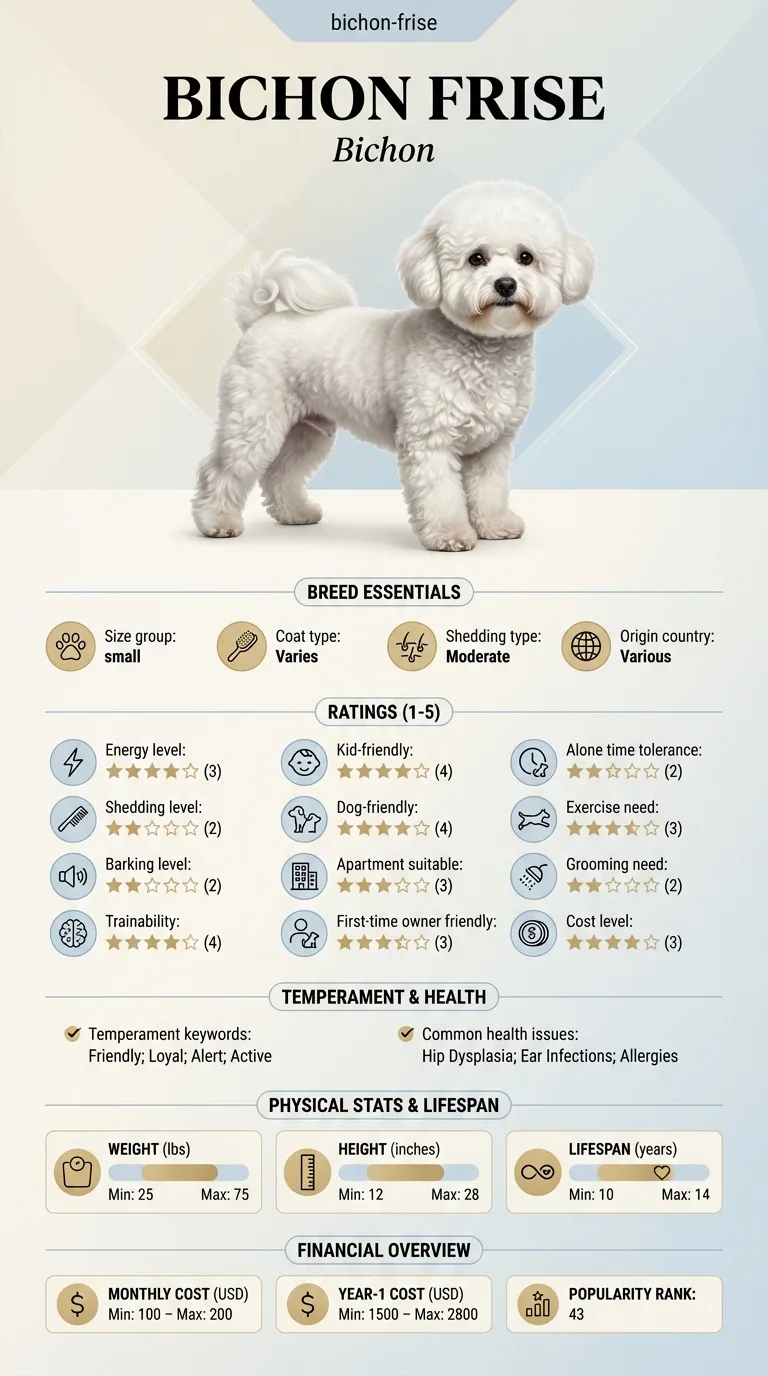
The heart muscle of a large dog works against different mechanical demands from that of a 12 to 18 pound companion dog, and the inherited variants identified so far cluster in particular large-breed lines. The Bichon Frise carries no such documented predisposition, and its recognised problems lie in the skin, the kneecaps, the urinary tract, the lens of the eye and the mouth. Where age does eventually affect a Bichon's heart, it does so at the valves rather than in the muscle, and it announces itself through a murmur that an annual stethoscope check will find.
For the breeds affected, environment is not the driver; genetics is, with nutrition under investigation as a contributing factor in some cases. For a Bichon Frise, the environmental factors that genuinely influence cardiac workload are ordinary ones. Excess weight, easy to accumulate in a dog with an exercise requirement of two out of five, makes the heart work harder every minute. A sedentary indoor life in a highly apartment-suited breed means reduced stamina can develop unnoticed, because the dog is never asked to do enough for it to show.
Book promptly for a genuine reduction in exercise tolerance, a new cough that persists more than a few days, fainting or near-fainting, or a resting breathing rate that has risen above your dog's established baseline. Go to an emergency clinic immediately for laboured or rapid breathing at rest, an inability to settle or lie down at night combined with breathing effort, gums that appear pale, grey or blue, coughing up pink froth, or collapse. Sudden weakness or paralysis of the hind legs with cold, painful feet is also an emergency, since it can indicate a clot originating from a diseased heart.
See all Bichon Frise health problems, which breeds are prone to dilated cardiomyopathy dcm, or the full Bichon Frise breed guide for temperament, exercise needs and ownership costs.
For most Bichon owners the timeline is one reassuring conversation. Where heart muscle disease is genuinely found in an individual dog, the occult phase may already have run for a long time before diagnosis, treatment usually begins immediately once chambers are affected, and rechecks follow every few months. Improvement in comfort after treatment for fluid accumulation is often rapid, within a day or two, but the underlying condition is managed for life rather than resolved.
Success for a Bichon Frise owner is spending cardiac attention where it pays: an annual stethoscope, a known baseline breathing rate, a lean dog, and prompt reporting of a cough or reduced stamina. That routine catches the valve disease this breed can actually develop, at the stage where it is straightforward to monitor. Chasing a large-breed muscle disease with expensive imaging in a healthy small dog is not thoroughness, it is misdirected effort.
Veterinary cardiologists use the word occult to describe the period when the disease is present and detectable on tests but invisible in the dog's behaviour. In predisposed breeds this stage can last a couple of years.
During it the chamber is enlarging, the muscle is weakening, and abnormal rhythms are often beginning to fire. None of that produces a symptom, because the heart has enough reserve to keep going. The dog runs, plays and eats normally.
This is precisely why organised screening programmes exist for the breeds at risk. An annual ultrasound scan, sometimes combined with a rhythm recording worn over twenty-four hours, detects the changes long before the dog is affected. Treatment started in the occult phase has been shown to delay the onset of heart failure meaningfully.
It is also why sudden cardiac death is such a feature of this disease in the breeds that get it. A dog that appears healthy on Tuesday can die abruptly from a rhythm disturbance, and the owner had no warning because there was none available to see.
The screened breeds are large and giant ones, headed by the Dobermann. The Bichon Frise is not among them, and dilated cardiomyopathy does not appear on the breed's documented health list.

Given that screening ultrasound is not indicated here, it is fair to ask what a Bichon owner should actually be doing about the heart. The answer is short and inexpensive.
The Okonkwo household had a five-year-old Dobermann called Juno and a seven-year-old Bichon Frise called Waffle, and both were due their annual appointments in the same week. Juno was booked for a cardiac screening ultrasound and a twenty-four hour rhythm recording, because her breed is one where heart muscle disease is common enough that organised screening is recommended and where treatment started in the silent phase makes a measurable difference. Waffle had a stethoscope on his chest for a full minute, a weight check, and a conversation about his teeth. His owner asked whether he should have the same scan as Juno. The vet's answer was direct: the scan would almost certainly be normal, would cost several hundred pounds, and would not change anything about his care. What Waffle needed was a dental, which he had six weeks later. Juno's screening was clear that year and is repeated annually. Waffle has had his breathing rate counted on the sofa every Sunday since.
Key takeaway: Screening is valuable precisely because it is targeted, and applying a large breed's cardiac protocol to a small companion dog buys anxiety rather than information.
It is not among the health issues documented for the breed, and the disease is concentrated in large and giant breeds where inherited forms have been identified. Individual small dogs are occasionally affected, usually with an identifiable underlying cause, but this is not a breed risk that a Bichon owner needs to plan around.
There is no evidence to support routine cardiac ultrasound in a breed with no documented predisposition and no clinical findings. The money is better spent on annual examinations and on the dental care this breed genuinely needs. If a vet finds a murmur, an abnormal rhythm or an enlarged heart on a radiograph, that changes the answer entirely.
Because the diseased muscle conducts electricity abnormally, and a chaotic ventricular rhythm can stop effective pumping within seconds. This can happen before the dog has ever shown a symptom of heart failure, which is the reason rhythm recording forms part of screening in the at-risk breeds.
The name describes the same anatomical change, a dilated, poorly contracting ventricle, but the causes, breed patterns and treatments differ. Human information should not be applied to a dog, and dog information should not be applied to a person. Ask your veterinarian rather than translating across species.
Valve disease is a leaking door; DCM is a weakened wall. Valve disease usually announces itself with a murmur and progresses slowly over years in small dogs. DCM often produces no murmur early on, needs ultrasound to detect, and belongs to a different population of dogs entirely.
Nutritional factors have been investigated in relation to heart muscle disease in dogs, including taurine status and certain diet formulations, and the picture is still developing. The practical step is to discuss your dog's actual food with your vet at a routine appointment rather than making changes based on headlines.
The disease is present and detectable on tests but produces no visible signs. In predisposed breeds this phase can last a couple of years.
No. Cardiac screening programmes target large and giant breeds, and this condition is not on the Bichon's documented health list.
Annual auscultation, twice yearly from eight, plus a home baseline sleeping breathing rate and attention to exercise tolerance.
Count chest rises for thirty seconds while your dog is genuinely asleep and double it. Establish the normal figure before you need it.
Not without a clinical reason. It is a significant cost and adds nothing for a breed with no documented predisposition and a normal examination.
A one-page prep sheet for this condition: the signs, the questions to ask, what to get priced. Unlocks here.
You get: Vet visit prep sheet
No spam. One-click unsubscribe. See our privacy policy.
Preview page 1 before you decide.