Health
What is the first thing to do if my Bichon's face swells suddenly?
Phone your veterinarian or the nearest emergency clinic immediately and describe the swelling, the gum colour and the breathing. Do not wait to see whether it settles.

Quick answer
What is the first thing to do if my Bichon's face swells suddenly?
Phone your veterinarian or the nearest emergency clinic immediately and describe the swelling, the gum colour and the breathing. Do not wait to see whether it settles.
A Bichon Frise that was fine an hour ago and now has a swollen muzzle is having an acute reaction, and the clock matters more than the cause.
Owners already used to their Bichon's everyday skin sensitivity are the likeliest to miss it. They see scratching constantly, so a sudden change reads as more of the same. First-time small-dog owners struggle too, because a dense curly coat hides welts that would be obvious on a short-coated dog.
This guide is not medical advice. If your dog shows pain, sudden behavior change, or worsening symptoms, consult a licensed veterinarian.
Some links may be affiliate links. We may earn a commission at no extra cost to you. We only suggest products we believe are helpful for dog owners.
We research and check what we publish, but we do not warrant that any figure, date, price, or statement is accurate, complete, or current, and we accept no liability for any loss, cost, injury, or other harm arising from the use of this site. Use it as one reference among several. You remain responsible for your own decisions and for your dog's care - confirm anything that matters with a licensed veterinarian or another qualified professional before you act on it. Full disclaimer.
An acute allergic reaction is a fast immune response to something the body has decided is a threat. In a Bichon Frise it usually shows as facial swelling, welts felt through the curly coat, sudden vomiting, or at worst weakness and laboured breathing. Unlike the breed's familiar chronic itching, it has a clear starting point and needs a same-day answer.
Severe reactions are uncommon in any one dog's lifetime. Mild ones, especially localised swelling after a sting or a puffy face after an appointment, turn up often enough that busy small-animal clinics see them weekly. Bichon owners are not facing a breed-specific epidemic here, but they are facing a coat that delays detection.
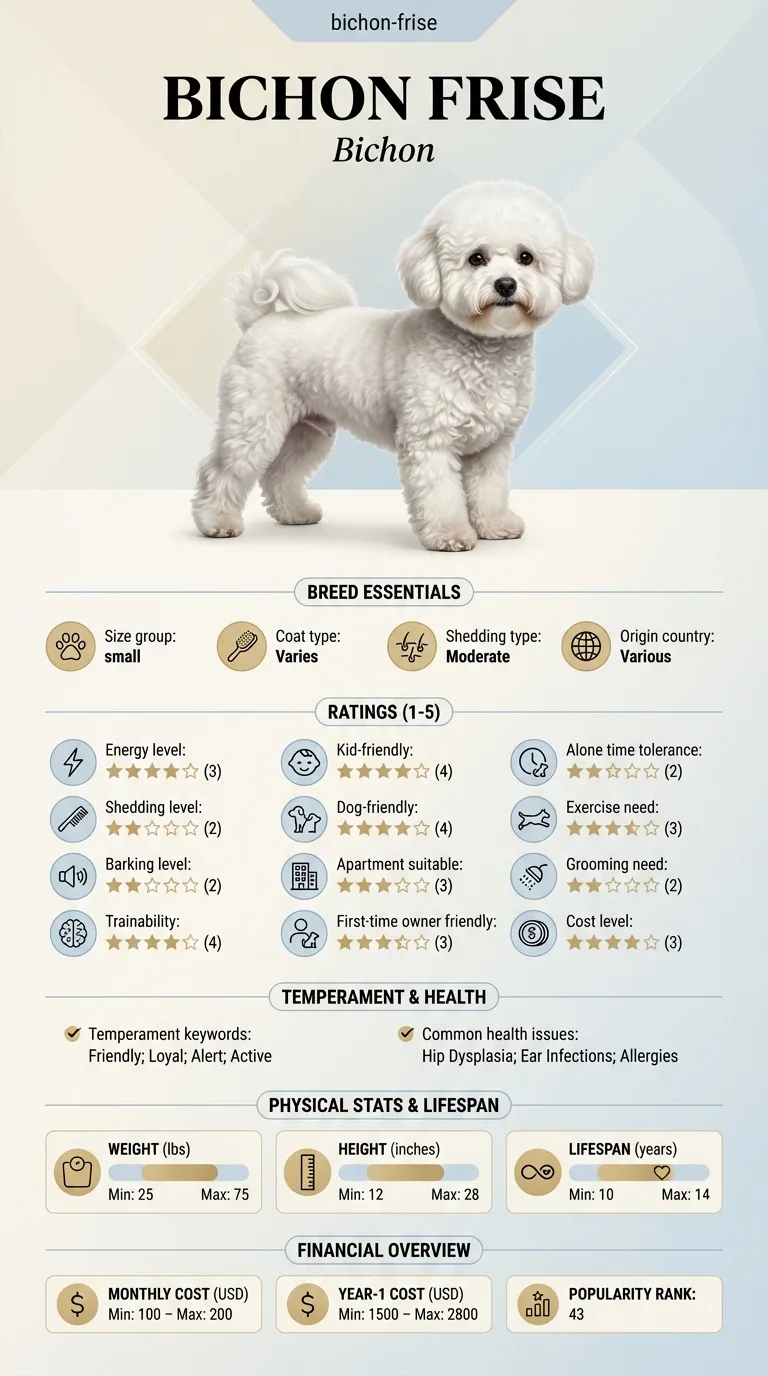
Two documented breed features matter. The first is a recognised tendency to skin allergies, which tells us the Bichon immune system is often already primed to overreact to environmental proteins. The second is size: at 12 to 18 pounds and 9 to 12 inches tall, this dog takes a proportionally large dose from any sting or injection and has a proportionally smaller airway to lose. The curly, dense, very low shedding double coat adds a practical third factor, hiding early hives and holding contact allergens against skin instead of letting them fall away.
Most acute reactions trace to a handful of ordinary household events. Warm months bring stinging insects into gardens at exactly the height a curious ten inch dog explores. Grooming days bring new shampoos and finishing sprays into contact with already-sensitive skin, and this breed's grooming need is at the top of the scale. Veterinary visits bundle several injections into one morning. Homes that rotate treats often, or that have visitors handing over food, raise exposure without noticing.
Call the same day for sudden facial or muzzle swelling, a new crop of hives, or vomiting that follows an injection, a new food or a sting. Go straight to an emergency clinic without calling first if your Bichon is labouring to breathe, has pale, white or grey gums, becomes wobbly or collapses, vomits repeatedly, or has swelling still spreading while you watch. Those are signs of anaphylaxis. It is a genuine emergency, it can kill a dog of this size, and it is treatable when treated fast. Bring the suspect product with you.
See all Bichon Frise health problems, which breeds are prone to allergic reactions, or the full Bichon Frise breed guide for temperament, exercise needs and ownership costs.
A mild reaction treated promptly usually settles within twelve to forty-eight hours, swelling first and skin appearance a few days later. A severe episode that needed hospitalisation may mean two or three quiet days afterwards. Identifying the trigger is the slow part: expect weeks of record keeping, and accept that in many cases the culprit is never named with certainty.
Success is not a dog who never reacts again, because nobody can promise that. It is an owner who spots swelling in minutes rather than hours, who has a written plan and a clinic number ready, who has removed the triggers they can control, and whose Bichon goes on living the ordinary cheerful fourteen to fifteen year life the breed is built for.
Skin allergies sit on the Bichon Frise list of documented health problems, so most owners have a mental baseline of what a bad day looks like. That baseline is what makes an acute reaction easy to dismiss.
A chronic flare builds. Your Bichon licks the front paws a little more this week than last, the skin between the toes turns pink, an ear starts smelling yeasty. It creeps in over days.
An acute reaction arrives. There is a before and an after, usually less than two hours apart. The muzzle thickens. The eyelids look heavy. Raised welts push the curly coat up into little tufts, so the coat surface goes bumpy before you see any skin. On a white dog the inside of the ear flap and the bare belly flush a deep pink that was not there in the morning.
Run your hands over the ribcage and along the spine. Hives you cannot see on a coated dog you can absolutely feel, like coins slipped under the fur. That check takes ten seconds and it is the single most useful habit a Bichon owner can build.

A wasp does not adjust its venom load for the dog it stings. The same injection a 70 pound retriever shrugs off arrives in a Bichon Frise weighing 12 to 18 pounds, so the dose per pound is roughly four to five times higher. That is why small companion breeds look dramatic during reactions a large dog would barely register.
The same arithmetic covers a swallowed bee, a mouthful of an unfamiliar treat, or a topical product mixed for a bigger animal. It also covers swelling itself: a few millimetres of tissue swelling in a nine to twelve inch tall dog's throat takes away a much larger fraction of the airway.
None of this makes your Bichon fragile. It means the window between mild and serious is narrower, so the sensible response in this breed is to call rather than wait and see.
Priya's Bichon Frise, Marzipan, was six and had eaten the same food since puppyhood. On a July afternoon he was nosing through clover when he yelped once and bolted to the patio door. Priya checked him, found nothing, and assumed he had startled himself. Nine minutes later his upper lip had thickened enough to change the shape of his face. She could not see hives through the coat, but running her hands down his sides she felt a dozen firm little discs she had never felt before. She phoned the clinic from the car. Marzipan was treated for a sting reaction, watched for four hours, and home by evening. What changed permanently was Priya's routine: the clover came out, she checks the lawn each spring for ground nests, and the rib check is now part of every evening brush.
Key takeaway: On a curly-coated white dog your hands find an allergic reaction long before your eyes do, and the minutes you save by feeling instead of looking are the minutes that matter.
Most acute reactions in small dogs appear within fifteen minutes to two hours of the trigger. Stings and injections sit at the fast end, food reactions at the slower end. If your Bichon is normal six hours after an exposure, an acute reaction is unlikely.
Do not medicate a reacting dog on your own judgment. Human formulations vary enormously in strength and some combination products contain ingredients dangerous to dogs, and a 15 pound Bichon leaves no margin for a guess. Phone your vet and let them decide.
Go now, without calling first, if your Bichon is struggling to breathe, has pale or grey gums, is unsteady or collapses, vomits repeatedly, or has swelling still spreading across the face while you watch. Those point toward anaphylaxis, a true emergency in a dog this size.
There is no evidence the breed reacts more often. What it does have is a documented tendency to skin allergies, a very low shedding curly double coat that hides hives, and a small body that concentrates any dose. Together those make reactions harder to catch early.
That is a decision for your veterinarian. Post-vaccination reactions can often be managed by spacing doses, pre-treating, or not stacking several products in one morning. Dropping core protection entirely carries its own risks, so plan the next appointment together.
More than most owners expect. A Bichon in full coat can be covered in welts that are invisible from across the room. Owners who keep a shorter trim, and who use their hands during daily brushing, catch swelling far earlier than owners who rely on looking.
It can, because sensitivity develops through repeated exposure rather than on first contact. That said, sudden dramatic episodes more often trace to something new: a different chew, a flavoured tablet, a table scrap, or an insect rather than the regular bowl.
Phone your veterinarian or the nearest emergency clinic immediately and describe the swelling, the gum colour and the breathing. Do not wait to see whether it settles.
Feel rather than look. Run flat palms over ribs, shoulders and belly. Hives feel like small firm discs under the coat, obvious to the hand long before the eye.
Treat it as one until a vet says otherwise. In a dog of nine to twelve inches, throat swelling that follows facial swelling can narrow the airway quickly.
Not permanently, but supervise in warm months and clear ground nests. A curious low-to-the-ground dog investigates flowering clover at nose height.
Accident and illness policies typically do, provided cover started before the episode and the reaction is not tied to an excluded pre-existing condition.
A one-page prep sheet for this condition: the signs, the questions to ask, what to get priced. Unlocks here.
You get: Vet visit prep sheet
No spam. One-click unsubscribe. See our privacy policy.
Preview page 1 before you decide.