Behavior
Which needs more exercise?
The Siberian Husky, rated Very high (5/5) versus Low (2/5).

Quick answer
Which needs more exercise?
The Siberian Husky, rated Very high (5/5) versus Low (2/5).
Bichon Frise or Siberian Husky? On paper they differ most on apartment suitability, and on the scales Siberian Husky is the heavier at 45–60 lbs. Here is how the two compare on everything that shapes an ordinary week.
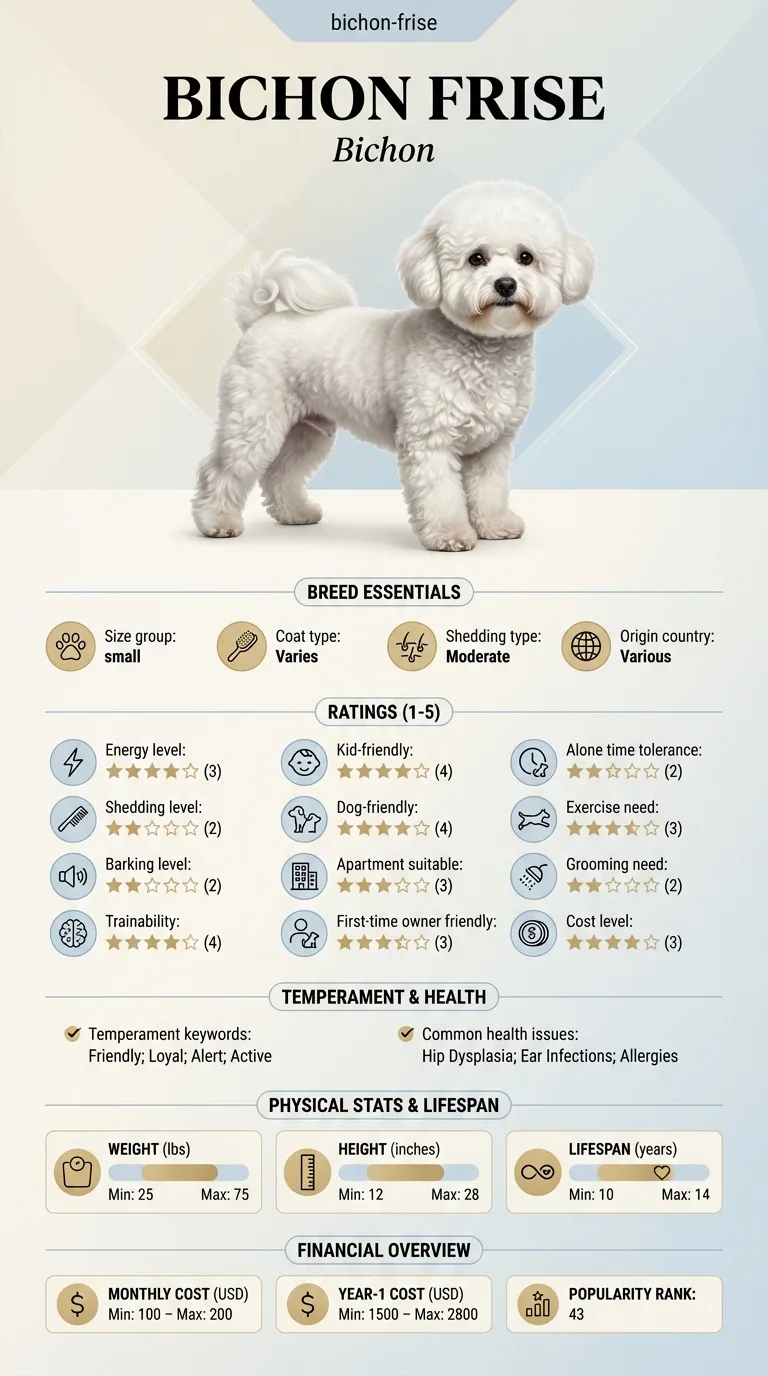
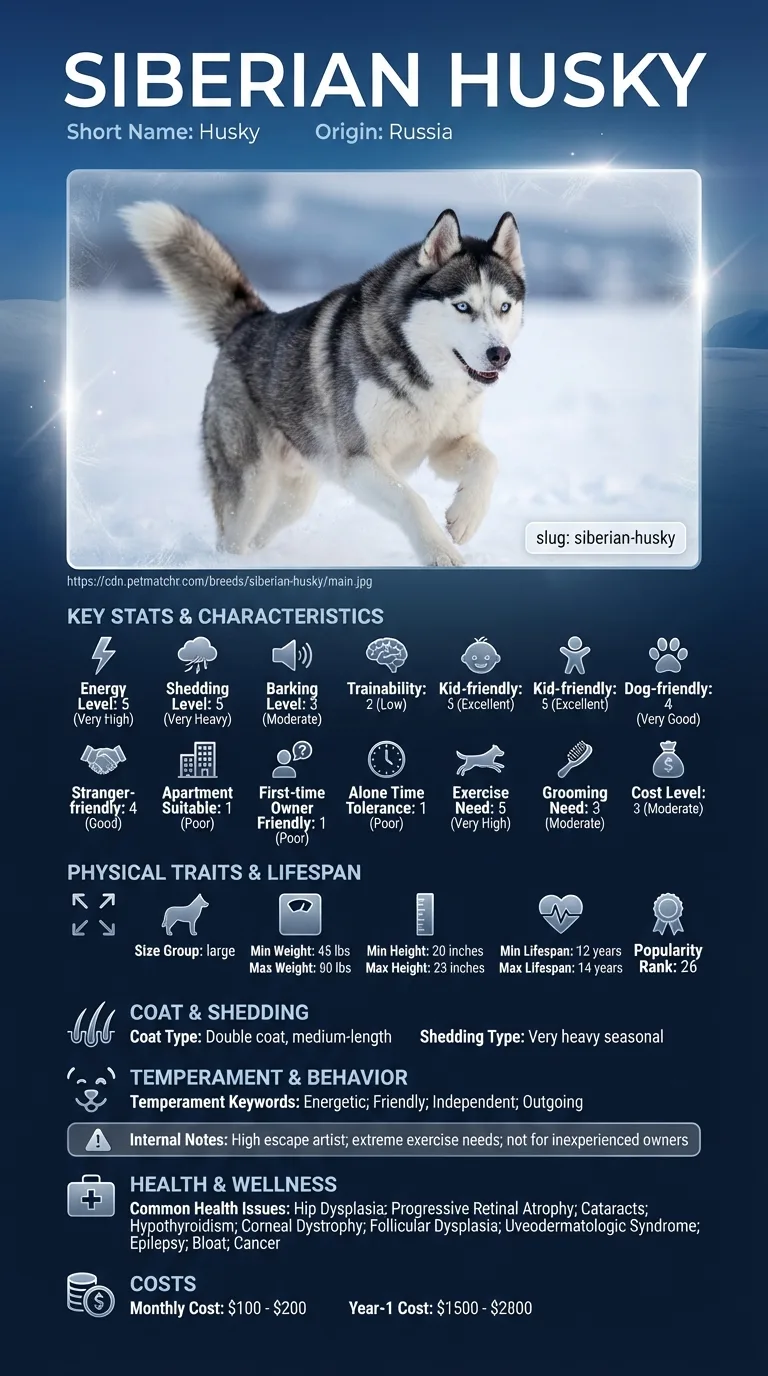
This is for someone already down to Bichon Frise and Siberian Husky and deciding between them. For this pair the decision usually turns on apartment suitability and shedding, so those are covered first and in most detail. Anyone choosing from a flat has a clear answer here: Bichon Frise rates 5/5 against 1/5. Breed history is left out; what follows is what you will actually live with.
Between Bichon Frise and Siberian Husky, apartment suitability is what separates them, and Bichon Frise is the lower-effort dog of the two to keep.
Choose Bichon Frise if you are in a flat or a smaller home, this is your first dog and shedding is a problem in your house.
Choose Siberian Husky if you do not want a standing grooming appointment, there are young children at home and you want a dog that can keep up with an active routine.
| Feature | bichon frise | siberian husky | Winner |
|---|---|---|---|
| Size class | small | large | Equal |
| Weight | 12–18 lbs | 45–60 lbs | Equal |
| Height | 9–12 in | 20–23 in | Equal |
| Lifespan | 14–15 years | 12–14 years | bichon frise |
| Exercise need | Low (2/5) | Very high (5/5) | bichon frise |
| Grooming need | Very high (5/5) | Moderate (3/5) | siberian husky |
| Shedding | Very low (1/5) | Very high (5/5) | bichon frise |
| Energy level | Moderate (3/5) | Very high (5/5) | Equal |
| Barking | Moderate (3/5) | Moderate (3/5) | Equal |
| Apartment suitability | Very high (5/5) | Very low (1/5) | bichon frise |
| Good for first-time owners | High (4/5) | Very low (1/5) | bichon frise |
| Tolerates being alone | Low (2/5) | Very low (1/5) | bichon frise |
| Trainability | Moderate (3/5) | Low (2/5) | bichon frise |
| Good with kids | High (4/5) | Very high (5/5) | siberian husky |
| Good with other dogs | High (4/5) | High (4/5) | Equal |
| Friendly to strangers | High (4/5) | High (4/5) | Equal |
| Cost level | Moderate (3/5) | Moderate (3/5) | Equal |
| Coat | Curly, dense double coat | Double coat, medium-length | Equal |
| Origin | Various | Russia | Equal |
| Typical monthly cost | $80–$150 | $100–$200 | Equal |
| Typical first-year cost | $1,100–$2,300 | $1,500–$2,800 | Equal |
The Siberian Husky runs considerably larger than the Bichon Frise — 45–60 lbs and 20–23 inches against 12–18 lbs and 9–12 inches — roughly three to four times the weight and more than double the height. Bred to pull sleds across long distances in Arctic conditions, the Husky carries a medium-length double coat built for insulation, a stark contrast to the Bichon's curly, dense coat designed purely for a companion dog's look. The size gap alone signals two very different daily-life commitments: a compact lap dog versus an athletic working breed built for endurance.
This is one of the widest exercise gaps in the entire comparison set: Very high (5/5) for the Husky against Low (2/5) for the Bichon, with energy level scored a tie at Moderate (3/5) versus Very high (5/5). A Siberian Husky bred for distance sled work needs serious daily exertion — running, hiking, or structured exercise — and becomes destructive and vocal when under-exercised, a well-documented problem in the breed. The Bichon's modest exercise needs sit at the opposite end of the spectrum entirely, making this pairing one of the clearest activity-level mismatches in the lineup.
Grooming need favors the Husky, Moderate (3/5) against the Bichon's Very high (5/5), but shedding runs in the completely opposite direction — Very low (1/5) for the Bichon versus Very high (5/5), the maximum score, for the Husky. Huskies famously 'blow coat' twice a year, releasing enormous volumes of undercoat over a period of weeks, a maintenance reality that surprises owners expecting a low-fuss breed just because brushing frequency is lower than the Bichon's. Anyone with allergies or a hair-sensitive household should weigh this carefully.
Apartment suitability shows another stark gap: Very high (5/5) for the Bichon against Very low (1/5) for the Husky, the lowest possible score — a breed built for open, cold-climate distances simply doesn't thrive in small, warm indoor spaces. Barking ties at Moderate (3/5) for both, but the Husky rates Very low (1/5) for tolerating time alone, the worst score in this entire comparison, meaning it needs far more consistent companionship or activity than a typical workday allows, a serious consideration for anyone gone eight-plus hours a day.
The Husky rates Low (2/5) trainability and Very low (1/5) first-time-owner suitability — the lowest first-time-owner score anywhere in this comparison — reflecting its Independent, strong-willed sled-dog heritage and a strong prey drive that make recall notoriously unreliable. The Bichon, by contrast, rates High (4/5) for first-time owners and Moderate (3/5) trainability. This is one of the clearest signals in the data: a Siberian Husky is genuinely a poor match for a first-time owner, while the Bichon remains an accessible, forgiving choice.
The Husky actually edges ahead with kids, Very high (5/5) against the Bichon's High (4/5), and both breeds tie at High (4/5) with other dogs and strangers — reflecting the Husky's genuinely Friendly, Outgoing pack temperament despite its training challenges. Families drawn to the Husky's striking looks and social nature should weigh that against its exercise and alone-time needs; the dog's sociability doesn't offset the daily activity commitment or the risk of destructive behavior if that commitment isn't consistently met.
The Bichon's 14–15 year lifespan slightly outpaces the Husky's 12–14 years, and the health lists diverge in scope: five conditions for the Bichon against ten for the Husky, including Cancer, Bloat, Epilepsy, and several eye conditions like Corneal Dystrophy and Progressive Retinal Atrophy alongside skin-related Follicular Dysplasia and Uveodermatologic Syndrome. The breadth of the Husky's list, spanning eyes, skin, and organs, means routine veterinary screening plays a bigger role in managing its long-term health than it does for the Bichon.
Cost level ties at Moderate (3/5) for both breeds, though the dollar figures still show a gap: $80–$150 monthly and $1,100–$2,300 in year one for the Bichon versus $100–$200 monthly and $1,500–$2,800 for the Husky. Beyond the baseline numbers, Husky owners should budget for the less quantifiable costs of a high-energy, escape-prone breed — secure fencing, more frequent replacement of dug-up landscaping, and potentially professional training to manage its independent streak.
Bichon Frise weighs 12–18 lbs and lives 14–15 years; Siberian Husky weighs 45–60 lbs and lives 12–14 years. The two diverge most on apartment suitability, shedding and exercise need and 3 other rated axes. They are level on barking, cost level and good with other dogs, so those cannot decide it. The comparison marks an easier option only where one exists. Facts like weight and country of origin are not scored. Both dogs are rated from the same dataset, which is what makes the numbers comparable with each other even though any individual dog sits somewhere inside its breed's range.

No — it's rated Very low (1/5) for first-time owners, the lowest score in this comparison, against the Bichon's High (4/5), largely due to its Independent temperament and demanding exercise needs.
Considerably more — rated Very high (5/5) versus the Bichon's Low (2/5); Huskies were bred for distance sled work and need serious daily exertion.
Yes, rated Very high (5/5) shedding, the maximum score, versus the Bichon's Very low (1/5) — Huskies blow their undercoat heavily twice a year.
Not well — it's rated Very low (1/5) for tolerating being alone, the lowest score anywhere in this comparison, meaning long solo stretches are a poor fit for the breed.
Yes, actually rated Very high (5/5), higher than the Bichon's High (4/5), reflecting its genuinely Friendly, Outgoing pack temperament.
The Bichon Frise, rated Moderate (3/5) versus the Husky's Low (2/5) — Huskies are intelligent but famously independent and difficult to recall reliably.
No — it's rated Very low (1/5) apartment suitability, the lowest score, against the Bichon's Very high (5/5).
The Siberian Husky, rated Very high (5/5) versus Low (2/5).
The Siberian Husky, rated Very high (5/5), the maximum score.
The Bichon Frise, by a wide margin.
The Siberian Husky, rated Very high (5/5) versus High (4/5).
Secure checkout on Stripe. We never see your card.
7-day money-back guarantee. Instant access.
Health information here is general and is not veterinary advice. If your dog shows pain, sudden behaviour change, or worsening symptoms, consult a licensed veterinarian.
Some links on this site are affiliate links. We may earn a commission at no extra cost to you, and we only suggest products we believe are helpful for dog owners.
We research and check what we publish, but we do not warrant that any figure, date, price, or statement is accurate, complete, or current, and we accept no liability for any loss, cost, injury, or other harm arising from the use of this site. Use it as one reference among several. You remain responsible for your own decisions and for your dog's care - confirm anything that matters with a licensed veterinarian or another qualified professional before you act on it. Full disclaimer.
Match your lifestyle to the right dog.
Take quizNot sure which breed is right for you? Take our 2-minute quiz to find out.
Take the quiz