Behavior
What are the signs of separation anxiety in a dog?
Barking or howling that starts soon after you leave, damage at exit points, indoor toileting, drooling and pacing.

Quick answer
What are the signs of separation anxiety in a dog?
Barking or howling that starts soon after you leave, damage at exit points, indoor toileting, drooling and pacing.
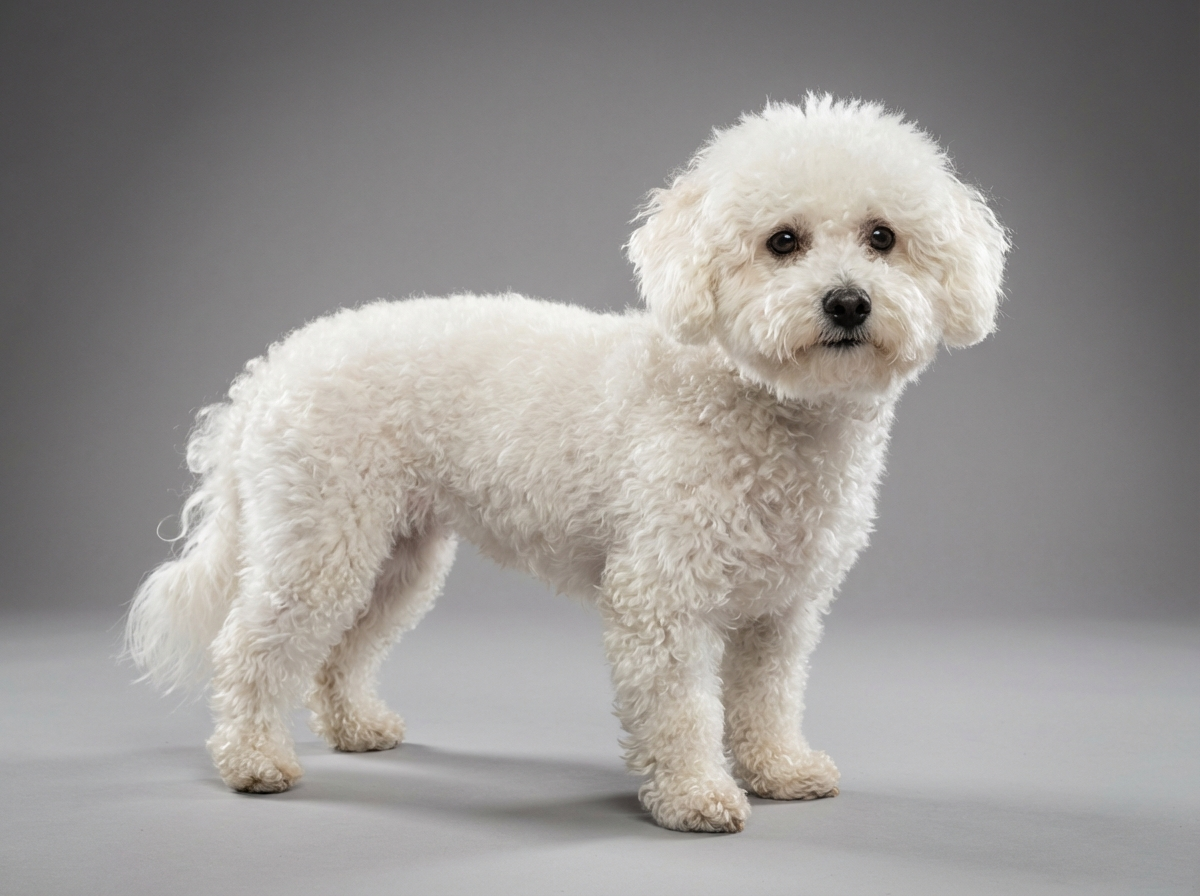
This is a dog engineered over centuries to want your company. Separation distress in a Bichon is not a training failure. It is the breed's defining trait pointing in an inconvenient direction.
Owners returning to office work after a period at home, people whose neighbours have complained about barking, and anyone finding scratched doorframes or puddles from a dog that is otherwise perfectly house-trained.
This guide is not medical advice. If your dog shows pain, sudden behavior change, or worsening symptoms, consult a licensed veterinarian.
Some links may be affiliate links. We may earn a commission at no extra cost to you. We only suggest products we believe are helpful for dog owners.
We research and check what we publish, but we do not warrant that any figure, date, price, or statement is accurate, complete, or current, and we accept no liability for any loss, cost, injury, or other harm arising from the use of this site. Use it as one reference among several. You remain responsible for your own decisions and for your dog's care - confirm anything that matters with a licensed veterinarian or another qualified professional before you act on it. Full disclaimer.
Separation-related distress is a panic response to being left, not disobedience or spite. In the Bichon Frise it is a foreseeable consequence of a temperament selected purely for companionship, with a documented low tolerance for time alone. It responds well to systematic graduated absence training, and poorly to almost everything else, including punishment, extra exercise alone, or the acquisition of a second dog.
Separation-related behaviour is among the most frequently reported behaviour problems in companion dogs, and breeds developed exclusively for human company are over-represented. Given the Bichon's low alone-time tolerance rating, an owner planning long working days should treat this as a likely challenge to prepare for rather than an unlikely one to react to.
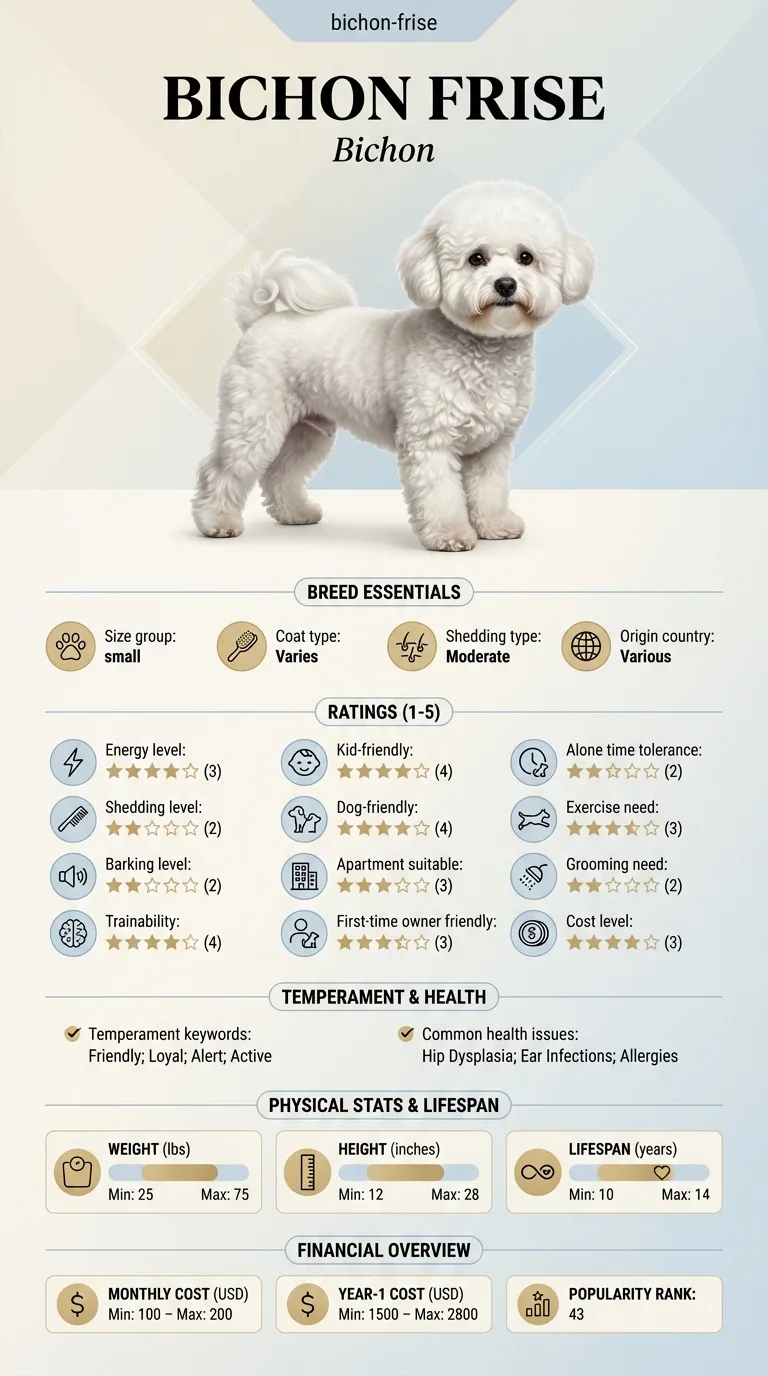
Every documented trait points the same way. The Bichon's tolerance for being alone is rated two out of five. Its temperament keywords are playful, curious, cheerful and affectionate. It scores highly for friendliness toward family, strangers and other dogs, and it is rated as highly suitable for apartments, which in practice means a dog designed to live in close proximity to its people. Its exercise requirement is modest, so physical tiredness is not available as a route to a calm dog left behind.
Modern working patterns are the immediate cause of most cases. A dog acquired during a period of home working, then left for eight hours when that changes, has had no opportunity to learn absence gradually. Apartment living raises the stakes because barking generates complaints, which adds owner stress that the dog reads. Households where the dog is never alone, even briefly, inadvertently prevent it from ever developing the skill.
Engage a qualified behaviourist early rather than after months of unsuccessful attempts, since repeated panicked absences make the problem harder to treat. Look for someone who works from video evidence and builds absences in graduated increments, and be wary of anyone who proposes punishment, anti-bark devices or simply leaving the dog to get over it. Because this breed's low alone-time tolerance is well documented, a behaviourist who knows companion breeds will set realistic expectations from the start.
Book a veterinary appointment before starting behaviour work, because pain and illness can both produce or worsen distress, and indoor urination in a house-trained dog has medical causes that must be excluded. Seek prompt attention if your dog is injuring itself, breaking teeth or nails on doors or crates, or if there is blood anywhere. Also worth discussing is whether anti-anxiety medication would make the training possible in a dog too aroused to learn, which is a decision only a vet can make.
See all Bichon Frise health problems, which breeds are prone to separation anxiety, or the full Bichon Frise breed guide for temperament, exercise needs and ownership costs.
Mild cases often improve substantially within four to six weeks. Established severe cases take several months and progress is not linear; setbacks after a disrupted week are normal rather than a sign of failure. The variable that most determines the timeline is whether full-length absences can genuinely be avoided during the programme.
Camera footage of a dog that settles within a few minutes of your departure and sleeps through the absence. Success is a calm dog, not a quiet one, and the difference matters: a dog that has learned that noise is pointless may still be distressed.
Both produce damage and noise, but the underlying state is different and so is the fix. A camera is what tells you which you have.
The treatment for separation distress is systematic desensitisation, and it works by never letting the dog experience the panic it fears. That is a demanding standard, and it is the reason most attempts fail.
Start by identifying the point at which your dog begins to worry. Film several departures and watch where the change happens: it is frequently long before you leave, at the point you pick up keys or put on shoes. Those pre-departure cues have to lose their meaning first, which means picking up keys and sitting back down, dozens of times, until the dog stops reacting.
Then build absence in increments the dog can handle. If your Bichon is calm for forty seconds and worried at sixty, you work at thirty. Not at five minutes because five minutes seems short to you. Progress is measured in seconds early on and that is normal.
The hardest requirement is avoiding full-length absences during training, because every panicked departure undoes progress. This usually means daycare, a sitter, or a friend for the period the protocol runs, which is where most households find the real cost.
A camera is not optional. You cannot titrate an absence you cannot observe, and owners consistently misjudge how quickly their dog becomes distressed.

If you think your Bichon has separation anxiety, the plan is three steps: write down what you have seen and when it started, book a veterinary appointment rather than waiting for the next flare, and take video of the behaviour or symptom before you go — the thing you are worried about rarely happens in the consulting room. Screening in the parents covers skin allergies, patellar luxation, bladder stones.
What the vet visit should produce is a diagnosis and a written plan, not just reassurance: what is being ruled out, what the monitoring interval is, and which signs mean you come back sooner. Ask what the treatment costs across a year rather than per visit, because that is the number that decides whether you are managing this condition or reacting to it.
Between appointments, keep a short log — dates, what you saw, what changed. It is the single most useful thing an owner brings to a follow-up, and for separation anxiety it is often what separates a clear pattern from a guess.
When Sam returned to the office, his Bichon Nell began howling within minutes and had scratched the paint off the inside of the front door within a fortnight. He tried longer morning walks, a second radio and a stuffed toy, and none of it helped. A behaviourist asked for footage. Nell's distress started the moment Sam picked up his rucksack, before he had reached the hallway. She was pacing and panting before the door closed. They spent two weeks on the rucksack alone. Then absences: forty seconds, then a minute, then three. Nell went to a sitter on working days throughout. Four months later she slept through a five-hour absence, and the door has not been touched since.
Key takeaway: The starting point is wherever the dog is still calm, which is usually far earlier and far shorter than an owner assumes. Longer walks and background noise do not treat panic.
The breed's tolerance for being left alone is rated two out of five, which is low. Combined with an affectionate, people-focused temperament and a history purely as a companion animal, this is a breed where separation problems are a foreseeable risk rather than a surprise.
There is no universal number, and any figure quoted is a household judgement rather than a breed rule. What matters is what your individual dog can tolerate calmly, which a camera will show you. Many Bichons manage a few hours comfortably once trained; some manage far less without preparation.
Usually not. Separation distress in this breed is typically about the absence of its people rather than about being alone in general, so a canine companion often makes no difference. It also doubles your costs and can teach a new dog to be anxious by observation.
It depends entirely on the dog. A dog that already loves its crate may settle better in one. A distressed dog confined in a space it cannot leave often panics harder and can injure itself trying to escape. Never introduce a crate as a solution to existing distress without professional guidance.
For some dogs, yes. Where anxiety is severe enough that the dog cannot learn because it is too aroused, veterinary-prescribed medication used alongside a behaviour programme can make the training possible. That is a discussion for your vet, and medication alone without a behaviour plan rarely resolves it.
Emotional departures and reunions do add to the contrast between your presence and your absence, and calm ones help. But this is a minor factor, and owners who focus on it alone rarely see change. The graduated absence work is what actually moves the needle.
Barking or howling that starts soon after you leave, damage at exit points, indoor toileting, drooling and pacing.
Set up a camera. It is the single most useful step, and owners are routinely wrong about when distress begins.
A qualified behaviourist works over several sessions, and daycare or sitters during the training period often cost more than the fees.
It may help mask outside noise but does not treat the underlying distress. Use it alongside a proper protocol, not instead.
Typically several weeks to a few months, depending on severity and how consistently full-length absences can be avoided.
Behaviour changes often start with pain. The prep sheet for this page covers what to rule out, and what to ask.
You get: Vet visit prep sheet
No spam. One-click unsubscribe. See our privacy policy.
Preview page 1 before you decide.