Training
Which is easier to train?
The Bichon Frise, rated Moderate (3/5) versus the Shiba's Low (2/5).

Quick answer
Which is easier to train?
The Bichon Frise, rated Moderate (3/5) versus the Shiba's Low (2/5).
Bichon Frise or Shiba Inu? On paper they differ most on shedding, and on the scales Shiba Inu is the heavier at 17–23 lbs. Here is how the two compare on everything that shapes an ordinary week.
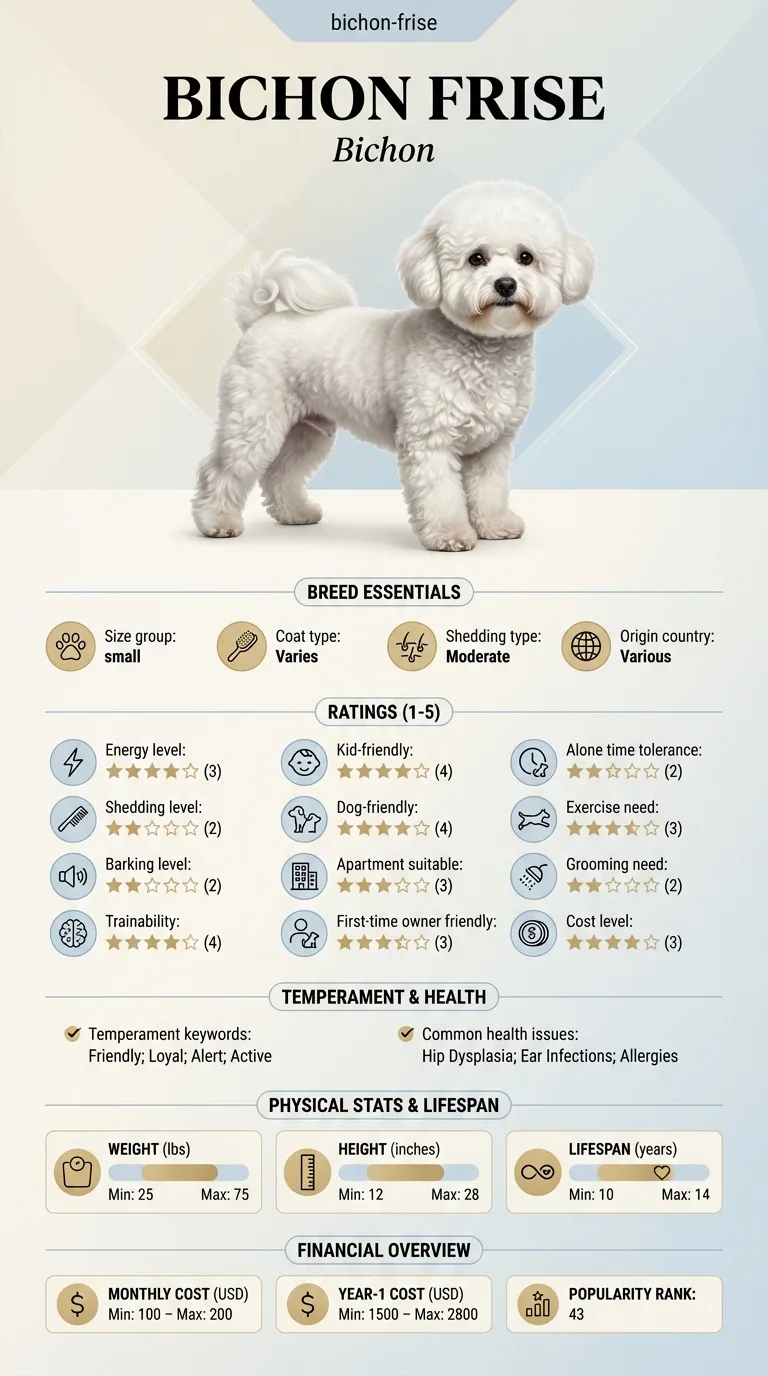
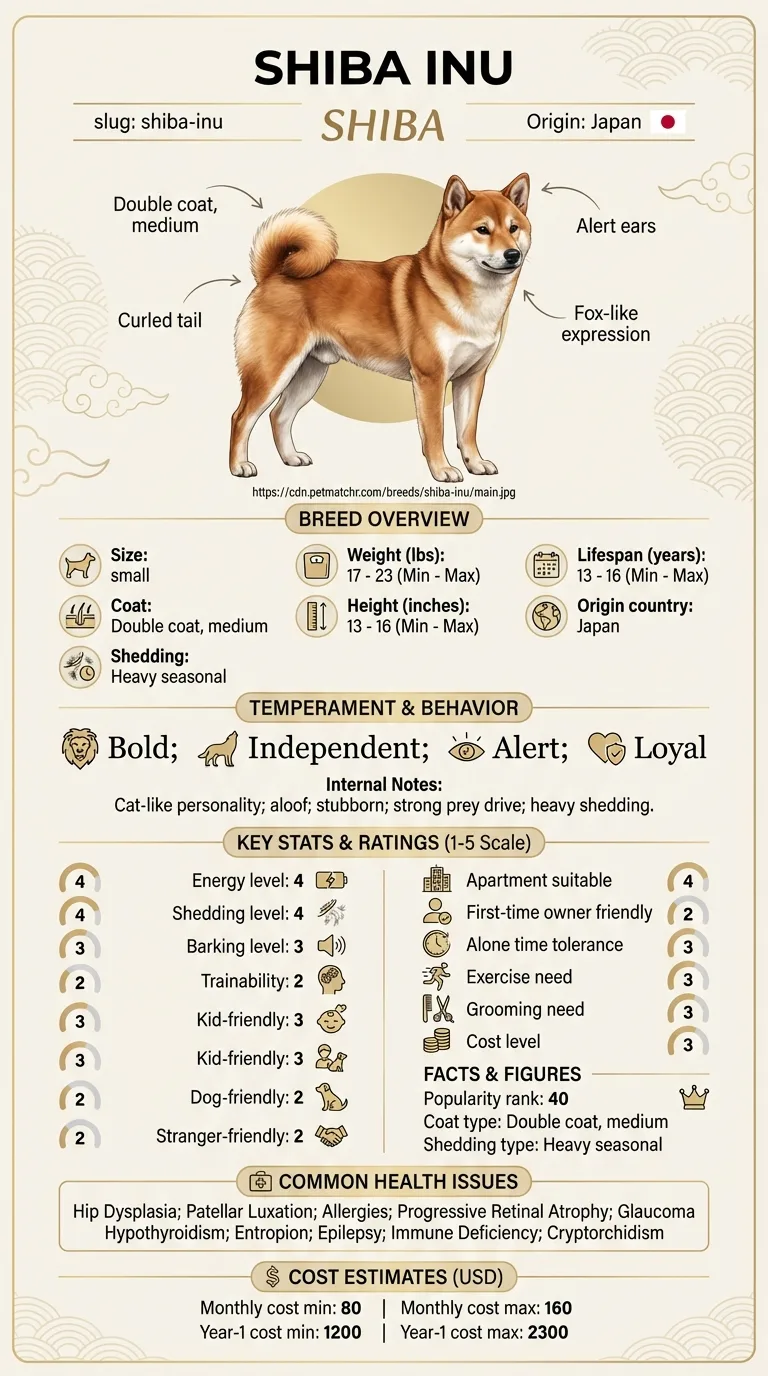
This is for someone already down to Bichon Frise and Shiba Inu and deciding between them. For this pair the decision usually turns on shedding and grooming need, so those are covered first and in most detail. Anyone choosing from a flat has a clear answer here: Bichon Frise rates 5/5 against 4/5. Breed history is left out; what follows is what you will actually live with.
Between Bichon Frise and Shiba Inu, shedding is what separates them, and Bichon Frise is the lower-effort dog of the two to keep.
Choose Bichon Frise if you are in a flat or a smaller home, this is your first dog and shedding is a problem in your house.
Choose Shiba Inu if you do not want a standing grooming appointment, the dog will be alone during the working day and you want a dog that can keep up with an active routine.
| Feature | bichon frise | shiba inu | Winner |
|---|---|---|---|
| Size class | small | small | Equal |
| Weight | 12–18 lbs | 17–23 lbs | Equal |
| Height | 9–12 in | 13–16 in | Equal |
| Lifespan | 14–15 years | 13–16 years | Equal |
| Exercise need | Low (2/5) | Moderate (3/5) | bichon frise |
| Grooming need | Very high (5/5) | Moderate (3/5) | shiba inu |
| Shedding | Very low (1/5) | High (4/5) | bichon frise |
| Energy level | Moderate (3/5) | High (4/5) | Equal |
| Barking | Moderate (3/5) | Moderate (3/5) | Equal |
| Apartment suitability | Very high (5/5) | High (4/5) | bichon frise |
| Good for first-time owners | High (4/5) | Low (2/5) | bichon frise |
| Tolerates being alone | Low (2/5) | Moderate (3/5) | shiba inu |
| Trainability | Moderate (3/5) | Low (2/5) | bichon frise |
| Good with kids | High (4/5) | Moderate (3/5) | bichon frise |
| Good with other dogs | High (4/5) | Low (2/5) | bichon frise |
| Friendly to strangers | High (4/5) | Low (2/5) | bichon frise |
| Cost level | Moderate (3/5) | Moderate (3/5) | Equal |
| Coat | Curly, dense double coat | Double coat, medium | Equal |
| Origin | Various | Japan | Equal |
| Typical monthly cost | $80–$150 | $80–$160 | Equal |
| Typical first-year cost | $1,100–$2,300 | $1,200–$2,300 | Equal |
The Shiba Inu runs modestly larger than the Bichon Frise — 17–23 lbs and 13–16 inches versus 12–18 lbs and 9–12 inches — though both stay solidly in small-breed territory and either fits comfortably in a standard car crate or a modest apartment hallway. The coat tells a more interesting story: the Bichon's curly, dense double coat needs constant styling, while the Shiba's medium double coat is closer to a wash-and-wear, spitz-type coat that sheds rather than mats. Physically compact and similarly sized, the two breeds diverge far more in temperament, facial expression, and coat behavior than in raw dimensions.
Exercise need edges toward the Shiba, Moderate (3/5) against the Bichon's Low (2/5), and energy level scores a tie at Moderate (3/5) versus High (4/5) — the Bold, Independent Shiba genuinely wants daily activity, though its self-sufficient nature means it's less likely to pester an owner for attention the way the Playful Bichon will. Both are manageable for moderately active owners, but the Shiba's exercise needs run a notch higher and its Independent streak means it won't always readily comply with a planned exercise routine the way a more people-focused breed might.
Grooming need favors the Shiba, Moderate (3/5) against the Bichon's Very high (5/5), but shedding flips decisively the other way — Very low (1/5) for the Bichon versus High (4/5) for the Shiba, whose spitz-type double coat blows out heavily twice a year. The trade-off is straightforward: the Bichon demands frequent professional grooming but leaves little hair behind, while the Shiba needs comparatively little professional grooming but will cover furniture and clothing in fur during seasonal shedding season.
Apartment suitability favors the Bichon, Very high (5/5) against the Shiba's still-respectable High (4/5), with barking tied at Moderate (3/5) for both. Where the two diverge more meaningfully is alone-tolerance: the Independent Shiba actually handles solo time better, rated Moderate (3/5) versus the Bichon's Low (2/5), a natural extension of its more self-sufficient, cat-like temperament compared to the Affectionate, attention-seeking Bichon, which was bred for close companionship rather than independence.
This is where the gap widens sharply: the Bichon is rated High (4/5) for first-time owners against the Shiba's Low (2/5), and trainability actually favors the Bichon too, Moderate (3/5) versus the Shiba's Low (2/5) — an unusual reversal, since Shibas are intelligent but famously Independent and prone to selective hearing, a combination that frustrates novice handlers expecting quick obedience. A first-time owner will almost certainly have an easier time with the Bichon's more cooperative, people-pleasing nature than with the Shiba's strong-willed, cat-like independence.
The Bichon leads across every social category here: High (4/5) with kids against the Shiba's Moderate (3/5), High (4/5) with other dogs against the Shiba's Low (2/5), and High (4/5) friendliness to strangers against the Shiba's Low (2/5). The Bold, Alert Shiba tends to be more selective about affection and can be reactive toward unfamiliar dogs, so households with frequent visitors, other pets, or young kids who want an eagerly social dog will find the Bichon a substantially easier fit.
Lifespan ties broadly between the two, both landing in the mid-to-high-teens range, but health concern count differs sharply: five conditions for the Bichon against ten for the Shiba, including Glaucoma, Epilepsy, Immune Deficiency, and Progressive Retinal Atrophy alongside joint issues like Hip Dysplasia and Patellar Luxation. Prospective Shiba owners should ask breeders about health testing for these eye and immune conditions specifically, since several appear regularly enough in the breed to warrant proactive screening.
Cost runs nearly identical: both rated Moderate (3/5) cost level, with the Bichon at $80–$150 monthly and $1,100–$2,300 in year one against the Shiba's $80–$160 monthly and $1,200–$2,300 — a difference of at most $10 a month once the ranges are lined up side by side. With baseline costs this close, the real budget variable is veterinary spending over the Shiba's longer list of potential health conditions, plus the possibility of professional trainer sessions to manage its Independent streak, rather than any meaningful gap in day-to-day care costs.
Bichon Frise weighs 12–18 lbs and lives 14–15 years; Shiba Inu weighs 17–23 lbs and lives 13–16 years. The two diverge most on shedding, grooming need and good for first-time owners and 2 other rated axes. They are level on barking and cost level, so those cannot decide it. The comparison marks an easier option only where one exists. Facts like weight and country of origin are not scored. Both dogs are rated from the same dataset, which is what makes the numbers comparable with each other even though any individual dog sits somewhere inside its breed's range.

Not especially — it's rated Low (2/5) for first-time owners and Low (2/5) trainability, reflecting its famously Independent, strong-willed temperament, versus the Bichon's High (4/5) and Moderate (3/5).
The Shiba Inu, rated High (4/5) versus the Bichon's Very low (1/5) — Shibas blow their spitz-type coat heavily twice a year.
It's rated Low (2/5), notably lower than the Bichon's High (4/5), and Shibas can be selective or reactive with unfamiliar dogs.
The Shiba Inu, rated Moderate (3/5) versus the Bichon's Low (2/5), consistent with its more independent, self-sufficient nature.
Yes, both rated Moderate (3/5) cost level, with nearly identical monthly and first-year cost ranges.
The data lists ten conditions for the Shiba, including Epilepsy and Immune Deficiency, versus five for the Bichon.
The Bichon Frise, rated High (4/5) versus the Shiba Inu's Low (2/5).
The Bichon Frise, rated Moderate (3/5) versus the Shiba's Low (2/5).
The Shiba Inu, rated Independent and Bold in temperament.
The Bichon Frise, rated Very low (1/5) versus High (4/5).
The Bichon Frise, rated High (4/5) versus Low (2/5).
Secure checkout on Stripe. We never see your card.
7-day money-back guarantee. Instant access.
Health information here is general and is not veterinary advice. If your dog shows pain, sudden behaviour change, or worsening symptoms, consult a licensed veterinarian.
Some links on this site are affiliate links. We may earn a commission at no extra cost to you, and we only suggest products we believe are helpful for dog owners.
We research and check what we publish, but we do not warrant that any figure, date, price, or statement is accurate, complete, or current, and we accept no liability for any loss, cost, injury, or other harm arising from the use of this site. Use it as one reference among several. You remain responsible for your own decisions and for your dog's care - confirm anything that matters with a licensed veterinarian or another qualified professional before you act on it. Full disclaimer.
Match your lifestyle to the right dog.
Take quizNot sure which breed is right for you? Take our 2-minute quiz to find out.
Take the quiz