Living
Do I need to raise my Bichon's food bowl?
No. Bowl height advice comes from large breed research. Choose a height your dog can eat from comfortably and stop thinking about it.

Quick answer
Do I need to raise my Bichon's food bowl?
No. Bowl height advice comes from large breed research. Choose a height your dog can eat from comfortably and stop thinking about it.
Sorting the bloat advice that matters for a Bichon Frise from the advice that does not takes about five minutes, and it is worth doing once properly rather than worrying about it forever.
New Bichon owners assembling a feeding routine from internet advice, and anyone who has just been handed a list of bloat rules by a well-meaning friend with a large breed. It suits people who want to know what the evidence actually supports rather than what gets repeated.
This guide is not medical advice. If your dog shows pain, sudden behavior change, or worsening symptoms, consult a licensed veterinarian.
Some links may be affiliate links. We may earn a commission at no extra cost to you. We only suggest products we believe are helpful for dog owners.
We research and check what we publish, but we do not warrant that any figure, date, price, or statement is accurate, complete, or current, and we accept no liability for any loss, cost, injury, or other harm arising from the use of this site. Use it as one reference among several. You remain responsible for your own decisions and for your dog's care - confirm anything that matters with a licensed veterinarian or another qualified professional before you act on it. Full disclaimer.
Bloat in everyday use covers two different things. One is a stomach uncomfortably full of gas or food, which is common, self-limiting and not dangerous. The other is gastric dilatation-volvulus, where the stomach twists and the dog goes into shock within hours. The first happens to Bichon Frises occasionally. The second is a large deep-chested breed emergency that this compact breed rarely faces.
Ordinary digestive discomfort is common in this breed as in any dog, and most of it resolves within a day. True gastric dilatation-volvulus is rare in small compact dogs and does not appear on the Bichon Frise list of documented health problems. Owners are far more likely to meet a dog that ate something it should not have than a dog whose stomach has rotated.
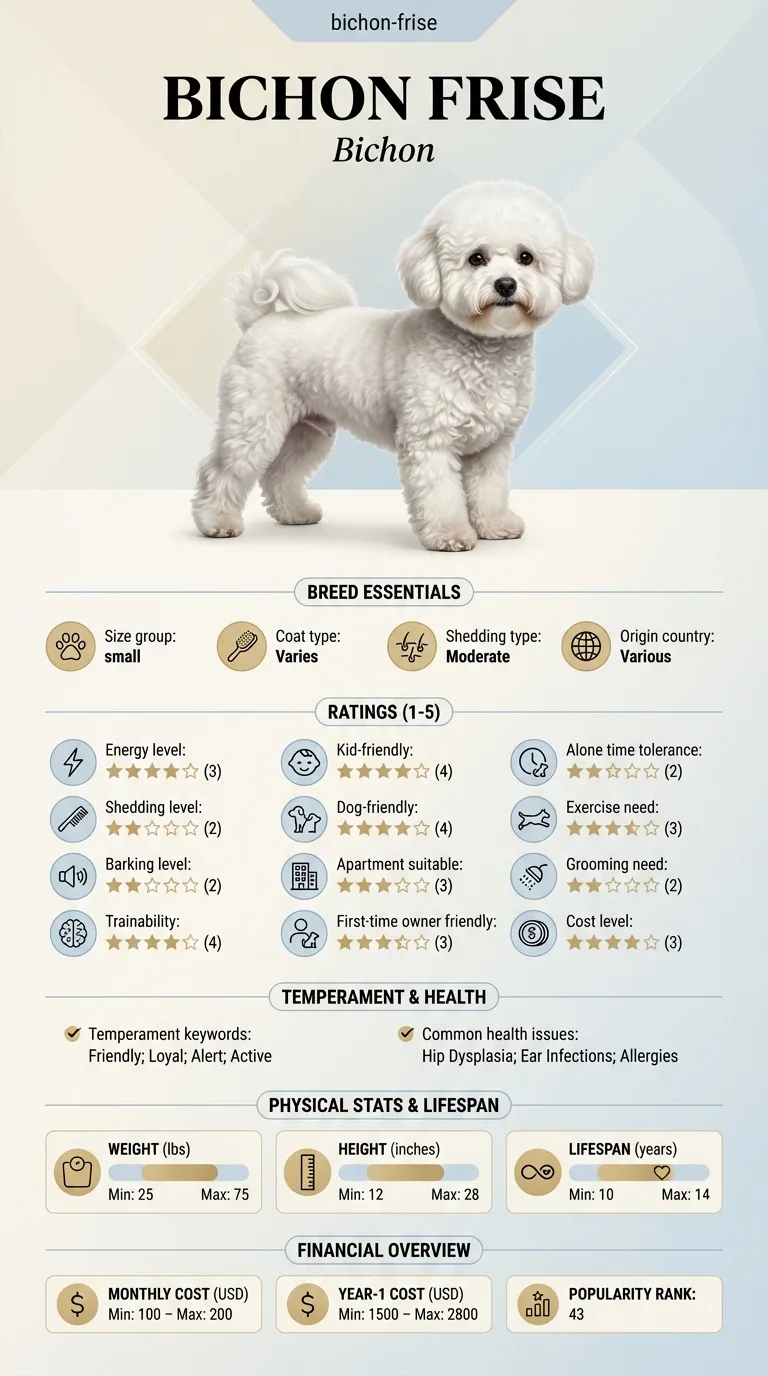
The Bichon Frise is not built for this condition, and that is the useful breed fact. A stomach twists most readily in a tall dog with a chest that is deep front to back and narrow side to side, which gives the organ room to swing. This breed measures 9 to 12 inches at the shoulder in a compact square frame weighing 12 to 18 pounds. Where the breed's own biology does bear on digestion is elsewhere: dental disease is documented here, and a painful mouth changes how a dog chews and swallows, while the same allergic tendency that affects the skin can also express itself as food sensitivity.
How a household feeds a small dog matters more than bowl height ever will. Homes with one large evening meal produce dogs that go many hours on an empty stomach and vomit bile in the morning. Homes where several people feed the dog produce overfeeding nobody has counted. Homes with accessible bins, worktops and children's snacks produce scavenging, which in this breed is the real gateway to acute digestive illness. Multi-dog households add competitive gulping, which turns a normal eater into a dog that inhales its bowl in twenty seconds.
Call the same day for repeated vomiting, a hunched praying posture, an abdomen that is painful when gently touched, refusal of food in a dog that normally eats eagerly, or blood in vomit or stool. Go to an emergency clinic immediately, without delay and without home remedies, if your Bichon is retching repeatedly and producing nothing, has a rapidly swelling hard abdomen, is drooling and pacing without being able to settle, has pale or grey gums, or collapses. Do not attempt to induce vomiting in a dog with a swollen abdomen or a suspected swallowed object, because it can make things considerably worse.
See all Bichon Frise health problems, which breeds are prone to bloat gdv, or the full Bichon Frise breed guide for temperament, exercise needs and ownership costs.
A feeding routine change takes about two weeks to show its effect, whether you are looking at morning bile vomiting, gulping or general comfort. Give any single change that long before judging it, and change one thing at a time. Scavenging behaviour takes longer to shift, typically four to eight weeks of consistent training, and it never becomes perfect. Managing access remains part of the plan permanently.
Success is an owner who is no longer anxious about a risk that barely applies to their dog, who feeds two measured meals a day, whose Bichon is not raiding bins, and who would recognise a genuine abdominal emergency immediately if one ever appeared. It is a calmer household and a leaner dog, which incidentally protects the joints that this breed genuinely does have trouble with.
Each of these circulates as universal truth. Some are useful for any dog, some are aimed at a body type your Bichon does not have, and one is actively unhelpful.
If you redirect the energy you were spending on bloat, here is where it earns more. Small companion dogs have their own predictable digestive pattern, and recognising it early saves far more trouble.
The first is scavenging. A curious, food-motivated Bichon that hoovers up material on walks meets fatty scraps, cooked bones and inedible objects. Fatty leftovers can inflame the pancreas. Fabric and toy fragments can obstruct a small intestine.
The second is early-morning bile vomiting. A dog fed one evening meal may have an empty stomach for fourteen hours and bring up yellow foam before breakfast. Splitting the ration or adding a late snack often solves it entirely.
The third is a hunched, praying posture with the chest lowered and the rear raised. That is a dog with abdominal pain trying to get comfortable, and it is a same-day veterinary sign in any breed.
The fourth is a change in what comes out. Persistent soft stool, mucus or blood matters more than a single dramatic incident, particularly in a dog with the skin allergies this breed is documented to have, since food sensitivity can show at both ends.

Poppy's owner, Hannah, had a Great Dane before she had a Bichon Frise. She brought all the habits with her: an elevated bowl, a strict hour of stillness after meals, and a lasting fear of the word bloat. Meanwhile Poppy was eating one large evening meal, vomiting yellow foam most mornings, and had put on two pounds because a second person in the house was topping the bowl up. Her vet made three changes. The daily amount was weighed and split across morning and evening. A small snack was added before bed. The bowl went back on the floor, where a nine inch dog eats more comfortably anyway. The morning vomiting stopped within a fortnight. Poppy lost the two pounds over four months. Hannah kept exactly one habit from her Great Dane days, which was knowing where the emergency clinic was and how long it took to drive there.
Key takeaway: Advice built around a giant breed does not scale down to a fifteen pound dog, and the effort spent following it is usually needed somewhere far more useful.
Not as a daily concern. Stomach rotation is tied to a deep narrow chest and large body size, neither of which this breed has, and it is not among the health issues documented for Bichon Frises. Knowing the emergency signs is worthwhile; restructuring your feeding routine around it is not.
Judge the dog rather than the belly. A well-fed dog that is relaxed, comfortable and asking for a walk has simply eaten. A dog with a tight abdomen that is pacing, drooling and trying unsuccessfully to vomit is a different situation entirely and needs emergency care.
For a dog that inhales its food, yes, though the benefit is in reduced gulping of air, less regurgitation and a bit of mental engagement rather than in bloat prevention. Scattering kibble on a snuffle mat achieves the same thing and adds enrichment for a curious breed.
Two measured meals a day is a better approach for most dogs of this breed, and not because of bloat. A dog with an exercise need of two out of five and a strong appetite gains weight easily on free access, and excess weight drives the joint problems this breed genuinely faces.
Gulping large volumes can make a dog uncomfortable and can bring on vomiting, but it is not a recognised cause of gastric rotation. If your Bichon is suddenly drinking far more than usual, that itself is worth a veterinary conversation, because increased thirst can signal several unrelated conditions.
Drive safely and do not attempt any home treatment. Do not try to make your dog vomit, do not give food, water or any medication, and do not press on the abdomen. Phone the clinic while someone else drives so they can prepare for your arrival.
No. Bowl height advice comes from large breed research. Choose a height your dog can eat from comfortably and stop thinking about it.
Two measured meals works for most adults, with three for puppies. Splitting the ration also helps dogs that vomit bile before breakfast.
Scavenging. Fatty scraps and swallowed objects cause far more small-dog emergencies than stomach rotation ever will.
Yes. A dog with its chest lowered and rear raised is usually in abdominal pain and needs a same-day veterinary appointment.
Not for this breed. Preventive stomach tacking is aimed at giant deep-chested dogs and is not routine practice for compact small dogs.
A one-page prep sheet for this condition: the signs, the questions to ask, what to get priced. Unlocks here.
You get: Vet visit prep sheet
No spam. One-click unsubscribe. See our privacy policy.
Preview page 1 before you decide.