Health
Does airway obstruction get worse over time?
Yes. Chronic negative pressure thickens throat tissue and eventually weakens the laryngeal cartilage, so untreated cases progress rather than staying stable.

Quick answer
Does airway obstruction get worse over time?
Yes. Chronic negative pressure thickens throat tissue and eventually weakens the laryngeal cartilage, so untreated cases progress rather than staying stable.
Owners usually ask whether their Mastiff's breathing is bad enough to operate on. The more useful question is what it will look like in three years if nobody does.
Owners who have been told their dog's breathing is borderline and asked to monitor it, and owners weighing an airway procedure against the anaesthetic risk of a giant breed. It is also for anyone whose Mastiff has started making noise it did not make a year ago.
This guide is not medical advice. If your dog shows pain, sudden behavior change, or worsening symptoms, consult a licensed veterinarian.
Some links may be affiliate links. We may earn a commission at no extra cost to you. We only suggest products we believe are helpful for dog owners.
We research and check what we publish, but we do not warrant that any figure, date, price, or statement is accurate, complete, or current, and we accept no liability for any loss, cost, injury, or other harm arising from the use of this site. Use it as one reference among several. You remain responsible for your own decisions and for your dog's care - confirm anything that matters with a licensed veterinarian or another qualified professional before you act on it. Full disclaimer.
Brachycephalic obstructive airway syndrome is the clinical form of restricted breathing in short-muzzled dogs. Primary abnormalities, narrowed nostrils and an over-long soft palate, create resistance. The dog compensates by breathing harder, and that effort produces secondary damage, everted saccules and eventually laryngeal collapse. In the English Mastiff the primary abnormalities are usually moderate, so clinical cases are a minority rather than the norm.
Clinically significant obstruction is uncommon in this breed compared with the flat-faced breeds where it defines the health profile. Most Mastiffs snore and dislike heat without ever needing an airway procedure. The reason it matters here is that a minority of individuals do sit at the compressed end of the range, and their disease is progressive, so recognising them early changes what surgery can achieve.
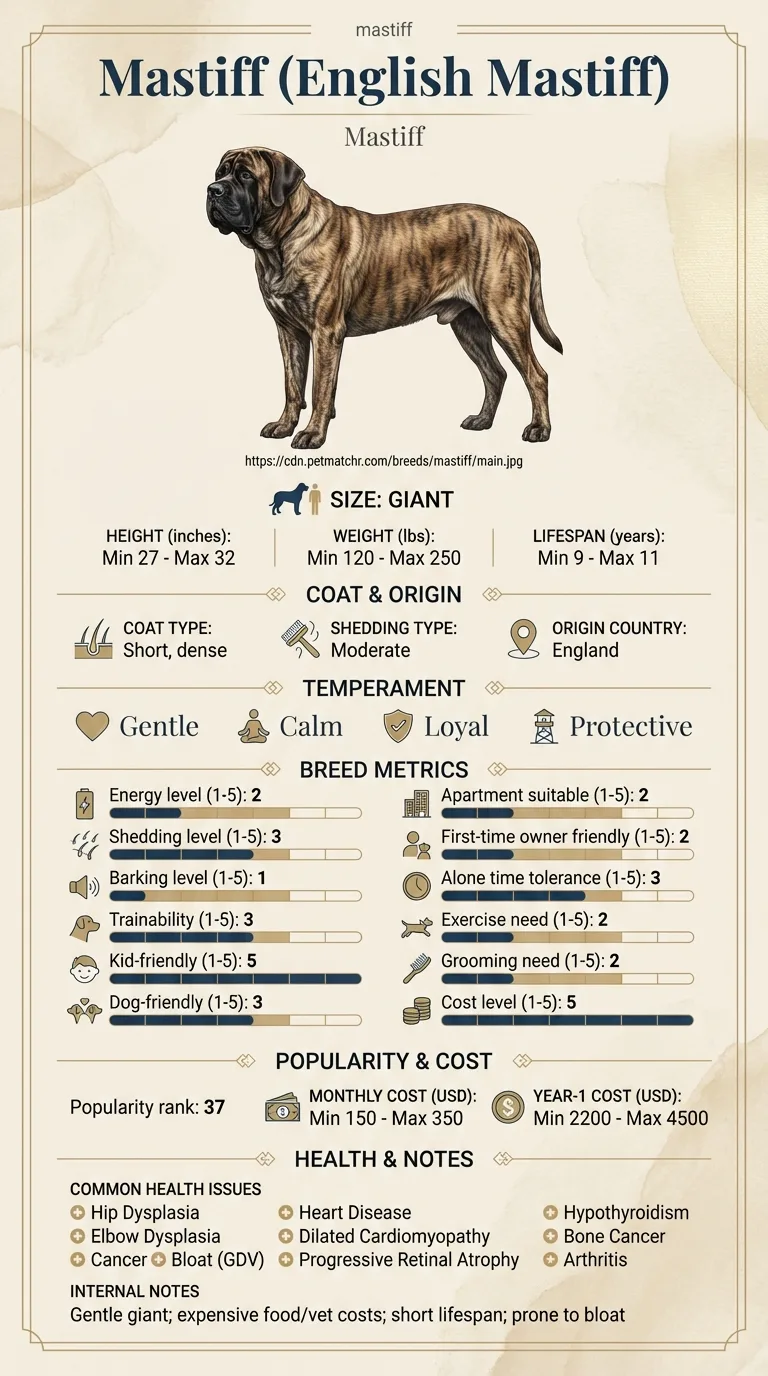
Selection for a broad, deep, foreshortened jaw compressed soft tissue into a shorter skull without reducing the amount of that tissue. The soft palate, in particular, may extend past the point where the airway begins. What makes this significant in a Mastiff rather than merely cosmetic is the body it serves: a dog of 120 to 250 pounds has a large metabolic demand and a large volume of air to move, so even a modest restriction is being asked to do a great deal of work every day.
Warmth and humidity are the conditions under which a compensating dog stops compensating, which is why cases are so often first recognised in summer. Body weight is the strongest modifiable factor, because fat around the neck and chest narrows the airway further and reduces lung expansion. Households where the dog is regularly whipped into excitement, or exercised hard in warm conditions, accelerate the secondary tissue changes that make later surgery less effective.
Book an assessment if there is breathing noise while your Mastiff is awake and at rest, if noise has increased over recent months, if exercise tolerance has fallen, if the dog gags or brings up froth, or if sleep is disturbed by choking or repeated repositioning. Ask specifically what would change the plan if you are told to monitor. Treat as an immediate emergency any collapse, blue, grey or very pale gums, frantic laboured breathing in a dog that is not overheated, or an inability to settle because of breathing effort. Airway crises can escalate within minutes, and a dog in one needs oxygen and sedation that only a clinic can provide.
See all Mastiff health problems, which breeds are prone to brachycephalic obstructive airway syndrome boas, or the full Mastiff breed guide for temperament, exercise needs and ownership costs.
From first concern to a definitive answer usually runs four to eight weeks, allowing for referral and a sedated examination. After straightforward surgery, most improvement is apparent within two to four weeks once swelling settles. Untreated, progression is measured in years rather than months, but it is genuine and it is one-directional.
In an operated dog, success is quiet breathing at rest, faster recovery after mild exercise, better heat tolerance and undisturbed sleep. In a monitored dog, success is a stable annual assessment with no increase in resting noise and no loss of exercise tolerance. In both, the underlying head shape remains and so does the need for sensible summer management.
The syndrome is not one abnormality but several, and crucially some of them are consequences of the others. That sequence is what makes timing matter.
Airway surgery in a giant breed sits at an awkward intersection. The dog whose breathing is worst is also the dog for whom anaesthesia carries the most risk, because a compromised airway is exactly what makes induction and recovery delicate. That is an argument for operating earlier, when the dog is younger and the obstruction milder, rather than for avoiding it.
Assessment usually begins with a clinical examination and an honest history, then moves to a graded exercise test in some centres and to direct visual examination of the throat under sedation. That last step is the one that actually answers the question, because a soft palate and a set of laryngeal cartilages cannot be judged from the outside. Imaging of the chest is often included to check for changes secondary to years of laboured breathing.
What surgery can and cannot do is worth stating plainly. Widening the nostrils and shortening an over-long palate reliably improves airflow, and the improvement is often dramatic in dogs assessed before secondary changes are advanced. Removing everted saccules helps. Established laryngeal collapse of a high grade is a different matter: it may not be reversible, and the options at that point become salvage procedures with significant trade-offs.
This is why the phrase we will monitor it deserves a follow-up question. Monitor for what, over what period, and what finding would change the plan. A specific answer, such as a re-examination in six months with a repeat throat examination if resting noise appears, is a plan. A vague one is a delay.
Recovery is generally short for the straightforward procedures, with most of the risk concentrated in the first twenty-four hours as swelling peaks. Giant breeds are usually kept in for that window, which is one of the reasons the cost is higher than the surgical time alone would suggest.

Anwen's Mastiff Griff had always snored. Her vet's advice at his three-year check was to monitor, and Anwen asked the obvious follow-up: monitor how. Together they settled on a thirty-second phone recording of Griff breathing on the kitchen floor, taken every March, and a note of how long his breathing took to settle after a ten minute walk. For two years the recordings sounded identical. In the fourth year Griff was audibly rasping while awake, and the recovery time after the walk had gone from about ninety seconds to nearly four minutes. That evidence, rather than an impression, is what triggered referral. A sedated examination found an over-long soft palate and mildly everted saccules, but no significant laryngeal collapse. Both were addressed surgically. Griff still snores at night. He no longer makes noise awake, and he came through the following summer without the flat-out panting Anwen had come to expect.
Key takeaway: Monitor is only useful advice if it comes with a method. A dated recording and a stopwatch turn a vague instruction into a decision you can actually make.
Much less common than in the flat-faced breeds. The Mastiff's muzzle is only moderately shortened and severe obstruction is not among the breed's defining health problems. Individual dogs at the more compressed end of the range do need assessment, which is why the signs are worth knowing.
When the dog is audible while awake and resting in a cool room, when noise has clearly increased over months, when exercise tolerance has fallen, or when there is gagging, regurgitation or disturbed sleep. Snoring only while asleep, in an otherwise unlimited dog, is generally not the threshold.
That is exactly the calculation your vet or a specialist will help you make, and it depends on grade, age and the dog's other health. The important asymmetry is that risk rises as the disease progresses, so postponing indefinitely does not keep the risk constant, it raises it.
The cartilage that holds the voice box open loses rigidity after years of being pulled inward by hard breathing, and it begins to fold into the airway. It is graded by severity, and the higher grades are much harder to treat because the damage is structural rather than a matter of excess tissue.
Usually it reduces it substantially rather than eliminating it, and improvement is greatest in dogs operated on before secondary changes develop. Owners typically report better sleep, better heat tolerance and better exercise tolerance more consistently than total silence.
In borderline dogs it sometimes can, and it should be attempted first in any overweight patient because it improves both breathing and anaesthetic safety. It cannot lengthen a shortened muzzle or shorten an over-long palate, so it is a first step rather than an alternative in genuinely obstructed dogs.
Expect a referral consultation, sedated examination and, if indicated, surgery with an overnight or two-night stay. For a giant breed the anaesthetic and hospitalisation components are meaningfully higher than for a small dog, and the total is a four-figure sum in most markets.
Yes. Chronic negative pressure thickens throat tissue and eventually weakens the laryngeal cartilage, so untreated cases progress rather than staying stable.
Direct visual inspection of the soft palate and larynx under sedation. It cannot be assessed accurately from outside the dog.
Blue or grey gums, collapse, or frantic laboured breathing in a dog that is not hot needs immediate veterinary attention.
Earlier assessment generally gives better outcomes, because the secondary changes that make surgery less effective accumulate with time.
Most giant breeds stay hospitalised for that period, because swelling peaks in the first twenty-four hours and needs professional monitoring.
A one-page prep sheet for this condition: the signs, the questions to ask, what to get priced. Unlocks here.
You get: Vet visit prep sheet
No spam. One-click unsubscribe. See our privacy policy.
Preview page 1 before you decide.