Health
What does pancreatitis look like?
Repeated vomiting, refusal of food, abdominal pain often with a bowing posture of front legs down and rear raised, lethargy and sometimes diarrhoea.

Quick answer
What does pancreatitis look like?
Repeated vomiting, refusal of food, abdominal pain often with a bowing posture of front legs down and rear raised, lethargy and sometimes diarrhoea.
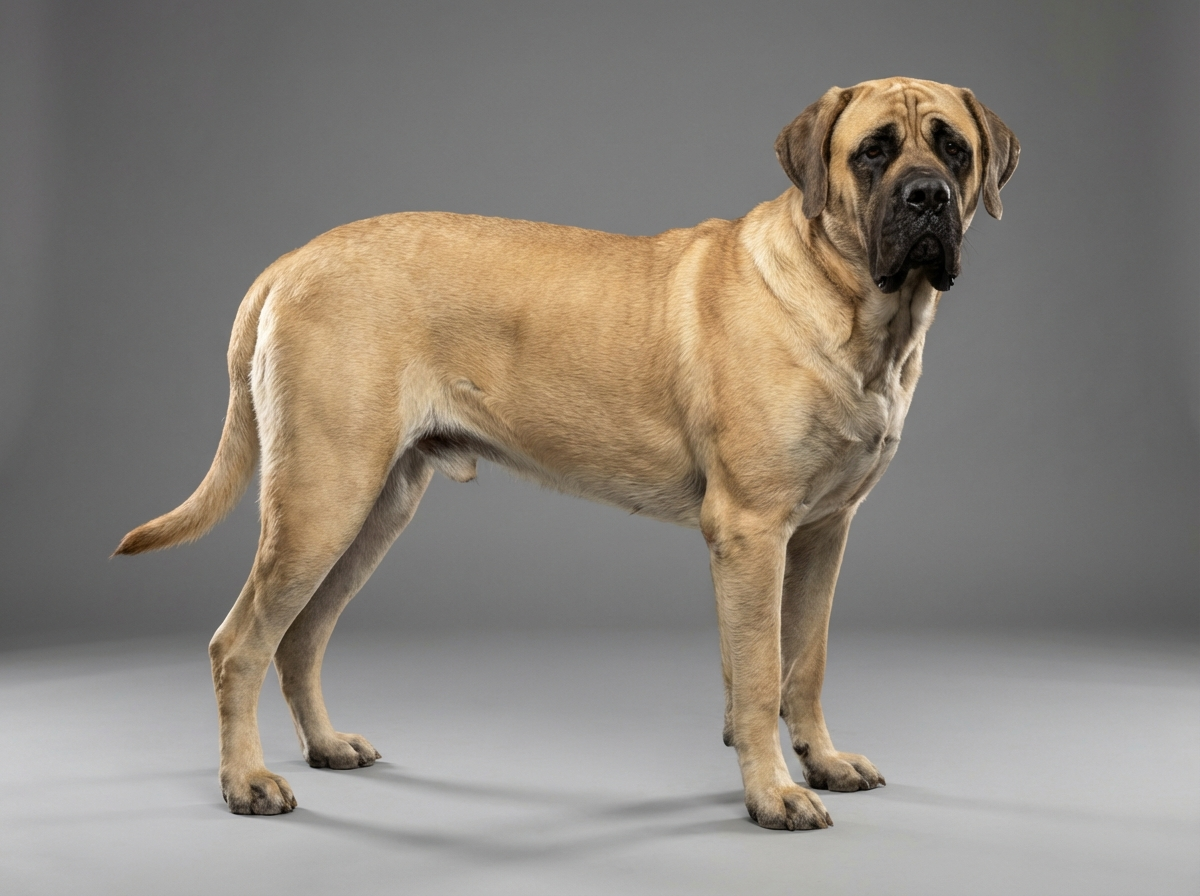
A dog standing 32 inches at the shoulder does not need to counter-surf. It simply reaches.
Owners of a Mastiff who is vomiting, off food and clearly uncomfortable, particularly after getting into something rich, and owners of a dog who has had one episode and wants to avoid another.
This guide is not medical advice. If your dog shows pain, sudden behavior change, or worsening symptoms, consult a licensed veterinarian.
Some links may be affiliate links. We may earn a commission at no extra cost to you. We only suggest products we believe are helpful for dog owners.
We research and check what we publish, but we do not warrant that any figure, date, price, or statement is accurate, complete, or current, and we accept no liability for any loss, cost, injury, or other harm arising from the use of this site. Use it as one reference among several. You remain responsible for your own decisions and for your dog's care - confirm anything that matters with a licensed veterinarian or another qualified professional before you act on it. Full disclaimer.
Pancreatitis is inflammation of the pancreas caused by digestive enzymes activating within the gland instead of in the intestine. It produces vomiting, abdominal pain, appetite loss and lethargy, and it ranges from a mild self-limiting episode to a life-threatening systemic illness. A high-fat meal is a well-recognised trigger, and in a household with a very tall dog, preventing access to rich food is largely a practical problem.
Pancreatitis is a common reason for dogs of all breeds to be admitted as emergencies and is not among the conditions documented as specific to Mastiffs. Its relevance here is twofold: this breed's height gives it access to food that most dogs cannot reach, and its documented bloat risk means every painful abdomen in a Mastiff has to be treated as potentially something faster and worse.
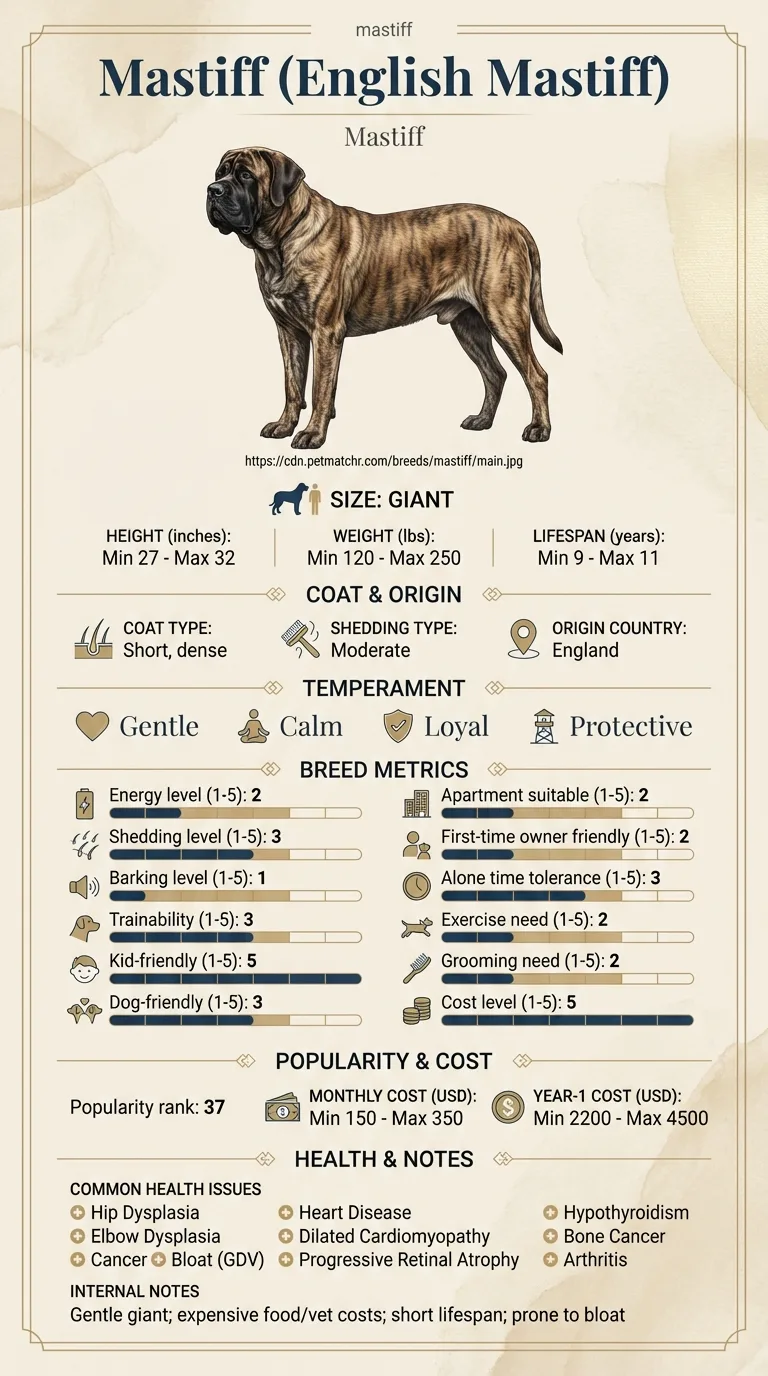
There is no documented Mastiff predisposition to pancreatitis, and it would be misleading to invent one. What the breed changes is exposure and stakes. Standing 27 to 32 inches at the shoulder, a Mastiff's head sits at worktop height, so counters, tables and standard kitchen bins are all within easy reach without any climbing or effort. On the other side, the breed's documented bloat risk means an owner cannot safely watch and wait when a Mastiff develops a painful abdomen, and its 120 to 250 pound body means treatment volumes, hospitalisation costs and handling difficulty all scale up considerably.
Household management is the main driver. Open bins, food left on counters, roast tins cooling within reach and unsupervised access to a kitchen during cooking all create opportunity. Visitors are a repeat offender, particularly at holidays, because a large dog looking hopeful is very persuasive to someone who does not know the rules. Body condition contributes, since overweight dogs appear to be at greater risk. Diets that are habitually rich, or supplemented with table food, keep a dog closer to the threshold than a consistent complete diet would.
Go to a veterinary clinic immediately, at any hour, if your Mastiff is repeatedly vomiting, will not eat, has a tense or painful abdomen, is adopting a bowing posture with the rear raised, or is restless and unable to settle. Do not attempt to distinguish this from bloat at home. Treat unproductive retching, a visibly distending abdomen, pale gums, or rapid deterioration as an absolute emergency requiring immediate travel. Do not withhold food and water for days hoping it settles, and never give human anti-sickness or pain medication. If your dog is known to have eaten something very fatty and seems fine, call for advice rather than waiting for signs.
See all Mastiff health problems, which breeds are prone to pancreatitis, or the full Mastiff breed guide for temperament, exercise needs and ownership costs.
A mild episode typically means one to three days of treatment, often with a night or two in hospital, and a return to normal appetite within a week. A severe episode can mean five days or more of intensive care and a recovery measured in weeks. Diet changes introduced afterwards are usually permanent. Where chronic pancreatitis develops, expect intermittent flare-ups over years rather than a single resolution.
Success after a first episode is a dog who returns to normal eating and energy and never has a second one, which depends far more on household discipline than on anything medical. For a dog with chronic disease, success is fewer and milder flares, stable weight and a consistent diet that everybody in the house respects. What owners should not expect is that the pancreas becomes robust again; once a dog has had pancreatitis it is generally treated as vulnerable to it for life.
The classic picture is repeated vomiting, complete loss of appetite, obvious abdominal pain, lethargy and sometimes diarrhoea. A dog in pancreatic pain often adopts a distinctive posture — front legs down and hindquarters raised, like a stretch that never ends — because it relieves pressure on an inflamed abdomen. Owners frequently describe it as bowing or praying.
In a Mastiff the crucial point is that these signs overlap heavily with bloat, which is documented on this breed's health issue list and is one of the fastest-moving emergencies in veterinary medicine. A dog with gastric dilatation and volvulus retches without producing anything, has a distending abdomen, is restless, and deteriorates rapidly. A dog with pancreatitis usually does bring something up.
That distinction is useful but nowhere near reliable enough for an owner to act on. Both present as a large dog with a painful abdomen who is retching and unwell, and one of them has a window measured in hours. The correct response to either is the same: go now, and let a vet sort out which it is.
Severity varies enormously. Some dogs have a mild episode that settles with a few days of supportive care. Others develop severe inflammation with systemic complications requiring intensive hospitalisation. There is no way to tell at the outset which one you are dealing with, and delay is what moves a dog from the first group to the second.
A high-fat meal is one of the best-recognised precipitants. In a household with a Mastiff, preventing that is largely an architecture problem.

If you think your Mastiff has pancreatitis, the plan is three steps: write down what you have seen and when it started, book a veterinary appointment rather than waiting for the next flare, and take video of the behaviour or symptom before you go — the thing you are worried about rarely happens in the consulting room. Screening in the parents covers hip dysplasia, elbow dysplasia, cancer.
What the vet visit should produce is a diagnosis and a written plan, not just reassurance: what is being ruled out, what the monitoring interval is, and which signs mean you come back sooner. Ask what the treatment costs across a year rather than per visit, because that is the number that decides whether you are managing this condition or reacting to it.
Between appointments, keep a short log — dates, what you saw, what changed. It is the single most useful thing an owner brings to a follow-up, and for pancreatitis it is often what separates a clear pattern from a guess.
Boxing Day morning, and Wendell's Mastiff, Tarquin, was found with his head in a roasting tin that had been left on the worktop overnight. He had eaten the fat, the skin and most of what was under it. By midday he was vomiting. By early afternoon he would not settle, kept standing with his front end down and his rear in the air, and cried when Wendell touched his belly. Wendell rang the emergency service, and the receptionist told him to come straight in without waiting. Radiographs were taken first to rule out bloat, which was normal, and bloodwork and ultrasound confirmed pancreatitis. Tarquin spent four days on fluids and pain relief. The bill was substantial, and covered. He went home on a low-fat prescription diet and has stayed on it since. The change Wendell made was small and permanent: the bin now lives inside a latched cupboard, and nothing is left on the worktop overnight, ever.
Key takeaway: Tarquin did not climb, jump or scheme. He was tall enough to stand and eat from a worktop. In a breed with a head at counter height, the effective prevention is not training the dog away from food but removing the opportunity entirely, and the go-now decision on the day is what kept a four-day admission from becoming something worse.
Treat it as one. Severity cannot be judged from outside, mild and severe episodes look similar at the start, and a Mastiff with a painful abdomen and repeated vomiting could equally have bloat, which is documented in this breed and can be fatal within hours. Go to a vet rather than waiting to see whether it settles overnight.
Usually a combination of the history, physical examination, blood tests including a pancreas-specific measure, and abdominal ultrasound. Imaging matters partly to look at the pancreas and partly to exclude other causes of the same picture. In a giant breed, radiographs are often taken early specifically to rule out gastric dilatation.
Supportively, in most cases: intravenous fluids, pain relief, anti-nausea medication and careful reintroduction of food. Current practice generally favours feeding sooner rather than starving a dog for days. Severe cases need intensive care. Treatment is prescribed and monitored by a vet, and there is no home version of it.
Yes, and recurrence is common enough that prevention is taken seriously after a first episode. Some dogs go on to develop chronic, low-grade pancreatic inflammation with intermittent flare-ups. A long-term low-fat diet and strict control of what the dog can access are the mainstays of prevention.
Usually a low-fat diet, prescribed or recommended by your vet, and often permanently. The important part is total consistency: no treats, chews or scraps outside that diet, because a single rich meal can undo months of careful management. Introduce any diet change gradually, given this breed's bloat risk.
A mild case managed with a couple of days of fluids and medication is a moderate bill. A severe case requiring several days of intensive care runs into thousands, and giant-breed patients cost more because fluid volumes, drug doses and hospital accommodation all scale with size. This is one of the arguments for insuring this breed early.
Repeated vomiting, refusal of food, abdominal pain often with a bowing posture of front legs down and rear raised, lethargy and sometimes diarrhoea.
You should not try. Bloat typically involves unproductive retching and a distending abdomen, but both present as a large dog with a painful abdomen. Go immediately and let a vet decide.
Often a high-fat meal, whether a bin raid, roast drippings, leftover skin or a generous visitor. Access matters more than intent with a dog this tall.
At 27 to 32 inches at the shoulder, its head is at worktop height without stretching. Counters, tables and kitchen bins are all within easy reach.
Often yes. Consistency is what makes it work, so no treats, chews or scraps outside the prescribed diet, since one rich meal can trigger a relapse.
A one-page prep sheet for this condition: the signs, the questions to ask, what to get priced. Unlocks here.
You get: Vet visit prep sheet
No spam. One-click unsubscribe. See our privacy policy.
Preview page 1 before you decide.