Living
Which breed is bigger?
The Mastiff, up to 250 lbs versus the Welsh Springer's 55 lbs.

Quick answer
Which breed is bigger?
The Mastiff, up to 250 lbs versus the Welsh Springer's 55 lbs.
Mastiff (English Mastiff) or Welsh Springer Spaniel? On paper they differ most on exercise need, and on the scales Mastiff (English Mastiff) is the heavier at 120–250 lbs. Here is how the two compare on everything that shapes an ordinary week.
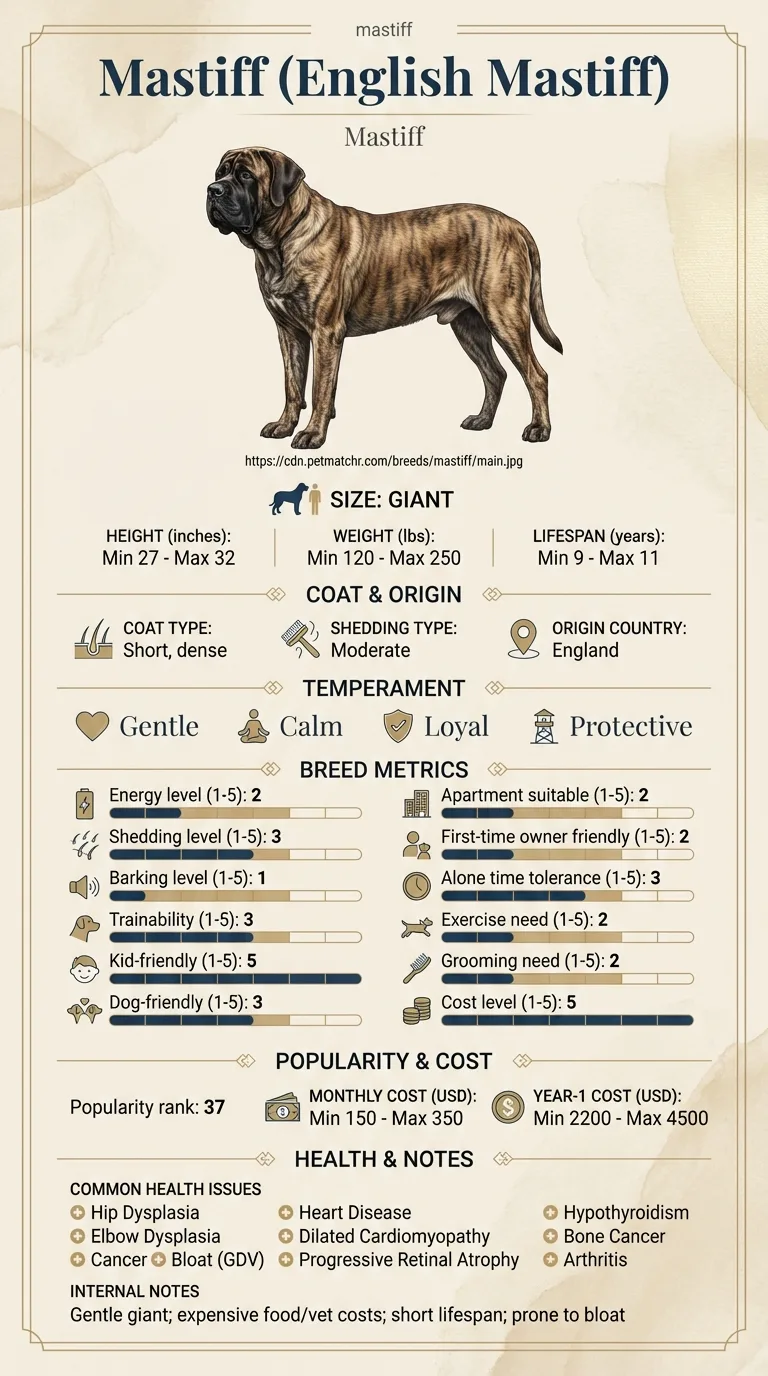
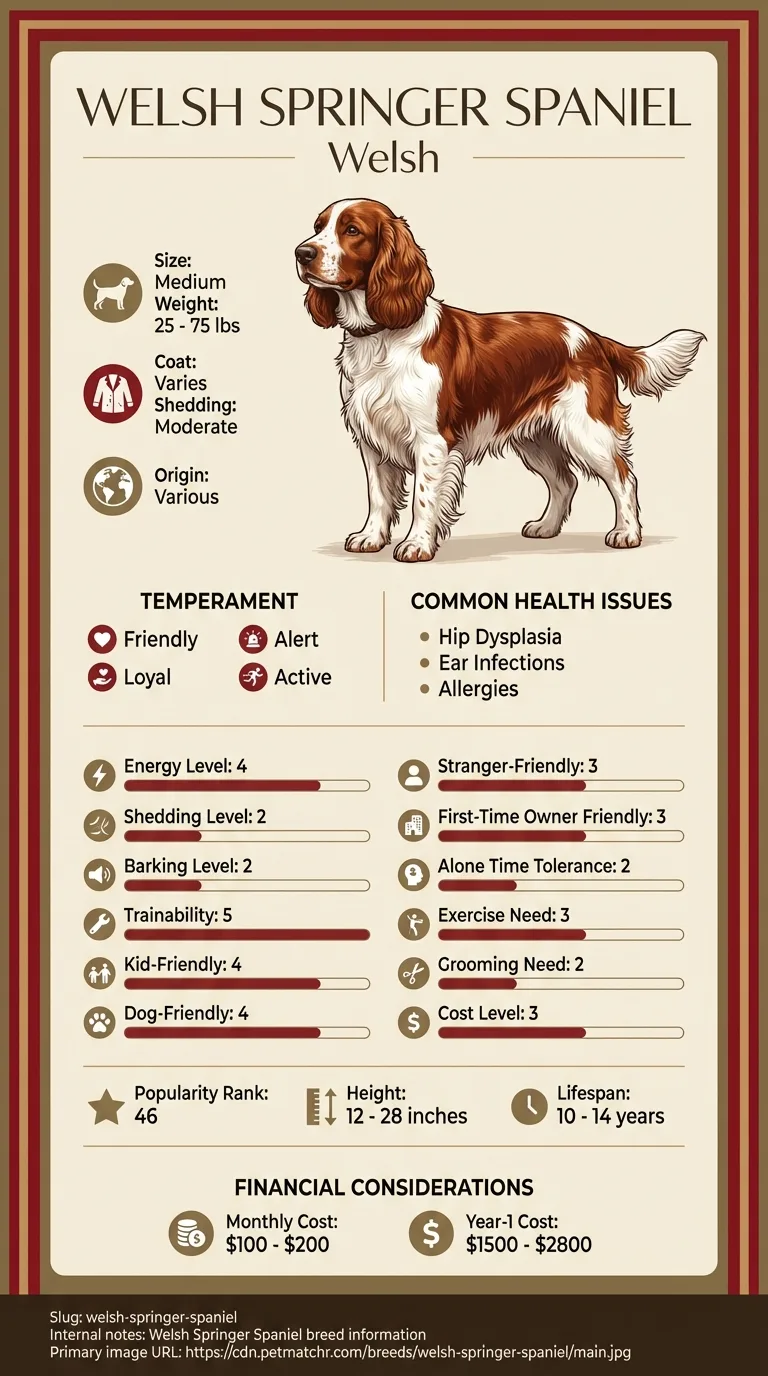
This is for someone already down to Mastiff (English Mastiff) and Welsh Springer Spaniel and deciding between them. For this pair the decision usually turns on exercise need and energy level, so those are covered first and in most detail. Both rate 2/5 for flats, so housing does not settle this one. It is written for the decision rather than the breed history.
Between Mastiff (English Mastiff) and Welsh Springer Spaniel, exercise need is what separates them, and Mastiff (English Mastiff) is the lower-effort dog of the two to keep.
Choose Mastiff (English Mastiff) if you do not want a standing grooming appointment, your walking routine is modest and the dog will be alone during the working day.
Choose Welsh Springer Spaniel if this is your first dog, you already have another dog and you want a dog that picks up training quickly.
| Feature | mastiff | welsh springer spaniel | Winner |
|---|---|---|---|
| Size class | giant | medium | Equal |
| Weight | 120–250 lbs | 35–55 lbs | Equal |
| Height | 27–32 in | 17–19 in | Equal |
| Lifespan | 9–11 years | 12–15 years | welsh springer spaniel |
| Exercise need | Low (2/5) | High (4/5) | mastiff |
| Grooming need | Low (2/5) | Moderate (3/5) | mastiff |
| Shedding | Moderate (3/5) | Moderate (3/5) | Equal |
| Energy level | Low (2/5) | High (4/5) | Equal |
| Barking | Very low (1/5) | Moderate (3/5) | mastiff |
| Apartment suitability | Low (2/5) | Low (2/5) | Equal |
| Good for first-time owners | Low (2/5) | Moderate (3/5) | welsh springer spaniel |
| Tolerates being alone | Moderate (3/5) | Low (2/5) | mastiff |
| Trainability | Moderate (3/5) | High (4/5) | welsh springer spaniel |
| Good with kids | Very high (5/5) | High (4/5) | mastiff |
| Good with other dogs | Moderate (3/5) | High (4/5) | welsh springer spaniel |
| Friendly to strangers | Moderate (3/5) | Moderate (3/5) | Equal |
| Cost level | Very high (5/5) | Moderate (3/5) | welsh springer spaniel |
| Coat | Short, dense | Medium, straight and water-resistant | Equal |
| Origin | England | Various | Equal |
| Typical monthly cost | $150–$350 | $100–$200 | Equal |
| Typical first-year cost | $2,200–$4,500 | $1,400–$2,900 | Equal |
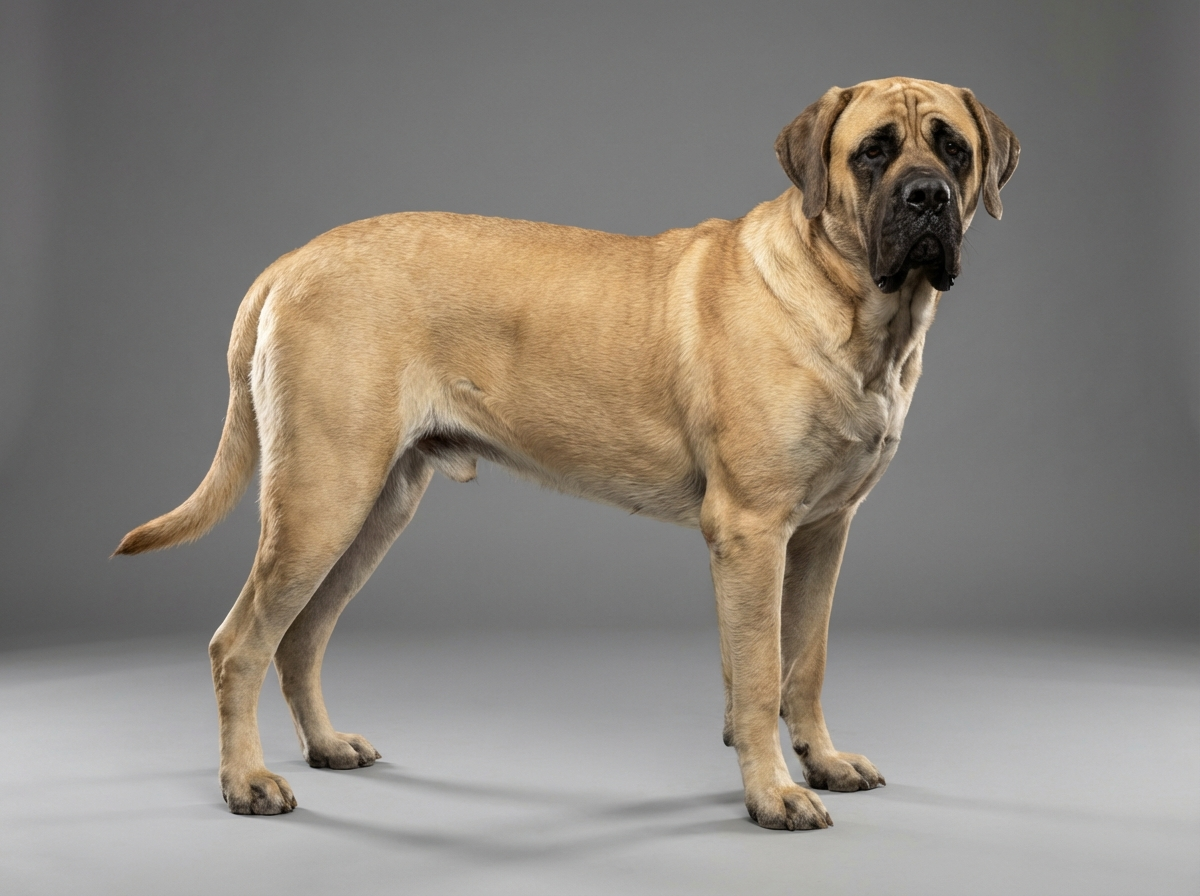
The gap between a Mastiff and a Welsh Springer Spaniel is enormous — up to 250 pounds versus 55 pounds at the top of each range, and 27-32 inches versus 17-19 inches in height. A full-grown Springer could comfortably stand underneath a Mastiff's belly. The Mastiff's giant-breed mass is built for guarding, while the medium-sized Springer's compact, athletic frame was shaped for flushing and retrieving game over rough terrain all day. Anyone picturing 'family dog' without a specific size in mind should know these two occupy nearly opposite ends of this site's size spectrum, with very different space and handling needs as a result.
The Welsh Springer Spaniel rates high (4/5) for both exercise need and energy level, well above the Mastiff's low (2/5) on both counts. As a working gundog breed, the Springer wants daily off-leash time, retrieving games, or a good long walk, and gets restless without it. The Mastiff's giant-breed calm means it's satisfied with far less activity, and in fact benefits from lighter exercise given the joint strain its size already puts on hips and elbows. A household with an active outdoor routine will find the Springer a willing daily partner; one wanting a lower-key companion will find the Mastiff asks for surprisingly little.
Both breeds land in the moderate range for coat care — grooming moderate (3/5) and shedding moderate (3/5) for the Springer, against the Mastiff's low (2/5) grooming and moderate (3/5) shedding, essentially a wash on shedding but a slight edge to the Mastiff on grooming effort. The Springer's medium, straight, water-resistant coat and feathered ears and legs need regular brushing, especially after outdoor or water activity, while the Mastiff's short, dense coat needs comparatively little beyond routine brushing and drool management. Neither breed is especially demanding on grooming compared to long-coated breeds, making this one of the more evenly matched categories in the comparison.
Both breeds share a low (2/5) apartment suitability rating, so neither is an ideal fit for tight quarters, though for different reasons — the Mastiff simply needs more physical space, while the Springer needs more room to burn off its higher energy level. Barking rates moderate (3/5) for the Springer against the Mastiff's very low (1/5), making the Mastiff the quieter housemate despite its size. Tolerating alone time favors the Mastiff too, moderate (3/5) versus the Springer's low (2/5), consistent with the Springer's loyal, people-oriented nature. A house with a yard suits either breed far better than an apartment, regardless of unit size.
The Welsh Springer Spaniel rates high (4/5) for trainability against the Mastiff's moderate (3/5), and edges ahead for first-time owners too, moderate (3/5) versus the Mastiff's low (2/5). Bred as a working gundog, the Springer responds readily to consistent training, though its reserved-with-strangers streak means early socialization matters as much as obedience work. The Mastiff's calm, loyal, protective temperament makes it generally easygoing but slower to pick up new commands, and its size means training lapses carry more weight — literally — than they would with a smaller breed. Overall the Springer is the more forgiving choice for someone newer to dog ownership.
The Mastiff edges ahead with kids, very high (5/5) against the Springer's high (4/5), while both tie at high (4/5) with other dogs. With strangers, both land at moderate (3/5), though the reasons differ — the Springer's documented reserved-with-strangers temperament produces initial wariness that softens with familiarity, while the Mastiff's protective instinct produces watchfulness rather than open suspicion. Both breeds are loyal and family-oriented at their core. A household expecting frequent new faces may need to invest more in the Springer's socialization, while a Mastiff's steady, gentle patience tends to make it reliably calm around kids from the outset.
The Welsh Springer Spaniel's 12-15 year lifespan far outpaces the Mastiff's 9-11, and its health list is markedly shorter — five conditions (hip dysplasia, ear infections, epilepsy, glaucoma, hypothyroidism) against the Mastiff's ten, which includes cancer, bloat, dilated cardiomyopathy, and bone cancer. Ear infections deserve particular attention for the Springer given its long, hanging ears, especially after time in water. The Mastiff's list reflects the harder physical toll that rapid giant-breed growth and enormous body mass take over a shorter life. Anyone weighing longevity heavily in this decision will find the Springer the considerably longer-lived, lower-risk breed on paper.
Cost level rates very high (5/5) for the Mastiff against moderate (3/5) for the Springer, and the figures track that gap closely — $150-$350 monthly and $2,200-$4,500 first-year for the Mastiff, versus $100-$200 monthly and $1,400-$2,900 for the Springer. Food volume tied to the Mastiff's massive size drives most of the difference, since it can outweigh a Springer by nearly 200 pounds. Grooming costs run modestly higher for the Springer given its feathered coat, but that difference is small next to the Mastiff's overall food and medication bills. Over the long run, the Welsh Springer Spaniel is clearly the more budget-friendly of the two breeds.
Mastiff (English Mastiff) weighs 120–250 lbs and lives 9–11 years; Welsh Springer Spaniel weighs 35–55 lbs and lives 12–15 years. The two diverge most on exercise need, energy level and barking and 1 other rated axes. They are level on apartment suitability, shedding and friendly to strangers, so those cannot decide it. In the table, a "winner" means easier for an ordinary household — not better. Size, coat and origin are recorded without a verdict. Because both breeds are scored the same way, the gaps are reliable even where the absolute numbers are rough.

The Welsh Springer Spaniel, by a significant margin — 12-15 years compared to the Mastiff's 9-11 years, with a much shorter list of associated health conditions as well.
It can be reserved at first — its temperament is described as reserved with strangers, rating moderate (3/5) for stranger-friendliness — but tends to warm up with consistent early socialization.
The Welsh Springer Spaniel, rated high (4/5) for exercise need against the Mastiff's low (2/5). As a working gundog breed, the Springer wants active daily outings.
Yes, very much so — they rate very high (5/5) with kids, the top score in this comparison, thanks to a famously gentle, patient, protective temperament.
The Welsh Springer Spaniel, at roughly $1,400-$2,900 in its first year versus the Mastiff's $2,200-$4,500, driven mainly by the Mastiff's much larger food and medication needs.
The Mastiff, rated very low (1/5) for barking against the Springer's moderate (3/5), despite its intimidating size.
A moderate amount — it rates moderate (3/5) for grooming, needing regular brushing especially around its feathered ears and legs, along with ear checks given its long, hanging ears.
The Mastiff, up to 250 lbs versus the Welsh Springer's 55 lbs.
The Welsh Springer Spaniel, at 12-15 years versus the Mastiff's 9-11 years.
The Welsh Springer Spaniel, rated high (4/5) versus the Mastiff's low (2/5).
The Welsh Springer Spaniel, at roughly $1,400-$2,900 versus the Mastiff's $2,200-$4,500 in year one.
Secure checkout on Stripe. We never see your card.
7-day money-back guarantee. Instant access.
Health information here is general and is not veterinary advice. If your dog shows pain, sudden behaviour change, or worsening symptoms, consult a licensed veterinarian.
Some links on this site are affiliate links. We may earn a commission at no extra cost to you, and we only suggest products we believe are helpful for dog owners.
We research and check what we publish, but we do not warrant that any figure, date, price, or statement is accurate, complete, or current, and we accept no liability for any loss, cost, injury, or other harm arising from the use of this site. Use it as one reference among several. You remain responsible for your own decisions and for your dog's care - confirm anything that matters with a licensed veterinarian or another qualified professional before you act on it. Full disclaimer.
Match your lifestyle to the right dog.
Take quizNot sure which breed is right for you? Take our 2-minute quiz to find out.
Take the quiz