Living
Which is the bigger dog?
The Mastiff, up to 250 pounds versus the Boston's 25-pound maximum.

Quick answer
Which is the bigger dog?
The Mastiff, up to 250 pounds versus the Boston's 25-pound maximum.
Boston Terrier or Mastiff (English Mastiff)? On paper they differ most on apartment suitability, and on the scales Mastiff (English Mastiff) is the heavier at 120–250 lbs. Here is how the two compare on everything that shapes an ordinary week.
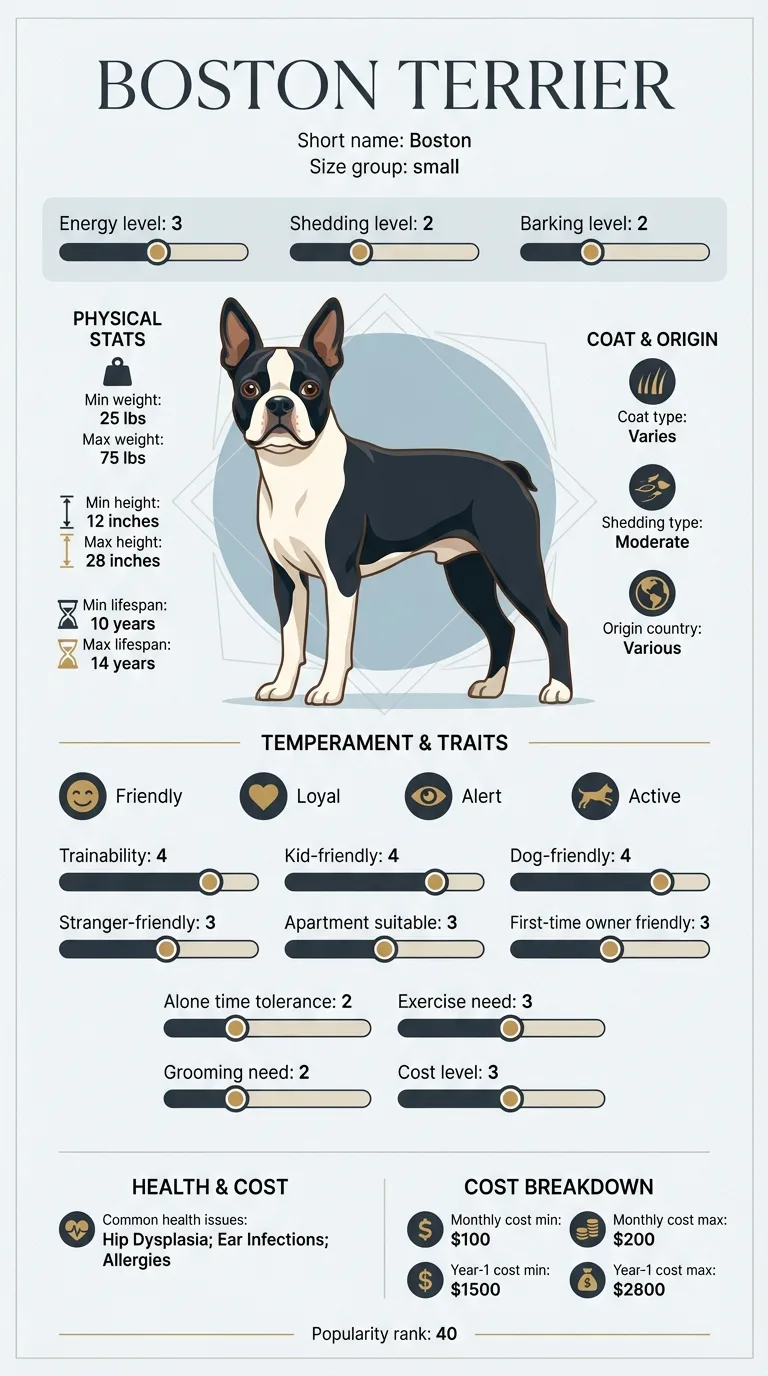
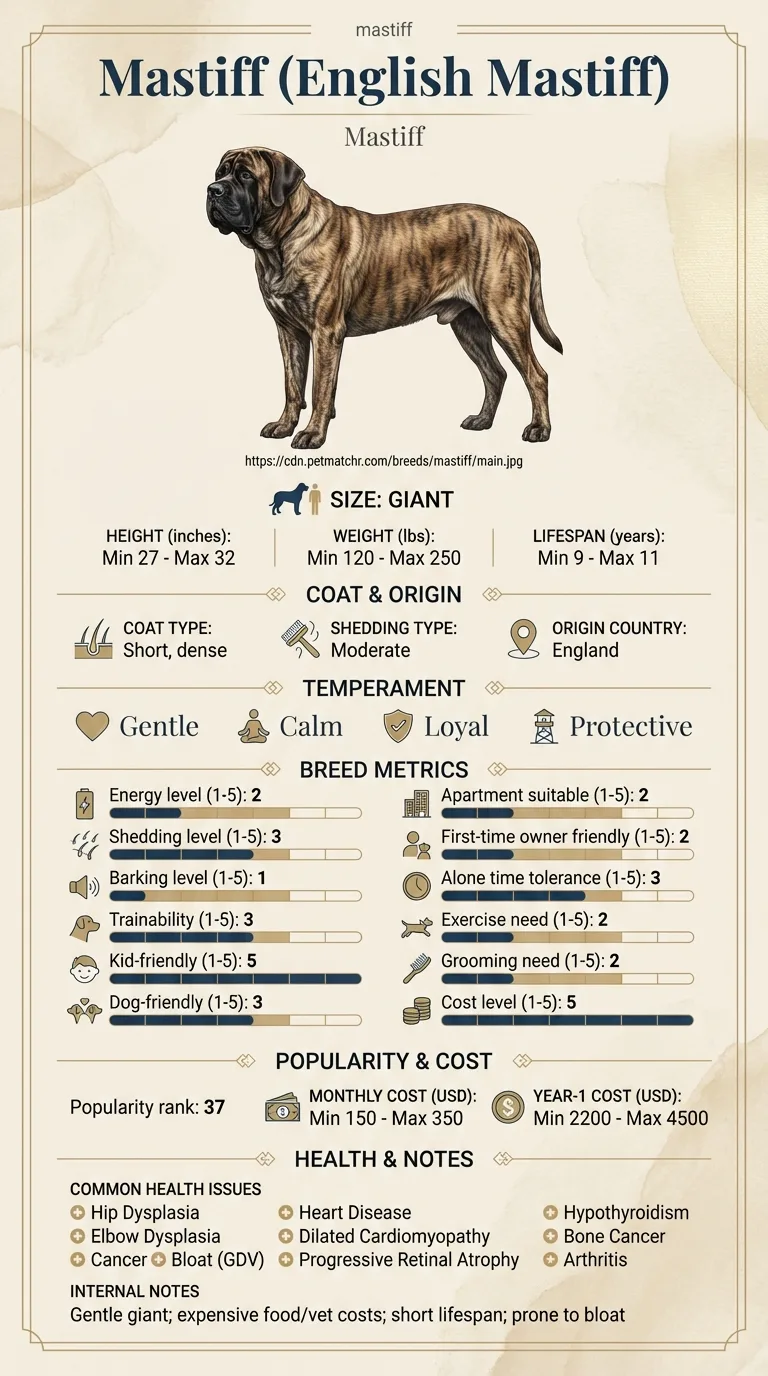
This is for someone already down to Boston Terrier and Mastiff (English Mastiff) and deciding between them. For this pair the decision usually turns on apartment suitability and good for first-time owners, so those are covered first and in most detail. Anyone choosing from a flat has a clear answer here: Boston Terrier rates 5/5 against 2/5. Breed history is left out; what follows is what you will actually live with.
Between Boston Terrier and Mastiff (English Mastiff), apartment suitability is what separates them, and Boston Terrier is the lower-effort dog of the two to keep.
Choose Boston Terrier if you are in a flat or a smaller home, this is your first dog and you do not want a standing grooming appointment.
Choose Mastiff (English Mastiff) if you want a dog that is more watchful with visitors.
| Feature | boston terrier | mastiff | Winner |
|---|---|---|---|
| Size class | small | giant | Equal |
| Weight | 12–25 lbs | 120–250 lbs | Equal |
| Height | 15–17 in | 27–32 in | Equal |
| Lifespan | 11–13 years | 9–11 years | boston terrier |
| Exercise need | Low (2/5) | Low (2/5) | Equal |
| Grooming need | Very low (1/5) | Low (2/5) | boston terrier |
| Shedding | Low (2/5) | Moderate (3/5) | boston terrier |
| Energy level | Moderate (3/5) | Low (2/5) | Equal |
| Barking | Low (2/5) | Very low (1/5) | mastiff |
| Apartment suitability | Very high (5/5) | Low (2/5) | boston terrier |
| Good for first-time owners | Very high (5/5) | Low (2/5) | boston terrier |
| Tolerates being alone | Moderate (3/5) | Moderate (3/5) | Equal |
| Trainability | High (4/5) | Moderate (3/5) | boston terrier |
| Good with kids | Very high (5/5) | Very high (5/5) | Equal |
| Good with other dogs | High (4/5) | Moderate (3/5) | boston terrier |
| Friendly to strangers | High (4/5) | Moderate (3/5) | boston terrier |
| Cost level | Moderate (3/5) | Very high (5/5) | boston terrier |
| Coat | Short and smooth | Short, dense | Equal |
| Origin | Various | England | Equal |
| Typical monthly cost | $80–$150 | $150–$350 | Equal |
| Typical first-year cost | $1,100–$2,300 | $2,200–$4,500 | Equal |
One hundred twenty to 250 pounds. That's the Mastiff's adult weight -- up to ten times heavier than a Boston Terrier's 12-to-25-pound frame, and the gap in height is just as dramatic, 27 to 32 inches against 15 to 17. The Mastiff is a genuine giant breed, one of the largest dogs recognized, while the Boston is unambiguously small. This isn't a difference that trims itself with training or diet; it's structural, and it shapes everything downstream -- the Mastiff needs a reinforced crate, a car built to carry it, and doorways it can pass through without incident, none of which a Boston owner ever has to think about.
Despite the size gap, exercise need ties at Low (2/5), and the Mastiff actually rates lower for energy level, Low (2/5) against the Boston's Moderate (3/5) -- giant breeds are often surprisingly sedentary, content to lounge for most of the day. That said, "low exercise need" on a 200-pound dog still means real, deliberate walks matter for joint health and weight management in a way it doesn't for a small breed. A Mastiff that gets too little movement can gain weight quickly, which stresses already vulnerable hips and elbows. The Boston's lighter frame is more forgiving of an inconsistent exercise schedule. Both breeds suit a calmer household, but the Mastiff's size raises the stakes on staying consistent.
The Boston Terrier edges ahead on both counts here, Very Low (1/5) grooming against the Mastiff's Low (2/5), and Low (2/5) shedding against Moderate (3/5). Neither gap is huge, but on a dog the Mastiff's size, even a "moderate" shedding rating translates into a larger physical volume of hair and drool around the house -- Mastiffs are notorious droolers, a trait the data doesn't score directly but that shows up constantly in owner reports. The Boston's short, smooth coat and dry mouth make for a tidier home overall. Anyone sensitive to slobber on walls and furniture should factor that in heavily, since it's arguably a bigger day-to-day nuisance for Mastiff owners than the shedding number alone suggests.
The Boston Terrier scores Very High (5/5) for apartment living against the Mastiff's Low (2/5), though interestingly the Mastiff actually barks less, Very Low (1/5) against the Boston's Low (2/5) -- a calm, low-vocalization breed despite its imposing size. The apartment mismatch here is almost entirely about physical space and weight rather than noise: a 200-pound dog simply needs more room to turn around, lie down, and move through a home comfortably. Both breeds tie at Moderate (3/5) for tolerating time alone, so neither is a natural fit for owners gone all day, regardless of unit size. A Mastiff can adapt to smaller housing better than its size suggests, but it needs deliberate space planning that a Boston never requires.
The Boston rates Very High (5/5) for first-time owners against the Mastiff's Low (2/5), and trainability follows the same pattern, High (4/5) versus Moderate (3/5). It's not that Mastiffs are hard to teach -- they're described as Gentle and Loyal -- it's that their sheer size means training mistakes carry real physical consequences. A Mastiff that hasn't learned not to pull on leash or jump up can genuinely knock over an adult, a risk a Boston simply doesn't present regardless of training gaps. Giant-breed rescues and trainers consistently recommend prior large-dog experience before taking on a Mastiff, while a Boston remains one of the more forgiving choices for someone training their very first dog.
Both breeds tie Very High (5/5) with kids, and the Mastiff's Gentle, Protective temperament has made it a classic gentle-giant family dog for generations, despite its intimidating size. The Boston pulls ahead with other dogs, High (4/5) against Moderate (3/5), and with strangers, High (4/5) against Moderate (3/5) -- the Mastiff's Protective streak can translate into wariness of unfamiliar people or dogs that a family should actively socialize against early. For households with frequent visitors or dog-park routines, the Boston's more consistently outgoing nature demands less active management. For households that want a calm, watchful presence around kids specifically, the Mastiff's temperament profile still delivers, size notwithstanding.
The Boston Terrier actually outlives the Mastiff, 11 to 13 years against just 9 to 11 -- giant breeds routinely have the shortest lifespans of any size class, a pattern that holds here despite the Mastiff's otherwise sturdy build. Its ten-item health list includes Cancer, Bloat (GDV), Dilated Cardiomyopathy, Bone Cancer, and Arthritis, conditions common to large, heavy-boned dogs whose frames carry enormous weight for a decade. The Boston's five conditions -- Brachycephalic Airway Syndrome, Patellar Luxation, Cataracts, Corneal Ulcers, Deafness -- are unrelated to size and instead trace to its flat face and eye structure. Both lists demand real vigilance, but a Mastiff owner is specifically watching for the sudden, often fatal onset of bloat that giant breeds are prone to.
The Mastiff is the most expensive breed in this comparison to keep -- $150 to $350 monthly and $2,200 to $4,500 in the first year, against the Boston's $80-$150 and $1,100-$2,300 -- and its cost level rates Very High (5/5) against the Boston's Moderate (3/5). Every recurring expense scales with the dog's size: food bills alone can run several times higher, medications are dosed by weight, and even routine services like boarding or grooming often charge giant-breed surcharges. Pet insurance premiums for Mastiffs also tend to run higher given the breed's shorter lifespan and conditions like bloat and cancer on its health list. A Boston's small frame keeps essentially every cost category proportionally lower.
Boston Terrier weighs 12–25 lbs and lives 11–13 years; Mastiff (English Mastiff) weighs 120–250 lbs and lives 9–11 years. The two diverge most on apartment suitability, good for first-time owners and cost level. They are level on tolerates being alone, exercise need and good with kids, so those cannot decide it. The comparison marks an easier option only where one exists. Facts like weight and country of origin are not scored. Both dogs are rated from the same dataset, which is what makes the numbers comparable with each other even though any individual dog sits somewhere inside its breed's range.

Dramatically bigger -- a Mastiff can weigh 120 to 250 pounds against a Boston Terrier's 12 to 25 pounds, up to ten times the weight.
Less than you'd expect, and less than Boston Terriers -- Mastiffs rate Very Low (1/5) for barking against the Boston's Low (2/5).
The Boston Terrier, rated Very High (5/5) against the Mastiff's Low (2/5) -- a Mastiff's sheer size makes training mistakes riskier for a novice handler.
The Boston Terrier, 11 to 13 years against the Mastiff's 9 to 11, a typical pattern for giant breeds.
Considerably more -- roughly $150-$350 a month against the Boston's $80-$150, driven by food, medication, and service costs that scale with the dog's size.
Yes -- they rate Very High (5/5) with kids, tied with the Boston Terrier, and their Gentle, Protective temperament has made them a classic family breed.
Bloat (GDV), a sudden and potentially fatal condition common in large, deep-chested breeds, alongside joint conditions like Hip and Elbow Dysplasia and a documented cancer risk.
The Mastiff, up to 250 pounds versus the Boston's 25-pound maximum.
The Mastiff, Very Low (1/5) versus the Boston's Low (2/5).
The Boston Terrier, by a wide margin at every cost category.
The Boston Terrier, 11-13 years versus the Mastiff's 9-11.
Secure checkout on Stripe. We never see your card.
7-day money-back guarantee. Instant access.
Health information here is general and is not veterinary advice. If your dog shows pain, sudden behaviour change, or worsening symptoms, consult a licensed veterinarian.
Some links on this site are affiliate links. We may earn a commission at no extra cost to you, and we only suggest products we believe are helpful for dog owners.
We research and check what we publish, but we do not warrant that any figure, date, price, or statement is accurate, complete, or current, and we accept no liability for any loss, cost, injury, or other harm arising from the use of this site. Use it as one reference among several. You remain responsible for your own decisions and for your dog's care - confirm anything that matters with a licensed veterinarian or another qualified professional before you act on it. Full disclaimer.
Match your lifestyle to the right dog.
Take quizNot sure which breed is right for you? Take our 2-minute quiz to find out.
Take the quiz