Health
What does cardiomyopathy mean?
Disease of the heart muscle itself, as distinct from a valve or vessel problem. In dogs the dominant form thins the muscle and stretches the chambers.

Quick answer
What does cardiomyopathy mean?
Disease of the heart muscle itself, as distinct from a valve or vessel problem. In dogs the dominant form thins the muscle and stretches the chambers.
You leave the appointment with a two-page report full of abbreviations, a prescription, and a vague sense that something serious has happened. This page translates the report.
Owners holding a fresh echocardiogram report and trying to work out how bad it is, and owners who have been told their dog has an enlarged heart and want to understand what is actually being measured and monitored over the years ahead.
This guide is not medical advice. If your dog shows pain, sudden behavior change, or worsening symptoms, consult a licensed veterinarian.
Some links may be affiliate links. We may earn a commission at no extra cost to you. We only suggest products we believe are helpful for dog owners.
We research and check what we publish, but we do not warrant that any figure, date, price, or statement is accurate, complete, or current, and we accept no liability for any loss, cost, injury, or other harm arising from the use of this site. Use it as one reference among several. You remain responsible for your own decisions and for your dog's care - confirm anything that matters with a licensed veterinarian or another qualified professional before you act on it. Full disclaimer.
Cardiomyopathy describes primary disease of the heart muscle. In the form relevant to giant breeds the muscle wall thins, the chambers enlarge, and the force of each contraction falls. The heart compensates for a long period, which is why so many dogs are entirely well at diagnosis, and then it stops compensating, which is when fluid accumulates and symptoms appear.
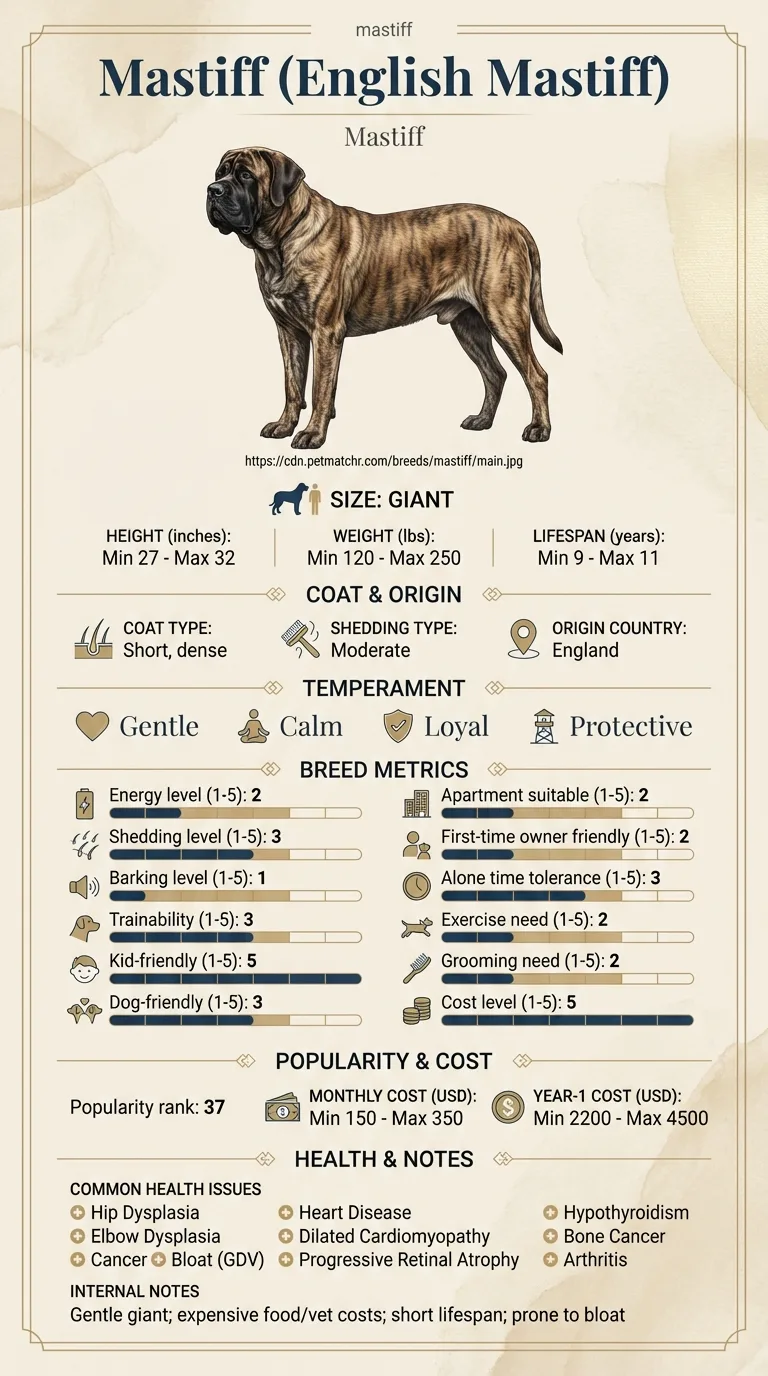
Both heart disease and dilated cardiomyopathy are named among the recognised health issues of the English Mastiff, which places muscle disease firmly on the list of things to plan around. Because the compensated stage is silent, the true frequency is almost certainly higher than the number of diagnosed cases, and it is one of the arguments for screening giant breeds before symptoms appear.
Large and giant breeds are the group in which canine dilated cardiomyopathy concentrates, and inheritance is the main driver within predisposed lines. The English Mastiff carries this predisposition explicitly. There is also a scaling problem: the heart of a dog weighing up to a quarter of a ton must generate output for an enormous body across a life of only nine to eleven years, and the muscle wall of a very large ventricle is mechanically disadvantaged compared with a small one. Disease therefore tends to declare itself in middle age.
Nothing in the household causes cardiomyopathy, but several things determine how much reserve the dog has when the muscle starts to fail. Weight is the largest of them. Heat matters in a breed that already cools inefficiently. Sporadic intense exercise after sedentary weeks is harder on a weakened heart than consistent moderate activity. Missed medication doses and lapsed rechecks account for a surprising amount of avoidable deterioration.
Contact the practice promptly for any fainting or collapse, a sleeping breathing rate that has risen above the threshold your vet gave you, a new cough, reduced appetite, or a swelling abdomen. Go immediately, as an emergency, if your Mastiff is breathing rapidly and with effort at rest, has pale, grey or blue gums, coughs up pink froth, collapses without prompt recovery, or becomes suddenly very weak. These indicate congestive failure or a serious rhythm event. If your dog is on a diuretic and stops drinking or eating, call the same day, because dehydration interacts badly with that medication.
See all Mastiff health problems, which breeds are prone to cardiomyopathy, or the full Mastiff breed guide for temperament, exercise needs and ownership costs.
Preclinical disease can remain stable for a year or several, and treatment aims to lengthen that period. Once congestive failure develops, management shifts to controlling fluid and the outlook shortens considerably. Rechecks run every six to twelve months while stable and more frequently after any change. This is lifelong management with a progressive trajectory, and the honest framing is time bought rather than cure achieved.
Success in the preclinical stage is a dog living an entirely ordinary Mastiff life, with a stable sleeping breathing rate, unchanged appetite and energy, and scan measurements that are not moving quickly. Later, success is a comfortable dog whose fluid is controlled, who is still eating and still interested in its household, with fewer emergency visits than an untreated dog would have.
Almost every figure on a canine echocardiogram report answers one of two questions: how stretched is the chamber, and how well does it squeeze.
Less than most owners fear at the moment of diagnosis, and more than they expect two years later.
In the preclinical stage the dog usually looks and behaves normally, and the treatment aim is to delay the onset of failure. Medication starts, the dog is weighed, and a recheck is booked. What changes at home is mostly administrative: a daily tablet, a repeat prescription, an appointment in the diary and a habit of counting sleeping breaths. The walks continue. The dog does not know anything has happened.
The changes worth making yourself are modest and specific. Keep the dog at the lean end of its healthy weight, because a heart with reduced output should not be pumping for a body carrying thirty unnecessary pounds. Move exercise to the cool of the day and make it consistent rather than sporadic. Reduce the moments of sudden extreme excitement, which are the peaks a compromised heart handles worst.
What you should not do is impose strict rest on a dog that has been told to continue normal activity. Muscle loss is not helpful, and in a breed already prone to joint disease, a dog that stops walking deteriorates in ways that have nothing to do with its heart.
Over the following years the plan is revised as the numbers move. Medication is added or increased. The interval between scans shortens. Eventually, in most dogs, congestive failure develops and management shifts to controlling fluid, which is when the sleeping breathing count you have been keeping becomes genuinely valuable rather than merely diligent.
One more thing worth saying plainly. Rhythm disturbances arising from diseased muscle carry a risk of sudden death, and in some giant breeds this can precede any sign of failure. That is an unpleasant fact and it is the reason cardiologists take fainting episodes so seriously in a dog with cardiomyopathy. Report every one.

Josef came home from the cardiology referral with a report covering two pages, a prescription and almost no recall of what had been said. His Mastiff Otto was six, symptom-free, and had been sent for a scan only because a murmur had been picked up at a routine check. A week later Josef rang the cardiology nurse and asked one question: which single number should he expect to change, and in which direction, if things were getting worse. He was told the left atrial measurement, and given a target breathing rate to call about. That reframed everything. Instead of a report he could not parse, Josef had one measurement to look for on each future scan and one number to count at home. He kept a page in a notebook with two columns. Otto stayed in the preclinical stage for a little over three years before any medication change was needed. Josef's view is that the diagnosis stopped being frightening the moment it became something he could follow.
Key takeaway: You do not need to understand a whole echocardiogram report. Ask which number to watch and what breathing rate should trigger a phone call, and the diagnosis becomes manageable.
Cardiomyopathy is the disease of the muscle. Heart failure is the consequence, when the heart can no longer keep fluid from accumulating in the lungs or abdomen. A dog can have cardiomyopathy for a long time before failure develops, and delaying that transition is what preclinical treatment is for.
Because treating the preclinical stage has been shown to extend the symptom-free period in dilated cardiomyopathy. Waiting for signs means starting later with less to work with. It feels counterintuitive to medicate a dog that seems fine, but this is one of the clearer areas in veterinary cardiology.
Typically every six to twelve months in a stable preclinical dog, and more often once the disease progresses or medication changes. Bring your home breathing counts to every appointment, since they tell the cardiologist what happened between visits.
The relationship between certain diets and heart muscle disease in dogs has been investigated extensively in recent years and remains an area of active discussion. Do not change your dog's food based on internet advice. Raise it specifically with your vet or cardiologist, who can advise on your individual dog.
It varies widely and depends on the stage at diagnosis, the severity of the chamber changes and whether serious arrhythmias are present. Dogs found in the preclinical stage generally do considerably better than those diagnosed in failure, which is the entire argument for screening a giant breed in middle age.
Often yes, but only with a plan built around the heart, and elective procedures should be reviewed against the current cardiac status. Make sure every clinic that treats your dog knows about the diagnosis and has the cardiologist's most recent report.
It is a meaningful ongoing cost, because cardiac drugs are dosed by body weight and a Mastiff may weigh five times what a spaniel does. Ask about the annual cost when treatment starts, and if you have insurance check how long-term conditions are handled by your policy.
Disease of the heart muscle itself, as distinct from a valve or vessel problem. In dogs the dominant form thins the muscle and stretches the chambers.
Disease visible on the scan while the dog still has no symptoms. It is the stage at which treatment does the most good.
Follow the cardiologist's specific advice. Most preclinical dogs continue normal moderate activity, and enforced rest causes muscle loss without benefit.
Because it usually reflects a rhythm disturbance from the diseased muscle, and those carry a risk of sudden death. Report every episode.
Your log of sleeping breathing rates, a current weight, dates of any fainting or coughing episodes, and the full medication list.
A one-page prep sheet for this condition: the signs, the questions to ask, what to get priced. Unlocks here.
You get: Vet visit prep sheet
No spam. One-click unsubscribe. See our privacy policy.
Preview page 1 before you decide.