Health
What does the grade number mean?
One is a kneecap that can be pushed out and returns instantly; two luxates during movement and slips back; three sits out most of the time; four is permanently displaced and cannot be replaced by hand.

Quick answer
What does the grade number mean?
One is a kneecap that can be pushed out and returns instantly; two luxates during movement and slips back; three sits out most of the time; four is permanently displaced and cannot be replaced by hand.
Grade two on a fifteen-pound terrier and grade two on a two-hundred-pound Mastiff are not the same clinical problem.
Owners of a Mastiff in whom patellar luxation has actually been confirmed, trying to understand the grading, the direction, and whether surgery is the right call for a dog this heavy.
This guide is not medical advice. If your dog shows pain, sudden behavior change, or worsening symptoms, consult a licensed veterinarian.
Some links may be affiliate links. We may earn a commission at no extra cost to you. We only suggest products we believe are helpful for dog owners.
We research and check what we publish, but we do not warrant that any figure, date, price, or statement is accurate, complete, or current, and we accept no liability for any loss, cost, injury, or other harm arising from the use of this site. Use it as one reference among several. You remain responsible for your own decisions and for your dog's care - confirm anything that matters with a licensed veterinarian or another qualified professional before you act on it. Full disclaimer.
Patellar luxation is graded one to four according to how readily and how permanently the kneecap leaves its groove, and classified by whether it slips inward or outward. The grade guides treatment, but in a Mastiff the decisive additional variable is body weight, which affects how much force a surgical repair must withstand and how difficult the restricted recovery period will be to enforce.
Patellar luxation is a common finding in toy and small breeds and an uncommon one in giant breeds. It is not listed among the conditions documented for Mastiffs. When it is genuinely present in a dog of this size, outward luxation and associated limb deformity are relatively more likely than the classic inherited inward pattern.
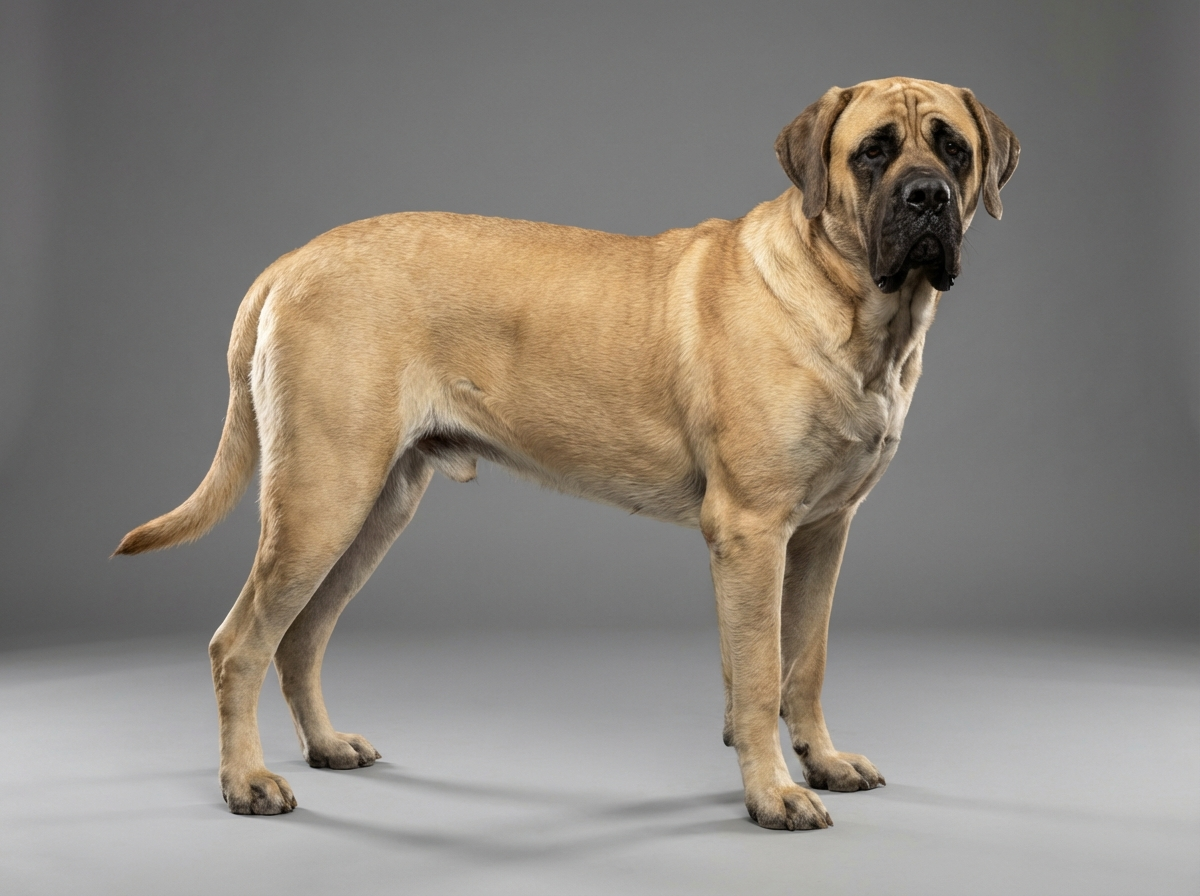
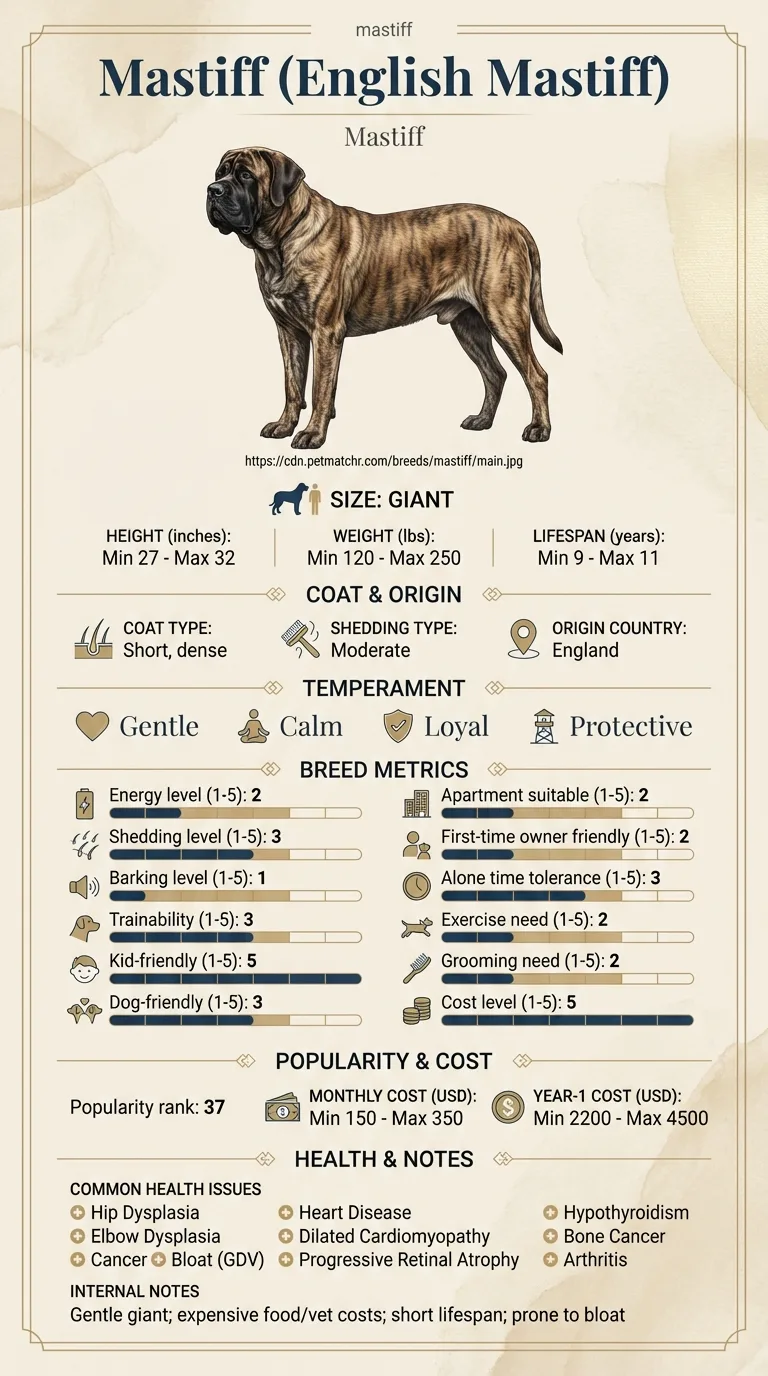
The classic inherited form of patellar luxation is a small-breed conformational problem, and it does not appear among the Mastiff's documented health issues. Where the condition does arise in this breed, the underlying cause is more often a broader skeletal deformity or an injury than the inherited groove-and-tendon pattern. What the Mastiff contributes is force. At 120 to 250 pounds and 27 to 32 inches at the shoulder, the loads passing through the stifle are several times those in a small dog, which changes how quickly a mildly abnormal joint deteriorates and how demanding any repair becomes.
Weight is the dominant modifiable factor, both for progression and for surgical outcome. Beyond that, the practical environment shapes the recovery more than the disease. A household with stairs, polished floors, a high tailgate and no ground-floor sleeping area makes six to eight weeks of restricted activity nearly impossible to enforce with a dog too heavy to carry. Households that make those adjustments before surgery consistently have an easier time than those that improvise afterwards.
Book an appointment if the skipping episodes become more frequent, if lameness begins to persist rather than resolve within seconds, or if your dog has started holding the leg differently at rest. Seek prompt care for a sudden marked worsening, an inability to bear weight, a leg that looks rotated or misshapen, or obvious pain when the knee is handled, since a dog with a luxating patella can also rupture a cruciate ligament and the second problem will not announce itself as new. After surgery, contact your surgeon urgently for swelling, discharge, heat around the incision, or any sudden loss of function in the operated leg.
See all Mastiff health problems, which breeds are prone to patellar luxation, or the full Mastiff breed guide for temperament, exercise needs and ownership costs.
Grade one findings often need nothing but annual reassessment, potentially for life. Where surgery is chosen, expect a period of weight loss beforehand that may run to several months in a giant breed, then hospitalisation of a day or two, six to eight weeks of strictly restricted activity, and a graded return over a further two to three months with rehabilitation support. Full remodelling of the joint continues for around six months.
Success is a dog walking soundly on a kneecap that stays where it belongs, without pain and without progressive deformity. It is not a joint that will never develop arthritis; some degree of change is likely at higher grades whatever is done. For a Mastiff, a realistic definition of success also includes an uncomplicated recovery, which depends as much on household organisation and body weight as on the surgery itself.
The scale describes the behaviour of the kneecap on examination, and it maps loosely onto how much intervention is likely to be needed.
Almost all published experience with patellar luxation surgery comes from small dogs, and that matters because several of the techniques used depend on the repair holding against the forces the dog generates.
The common procedures involve deepening the groove the kneecap runs in, moving the tendon's attachment point on the shin bone so the pull is straight, and tightening or releasing the soft tissue on either side. The bone attachment is usually secured with pins or wire. In a fifteen-pound dog that construct is asked to resist modest forces. In a Mastiff weighing 120 to 250 pounds, the same repair faces loads several times greater, and the risk of implant failure or of the repair loosening during recovery rises accordingly.
Recovery is the other issue. Successful outcomes depend on genuinely restricted activity for six to eight weeks, and enforcing that with a giant breed is materially harder than with a small dog. A terrier can be carried outside to toilet. A Mastiff cannot, and every trip into the garden is a full weight-bearing event on the repaired leg.
None of this means surgery is wrong for a large dog. It means the conversation should be with an orthopaedic specialist who operates on giant breeds regularly, that pre-operative weight loss is often part of the plan, and that the recovery period needs to be organised realistically before the date is booked rather than afterwards.

If you think your Mastiff has patellar luxation, the plan is three steps: write down what you have seen and when it started, book a veterinary appointment rather than waiting for the next flare, and take video of the behaviour or symptom before you go — the thing you are worried about rarely happens in the consulting room. Screening in the parents covers hip dysplasia, elbow dysplasia, cancer.
What the vet visit should produce is a diagnosis and a written plan, not just reassurance: what is being ruled out, what the monitoring interval is, and which signs mean you come back sooner. Ask what the treatment costs across a year rather than per visit, because that is the number that decides whether you are managing this condition or reacting to it.
Between appointments, keep a short log — dates, what you saw, what changed. It is the single most useful thing an owner brings to a follow-up, and for patellar luxation it is often what separates a clear pattern from a guess.
When Imogen's Mastiff, Barnabas, was found to have a grade three outward luxation of the left kneecap at four years old, her first question was how soon he could be operated on. Her surgeon's answer was not for a while. Barnabas weighed 231 pounds. The plan began with radiographs of the whole limb, which showed a degree of rotation in the femur that changed which procedure was appropriate. Then came five months of measured feeding and controlled walking that took thirty-one pounds off him. Imogen used that time to move his bed downstairs, fit rubber matting along the hall and through the kitchen, buy a ramp, and arrange for her brother to stay for the first fortnight after the operation. The surgery went ahead in the autumn. The eight weeks of restricted activity were, she said, harder than anything else about it, but the repair held. Barnabas was walking soundly by the spring.
Key takeaway: For a giant breed the operation is the short part. Weight reduction beforehand and a household set up to enforce genuine rest afterwards are what carry a repair through the period when the forces on it are highest and the dog understands none of it.
Usually not immediately. Grade one findings are often incidental and many dogs never progress. The sensible response is to keep the dog lean, maintain good thigh muscle through steady exercise, and have the knee reassessed at annual checks. Note it in the file, because it changes how a future lameness would be interpreted.
Yes. Repeated luxation wears the ridges of the groove down, so the kneecap displaces more easily, and the abnormal pull can gradually change the shape of the bones. Progression is more likely in a heavy dog and in one carrying excess weight. This is why grades are reassessed rather than recorded once.
Because in a large dog, outward luxation is often part of a broader limb deformity involving the femur or tibia rather than a purely local problem in the knee. Imaging shows whether the bones themselves are rotated or bowed, which changes the surgical plan considerably and may call for a different procedure entirely.
Persistent abnormal tracking damages the joint surfaces over time, and arthritis is a realistic long-term consequence, particularly at higher grades. Arthritis is already documented among this breed's health issues, so a Mastiff with a luxating patella has two reasons for that joint to deteriorate rather than one.
Very often yes, and surgeons frequently insist on it. Lower body weight reduces the load on the repair during healing, improves anaesthetic safety in a giant breed, and makes the restricted recovery period easier to manage. Weight loss in a dog this size takes months, so it needs starting well before the planned date.
In small breeds patellar luxation has a well-recognised inherited component. It is not among the conditions documented for Mastiffs, so its appearance in this breed is less clearly a breeding question. If your dog is affected, discuss with your vet and your breeder before making any breeding decision, and be guided by the specialist's view on whether the cause looks developmental or traumatic.
One is a kneecap that can be pushed out and returns instantly; two luxates during movement and slips back; three sits out most of the time; four is permanently displaced and cannot be replaced by hand.
Yes. Inward slipping is the small-breed pattern. Outward slipping is proportionally more associated with large dogs and often accompanies a wider bone deformity needing imaging.
The repair faces much greater forces and the restricted recovery is harder to enforce. It is often still the right choice, but it belongs with a specialist who operates on large dogs regularly.
Usually not. Keep the dog lean, maintain thigh muscle, and reassess annually. Record it, since it changes how any future lameness is interpreted.
Frequently. It reduces load on the healing repair and improves anaesthetic safety. Start months ahead, since weight loss in a giant breed is slow.
A one-page prep sheet for this condition: the signs, the questions to ask, what to get priced. Unlocks here.
You get: Vet visit prep sheet
No spam. One-click unsubscribe. See our privacy policy.
See a sample page before you decide.
Early access list
The free prep sheet covers the same-day warning signs, a symptom log and the questions to ask. We are considering a fuller kit that adds a cost worksheet for the usual tests and treatments (US price ranges with their sources) and a plain-English guide to ways of covering the bill. It is not built yet; this list tells us whether it is worth building.
One email, no spam, unsubscribe anytime. Information only, not veterinary advice.