Health
Why do allergies in Mastiffs often lead to skin infections?
Scratching from allergic itching damages the skin barrier, letting normally harmless bacteria or yeast overgrow into a secondary infection.

Quick answer
Why do allergies in Mastiffs often lead to skin infections?
Scratching from allergic itching damages the skin barrier, letting normally harmless bacteria or yeast overgrow into a secondary infection.
Allergic itching in a Mastiff is rarely just itching for long - left alone, it tends to become an infection.
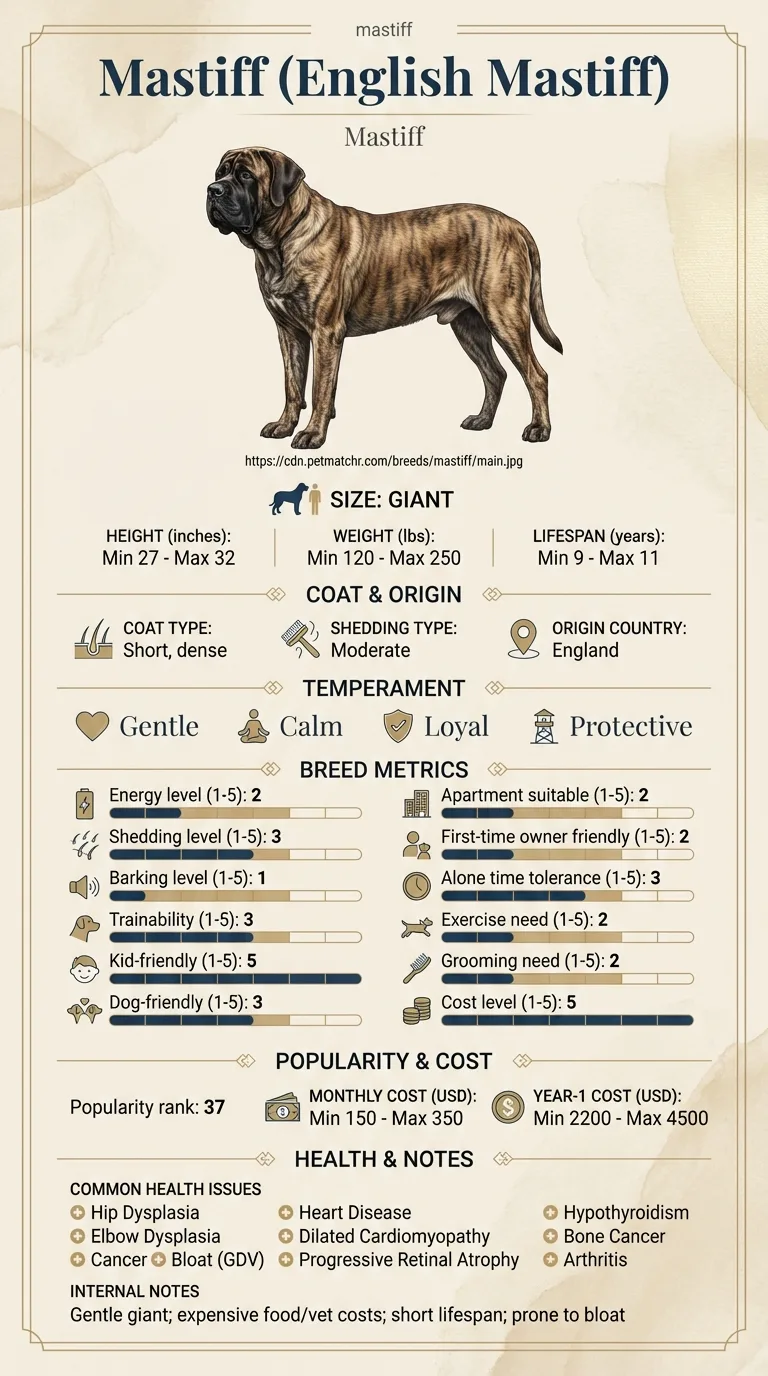
This affects owners noticing recurring scratching, licking, red skin, or a persistent odor in their Mastiff, especially those who've already tried a shampoo or two without lasting improvement and aren't sure whether the cause is environmental, food-related, or something else.
This guide is not medical advice. If your dog shows pain, sudden behavior change, or worsening symptoms, consult a licensed veterinarian.
Some links may be affiliate links. We may earn a commission at no extra cost to you. We only suggest products we believe are helpful for dog owners.
We research and check what we publish, but we do not warrant that any figure, date, price, or statement is accurate, complete, or current, and we accept no liability for any loss, cost, injury, or other harm arising from the use of this site. Use it as one reference among several. You remain responsible for your own decisions and for your dog's care - confirm anything that matters with a licensed veterinarian or another qualified professional before you act on it. Full disclaimer.
Skin allergies in Mastiffs typically present as persistent itching, redness, and irritation that, left unaddressed, tend to progress into secondary bacterial or yeast infections. The underlying trigger can be environmental, food-related, or both, and long-term management depends on identifying the pattern rather than simply treating each flare-up as it appears.
Allergic skin disease is a common complaint across large and giant breeds generally, and it's frequent enough in Mastiffs that many owners will manage at least one significant flare-up over the dog's lifetime, often recurring seasonally or intermittently.
Skin allergies aren't unique to this breed's documented genetic profile, but a short, dense coat offers less of a physical barrier against environmental allergens reaching the skin directly compared to some heavier-coated breeds. Once an allergic reaction begins, the same coat type makes early skin changes - redness, small bumps - somewhat easier to spot, which is a practical advantage for early intervention.
Pollen-heavy seasons, dusty or high-mold indoor environments, and inconsistent flea prevention can all introduce or worsen environmental allergens. Diet choice and ingredient consistency play a separate but equally important role for dogs with a food component to their allergic response.
See a vet if itching is persistent, if you notice increasing redness, odor, or discharge suggesting secondary infection, or if over-the-counter approaches haven't produced improvement within a couple of weeks. Recurring infections in particular deserve a proper diagnostic workup rather than repeated short-term treatment.
See all Mastiff health problems, which breeds are prone to skin allergies, or the full Mastiff breed guide for temperament, exercise needs and ownership costs.
Acute flare-ups and secondary infections often improve within two to four weeks of appropriate treatment. Identifying the underlying trigger, especially through an elimination diet trial, can take two to three months of consistent effort.
Success looks like fewer, milder flare-ups managed quickly when they occur, not necessarily a dog that never shows any allergic symptoms again. For many dogs, this becomes an ongoing but well-controlled part of routine care.
Allergic skin disease creates a cycle that's worth understanding because it explains why symptoms often seem to get worse in bursts rather than steadily. An allergic trigger causes itching, which leads to scratching and licking, which damages the skin's surface barrier, which then allows opportunistic bacteria or yeast that normally live harmlessly on the skin to overgrow and cause a secondary infection. That infection itself causes more itching, restarting the cycle at a worse baseline than before.
This is why a course of antibiotics or antifungal treatment can bring dramatic short-term relief without solving the underlying problem - it treats the infection layered on top, but the original allergic trigger is still there, ready to restart the cycle unless it's identified and managed separately.
Distinguishing environmental from food allergies helps target management rather than guessing.

Owen had treated his Mastiff Ruby for ear infections three times in eight months, each time clearing up with medication only to return a few weeks later. Frustrated, he brought it up during a routine visit, and his vet asked a question he hadn't considered: was Ruby itchy anywhere else, and did the timing line up with any particular season. Looking back, Owen realized Ruby's paw-licking and belly redness had been worse each spring, right around when the ear infections started. The vet explained that the ears were a downstream symptom of an underlying environmental allergy, not a standalone ear problem, and that treating the infections without addressing the allergy meant they'd keep coming back. A combination of a seasonal management plan, regular paw wipes after walks, and a medicated shampoo routine reduced Ruby's flare-ups significantly the following spring. She still gets itchy during peak pollen weeks, but Owen catches it early now instead of waiting for another ear infection to show up.
Key takeaway: Recurring localized symptoms like ear infections are often just the most visible piece of a broader allergic pattern - treating the visible symptom repeatedly without addressing the underlying allergy rarely breaks the cycle.
Allergic itching damages the skin's protective barrier, allowing normally harmless bacteria or yeast to overgrow into infection. Treating the infection helps short-term, but the underlying allergy needs separate, ongoing management or the cycle tends to repeat.
Environmental allergies often follow a seasonal pattern and commonly affect the paws and ears. Food allergies tend to be present year-round and can include digestive symptoms. A supervised elimination diet trial is the most reliable way to confirm a food component.
Increasing redness, an unpleasant odor, greasy or crusty patches, and skin that seems more inflamed than simple itching would explain are all signs an infection has developed on top of the original allergy.
Most allergic skin disease is managed rather than cured. The goal is usually identifying and reducing exposure to triggers and controlling flare-ups quickly, rather than expecting the underlying sensitivity to disappear.
A proper trial typically runs eight to twelve weeks on a strictly controlled diet before any conclusions can be drawn, since shorter trials often produce unreliable or misleading results.
Regular bathing with a vet-recommended shampoo can help remove allergens and support the skin barrier, but frequency and product choice should be guided by your vet, since over-bathing with the wrong product can sometimes worsen irritation.
Scratching from allergic itching damages the skin barrier, letting normally harmless bacteria or yeast overgrow into a secondary infection.
Both occur, and many affected dogs have a combination of the two rather than a single clear cause.
Typically eight to twelve weeks on a strictly controlled diet, since shorter trials often give unreliable results.
Usually not - most allergic skin disease is managed long-term rather than cured outright.
Increasing redness, odor, greasy or crusty patches, and inflammation beyond what simple itching would explain.
A one-page prep sheet for this condition: the signs, the questions to ask, what to get priced. Unlocks here.
You get: Vet visit prep sheet
No spam. One-click unsubscribe. See our privacy policy.
See a sample page before you decide.
Early access list
The free prep sheet covers the same-day warning signs, a symptom log and the questions to ask. We are considering a fuller kit that adds a cost worksheet for the usual tests and treatments (US price ranges with their sources) and a plain-English guide to ways of covering the bill. It is not built yet; this list tells us whether it is worth building.
One email, no spam, unsubscribe anytime. Information only, not veterinary advice.