DogBreedCompass
← Back to breed profile

Mastiff Kidney Disease: A Problem That Hides Until It Cannot

Quick answer

What is the earliest sign of kidney disease?

Increased drinking and urination, because failing kidneys can no longer concentrate urine. In a giant breed this is easy to miss, so measure water intake over twenty-four hours rather than estimating.

Drinking more water is not a quirk. In a middle-aged or older Mastiff it is one of the few early warnings this disease gives.

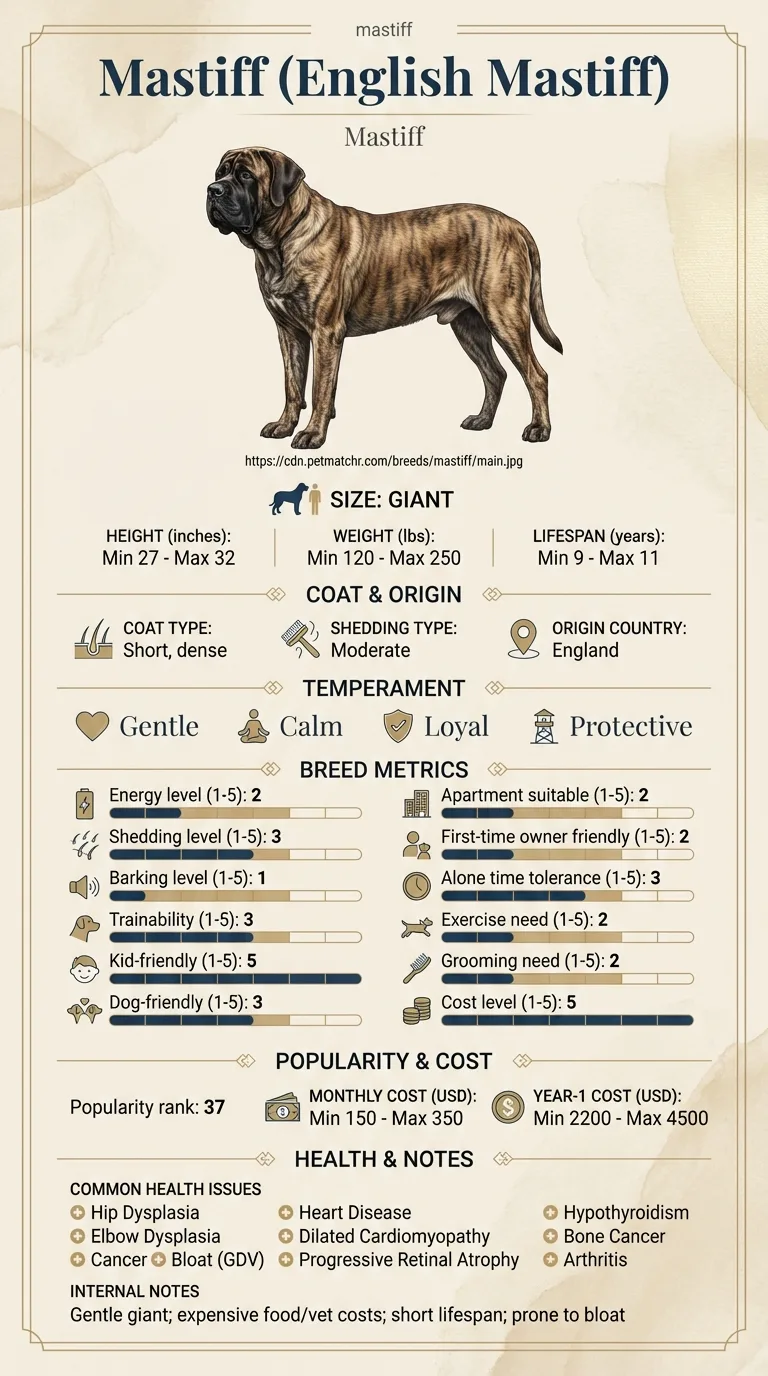
Mastiff Kidney Disease: A Problem That Hides Until It Cannot infographic

Owners of an older Mastiff who has started drinking or urinating more, losing condition, or eating less enthusiastically, and anyone who has just been given a kidney diagnosis and a staging number they do not understand.

Important reminder

This guide is not medical advice. If your dog shows pain, sudden behavior change, or worsening symptoms, consult a licensed veterinarian.

Some links may be affiliate links. We may earn a commission at no extra cost to you. We only suggest products we believe are helpful for dog owners.

What this problem looks like

Chronic kidney disease is a progressive loss of functioning kidney tissue that stays hidden until most of the reserve is gone. The first outward change is usually increased drinking and urinating, followed later by appetite loss, weight loss and nausea. It cannot be reversed, but staging-led management — diet, blood pressure control, hydration and monitoring — can meaningfully slow it and keep a dog comfortable.

Common triggers

  • Age-related loss of functioning kidney units over years
  • Chronic dental disease and other long-running inflammatory conditions
  • High blood pressure damaging kidney tissue progressively
  • Episodes of dehydration, including around anaesthesia or illness
  • Medications that place additional demand on compromised kidneys

This is one of the most frequently diagnosed conditions in older dogs generally rather than a breed-specific Mastiff problem. Its relevance to this breed comes from lifespan: at nine to eleven years, a Mastiff enters the typical age range for kidney disease while owners still think of the dog as middle-aged, so it is easy to attribute early changes to nothing in particular.

Why this happens

Breed factors

Kidney disease is not listed among the Mastiff's documented health issues, and there is no anatomical feature of the breed that drives it the way size drives joint disease. What the breed contributes is scale and timeline. A nine-to-eleven-year lifespan means the geriatric window opens early, so a seven-year-old Mastiff is squarely in the age band worth screening. Size then affects detection: a large dog's normal water intake is high enough to hide a doubling, and several pounds of weight loss disappear on a big frame.

Environment factors

Hydration and dental health are the two environmental factors most often overlooked. A dog with limited access to fresh water, or one that spends hot days losing fluid through heavy panting in a breed that already tolerates heat poorly, is repeatedly stressing the kidneys. Chronic dental disease keeps a low-grade inflammatory load running for years. Diet plays a role once disease is established, and how consistently a prescription food is actually fed — as opposed to prescribed — often determines whether it helps at all.

What you can do at home (once it is not an emergency)

When to talk to your vet

Book a blood and urine test if your Mastiff has started drinking or urinating noticeably more, is losing weight without a diet change, has become fussy about food, or has developed bad breath with a chemical smell. Go urgently if your dog stops drinking, vomits repeatedly, becomes weak or unsteady, has not urinated in twelve hours, or seems suddenly disoriented, as these suggest either a crisis in chronic disease or an acute kidney injury that needs immediate treatment. Straining to urinate with little or no output is an emergency and should never be assumed to be chronic kidney disease.

At home, alongside your vet's plan

  • Measure water intake over a full twenty-four hours using a marked jug, and repeat every few months. A number beats an impression, especially in a dog that drinks a lot normally.
  • Provide several water stations around the house and refresh them daily. A large dog should never have to work to find a drink.
  • Weigh your Mastiff monthly on the same scale and log it. Gradual weight loss is the sign owners of big dogs miss most often.
  • Keep a note of appetite: not just whether the bowl is emptied, but whether the dog approaches food with the same enthusiasm.
  • Introduce any prescribed diet slowly over one to two weeks, mixing in increasing proportions. Sudden food changes are poorly tolerated in a deep-chested giant breed.
  • Tell every vet who sees your dog about the diagnosis, including emergency clinics, before any procedure or medication.

See all Mastiff health problems, which breeds are prone to kidney disease, or the full Mastiff breed guide for temperament, exercise needs and ownership costs.

What to expect, and how you know it is working

Chronic kidney disease progresses over months to years rather than days, and its pace varies widely between individuals. Dogs caught in an early stage can remain stable for a long time with monitoring and diet. Once appetite and nausea become the daily issue, the picture usually changes over months. Expect testing intervals to shorten as the disease advances, and expect the plan to be revised at nearly every recheck.

Success is a dog who is eating, drinking, maintaining weight and behaving normally, with bloodwork that moves slowly or not at all between tests. It is not normal kidney values, which will not return. In a breed whose whole life spans nine to eleven years, holding a stable stage for a further year or two is a substantial result, and the honest goal is comfortable time rather than cure.

Why increased drinking is the signal to take seriously

A healthy kidney concentrates urine, pulling water back into the body and excreting waste in a small volume. As functioning tissue is lost, the remaining kidney can no longer concentrate properly, so it produces larger volumes of dilute urine. The dog then drinks more to keep up. This is why increased thirst and increased urination arrive together, and why they show up before appetite loss or weight loss.

The difficulty in a Mastiff is that the baseline is already high. A dog weighing 120 to 250 pounds drinks a great deal of water normally, and a household refilling a large bowl several times a day may not register that it has become several times more. Owners of small dogs notice this change far more readily.

The practical answer is to measure rather than estimate, at least once. Fill a jug with a known volume, use it to fill the bowl for twenty-four hours, and record what was used. Do it again a few months later. A number is comparable in a way that an impression is not.

Urine output tells the same story from the other side. Larger puddles, needing to go out overnight when the dog previously slept through, or an accident in a reliably house-trained adult are all worth a blood and urine test rather than a shrug.

What staging means and what changes at each level

Vets stage chronic kidney disease to decide what to do rather than to label the dog. Broadly, the plan changes like this.

Mastiff Kidney Disease: A Problem That Hides Until It Cannot - What staging means and what changes at each level
  • Earliest stage: often no symptoms at all, picked up on routine bloodwork or urine testing. The interventions are unglamorous — free access to water at all times, avoiding drugs hard on the kidneys, and repeat testing to establish the trajectory.
  • Early to middle stages: this is where a prescription kidney diet is usually introduced, and where it does the most good. These diets restrict phosphorus and adjust protein, and diet is one of the better-supported interventions in the whole condition.
  • Middle stages: management of blood pressure and protein loss in the urine typically begins, both of which accelerate kidney damage if left alone. This is also when monitoring intervals shorten from yearly to a few months.
  • Advanced stage: appetite, nausea and hydration become the daily focus. Some dogs receive fluids given under the skin at home, which is entirely manageable but is a significantly larger volume of fluid in a giant breed than in a small dog.
  • Throughout: never restrict water access. Reducing a dog's drinking to control urination in kidney disease is dangerous, because that water is the only thing keeping the dog hydrated against obligatory losses.

What to do next about kidney disease in Mastiffs

If you think your Mastiff has kidney disease, the plan is three steps: write down what you have seen and when it started, book a veterinary appointment rather than waiting for the next flare, and take video of the behaviour or symptom before you go — the thing you are worried about rarely happens in the consulting room. Screening in the parents covers hip dysplasia, elbow dysplasia, cancer.

What the vet visit should produce is a diagnosis and a written plan, not just reassurance: what is being ruled out, what the monitoring interval is, and which signs mean you come back sooner. Ask what the treatment costs across a year rather than per visit, because that is the number that decides whether you are managing this condition or reacting to it.

Between appointments, keep a short log — dates, what you saw, what changed. It is the single most useful thing an owner brings to a follow-up, and for kidney disease it is often what separates a clear pattern from a guess.

The jug on the kitchen counter

Meredith had not thought much about how much her eight-year-old Mastiff, Barnaby, drank. He was a huge dog and he had always emptied his bowl. What made her pay attention was waking at four in the morning three nights running to let him out. Her vet asked her to measure. She marked a two-litre jug, used only that to fill his bowl, and wrote down what she got through. The figure was far higher than she expected, and higher again than the range her vet gave for a dog of his size. Blood and urine tests showed early chronic kidney disease. Barnaby had no other symptoms at all; his appetite was excellent and his weight was steady. He went onto a monitoring schedule, then a renal diet six months later when his vet judged the stage was right. He stayed stable for just over two years, and Meredith kept measuring his water once a month for the rest of his life.

Key takeaway: In a dog that normally drinks a lot, a significant increase is invisible without measurement. A marked jug and one twenty-four hour record turned a vague night-time nuisance into a diagnosis made early enough for the diet and monitoring to matter.

Frequently asked questions

Is kidney disease common in Mastiffs?

Chronic kidney disease is a common condition in older dogs of all breeds and is not one of the issues documented as characteristic of Mastiffs specifically. What makes it relevant here is timing: with a lifespan of nine to eleven years, a Mastiff reaches the age band where kidney disease appears while still seeming middle-aged to its owner.

Can kidney disease be reversed?

Chronic kidney disease is not reversible. Nephrons that have been lost do not regenerate. Management aims to slow further loss and to control the consequences, and it can be genuinely effective at both. Acute kidney injury, which is a different problem with a sudden cause, can sometimes be recovered from if treated fast.

Should I switch to a kidney diet as soon as I hear the diagnosis?

Follow your vet's staging rather than acting immediately on your own. Prescription renal diets are valuable at the right stage and less appropriate very early. There is also a practical issue in this breed: a Mastiff eats a large volume, so an abrupt food change risks digestive upset, and transitions should be gradual.

How often should bloodwork be repeated?

It depends on stage. A dog with early, stable disease might be checked every six to twelve months, while a dog in a more advanced stage may need testing every one to three months. Urine testing matters as much as blood testing, particularly for protein loss and concentrating ability.

Are there medications that are bad for the kidneys?

Several commonly used drug classes need care in a dog with reduced kidney function, and dehydration during anaesthesia is a risk factor. This is a genuine reason to make sure every vet who treats your dog knows about the diagnosis, including out-of-hours clinics. Never give human medication to a dog with kidney disease.

Does a large breed face anything different here?

The disease process is the same, but the logistics scale. Water bowls empty faster, subcutaneous fluid volumes are larger, prescription diets cost considerably more per month, and weight loss is harder to spot on a big frame. Weighing regularly matters more in a giant breed, because a ten-pound loss can be invisible by eye.

Quick answers

View more answers
Health

What is the earliest sign of kidney disease?

Increased drinking and urination, because failing kidneys can no longer concentrate urine. In a giant breed this is easy to miss, so measure water intake over twenty-four hours rather than estimating.

Health

Should I limit water if my dog is urinating more?

Never. In kidney disease that water is what keeps the dog hydrated against unavoidable losses. Restricting it is dangerous.

Health

Can chronic kidney disease be cured?

No. Lost kidney tissue does not regenerate. Management slows further loss and controls symptoms, and done well it can add good time.

Health

When does a renal diet get introduced?

Usually at early to middle stages, on your vet's advice. Introduce it gradually, since a giant breed eats a large volume and abrupt changes upset digestion.

Health

How do I spot weight loss on a very large dog?

Weigh monthly on the same scale. Ten pounds off a two-hundred-pound dog is significant and almost impossible to see by eye.

Related DogBreedCompass guides

  • kidney and bladder stones in MastiffsStones are a separate urinary problem with different signs and urgency.
  • diabetes in MastiffsIncreased thirst and urination overlap with diabetes and need distinguishing.
  • Mastiff liver diseaseAppetite loss and weight change also feature in this breed's liver conditions.
  • anaesthesia considerations in MastiffsKidney function influences anaesthetic and drug choices for other procedures.
  • cost of owning a MastiffPrescription diets and frequent monitoring change monthly running costs.
  • Mastiff breed overviewBreed profile with lifespan and documented health issues.

Bring the right questions to the vet

A one-page prep sheet for this condition: the signs, the questions to ask, what to get priced. Unlocks here.

You get: Vet visit prep sheet

No spam. One-click unsubscribe. See our privacy policy.

Preview page 1 before you decide.

Related guides