Health
Do Mastiffs get Legg-Calvé-Perthes disease?
Very rarely. It is overwhelmingly a toy and small breed condition affecting dogs under about twenty pounds, usually between five and eight months old.

Quick answer
Do Mastiffs get Legg-Calvé-Perthes disease?
Very rarely. It is overwhelmingly a toy and small breed condition affecting dogs under about twenty pounds, usually between five and eight months old.
The honest answer to "does my Mastiff have Legg-Calvé-Perthes?" is almost always no. The useful question is what else causes a young giant breed to limp.
Owners of a Mastiff puppy or adolescent with hind-limb lameness who have searched the condition and want to know whether it applies, and what the real candidates are.
This guide is not medical advice. If your dog shows pain, sudden behavior change, or worsening symptoms, consult a licensed veterinarian.
Some links may be affiliate links. We may earn a commission at no extra cost to you. We only suggest products we believe are helpful for dog owners.
We research and check what we publish, but we do not warrant that any figure, date, price, or statement is accurate, complete, or current, and we accept no liability for any loss, cost, injury, or other harm arising from the use of this site. Use it as one reference among several. You remain responsible for your own decisions and for your dog's care - confirm anything that matters with a licensed veterinarian or another qualified professional before you act on it. Full disclaimer.
Legg-Calvé-Perthes disease is the death and collapse of the femoral head following loss of its blood supply, causing progressive one-sided hind-limb lameness in young dogs. It is a well-recognised condition of toy and small breeds and is rare in large and giant dogs. For a Mastiff owner, the practical value of understanding it is mostly in knowing what it is not, and in recognising the growth-related conditions that genuinely do affect this breed.
This condition does not appear among the health issues documented for Mastiffs, and cases in giant breeds are uncommon enough to be unusual. By contrast, hip dysplasia, elbow dysplasia and arthritis are all explicitly documented in this breed, and growth-related lameness in adolescence is a routine reason for a large-breed puppy to see a vet.
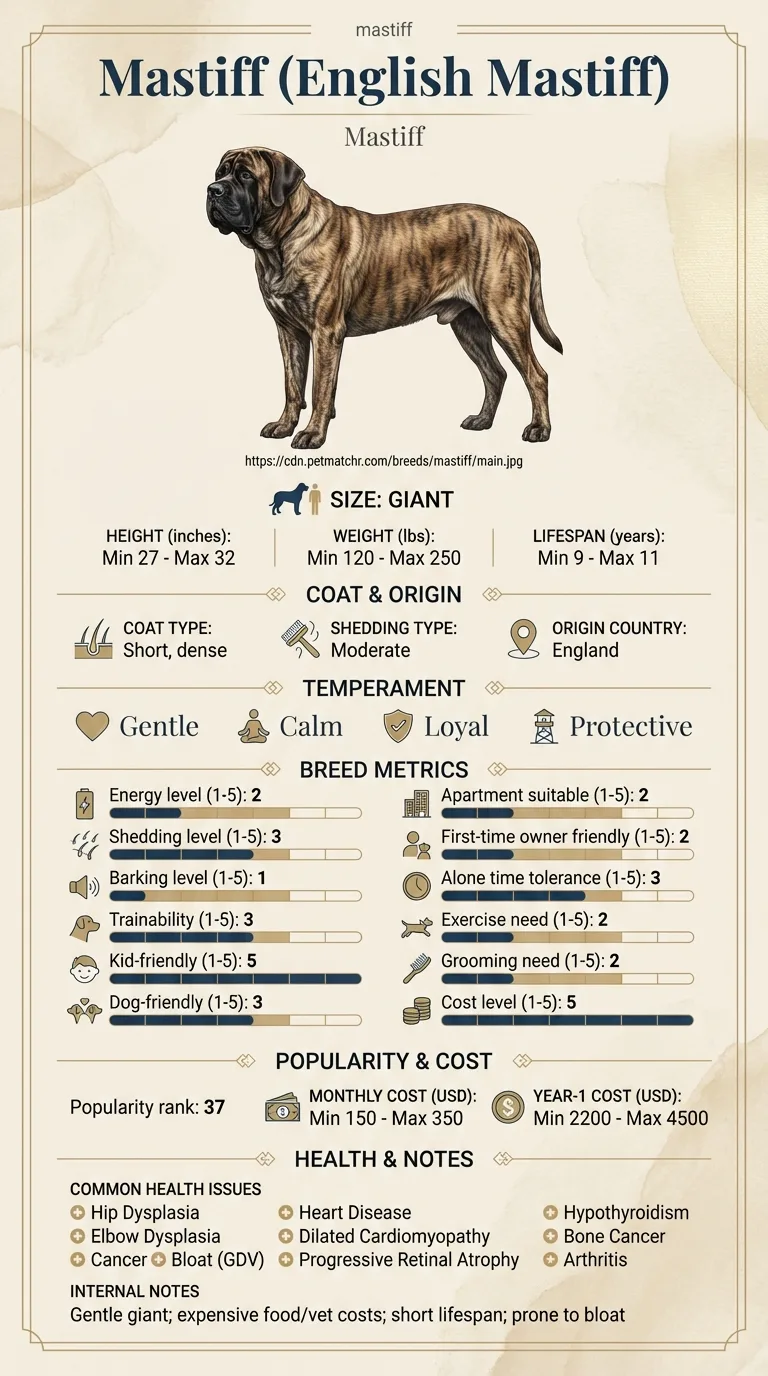
The vulnerability that produces Legg-Calvé-Perthes appears to be concentrated in small-breed anatomy and genetics rather than in giant breeds, which is why a Mastiff is an unlikely candidate. What the Mastiff does have is one of the most demanding growth curves in the dog world: a puppy that will reach 120 to 250 pounds and stand 27 to 32 inches must build that skeleton in roughly twelve to eighteen months. That rate is precisely what drives the conditions genuinely seen here — hip and elbow dysplasia, both documented in the breed, along with cartilage and long-bone growth disorders.
Growth-stage management is where owners have real influence. Feeding a giant-breed puppy for maximum size loads soft cartilage with weight it is not ready for. Allowing repeated jumping down from height, long forced walks, or hard running on unforgiving surfaces before maturity adds impact at the worst possible time. Slippery flooring forces a heavy puppy to splay and scramble. None of these causes femoral head necrosis, but all of them contribute to the lameness a young Mastiff is actually likely to develop.
Book an appointment for any limp lasting more than a couple of days, any limp in a growing puppy, or any lameness accompanied by swelling, heat or obvious pain. Seek same-day care if your Mastiff will not bear weight on a limb at all, cries out when it is handled, has a visibly deformed or swollen leg, or became lame after a fall. In an adult or older Mastiff, a persistent limp with a firm swelling near a joint should be imaged promptly rather than rested and watched, because bone cancer is documented in this breed and early assessment matters.
See all Mastiff health problems, which breeds are prone to legg calv perthes disease, or the full Mastiff breed guide for temperament, exercise needs and ownership costs.
Reaching a diagnosis for a limping giant-breed puppy usually takes one to three weeks, often involving radiographs and sometimes a period of rest to see what changes. Panosteitis resolves over weeks to months as growth completes. Hip and elbow dysplasia are lifelong and managed rather than cured. If Legg-Calvé-Perthes were confirmed, treatment would be surgical and the recovery would be a matter of months, complicated in this breed by body weight.
Success is an accurate diagnosis reached without wasted time, and a growth plan that protects the joints through the year that matters most. For most limping Mastiff puppies, success means the limp is explained by something self-limiting and the dog grows out of it, or it is explained by a joint condition caught early enough that weight control and controlled exercise can shape the next decade. Being told it is not Legg-Calvé-Perthes is the beginning of the answer, not the end of it.
The femoral head — the ball at the top of the thigh bone — receives its blood supply through a small number of vessels running along the bone's neck. In young dogs this supply is precarious, and in certain small breeds it appears to be more vulnerable still, for reasons thought to involve both blood vessel anatomy and inherited factors.
When that supply is interrupted, the bone tissue in the femoral head dies. The joint surface then deforms as the weakened bone collapses under load, producing pain and progressive lameness. Because the process is one of bone death and collapse rather than inflammation, it is slow and steadily worsening rather than sudden.
The overwhelming pattern in veterinary practice is small dogs, typically under about twenty pounds, in the second half of their first year, and usually affecting one hip. Reports in large and giant breeds are rare enough to be notable when they occur. That is not a guarantee about your individual dog, but it is a strong reason for a vet to investigate more common causes first rather than reaching for this diagnosis.
Treatment, where the condition is confirmed, generally involves surgically removing the damaged femoral head so the body forms a false joint of fibrous tissue. That works well in a small dog whose body weight the false joint can support. In a dog heading toward 250 pounds it is a far less appealing option, which is another reason the diagnosis is approached carefully in a giant breed.
These are the conditions a vet will genuinely be weighing in a growing giant-breed dog with hind-limb lameness.

Rosalind's Mastiff, Ptolemy, started favouring his left hind leg at seven months. She had found an article about Legg-Calvé-Perthes and arrived at her vet worried about a hip that was dying. Her vet examined him, took radiographs of both hips, and found no collapse of either femoral head. The sockets looked reasonable for his age. Two weeks later Ptolemy was sound on the left and limping on the right front instead. That shift was the answer. Panosteitis was confirmed, and Rosalind was told it would come and go for a few months and then stop. She kept him on short lead walks, held his food to the growth curve her vet set, and put rubber matting through the kitchen. He was sound by eleven months and has been ever since. He is now five and weighs 196 pounds.
Key takeaway: The condition Rosalind had researched belonged to dogs a tenth of Ptolemy's eventual size. What identified the real problem was the detail she almost did not mention: the limp had moved to a different leg.
It would be very unusual. The condition is strongly concentrated in toy and small breeds, and reports in giant breeds are rare. Your vet will not rule it out on breed alone, but they will reasonably investigate hip dysplasia, panosteitis and cartilage disorders first, because those are far more likely in a dog of this size.
Radiographs. Legg-Calvé-Perthes produces a characteristic moth-eaten, collapsed appearance of the femoral head itself, usually on one side only. Hip dysplasia shows a shallow socket and poor coverage of the ball, typically affecting both hips. The two look quite different on film even though they can feel similar to an owner.
A shifting lameness in a fast-growing large-breed adolescent is a classic description of panosteitis. It is painful but self-limiting, resolving as growth completes, and is managed with rest and pain relief prescribed by your vet. It is worth having confirmed rather than assumed, since other conditions can shift too.
Any persistent limp deserves a vet visit regardless of age. In puppies and adolescents the growth-related conditions dominate. In an adult or older Mastiff, a new limp that does not resolve within a few days should be imaged rather than rested, because bone tumours are documented in this breed and time matters.
Removing the femoral head relies on the body forming a fibrous false joint that carries the dog's weight. That works well in a small dog and much less predictably in one weighing well over a hundred pounds. This is why, in the rare giant-breed case, surgeons weigh the options far more carefully.
Restrict activity to short lead walks only, stop stairs and jumping, and keep your puppy on non-slip surfaces. Do not give human painkillers, several of which are dangerous to dogs. Note when the limp is worst, whether it improves with rest, and whether it has moved between legs, since your vet will ask all three.
Very rarely. It is overwhelmingly a toy and small breed condition affecting dogs under about twenty pounds, usually between five and eight months old.
Hip dysplasia, panosteitis or osteochondritis dissecans. All three are associated with rapid growth in large breeds and are far more common here.
Panosteitis, a self-limiting inflammation of the long bones in fast-growing adolescents. It resolves as growth finishes but should be confirmed by a vet.
On radiographs. Perthes collapses the femoral head itself, usually on one side. Dysplasia shows a shallow socket and poor ball coverage, usually on both.
Short lead walks only, no stairs or jumping, non-slip floors, and no human painkillers. Note when the limp is worst and whether it has changed legs.
A one-page prep sheet for this condition: the signs, the questions to ask, what to get priced. Unlocks here.
You get: Vet visit prep sheet
No spam. One-click unsubscribe. See our privacy policy.
Preview page 1 before you decide.