Health
What is a liver shunt?
An abnormal vessel that lets blood from the intestines bypass the liver, so toxins including ammonia reach the rest of the body unfiltered and the liver stays underdeveloped.

Quick answer
What is a liver shunt?
An abnormal vessel that lets blood from the intestines bypass the liver, so toxins including ammonia reach the rest of the body unfiltered and the liver stays underdeveloped.
A puppy that seems dull or strange an hour after eating is describing a very specific problem, and the timing is the clue.
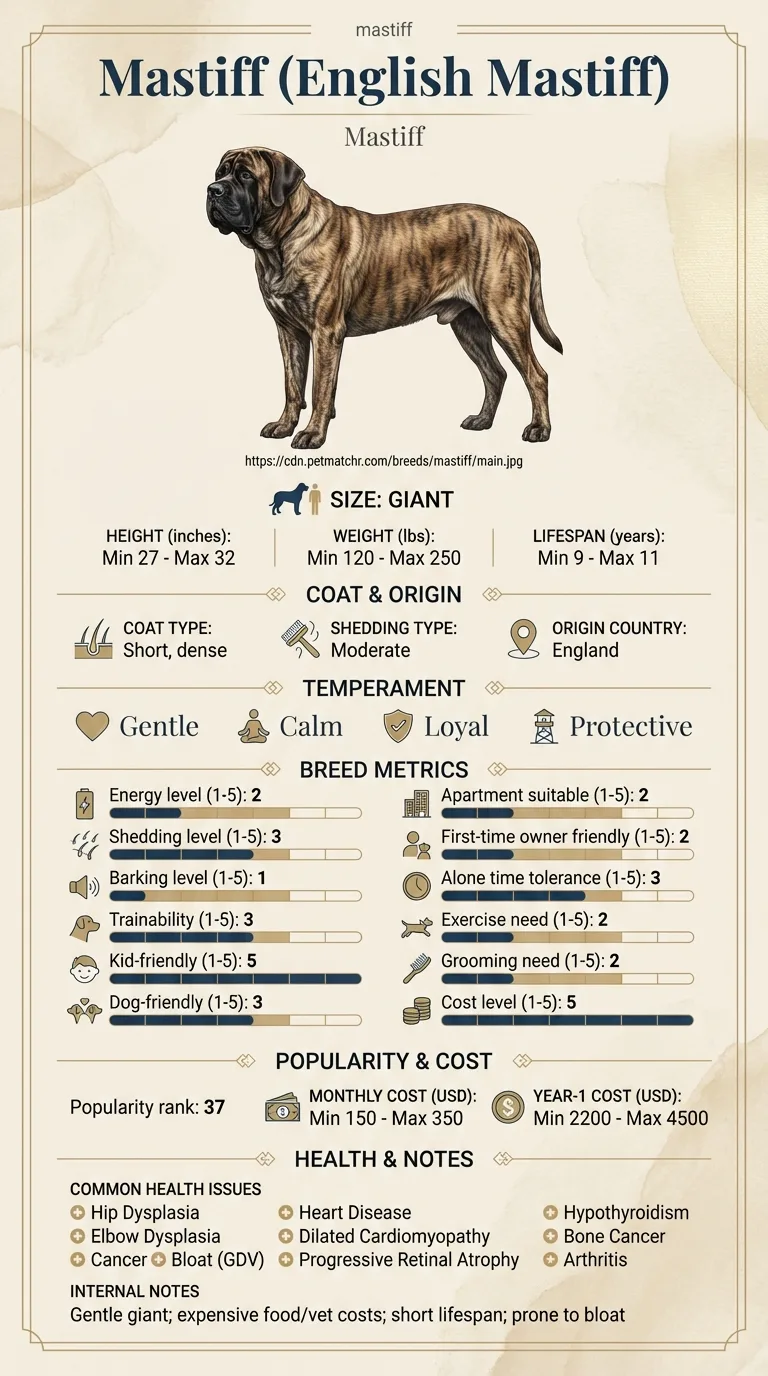
Owners of a Mastiff puppy who is small for the litter, slow to grow, occasionally disoriented, or unusually affected by anaesthesia or sedation.
This guide is not medical advice. If your dog shows pain, sudden behavior change, or worsening symptoms, consult a licensed veterinarian.
Some links may be affiliate links. We may earn a commission at no extra cost to you. We only suggest products we believe are helpful for dog owners.
We research and check what we publish, but we do not warrant that any figure, date, price, or statement is accurate, complete, or current, and we accept no liability for any loss, cost, injury, or other harm arising from the use of this site. Use it as one reference among several. You remain responsible for your own decisions and for your dog's care - confirm anything that matters with a licensed veterinarian or another qualified professional before you act on it. Full disclaimer.
A portosystemic shunt is an abnormal blood vessel that carries intestinal blood past the liver instead of through it. Toxins that should be filtered out reach the brain, producing neurological signs that typically cluster one to three hours after meals, while the liver itself remains small and underdeveloped. In large and giant breeds the shunt vessel is usually inside the liver, which makes correction considerably more complex than in small dogs.
Liver shunts are uncommon overall and are not documented among the Mastiff's characteristic health issues. Where they occur in giant breeds, the intrahepatic form predominates. A Mastiff puppy that is failing to thrive is far more likely to have a different cause, but a shunt is worth excluding because the signs are easy to overlook and the condition is treatable.
The Mastiff's relevance to shunts is about which type rather than how likely. Large and giant breeds are associated with the intrahepatic form, arising from a foetal vessel within the liver that fails to close after birth, whereas small breeds usually have a single vessel outside the organ. The breed's growth expectations also change how failure to thrive is interpreted: a Mastiff puppy is supposed to gain weight at a remarkable rate on the way to 120 to 250 pounds, so one that stays small and out of condition stands out more sharply than a small-breed puppy would.
The shunt itself is a developmental anomaly, not something the environment causes, and owners should not look for something they did wrong. What environment influences is the severity of episodes. Diet composition, particularly protein content and digestibility, changes how much ammonia is produced. Constipation, intestinal bleeding, dehydration and infection all raise circulating ammonia and can tip a stable dog into a bad episode. Consistency of feeding and medication is therefore the practical lever in medical management.
Book an appointment promptly for a puppy that is not growing as expected, has intermittent vomiting or diarrhoea without explanation, or shows any post-meal dullness, staring, circling or head pressing. Mention explicitly any unusually slow or strange recovery from sedation. Seek emergency care immediately for seizures, collapse, an inability to stand, blindness that comes on suddenly, or a dog that cannot be roused, as these indicate severe toxin accumulation. Also treat sudden vomiting of blood or black tarry stools as urgent, since intestinal bleeding sharply worsens the condition.
See all Mastiff health problems, which breeds are prone to liver shunts, or the full Mastiff breed guide for temperament, exercise needs and ownership costs.
Bile acid testing gives an answer within days. Imaging and specialist referral typically add two to six weeks. Medical stabilisation on diet and medication usually shows a clear improvement within one to three weeks. Surgical closure of an intrahepatic shunt, where it is possible, is a specialist procedure with a recovery measured in months and a period of close monitoring afterwards while the liver adapts to full blood flow.
For a dog whose shunt is successfully closed, success can genuinely mean a normal life, normal growth and no ongoing treatment. For a dog managed medically, success looks different: no neurological episodes, steady weight gain, stable bloodwork, and a routine that the household can maintain indefinitely. Owners should hear the prognosis from a specialist who has seen the imaging, because outcomes for intrahepatic shunts in giant breeds vary considerably from case to case.
Shunts are divided by where the abnormal vessel runs, and the division tracks body size closely enough to be useful.
In small breeds the vessel usually lies outside the liver. It is a single abnormal connection in the abdomen, and because it is accessible, surgical correction is comparatively straightforward.
In large and giant breeds the more typical form lies inside the liver itself. This is a foetal vessel that should close shortly after birth and does not, leaving a channel through the liver substance that blood takes in preference to the normal filtering route. Because it is embedded within the organ rather than lying beside it, surgical closure is technically far more demanding and is generally done at specialist centres, sometimes using techniques that narrow the vessel gradually rather than tying it off at once.
The reason gradual closure is preferred is worth understanding. A liver that has never handled full blood flow cannot suddenly take all of it. Closing a shunt abruptly can cause a dangerous rise in pressure in the vessels feeding the liver. Slow closure gives the underdeveloped liver time to build the vasculature it needs.
Both forms produce the same downstream problem: toxins that should have been removed, particularly ammonia from protein digestion, circulating to the brain.
The characteristic pattern is neurological signs that worsen one to three hours after eating, because that is when protein breakdown products flood a bloodstream that has no filter.

Bram's Mastiff puppy, Hesper, was the smallest of her litter and stayed that way. At four months she weighed noticeably less than her breeder expected, and she was a fussy, unenthusiastic eater. What Bram mentioned almost as an aside was that she got odd in the evenings. An hour or so after her supper she would stand facing the utility room wall, sometimes pressing her forehead against it, and she seemed not to hear him. It lasted twenty minutes or so and then she was herself again. His vet ran a bile acid test that week. The post-meal value was dramatically raised. A CT scan at a referral centre found an intrahepatic shunt. Hesper was stabilised on a prescription diet and medication while the surgical team assessed her, and the wall-staring stopped within a fortnight. Bram's log of what she ate and when she went strange was, the specialist told him, the most useful document in the file.
Key takeaway: The failure to thrive got Hesper to a vet, but the timing of the evening episodes is what pointed at the liver. Neurological signs that reliably follow a meal by an hour or two are a specific pattern, and an owner's written record of it is often more diagnostic than anything seen in the consulting room.
They are not among the health issues documented as characteristic of this breed, and shunts overall are uncommon. Where they do occur in a giant breed, the form is usually the one inside the liver rather than the small-breed type outside it. Most Mastiff puppies who fail to thrive turn out to have a different explanation.
Usually starting with a bile acid test, which measures liver function by comparing a fasted blood sample with one taken two hours after a meal. A markedly raised post-meal value strongly suggests the liver is being bypassed. Confirmation and mapping of the vessel then requires imaging, typically ultrasound or a CT scan.
Medical management can control symptoms substantially, using a specific diet and medications prescribed to reduce the production and absorption of ammonia in the gut. It does not correct the shunt, and long-term outcomes are generally better with successful surgical closure. This is a decision to make with a specialist rather than in general practice.
Because the liver metabolises most anaesthetic and sedative drugs, and a bypassed liver clears them slowly. A puppy that took an unusually long time to wake up, or that behaved oddly for a day afterwards, is worth investigating. Always tell your vet if this has happened before any future procedure.
Typically a reduced-protein, highly digestible prescription diet designed to limit the ammonia produced during digestion. In a giant-breed puppy this creates tension with growth requirements, and it is not something to attempt without veterinary supervision. A growing Mastiff on an inappropriate homemade low-protein diet can develop entirely new problems.
It varies a great deal with the type, the severity and whether closure is achievable. Dogs whose shunt is successfully closed can go on to live normal lives. Dogs managed medically often do reasonably well for years but remain vulnerable to episodes. Intrahepatic shunts in giant breeds are the more difficult group, and the prognosis conversation belongs with a specialist who has seen the imaging.
An abnormal vessel that lets blood from the intestines bypass the liver, so toxins including ammonia reach the rest of the body unfiltered and the liver stays underdeveloped.
Protein digestion releases ammonia, which a bypassed liver cannot clear. Dullness, staring, circling or unsteadiness typically appear one to three hours after eating.
Giant breeds more often have the shunt vessel inside the liver rather than outside it, which makes surgical closure technically harder and usually staged rather than immediate.
A bile acid test comparing fasted and post-meal blood samples, followed by ultrasound or CT to locate the vessel if the result suggests a shunt.
It can be. The liver clears most sedative drugs, so a prolonged or strange recovery in a young dog is worth investigating and must be reported before any future procedure.
A one-page prep sheet for this condition: the signs, the questions to ask, what to get priced. Unlocks here.
You get: Vet visit prep sheet
No spam. One-click unsubscribe. See our privacy policy.
Preview page 1 before you decide.