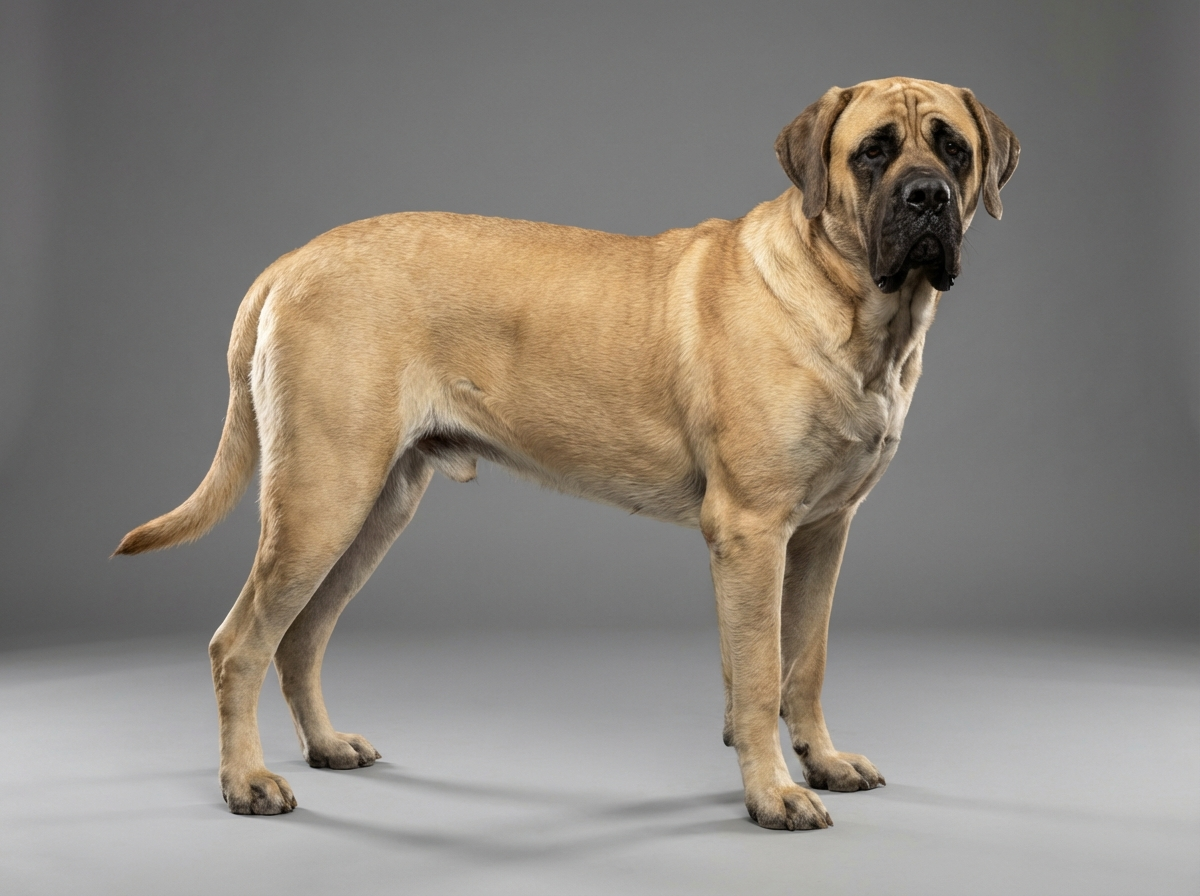
Health
Is a slipping kneecap likely in a Mastiff?
Not particularly. It is a small-breed conformational problem and is not documented for this breed. Sudden hind-limb lameness in a heavy dog more often means a cruciate ligament rupture.

Quick answer
Is a slipping kneecap likely in a Mastiff?
Not particularly. It is a small-breed conformational problem and is not documented for this breed. Sudden hind-limb lameness in a heavy dog more often means a cruciate ligament rupture.
In a giant breed, the sudden hind-leg lameness that everyone calls a slipped kneecap is far more often a torn ligament.
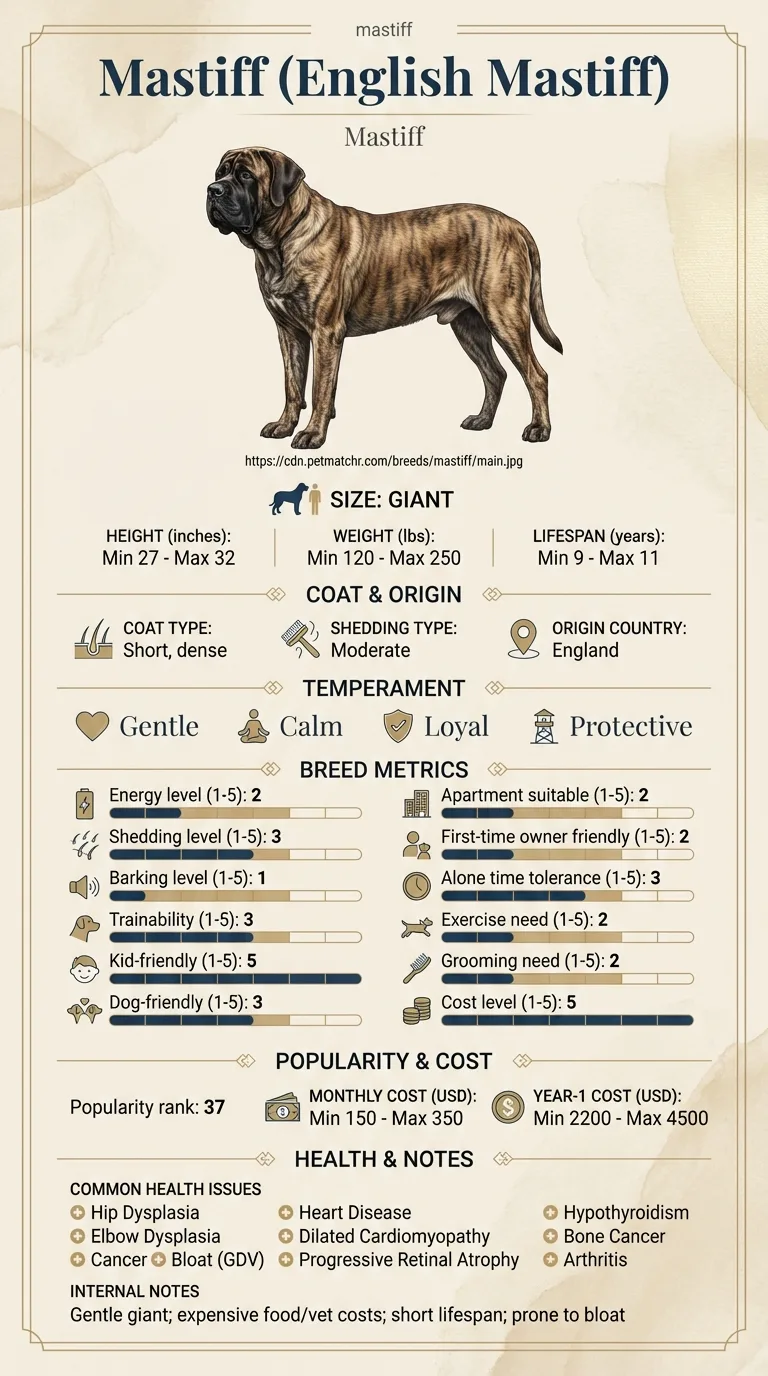
Owners of a Mastiff with intermittent or sudden hind-limb lameness who have been told, or have read, that the kneecap might be slipping, and want to know whether that is plausible.
This guide is not medical advice. If your dog shows pain, sudden behavior change, or worsening symptoms, consult a licensed veterinarian.
Some links may be affiliate links. We may earn a commission at no extra cost to you. We only suggest products we believe are helpful for dog owners.
We research and check what we publish, but we do not warrant that any figure, date, price, or statement is accurate, complete, or current, and we accept no liability for any loss, cost, injury, or other harm arising from the use of this site. Use it as one reference among several. You remain responsible for your own decisions and for your dog's care - confirm anything that matters with a licensed veterinarian or another qualified professional before you act on it. Full disclaimer.
A luxating patella is a kneecap slipping out of its groove, producing the characteristic intermittent skipping gait seen in small breeds. It is not among the conditions documented for Mastiffs, and the giant-breed build does not fit the inherited pattern. In a heavy dog with hind-limb lameness, cruciate ligament disease is the far more likely explanation, and distinguishing the two is the point of the veterinary examination.
Patellar luxation is common in toy and small breeds and uncommon in giant ones. Cruciate ligament rupture, by contrast, is one of the most frequent orthopaedic problems in large dogs, and it commonly affects the second knee within a couple of years of the first. Hip dysplasia and arthritis, both documented in Mastiffs, add further sources of hind-limb lameness.
The inherited malformations behind patellar luxation — a shallow femoral groove and a misplaced tendon attachment — are concentrated in small breeds, and nothing in the Mastiff's documented health profile suggests this pattern. What the breed does carry is weight and the joint disease that follows it: hip dysplasia, elbow dysplasia and arthritis all appear on the breed's list. A dog reaching 120 to 250 pounds puts enormous, sustained load through the stifle, which is precisely the mechanism behind the gradual cruciate degeneration seen so often in large breeds.
Body condition dominates. A Mastiff carrying excess weight loads every hind-limb joint continuously, and the ligament failure that results is usually the end of a long process rather than a single accident. Household surfaces matter: polished floors force a heavy dog to splay and grip, and a high tailgate produces repeated hard landings. Exercise pattern matters too, since a dog that is inactive all week and then asked for intense activity at the weekend has neither the muscle support nor the conditioning to protect its knees.
Book an examination for any hind-limb lameness lasting more than a day or two, for a limp that comes and goes over weeks, or for a dog that has started sitting with a leg splayed to the side. Do not delay simply because the lameness has eased, as partial cruciate tears characteristically improve before worsening. Seek same-day care if your Mastiff cannot bear any weight on a hind leg, if the leg is visibly swollen or misshapen, if the dog cries out when it is touched, or if lameness followed an obvious accident. In an older Mastiff, persistent lameness with a firm swelling near a joint should be imaged promptly, since bone cancer is documented in this breed.
See all Mastiff health problems, which breeds are prone to luxating patellas, or the full Mastiff breed guide for temperament, exercise needs and ownership costs.
Examination and imaging usually give an answer within one to two weeks. If cruciate surgery is chosen, expect a recovery of eight to twelve weeks of strictly controlled activity, followed by a gradual return over several more months, with rehabilitation throughout. Where the second knee is affected later, the process repeats. Conservative management of mild patellar luxation is judged over a few months and centres on weight and muscle rather than on any procedure.
Success is a dog who bears weight evenly, walks comfortably, and rises without difficulty, on a joint that will nonetheless develop some arthritis over time. It is not a knee restored to its original state. Getting the diagnosis right is itself a large part of success here: managing a Mastiff for a slipping kneecap while a cruciate ligament continues to fail wastes the months in which intervention would have done the most good.
The kneecap sits in a groove at the end of the femur and is held on track by the pull of the thigh muscles above and the tendon below. Luxation occurs when that alignment is wrong — usually because the groove is too shallow, or because the attachment point on the shin bone sits off to one side, pulling the kneecap sideways with every step.
Those conformational faults are strongly associated with small breeds, where they are often inherited and frequently affect both knees. The characteristic intermittent skipping gait reflects a kneecap popping out and then slipping back in on its own.
A Mastiff's stifle is built on a much larger scale and carries far greater load, and this pattern of malformation is not one of the conditions documented for the breed. Where patellar problems do appear in large dogs they are more often the outward-slipping kind and are more often linked to trauma or to a broader limb deformity than to the inherited small-breed pattern.
Meanwhile the structure that genuinely fails in the knee of a heavy dog is the cranial cruciate ligament, which stabilises the joint against the shin bone sliding forward. In large breeds this ligament tends to degenerate progressively rather than snap in a single accident, and rupture is one of the most common orthopaedic problems in dogs of this size. The two conditions can both produce hind-limb lameness, which is exactly why they get confused.
Only a veterinary examination can settle this, but these are the features that point one way or the other and are worth reporting accurately.

If you think your Mastiff has luxating patellas, the plan is three steps: write down what you have seen and when it started, book a veterinary appointment rather than waiting for the next flare, and take video of the behaviour or symptom before you go — the thing you are worried about rarely happens in the consulting room. Screening in the parents covers hip dysplasia, elbow dysplasia, cancer.
What the vet visit should produce is a diagnosis and a written plan, not just reassurance: what is being ruled out, what the monitoring interval is, and which signs mean you come back sooner. Ask what the treatment costs across a year rather than per visit, because that is the number that decides whether you are managing this condition or reacting to it.
Between appointments, keep a short log — dates, what you saw, what changed. It is the single most useful thing an owner brings to a follow-up, and for luxating patellas it is often what separates a clear pattern from a guess.
Tobias brought his Mastiff, Juno, in convinced she had a slipping kneecap. She had gone lame on the right hind after turning sharply in the garden, and a neighbour with a Yorkshire terrier had described exactly that pattern in her own dog. What Tobias had not registered was that Juno's lameness had never gone away between episodes. It eased after a few days of rest, then came back worse after any longer walk. She had also started sitting with the right leg splayed out flat to the side, which he had assumed was a sprawling habit. The examination found a partially torn cruciate ligament. Her kneecaps were entirely normal. Juno weighed 172 pounds, about fifteen more than her vet wanted. She had surgery six weeks later, after losing some of that weight, and went through eleven weeks of restricted activity and hydrotherapy. Her left knee needed the same operation two years afterwards, which her surgeon had told Tobias to expect.
Key takeaway: The small-breed pattern Tobias was matching against did not fit his dog. The two details that pointed at the real problem were that the lameness never fully resolved, and that Juno had changed how she sat.
It is possible, but it is not among the conditions documented as characteristic of the breed, and the inherited small-breed pattern does not fit a dog of this build. Where it occurs in a large dog it is more often associated with injury or with a wider limb deformity. Your vet will check the patella but will usually be more concerned about the cruciate ligament.
In large breeds the ligament usually degenerates over time rather than tearing in one traumatic event. Body weight, the angle of the joint and ongoing microscopic damage combine so that the ligament weakens until an ordinary movement finishes it. That is why owners so often report that nothing dramatic happened.
Partial cruciate tears very often improve for a while and then worsen, which misleads owners into waiting. Meanwhile the unstable joint is damaging cartilage and the meniscus. A hind-limb lameness in a giant breed deserves examination rather than a wait-and-see period, even if it appears to be settling.
It depends on the diagnosis and severity. Mild patellar luxation in a large dog may be managed conservatively. Cruciate rupture in a dog over about thirty pounds is usually treated surgically, because conservative management rarely stabilises a joint carrying that much weight. For a Mastiff the surgical options and their costs are worth discussing with an orthopaedic specialist.
Substantially. Every pound of body weight is force through the stifle, and excess weight both increases the chance of ligament failure and makes recovery from any knee surgery slower and less complete. In a breed that can reach 250 pounds, weight control is the most powerful thing an owner controls.
Short lead walks only, no stairs, no jumping in or out of vehicles, and non-slip flooring indoors. Do not encourage the dog to use the leg or to test it. Do not give human painkillers, several of which are toxic to dogs and can mask the findings your vet needs.
Not particularly. It is a small-breed conformational problem and is not documented for this breed. Sudden hind-limb lameness in a heavy dog more often means a cruciate ligament rupture.
A brief hop with one hind leg carried for two or three strides, then normal walking. Cruciate lameness does not clear within seconds like that.
In big breeds the ligament degenerates gradually under load until an ordinary movement finishes it, which is why owners rarely recall a dramatic injury.
No. Partial cruciate tears often improve temporarily while the unstable joint keeps damaging cartilage. Have it examined even if it seems to be settling.
Enormously. Body weight is force through the joint, affecting both the chance of failure and the quality of recovery from any surgery.
A one-page prep sheet for this condition: the signs, the questions to ask, what to get priced. Unlocks here.
You get: Vet visit prep sheet
No spam. One-click unsubscribe. See our privacy policy.
Preview page 1 before you decide.