Health
What is the earliest sign of allergies in a Mastiff?
Usually paw licking and rust-coloured staining between the toes, appearing before any obvious rash or ear trouble.

Quick answer
What is the earliest sign of allergies in a Mastiff?
Usually paw licking and rust-coloured staining between the toes, appearing before any obvious rash or ear trouble.
Nobody diagnoses their dog with allergies. They notice a paw that never dries, an ear that keeps coming back, and a skin fold that has started to smell.
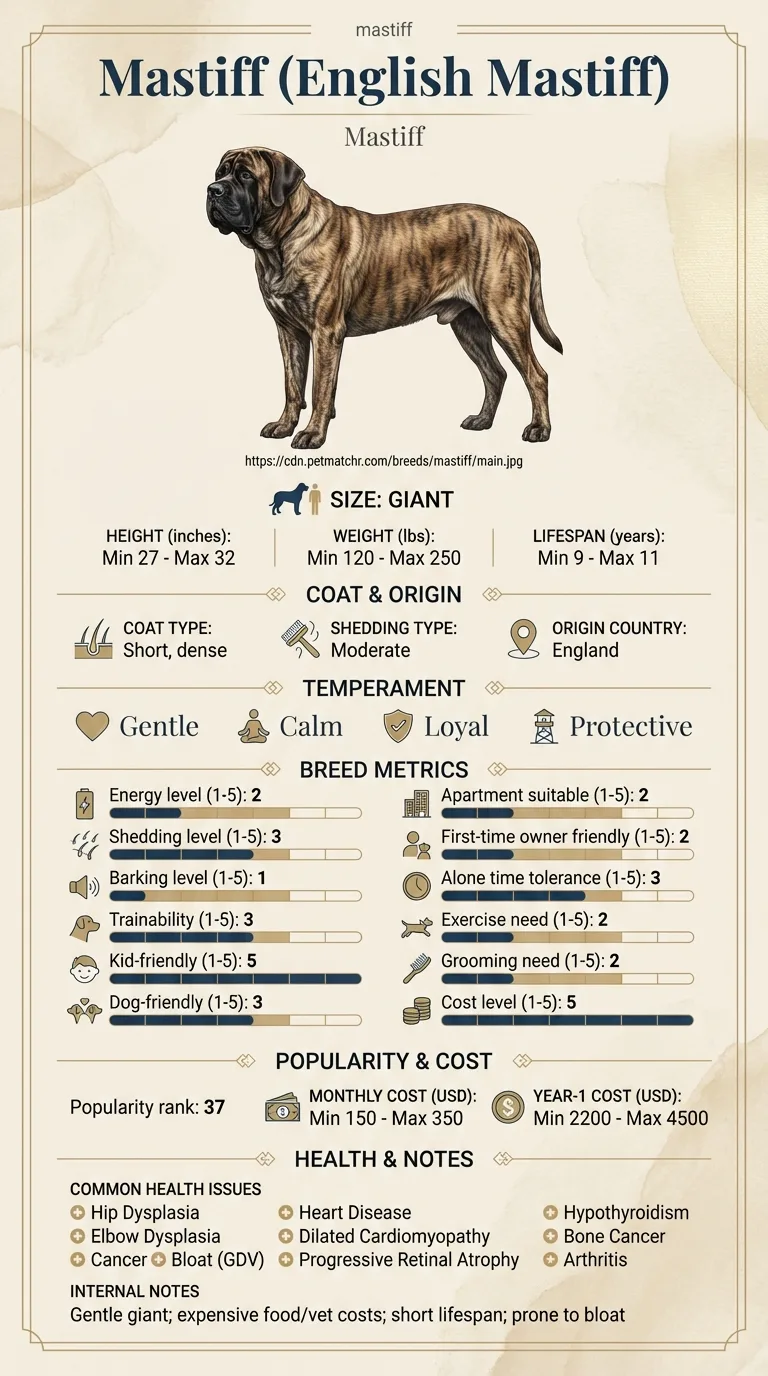
Owners on their second or third round of ear drops who suspect they are treating a symptom rather than a cause, and anyone whose Mastiff is comfortable through winter and miserable every spring. Because grooming needs for this breed are otherwise light, allergy management often feels like the first genuinely demanding coat work an owner has had to learn.
This guide is not medical advice. If your dog shows pain, sudden behavior change, or worsening symptoms, consult a licensed veterinarian.
Some links may be affiliate links. We may earn a commission at no extra cost to you. We only suggest products we believe are helpful for dog owners.
We research and check what we publish, but we do not warrant that any figure, date, price, or statement is accurate, complete, or current, and we accept no liability for any loss, cost, injury, or other harm arising from the use of this site. Use it as one reference among several. You remain responsible for your own decisions and for your dog's care - confirm anything that matters with a licensed veterinarian or another qualified professional before you act on it. Full disclaimer.
Allergic skin disease in Mastiffs is a long-running inflammatory condition rather than a single illness. The immune system overreacts to ordinary environmental material, the skin barrier weakens, and bacteria and yeast that normally cause no trouble begin to. Day to day it looks like scratching, paw licking, smelly ears, and patches of damaged skin in the warm damp places.
Itchy skin is one of the most frequent reasons any dog is brought to a vet, and Mastiffs are not exempt. What sets the breed apart is how quickly a mild allergy becomes a complicated one. The heavy ears and lip folds mean secondary infection arrives early, so a Mastiff often presents with an infection already established rather than with simple itching.
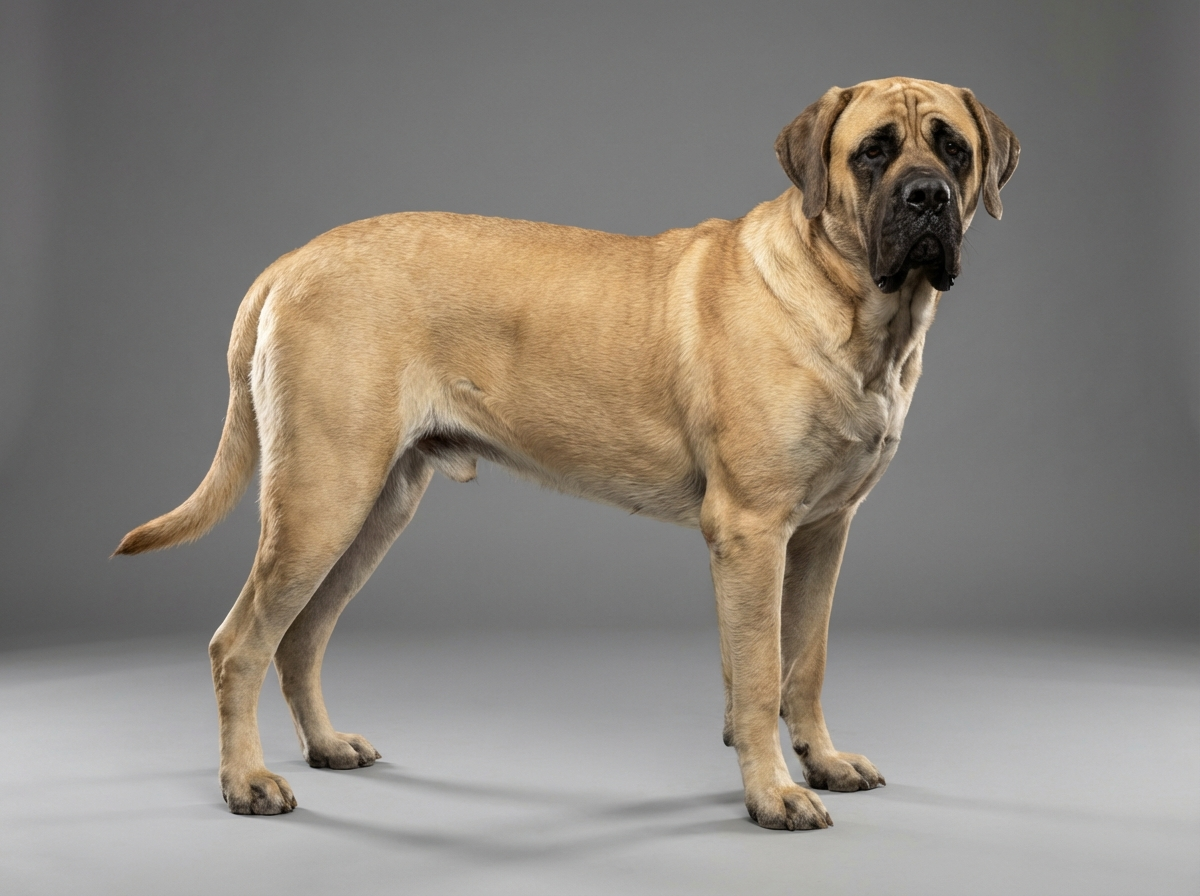
The relevant traits are structural rather than exotic. Pendulous ears cover the canal and hold heat. Loose lower lips create permanently moist pockets. A short, dense coat sits close to the skin and offers little separation from grass and pollen on a walk. None of these cause allergy, but every one of them converts an allergic dog into an infected one faster than a lighter-built, prick-eared breed would.
Where and how the dog lives shapes the severity. Long grass and pollen-heavy walks in spring load the coat. Carpeted rooms and unwashed bedding concentrate dust mites around a dog that sleeps twelve or more hours a day. Damp housing feeds mould. And an inconsistent parasite routine leaves flea allergy on the table, which undoes every other effort you make.
Book an appointment for any ear that smells, discharges or has become painful to touch, for skin that is broken, oozing or has developed a hot spot, and for a dog whose scratching is interrupting sleep. Sudden onset pain in an ear, head tilt, loss of balance or a dog that yelps when the ear is handled deserves same-day attention rather than a wait, because a deep ear infection can involve the middle ear. If facial swelling appears suddenly, or breathing changes, stop treating this as a chronic problem and go immediately, since that is a different and acute emergency.
See all Mastiff health problems, which breeds are prone to allergies, or the full Mastiff breed guide for temperament, exercise needs and ownership costs.
Secondary infections clear within two to four weeks of correct treatment. Getting the underlying allergy under control is a season-long project, and most owners need one full year to learn their own dog's pattern and settle on a plan that holds. Food trials add three months on their own.
A realistic goal is a dog that has occasional mild flare-ups you recognise and manage early, not a dog that never itches. Concretely: ears that stay clean between routine checks, feet without staining, uninterrupted sleep, and no more than one or two vet visits a year for skin.
Allergy is a whole-dog condition, but it declares itself in a predictable handful of places. Knowing the map saves months.
Recurrent ear infection is the single most common way allergy announces itself in this breed, and it is also the most commonly mistreated. The infection is real, but it is a passenger. Allergic inflammation swells the lining of the canal, warmth and humidity build behind a heavy hanging ear, and yeast or bacteria that live harmlessly on every dog get a habitat.
Treat only the passenger and the ear clears, then returns six weeks later. Treat the underlying allergy and the ear stops being hospitable. That distinction is worth pushing your vet on if you have been through three courses of drops in a year.
The same logic applies to the folds. A Mastiff's face is not as wrinkled as a Bulldog's, but the lower lip pockets hold moisture all day, and an allergic dog's skin barrier there is already compromised. Drying those pockets after meals and after drinking is unglamorous, takes forty seconds, and prevents more infections than any shampoo.
Diet deserves a mention and a caution. Genuine food allergy is far less common than environmental allergy, and it does not read a calendar, so a dog that is itchy only from April to September is telling you something. If a food trial is warranted, it has to be strict for eight to twelve weeks, which means no chews, no scraps, and no negotiating with a 200 pound dog who has learned that staring works.

Otto, an apricot Mastiff of four, had been treated for ear infections three times in fourteen months. Each course worked. Each time the ear returned within two months, and his owner Daniel had started to assume this was simply what large floppy ears did. At the fourth visit a different vet asked about his feet. Daniel had genuinely never mentioned the paw licking, because it seemed like a habit rather than a symptom. Both front feet were stained, the skin between the pads was pink, and the pattern was worst from late April onward. Otto was managed for environmental allergy rather than for ears. Daniel added a post-walk wipe-down, a fixed monthly parasite date, and daily drying of the lip folds. Otto had one mild ear flare the following spring and none the year after.
Key takeaway: When an ear infection keeps returning in a Mastiff, the ear is usually not the problem. Look at the feet, the belly and the calendar before agreeing to another round of drops.
Skin and ear trouble is well recognised in the breed, though not everything that itches is an allergy. What makes a Mastiff's allergies harder to live with than a terrier's is the plumbing: drop ears, damp lip folds and a great deal of skin surface, all of which turn mild inflammation into a stubborn infection.
Seasonality is the strongest clue. Itching that peaks with pollen and fades in winter points environmental. Year-round itching, especially with recurrent ear disease and loose stools, raises the question of food. Only a properly run elimination trial answers it, and it has to be run without cheating.
Ask your vet to set the frequency for your dog, because over-cleaning an already inflamed canal causes its own damage. A common pattern is a gentle vet-recommended cleaner once or twice a week during the season, plus drying after swimming or bathing.
Regular bathing genuinely helps environmental allergy by physically removing pollen from the coat, provided the product is gentle and the dog is dried properly. The trap with a Mastiff is the drying. Damp skin under the neck and in the lip folds is worse than a slightly dusty coat.
It helps. A short, dense coat dries faster than a double coat and lets you see the skin, so redness and hot spots get caught early. The trade-off is that there is less barrier between grass, pollen and skin during walks.
Environmental allergy is managed rather than cured. Most dogs need some form of ongoing plan for life, adjusted seasonally. Food allergy is different: if a genuine trigger ingredient is identified and permanently removed, that particular dog can be effectively symptom-free.
It can be, and body weight is the reason. Medications, prescription diets and shampoos are all consumed in proportion to a dog that may weigh a quarter of a ton, so the same treatment plan costs several times what it would for a spaniel.
Usually paw licking and rust-coloured staining between the toes, appearing before any obvious rash or ear trouble.
Yes, daily. A soft cloth after meals and drinking keeps the damp pockets from becoming infected skin, which matters more in an allergic dog.
Eight to twelve weeks with absolutely no other foods, treats or flavoured chews. Anything less does not produce an interpretable answer.
Yes. Flea allergy is common, a single bite is enough in a sensitised dog, and fleas arrive on clothing and in gardens without any canine introduction.
Indirectly. A dog conditioned to accept ear handling and foot wiping makes daily care possible, which is most of the battle in a breed this strong.
A one-page prep sheet for this condition: the signs, the questions to ask, what to get priced. Unlocks here.
You get: Vet visit prep sheet
No spam. One-click unsubscribe. See our privacy policy.
Preview page 1 before you decide.