Health
How does pancreatitis cause diabetes?
Repeated inflammation scars the pancreas and can destroy the clusters of insulin-producing cells scattered within it, leaving the dog unable to control blood glucose.

Quick answer
How does pancreatitis cause diabetes?
Repeated inflammation scars the pancreas and can destroy the clusters of insulin-producing cells scattered within it, leaving the dog unable to control blood glucose.
One organ, two jobs, and a dog that has had several bouts of pancreatitis may quietly be losing the second one.
Owners of a senior Mastiff with a history of pancreatic flare-ups who have noticed increased drinking or weight loss, and owners managing both conditions at once in a very large dog.
This guide is not medical advice. If your dog shows pain, sudden behavior change, or worsening symptoms, consult a licensed veterinarian.
Some links may be affiliate links. We may earn a commission at no extra cost to you. We only suggest products we believe are helpful for dog owners.
We research and check what we publish, but we do not warrant that any figure, date, price, or statement is accurate, complete, or current, and we accept no liability for any loss, cost, injury, or other harm arising from the use of this site. Use it as one reference among several. You remain responsible for your own decisions and for your dog's care - confirm anything that matters with a licensed veterinarian or another qualified professional before you act on it. Full disclaimer.
The pancreas produces digestive enzymes and insulin from the same organ, so inflammation of one part can destroy the other. Repeated or chronic pancreatitis can eliminate enough insulin-producing tissue to cause diabetes, and poorly controlled diabetes in turn raises the risk of further pancreatic inflammation. Managing both together is considerably more demanding than managing either alone, particularly in a giant breed on weight-scaled insulin doses.
Neither condition is listed among the health issues documented as characteristic of Mastiffs, and most dogs with a single pancreatitis episode never become diabetic. Both become more likely in the second half of life, which in a breed living nine to eleven years arrives sooner than owners expect. Recurrent pancreatitis is the main pathway between them.
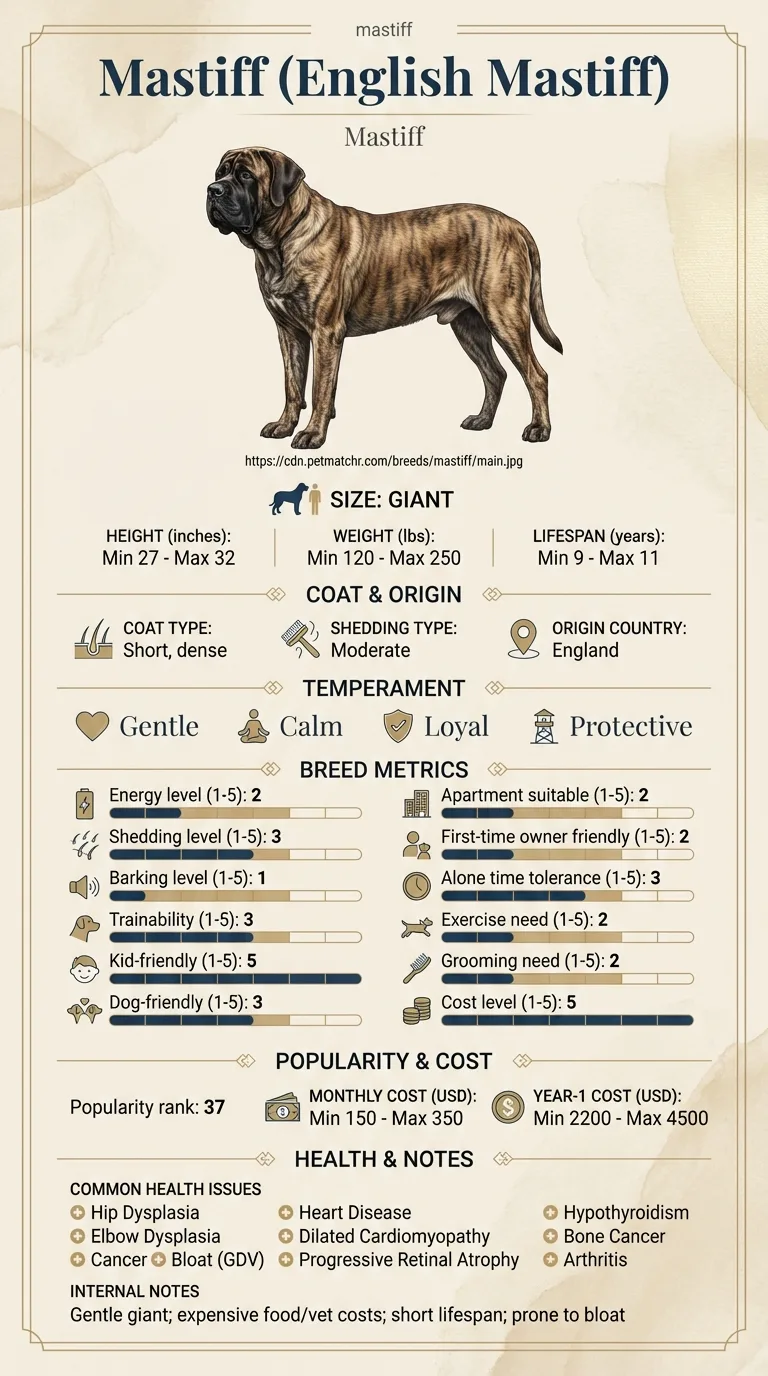
Neither pancreatitis nor diabetes is documented as a Mastiff-specific problem, and the honest position is that this pairing affects dogs of all breeds. Where being a Mastiff matters is in practical burden and in exposure. Insulin, prescription diet and monitoring are all dosed or portioned by weight, so a dog of 120 to 250 pounds is at the expensive end of every element. The breed's height of 27 to 32 inches also puts its head at worktop level, giving it easy access to the rich food that precipitates pancreatic flares. And with a lifespan of only nine to eleven years, the senior window in which both conditions appear opens early.
Routine is the dominant factor once both conditions are present. Households that feed at consistent times with consistent quantities achieve stable control far more easily than those that improvise. Access to fatty food remains the main precipitant of flares, so bins, worktops and visitors matter as much here as in isolated pancreatitis. Excess body weight worsens insulin resistance. Perhaps most practically, a household with only one person able to give injections is fragile, because a single illness or unplanned absence disrupts a twice-daily schedule that cannot simply be skipped.
Contact your vet the same day if your diabetic Mastiff refuses food, vomits, or seems to have abdominal pain, since a pancreatic flare in a diabetic dog can escalate quickly. Do not give a full insulin dose to a dog that has not eaten without advice. Go to an emergency clinic immediately for weakness, trembling, disorientation, seizures or collapse after insulin, which suggest dangerously low blood glucose, and follow the specific emergency instructions your vet has given you in advance. Also treat rapid breathing, a sweet chemical smell on the breath, profound lethargy or repeated vomiting in a diabetic dog as an emergency, as these can indicate a severe metabolic crisis.
The relationship runs in both directions, which is what makes this pairing difficult to manage.
Going one way, chronic or repeated pancreatitis destroys pancreatic tissue. Each episode leaves scarring, and if enough of the insulin-producing clusters are lost, blood glucose can no longer be controlled and diabetes results. This is why a history of recurrent pancreatitis raises the index of suspicion when an older dog starts drinking heavily.
Going the other way, poorly controlled diabetes alters fat metabolism in ways that appear to increase the likelihood of further pancreatic inflammation. It also makes a dog vulnerable to a severe metabolic crisis in which the body, unable to use glucose, begins breaking down fat and producing acidic by-products. That crisis is a genuine emergency, and pancreatitis is one of the common events that tips a stable diabetic dog into it.
The practical result is that neither condition can be managed in isolation. The low-fat diet used to reduce pancreatic flares has to be reconciled with the consistent carbohydrate and calorie intake needed for stable insulin dosing. A dog that stops eating because its pancreas is inflamed still has insulin on board, which creates its own danger.
This is why owners in this situation should expect closer veterinary involvement than for either condition alone, and why any change in appetite is significant rather than a minor detail.
See all Mastiff health problems, which breeds are prone to pancreatitis diabetes, or the full Mastiff breed guide for temperament, exercise needs and ownership costs.
Stabilising a newly diabetic dog usually takes four to twelve weeks of dose adjustments with repeated monitoring, and it is normal for this to feel slow and uncertain. Once stable, expect rechecks every three to six months, and expect the dose to need occasional revision indefinitely. Pancreatic flares interrupt the picture and may require the diabetic plan to be rebuilt afterwards. Both conditions are managed for life rather than resolved.
Success is a dog with a stable weight, a normal appetite, drinking a consistent amount, and going months between veterinary interventions. It is a routine the household can genuinely sustain, with more than one person able to run it. Perfect glucose readings are not the target and chasing them causes more harm than good; a comfortable, stable dog with reasonable control is the realistic goal. Given this breed's nine-to-eleven-year lifespan, two or three good years after diagnosis is a substantial outcome.
Diabetes is manageable, and many dogs live well with it for years. What owners underestimate is how much the routine constrains a household, particularly with a dog this size.

If you think your Mastiff has pancreatitis & diabetes, the plan is three steps: write down what you have seen and when it started, book a veterinary appointment rather than waiting for the next flare, and take video of the behaviour or symptom before you go — the thing you are worried about rarely happens in the consulting room. Screening in the parents covers hip dysplasia, elbow dysplasia, cancer.
What the vet visit should produce is a diagnosis and a written plan, not just reassurance: what is being ruled out, what the monitoring interval is, and which signs mean you come back sooner. Ask what the treatment costs across a year rather than per visit, because that is the number that decides whether you are managing this condition or reacting to it.
Between appointments, keep a short log — dates, what you saw, what changed. It is the single most useful thing an owner brings to a follow-up, and for pancreatitis & diabetes it is often what separates a clear pattern from a guess.
Sylvie's Mastiff, Cornelius, had pancreatitis at seven, mildly again at eight, and a third time at nine. Each episode was managed, each time he recovered, and each time Sylvie tightened the household rules a little further. What she noticed in the spring after the third was that he was drinking constantly. He was also eating with real enthusiasm while visibly losing condition across his back end, which she had put down to age. Bloodwork confirmed diabetes. The insulin-producing tissue had taken enough damage across three episodes that his glucose control had gone. The first three months were hard. Cornelius weighed 187 pounds and his dose took eight weeks to settle. Sylvie taught her son to give the injections so she was not the only one, and they anchored everything to seven in the morning and seven at night. His diet had to satisfy two sets of requirements at once, which took a nutritionist to resolve. He lived another two years, stable, on the same routine every single day.
Key takeaway: Each of Cornelius's pancreatitis episodes was survivable on its own; the cumulative damage was not. Sylvie's most important decision after the diagnosis was not medical but structural: teaching a second person to inject, which turned a fragile routine into one that lasted two years.
No, and most do not. A single episode that resolves fully is unlikely to destroy enough insulin-producing tissue to matter. The risk rises with repeated or chronic inflammation, which is one of the strongest arguments for taking prevention seriously after a first episode rather than treating it as bad luck.
Increased drinking and urinating, increased appetite alongside weight loss, and a duller coat. In a giant breed the drinking change is easy to miss because the baseline is already high, so measure intake over twenty-four hours with a marked jug rather than estimating. Weight loss on a big frame is also easily overlooked.
Canine diabetes generally requires insulin, and it is not usually reversible through diet alone. Diet is important for stability but it is not a substitute for insulin. Be sceptical of anything marketed as an alternative to insulin for a diabetic dog; withholding it is dangerous.
This needs a vet, and often a nutritionist, because the two requirements pull in different directions. The general principle is consistency: the same food, the same amounts, at the same times every day, so that insulin dosing has a stable target. Do not improvise between two sets of dietary advice found online.
Contact your vet before giving insulin. A full dose in a dog that has not eaten can cause dangerously low blood glucose. Refusal to eat in a diabetic dog with a pancreatitis history is also a warning sign of a flare-up, so it warrants a call rather than a wait.
Yes. Diabetic dogs commonly develop cataracts, sometimes rapidly, and vision can be lost over a short period. This is worth knowing in advance so it is not a shock. Cataract is separately noted as an eye condition in this breed, so mention any change in vision at diabetic rechecks.
Repeated inflammation scars the pancreas and can destroy the clusters of insulin-producing cells scattered within it, leaving the dog unable to control blood glucose.
Increased drinking and urinating, a bigger appetite alongside weight loss, and a duller coat. Measure water intake rather than estimating it in a big dog.
Call your vet before giving insulin. A full dose without food risks dangerously low blood glucose, and refusing food may signal a pancreatic flare.
Injections roughly every twelve hours with meals, indefinitely, plus monitoring and dose adjustments. A second trained person in the household is close to essential.
No. Canine diabetes generally requires insulin. Diet supports stability but is not an alternative, and withholding insulin is dangerous.
A one-page prep sheet for this condition: the signs, the questions to ask, what to get priced. Unlocks here.
You get: Vet visit prep sheet
No spam. One-click unsubscribe. See our privacy policy.
Preview page 1 before you decide.