Behavior
Do Mastiffs get separation anxiety?
Some do, given their strong attachment to family, though it's not universal and often depends on early exposure to being alone.

Quick answer
Do Mastiffs get separation anxiety?
Some do, given their strong attachment to family, though it's not universal and often depends on early exposure to being alone.
A Mastiff's devotion is usually the reason people fall for the breed - it's also exactly what can make solitude so hard for the dog.
This is common among owners whose work schedule or lifestyle requires leaving the dog alone regularly, especially first-time giant-breed owners who didn't anticipate how strongly their calm, home-loving dog would react to solitude.
This guide is not medical advice. If your dog shows pain, sudden behavior change, or worsening symptoms, consult a licensed veterinarian.
Some links may be affiliate links. We may earn a commission at no extra cost to you. We only suggest products we believe are helpful for dog owners.
We research and check what we publish, but we do not warrant that any figure, date, price, or statement is accurate, complete, or current, and we accept no liability for any loss, cost, injury, or other harm arising from the use of this site. Use it as one reference among several. You remain responsible for your own decisions and for your dog's care - confirm anything that matters with a licensed veterinarian or another qualified professional before you act on it. Full disclaimer.
Separation anxiety in Mastiffs stems from the same deep attachment that makes them beloved family dogs, but it plays out at a scale that smaller breeds simply don't produce - property damage and self-injury risk that come from panic in a dog this large and strong. Recognizing true anxiety versus simple boredom is the first step toward the right kind of help.
Separation-related distress isn't universal in this breed, but it's common enough among giant, people-oriented breeds generally that many owners encounter at least a mild version of it, particularly if the dog wasn't gradually introduced to alone time as a puppy.
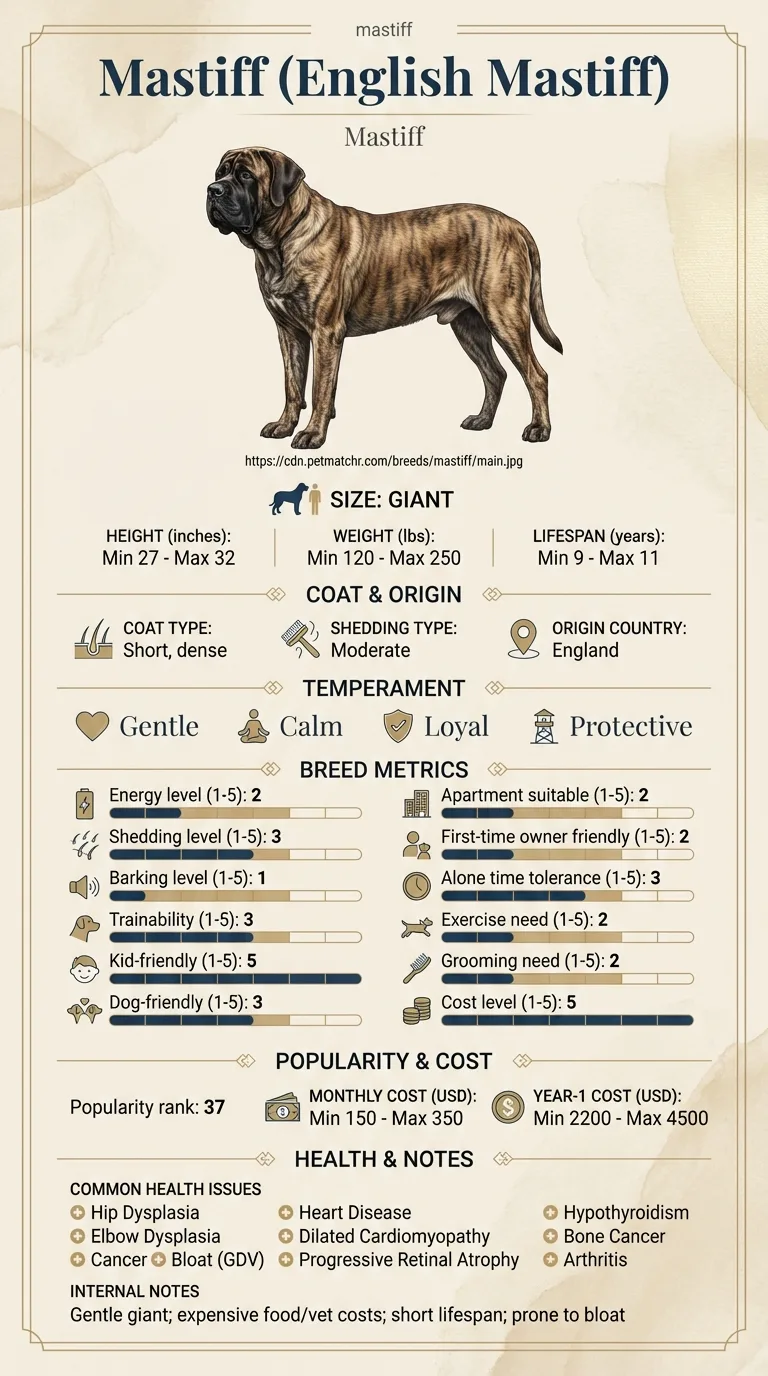
This breed's core temperament - gentle, calm, loyal, and protective - comes with genuine attachment to its people, and a moderate rather than high tolerance for being left alone. A dog bred for centuries to stay close to its family and property doesn't always adjust easily to extended solitude, particularly if that wasn't built up gradually from an early age.
Households with inconsistent schedules, a recent change in who's normally present, or a jump from near-constant company to long stretches alone can all trigger or worsen separation distress. A dog that's never practiced calm short absences has no track record of coping to draw on when a longer one is suddenly required.
Bring in a trainer experienced with separation anxiety specifically if destructive behavior or vocalizing is escalating, if self-injury has occurred, or if the structured desensitization process isn't progressing on its own after several weeks of consistent effort.
Talk to your vet if anxiety is severe, involves self-injury, or isn't improving with consistent management, since some dogs benefit from a combination of behavioral work and veterinary-guided support alongside training.
See all Mastiff health problems, which breeds are prone to separation anxiety, or the full Mastiff breed guide for temperament, exercise needs and ownership costs.
Mild cases often show improvement within a few weeks of consistent, gradual practice. More significant anxiety can take a few months of structured work, sometimes alongside veterinary support, before the dog can reliably handle a normal workday alone.
Success looks like a dog that settles within a few minutes of being left and shows no destructive or distress behavior during a normal absence, not necessarily a dog that never minds being alone at all.
The behaviors themselves overlap with any breed's separation anxiety, but the scale is distinct.
It's worth separating true separation anxiety from boredom-driven destruction, since they call for different responses. A bored dog left with nothing to do might chew something inconvenient once in a while, but generally settles down once the initial restlessness passes. A dog with genuine separation anxiety shows distress the moment it registers it's alone - the drooling, pacing, and vocalizing usually start within minutes, not hours, and the destruction is typically concentrated around exit points rather than scattered randomly.
This distinction matters because boredom responds well to more exercise and enrichment, while true separation anxiety usually needs a structured desensitization plan and sometimes veterinary support, since it's rooted in genuine panic rather than excess energy.

Grace's Mastiff Samson had always been velcro-close to her, and she assumed that would just mean a dog who followed her from room to room. It became a bigger issue once she returned to working outside the home and needed to leave him alone for full workdays for the first time. The first week brought two damaged door frames and a call from a neighbor about extended howling. A trainer experienced with separation anxiety helped Grace see the pattern clearly: Samson's distress started within minutes of her leaving, concentrated entirely around the front door, which pointed to genuine anxiety rather than boredom. They built a plan starting with departures of just a few minutes, building slowly over several weeks based on how calm Samson stayed each time. By two months, Samson could handle a full workday with a stuffed chew toy and the radio on, settling within about ten minutes of Grace leaving instead of immediately panicking.
Key takeaway: In a dog this strong, separation anxiety isn't just an inconvenience - it's a safety issue that needs a structured, gradual plan rather than hoping the dog simply gets used to it over time.
Their strong attachment to family and moderate tolerance for being alone means some individuals do struggle with it, particularly if they weren't gradually accustomed to solitude, though it's not a universal trait across every dog in the breed.
True separation anxiety shows distress almost immediately after the owner leaves - pacing, drooling, vocalizing - concentrated around exit points. Boredom-driven destruction tends to happen more randomly throughout the time alone and responds well to more exercise and enrichment.
Yes. A large, strong dog attempting to escape a crate or room during a panic episode can cause significant property damage and real injury to itself in a way a smaller dog attempting the same behavior typically can't.
Begin with very short absences the dog can handle without distress, gradually increasing duration only as the dog stays calm. Pairing departures with a predictable, low-key routine rather than an emotional goodbye also helps.
Only if the dog is already comfortable and calm in the crate before anxiety became an issue. Crating a dog already in a panic response can increase the risk of self-injury as it tries to escape.
If distress is severe, escalating despite consistent management, or resulting in self-injury or serious property damage, a trainer experienced in separation anxiety and a vet conversation about additional support are both reasonable next steps.
Some do, given their strong attachment to family, though it's not universal and often depends on early exposure to being alone.
Their size and strength mean panic-driven attempts to escape a crate or room can cause more damage and greater risk of self-injury.
Start with very short absences the dog can tolerate calmly and build up gradually rather than jumping straight to a full workday alone.
No - boredom can also cause destruction, but it tends to be less immediate and less concentrated around doors or exit points.
Many owners see gradual improvement over several weeks to a few months with consistent, structured practice, though severe cases can take longer.
Behaviour changes often start with pain. The prep sheet for this page covers what to rule out, and what to ask.
You get: Vet visit prep sheet
No spam. One-click unsubscribe. See our privacy policy.
Preview page 1 before you decide.