Health
What is the most dangerous sign of an allergic reaction in a GSP?
Weakness or collapse with pale gums. That combination points to circulatory shock and needs an emergency clinic now, not an appointment tomorrow.

Quick answer
What is the most dangerous sign of an allergic reaction in a GSP?
Weakness or collapse with pale gums. That combination points to circulatory shock and needs an emergency clinic now, not an appointment tomorrow.
One minute your GSP is quartering a hedgerow, the next his face looks a size too big. These reactions move fast, and telling a nuisance from an emergency is the whole skill.
Hunting and field-trial owners see this most, because a dog running open cover meets more ground nests in one October morning than a suburban dog meets in a year. It also worries owners after vaccine or parasite-product appointments.
This guide is not medical advice. If your dog shows pain, sudden behavior change, or worsening symptoms, consult a licensed veterinarian.
Some links may be affiliate links. We may earn a commission at no extra cost to you. We only suggest products we believe are helpful for dog owners.
We research and check what we publish, but we do not warrant that any figure, date, price, or statement is accurate, complete, or current, and we accept no liability for any loss, cost, injury, or other harm arising from the use of this site. Use it as one reference among several. You remain responsible for your own decisions and for your dog's care - confirm anything that matters with a licensed veterinarian or another qualified professional before you act on it. Full disclaimer.
An acute allergic reaction is a rapid immune response to a recent exposure. In German Shorthaired Pointers it most often follows an insect sting picked up while working cover, and shows as hives, a swollen muzzle, or at the severe end vomiting, weakness and collapse. It is not the slow seasonal itch owners usually mean by the word allergy.
Severe anaphylaxis is rare in every breed. Mild hives and a puffy face are far more common, and most GSP owners who hunt regularly will see it at least once across a dog's ten to twelve year life. Frequency tracks time spent in rough cover, not anything inherited.
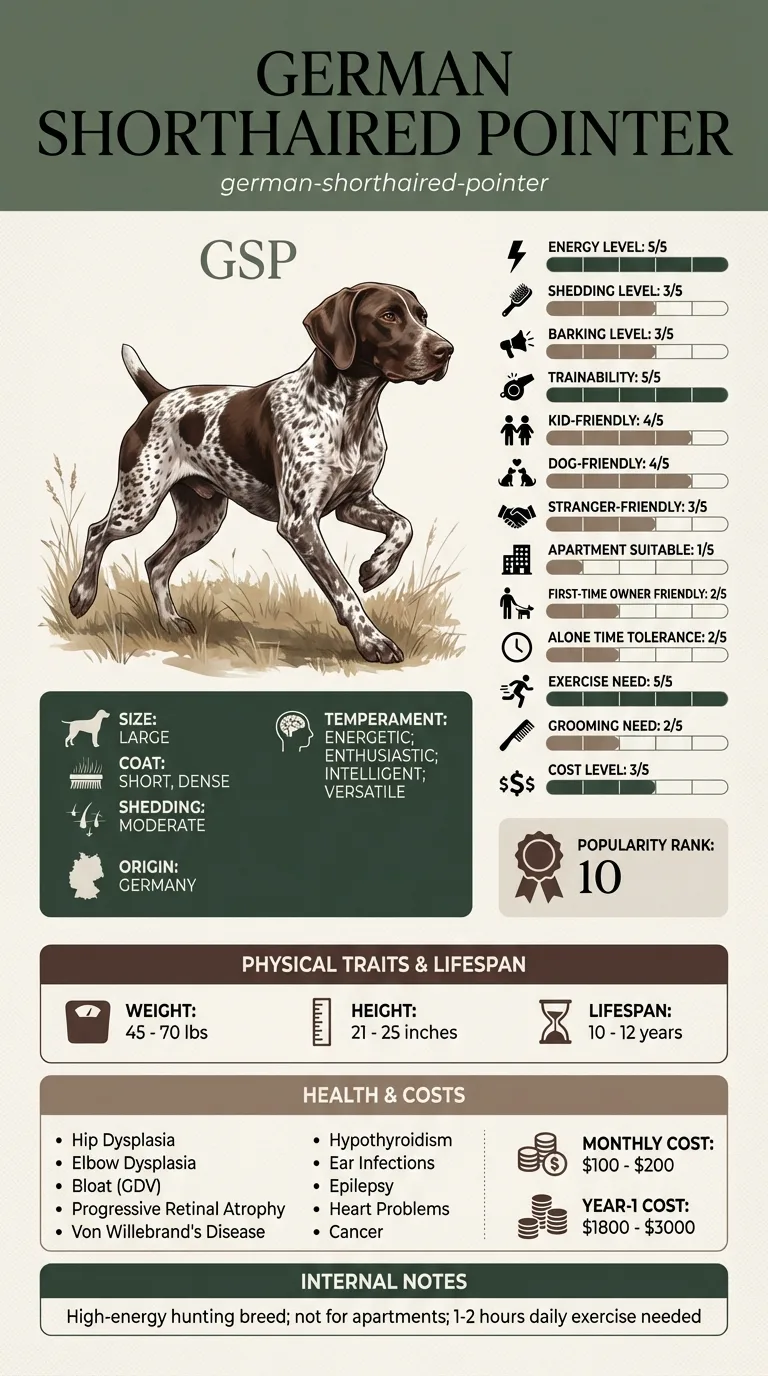
Nothing in the German Shorthaired Pointer's record marks it as an allergy-prone breed. The driver here is build and job. A 45 to 70 pound dog standing 21 to 25 inches, bred in Germany as a versatile gundog with a top-end exercise requirement, spends its working life nose-down in the low cover where stinging insects nest. The short, dense coat grooms easily but is a thin barrier, and the belly and groin are effectively bare.
Late summer and early autumn are the risk window, when wasp colonies peak and bird season opens. Warm, dry banks with old rodent burrows hold the nests dogs blunder into. Product reactions cluster on clinic days, and food reactions follow any change of diet or chew, which is why introducing something new the night before a big day out is a bad habit.
Call the same day for hives or any facial swelling, even in a cheerful dog, because the reaction may still be building. Go straight to an emergency clinic, skipping the phone call if that is faster, for noisy or laboured breathing, gums that are pale, grey or blue, sudden weakness or collapse, repeated vomiting alongside a swollen face, or swelling around the throat and tongue. Anaphylaxis is a true emergency and dogs die from it when owners wait to see whether it settles.
See all German Shorthaired Pointer health problems, which breeds are prone to allergic reactions, or the full German Shorthaired Pointer breed guide for temperament, exercise needs and ownership costs.
Treated promptly, hives and facial swelling usually flatten within four to eight hours and are gone by morning. Mild cases can take a full day. A dog treated for anaphylaxis is normally held for observation and back to normal work within a week, though your vet may want a quiet fortnight first.
Not a dog that never reacts, since you cannot control what nests in a hedgerow. Success is an owner who spots hives in the first ten minutes, knows without hesitating which signs mean drive now, has the emergency clinic already saved, and can give the vet a clear account of what changed today.
Reactions follow a rough sequence. Knowing it lets you judge whether your GSP is climbing the ladder or holding steady, which is the most useful thing you can report on the phone.
Several problems mimic this. A swollen muzzle with drooling can be a grass awn lodged in the gum or a cracked tooth, both common in dogs that carry things. One hot, tight swelling on a limb that grows over a day is more likely an abscess or a snake bite. Sudden weakness with pale gums after hard work on a warm day may be heat stress, or in a deep-chested dog the start of gastric dilatation, and none of those are treated like anaphylaxis.
One breed-specific confounder matters: von Willebrand's disease is documented in German Shorthaired Pointers. A dog with a bleeding disorder can develop bruise-like blotches that a worried owner reads as hives. If you are seeing flat purple patches rather than raised welts, say so when you call.

Ripple, a four-year-old liver roan bitch, was working a dry ditch bank in early September when her handler heard a yelp and saw her spin. She carried on hunting for six or seven more minutes before he called her in. By then her lower lip was thick and her eyelids were closing. He ran a hand down her flank, found the ribs studded with welts, photographed her and drove to the clinic twenty minutes away. On the way she vomited once in the crate. He reported that at the desk, and it moved her straight into a treatment room rather than the waiting area. She was treated and held five hours. The swelling retreated within the first hour, rose slightly again, then went. She was home that night and hunting the following weekend. Her handler went back in daylight, found the nest in a rabbit scrape, and marked it on his phone map.
Key takeaway: The vomiting was the detail that mattered, and he only had it because he was watching. In an acute reaction, what you notice in the first fifteen minutes shapes the outcome more than anything you can do at home.
Reactions to a sting or an injection usually start within twenty minutes, and hives can appear in under ten. Reactions to something eaten are slower, often one to three hours. A swelling that built slowly across two days is probably not an allergic reaction at all.
Facial swelling in a bright dog breathing normally is urgent rather than critical, but it still needs a same-day call, because the reaction may still be climbing. If breathing changes, the gums go pale, or he vomits and then seems weak, drive to an emergency clinic.
Do not dose from the cupboard. Strengths vary and many combination cold remedies contain decongestants that are dangerous for dogs. Phone the clinic while you drive; if they want something given first, they will tell you what and how much for your dog's weight.
It can. Sensitisation is real, and a dog that had hives the first time may respond harder the second. Log the date and circumstances, tell your vet, and treat any future sting as a phone call rather than a wait-and-see.
Muzzle and mouth first, because this is a scenting dog that pushes its nose into cover, then feet from stepping on a nest, then belly and groin where there is almost no coat. Mouth stings need extra caution because the swelling sits near the airway.
Usually an injection to shut the response down, then observation until the swelling is clearly retreating. Severe cases need fluids and intensive support. The observation window matters because some dogs rebound a few hours after the first drugs wear off.
Weakness or collapse with pale gums. That combination points to circulatory shock and needs an emergency clinic now, not an appointment tomorrow.
At least six hours of close observation, and overnight if the face swelled at all, because reactions can rebound once the first wave settles.
Usually yes, with a plan. Most owners keep working the dog and simply carry a clinic address and a vet-agreed emergency step for the ground they hunt.
An after-hours exam with injections and a few hours of observation is a real bill, and anaphylaxis needing overnight support costs far more. Ask your clinic for its out-of-hours exam fee before you need it.
A one-page prep sheet for this condition: the signs, the questions to ask, what to get priced. Unlocks here.
You get: Vet visit prep sheet
No spam. One-click unsubscribe. See our privacy policy.
See a sample page before you decide.
Early access list
The free prep sheet covers the same-day warning signs, a symptom log and the questions to ask. We are considering a fuller kit that adds a cost worksheet for the usual tests and treatments (US price ranges with their sources) and a plain-English guide to ways of covering the bill. It is not built yet; this list tells us whether it is worth building.
One email, no spam, unsubscribe anytime. Information only, not veterinary advice.