Health
What are the signs of pancreatitis in a dog?
Repeated vomiting, refusal to eat, abdominal pain, a hunched or held stretch posture with hindquarters raised, restlessness and often fever. It develops over hours rather than days.

Quick answer
What are the signs of pancreatitis in a dog?
Repeated vomiting, refusal to eat, abdominal pain, a hunched or held stretch posture with hindquarters raised, restlessness and often fever. It develops over hours rather than days.
An enthusiastic scavenger, a dropped sandwich and a bin left within reach are enough. This is one of the few serious canine emergencies that owners routinely cause by accident.
Owners of a GSP that eats anything it finds, people who have just realised the dog got into something over a holiday weekend, and anyone whose dog has had one episode and wants to know whether it will happen again.
This guide is not medical advice. If your dog shows pain, sudden behavior change, or worsening symptoms, consult a licensed veterinarian.
Some links may be affiliate links. We may earn a commission at no extra cost to you. We only suggest products we believe are helpful for dog owners.
We research and check what we publish, but we do not warrant that any figure, date, price, or statement is accurate, complete, or current, and we accept no liability for any loss, cost, injury, or other harm arising from the use of this site. Use it as one reference among several. You remain responsible for your own decisions and for your dog's care - confirm anything that matters with a licensed veterinarian or another qualified professional before you act on it. Full disclaimer.
Pancreatitis is premature activation of digestive enzymes inside the pancreas, causing the organ to inflame and effectively begin digesting itself. It produces severe abdominal pain, repeated vomiting and rapid dehydration, and in its severe form can involve other organ systems. Gastrointestinal disease is not among the German Shorthaired Pointer's documented breed concerns, but the breed's scavenging habits and outdoor working life supply the dietary triggers unusually reliably.
Pancreatitis is one of the more frequently diagnosed abdominal emergencies in dogs generally and is not specific to this breed. What is distinctive about German Shorthaired Pointers is the exposure: a dog that spends one to two hours daily in the field, has a strong food drive, and attends social hunting and shooting events encounters trigger foods far more often than a dog whose diet is entirely controlled indoors.
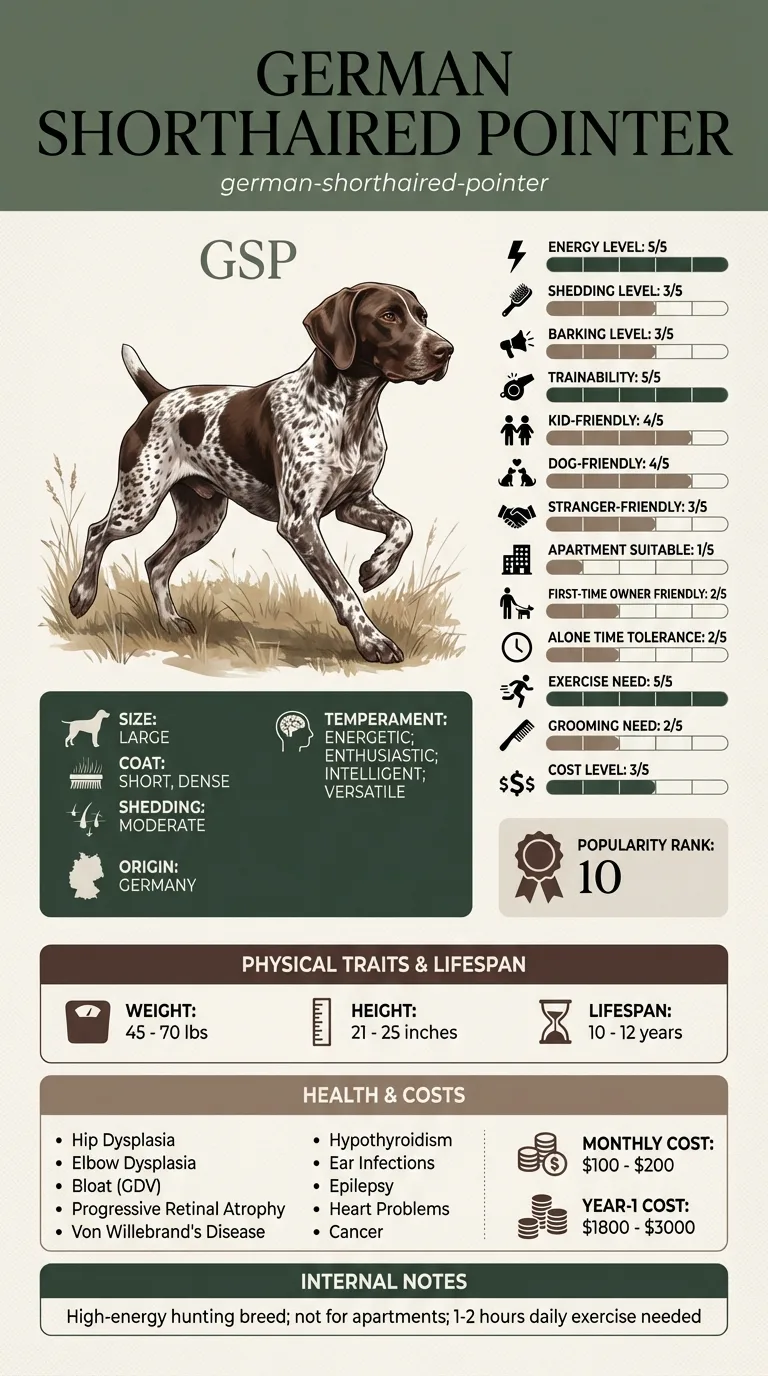
The German Shorthaired Pointer's contribution to this condition is behavioural rather than anatomical. There is no pancreatic entry on the breed's documented health list, which names hip and elbow dysplasia, bloat, retinal atrophy, von Willebrand's disease, hypothyroidism, ear infections, epilepsy, heart problems and cancer. What the breed supplies is a versatile, enthusiastic hunter rated five out of five for exercise need that spends its days nose-down in exactly the environments where scavengeable material accumulates. Food motivation makes it highly trainable, which is an asset, but the same drive is what empties a bin.
This is a condition largely defined by opportunity. Household environments with accessible bins, compost heaps and kitchen counters produce a steady stream of cases, clustering around holidays and barbecues. Rural and sporting environments add carrion, game preparation waste and communal meals where multiple people may feed a persuasive dog. Under-exercise contributes indirectly through weight gain. In multi-person households the risk is compounded because nobody knows what anyone else gave the dog.
Seek same-day veterinary care for repeated vomiting, refusal to eat combined with obvious discomfort, a hunched posture or a repeatedly held stretch with the hindquarters raised, marked lethargy, or a painful abdomen. Go immediately, without delay, if there is collapse, pale gums, a distended abdomen, or unproductive retching, since the last of these suggests gastric torsion rather than pancreatitis and is an even more time-critical emergency. Do not attempt home fasting, do not give human pain medication, and do not wait to see whether the dog improves overnight; deterioration in severe pancreatitis can be rapid.
See all German Shorthaired Pointer health problems, which breeds are prone to pancreatitis, or the full German Shorthaired Pointer breed guide for temperament, exercise needs and ownership costs.
A mild episode typically means one to three days of veterinary treatment and a return to eating within that period, followed by a couple of weeks on a controlled diet. Severe cases need several days of intensive hospitalisation and a longer, less predictable recovery. Appetite is usually the last thing to normalise. Where a low-fat diet is prescribed afterwards, expect it to run for months at minimum and often permanently.
For a first episode with an identified trigger, success is complete recovery, a dog eating normally on an appropriate diet, and a household that has genuinely closed off the access that caused it. For a dog with recurrent episodes, success is longer intervals between flare-ups and milder ones when they come, achieved through strict dietary control. Success is not a dog that can go back to eating scraps.
The classic presentation is a dog that vomits repeatedly, will not eat, and looks genuinely miserable rather than merely off-colour. Abdominal pain is the defining feature and it can be severe.
There is a posture worth learning. A dog with a painful upper abdomen will often stretch its front legs forward with the chest lowered and the hindquarters raised, holding the position for far longer than a normal stretch. It is sometimes described as the prayer position, and it is an attempt to relieve pressure on an inflamed pancreas. In a breed that stretches often after rest, the giveaway is that this stretch is held and repeated.
Other signs include a hunched stance, reluctance to be picked up around the middle, restlessness and an inability to settle, drooling, and diarrhoea. Fever is common. Dehydration develops quickly because the dog is losing fluid and refusing to drink.
Severity varies enormously. Some episodes are mild and resolve over a few days with supportive care. Others progress to shock, clotting abnormalities and organ dysfunction. From the outside, on day one, the mild version and the dangerous version look very similar, which is why this is not a condition to assess at home.
Diet-related triggers are the most common identifiable cause, and this breed's lifestyle supplies them generously.

If you think your GSP has pancreatitis, the plan is three steps: write down what you have seen and when it started, book a veterinary appointment rather than waiting for the next flare, and take video of the behaviour or symptom before you go — the thing you are worried about rarely happens in the consulting room. Screening in the parents covers hip dysplasia, elbow dysplasia, bloat (gdv).
What the vet visit should produce is a diagnosis and a written plan, not just reassurance: what is being ruled out, what the monitoring interval is, and which signs mean you come back sooner. Ask what the treatment costs across a year rather than per visit, because that is the number that decides whether you are managing this condition or reacting to it.
Between appointments, keep a short log — dates, what you saw, what changed. It is the single most useful thing an owner brings to a follow-up, and for pancreatitis it is often what separates a clear pattern from a guess.
Sorcha's GSP, Kit, had been immaculate all season. On the last drive of a December day he disappeared into a ditch for perhaps ninety seconds and came back looking pleased with himself. By nine that evening he had vomited four times and was standing in the kitchen with his front legs stretched out and his back end up, holding it, over and over. Sorcha recognised the posture from something she had read and drove him in. He was hospitalised on fluids for two days with pancreatitis, and recovered fully. She spent the following spring teaching him a leave it that worked at distance, which she describes as the least glamorous training she has ever done and the only reason she now lets him work ditches at all.
Key takeaway: Ninety seconds out of sight is enough. In a scavenging breed the practical defence is a trained cue that works at distance, because management alone cannot cover open country.
Through a combination of clinical signs, a specific blood test for pancreatic enzyme concentration, and imaging, usually ultrasound. No single test is perfect, which is why vets weigh several sources together. Bloodwork also assesses hydration, kidney and liver function and electrolytes, all of which shape treatment.
Do not manage this at home. Prolonged fasting was once standard and is no longer recommended; current practice generally favours early, careful feeding because it supports the intestinal lining. Withholding food at home also delays diagnosis of a condition that can deteriorate quickly. Go to the vet rather than starting a plan yourself.
The core of treatment is intravenous fluids to restore circulation to the inflamed organ, effective pain relief, control of nausea, and careful nutritional support. There is no drug that switches off the process; treatment supports the dog while the inflammation settles. Severe cases need intensive hospitalisation for several days.
Often yes, at least for a substantial period, and permanently for dogs that have had repeated episodes. A single mild episode with a clear one-off trigger may allow a return to normal food after recovery. This is a decision for your vet based on the severity and whether the cause was identified.
Yes. Some dogs have a single episode and never another; others develop a recurrent or chronic pattern with repeated flare-ups. Recurrence risk is one of the strongest arguments for genuinely strict management of what the dog eats afterwards, including from other people in the household.
Very much so. Beyond the fat load, cooked bones splinter and cause intestinal perforation and obstruction. Fatty trimmings and bones are frequently offered together, which is why the period around large holiday meals produces a recognisable spike in emergency presentations at veterinary clinics.
The early signs are set out in the sections above, and they are the reason to book a veterinary appointment rather than wait. Pancreatitis in GSPs is diagnosed by a vet, not from a symptom list, and the sooner it is on record the more options remain open.
The early signs are set out in the sections above, and they are the reason to book a veterinary appointment rather than wait. Pancreatitis in German Shorthaired Pointers is diagnosed by a vet, not from a symptom list, and the sooner it is on record the more options remain open.
Repeated vomiting, refusal to eat, abdominal pain, a hunched or held stretch posture with hindquarters raised, restlessness and often fever. It develops over hours rather than days.
Yes. Severe cases can progress to shock and organ dysfunction, and mild and severe episodes look similar on day one. Seek veterinary care the same day.
Most often a sudden fatty meal: scraps, trimmings, bin contents, or scavenged carrion and gut piles in the field. Excess body weight increases the risk.
No. Prolonged fasting is no longer recommended and home management delays diagnosis of a condition that can deteriorate rapidly. Go to a vet.
A reliable leave it and a solid drop cue are genuine preventive medicine for a scavenging breed, and they work in the field where management alone cannot.
A one-page prep sheet for this condition: the signs, the questions to ask, what to get priced. Unlocks here.
You get: Vet visit prep sheet
No spam. One-click unsubscribe. See our privacy policy.
Preview page 1 before you decide.