Health
What skull type is a German Shorthaired Pointer?
Mesocephalic, meaning balanced proportions with a long functional muzzle. It is not a short-faced breed and does not carry brachycephalic airway risk.

Quick answer
What skull type is a German Shorthaired Pointer?
Mesocephalic, meaning balanced proportions with a long functional muzzle. It is not a short-faced breed and does not carry brachycephalic airway risk.
The short version: no, your GSP is not brachycephalic. The more useful version is how to check that for yourself, especially if your dog is a cross and nobody is certain what went into it.
Prospective owners comparing breeds on health grounds, owners of pointer crosses of uncertain parentage, and anyone whose insurance or airline paperwork has raised a question about their dog's skull type.
This guide is not medical advice. If your dog shows pain, sudden behavior change, or worsening symptoms, consult a licensed veterinarian.
Some links may be affiliate links. We may earn a commission at no extra cost to you. We only suggest products we believe are helpful for dog owners.
We research and check what we publish, but we do not warrant that any figure, date, price, or statement is accurate, complete, or current, and we accept no liability for any loss, cost, injury, or other harm arising from the use of this site. Use it as one reference among several. You remain responsible for your own decisions and for your dog's care - confirm anything that matters with a licensed veterinarian or another qualified professional before you act on it. Full disclaimer.
Brachycephalic features are the consequences of a skull shortened front to back: narrowed nostrils, crowded soft tissue, a shortened upper jaw and a compromised airway. The German Shorthaired Pointer does not have them. Its long, mesocephalic skull is built to house a large scenting apparatus and, incidentally, a large cooling surface.
Not applicable as a breed trait. No brachycephalic condition appears among the German Shorthaired Pointer's documented health issues, and a purebred GSP with a genuinely shortened muzzle would be well outside the breed's conformation. Individual dogs with crossbred ancestry are a separate question and should be assessed on their own anatomy.
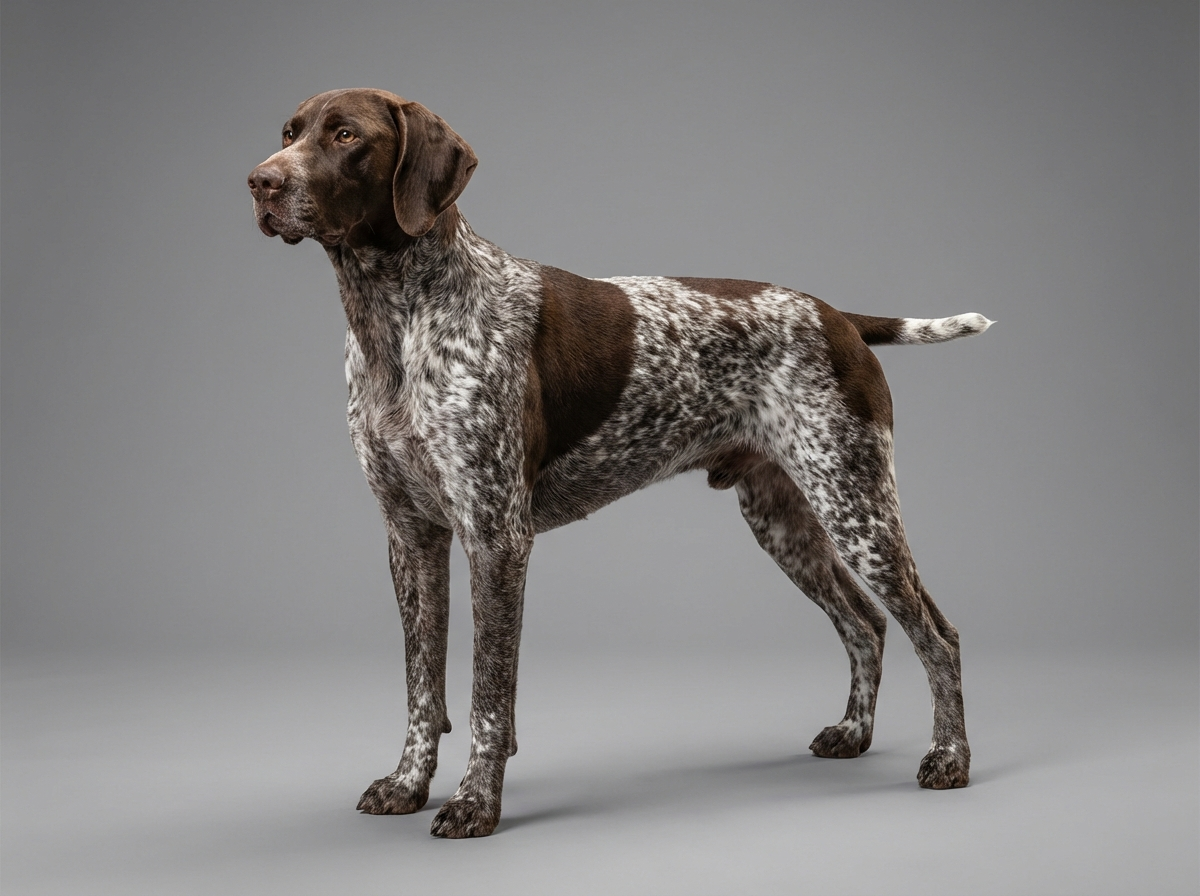
The German Shorthaired Pointer was developed in Germany as a versatile hunting dog expected to find game by scent, point it, and retrieve from land and water. That job selected directly for a long muzzle with a large nasal chamber, and against anything that compromised airflow, because a dog that cannot breathe cannot gallop for an hour. The result is a 21 to 25 inch dog with a balanced head, open nostrils, and an airway that functions the way a working dog's needs to.
Nothing in a dog's environment produces brachycephalic features, which are structural and inherited. Environment does explain why the question comes up: hot weather, hard exercise and grass awns in field cover all produce breathing symptoms in perfectly normal pointers, and an owner searching those symptoms is very likely to land on brachycephalic material written for entirely different breeds.
Book an appointment for persistent snorting, rasping or snoring that is new or worsening, for noise or discharge coming from one nostril only, for repeated pawing at the face, or for any change in the sound of your dog's bark. In a breed with no anatomical excuse for airway noise, these are findings rather than quirks. Go urgently for laboured breathing at rest, a dog standing with its neck extended and elbows out, gums that look pale, grey or blue, distressed panting that will not settle, or noisy breathing that has appeared suddenly and is getting worse over hours.
See all German Shorthaired Pointer health problems, which breeds are prone to brachycephalic features, or the full German Shorthaired Pointer breed guide for temperament, exercise needs and ownership costs.
There is no condition here to resolve. What an owner should expect is a one-off reassurance, ideally confirmed at a routine health check, and then a shift of attention to the problems this breed genuinely has. If your dog does have breathing noise, expect an examination and possibly imaging within a couple of weeks rather than a breed-based explanation.
An owner who can look at their own dog's profile and nostrils and say confidently that the airway is structurally normal, who knows what their dog sounds like asleep, and who therefore recognises genuine airway noise as a reason to see a vet rather than as a breed characteristic to live with.
Skull type is a matter of proportion, not of breed labels, and it is something an owner can assess reasonably well at home. None of this replaces a veterinary opinion, but it will tell you which conversation you need to have.
The German Shorthaired Pointer's skull is not merely long by accident of fashion. It is long because the dog's job depends on what is inside it.
A hunting dog locating game by air scent needs an enormous olfactory surface, and that surface lives in the folded turbinate bones filling the nasal chamber. A longer muzzle houses more of them. When the dog inhales at a gallop, air passes over those folded surfaces and scent molecules are captured in the mucus lining them. Shorten the muzzle and you shorten the apparatus, which is a large part of why flat-faced breeds are not used as tracking or pointing dogs.
The same architecture does a second job. Because dogs shed heat mainly by evaporation from the airway rather than through the skin, that folded, moist nasal surface is also the breed's radiator. A long-muzzled dog has a substantially larger evaporating area than a flat-faced one of the same weight. This is a genuine advantage, and it is why a German Shorthaired Pointer can work in conditions that would put a bulldog in serious danger, even though the GSP's own limits are real and reached faster than its enthusiasm suggests.

Comet came from a rescue as a presumed German Shorthaired Pointer cross, liver-ticked and lanky, with paperwork that said very little. His new owner had read about flat-faced breed problems and wanted to know whether the unknown half of his heritage had left him anything to worry about. The vet did the assessment in about ninety seconds. Muzzle length roughly half the head, nostrils open and staying open on inhalation, breathing silent at rest, and a normal jaw alignment. Structurally, Comet had inherited a completely functional airway. What the same appointment did turn up was a persistent head shake and a smell from one ear, which his owner had assumed was normal for a dog with drop ears. That, not the skull, was the actual finding of the visit. He was treated for an ear infection and put on a drying routine after swimming.
Key takeaway: The question about skull shape was answered in a minute and a half and turned out to be the least interesting thing about the dog. In this breed and its crosses, the ears are far more likely to need your attention than the nose.
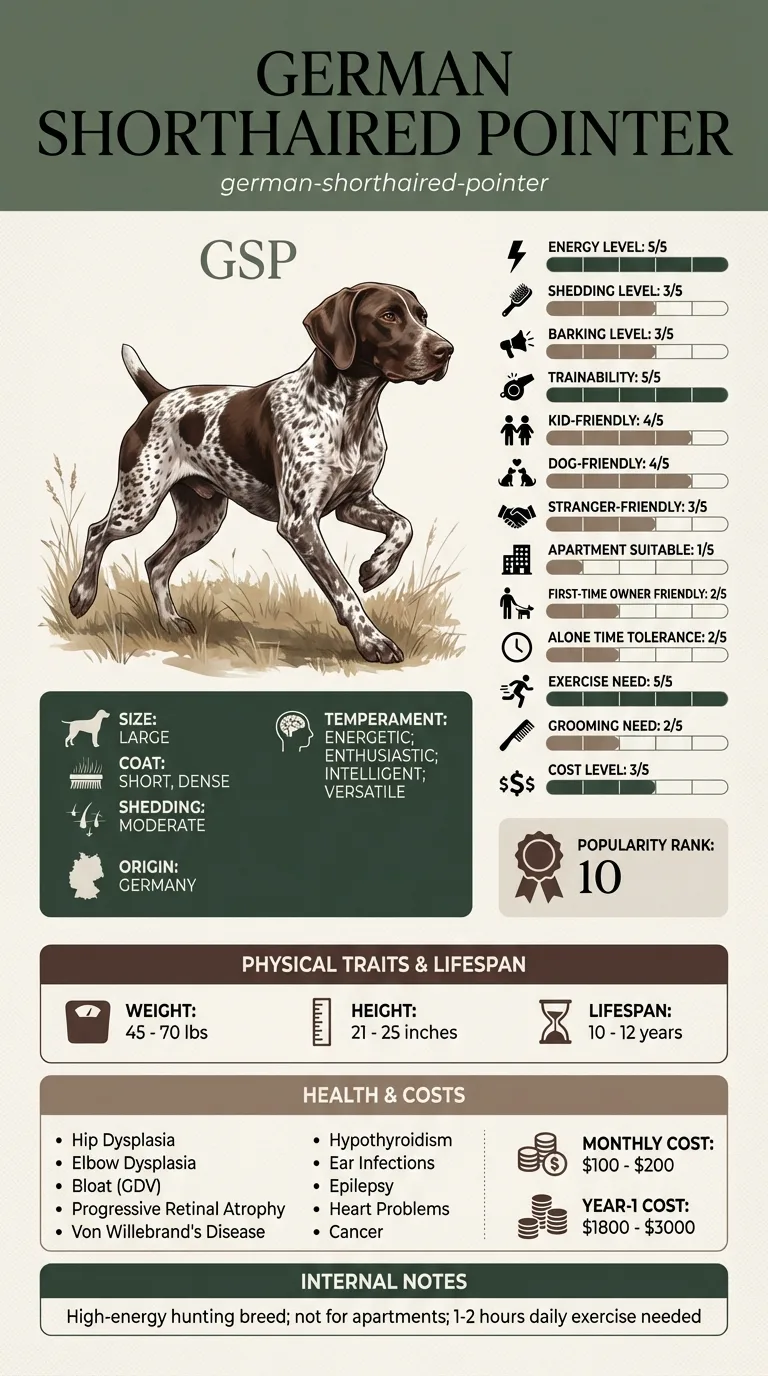
No. The breed is mesocephalic, with a balanced skull and a long muzzle roughly half the length of the head. Brachycephalic airway problems do not appear anywhere on the breed's documented health list, which covers hip and elbow dysplasia, bloat, eye disease, a bleeding disorder, thyroid disease, ear infections, epilepsy, heart problems and cancer.
Assess the individual dog rather than the paperwork. Muzzle proportion, nostril shape and noise at rest tell you more than a breed label. If any of those look abnormal, ask your vet for a functional assessment rather than assuming the pointer half is protective.
Brief reverse sneezing, a rapid snorting inhalation that stops within a minute, is common in all breeds and usually harmless. Persistent snorting, or noise that comes from one nostril, is different and can mean an obstruction such as a grass seed, which this breed picks up readily in field cover.
Not as a breed characteristic. If an individual German Shorthaired Pointer needs airway surgery it is because something specific is wrong, such as a laryngeal problem or an obstruction, rather than because of inherited proportions. The investigation should be individual, not breed-based.
Some airlines restrict short-muzzled breeds because of the risk in transit, and some insurers price them differently. A German Shorthaired Pointer is not in those categories. If a form asks, the answer is that the breed is mesocephalic with a normal airway.
The relevant ones are not skeletal. Drop ears predispose to the ear infections listed among the breed's health issues, and the eyes and nose are exposed to injury and grass awns during field work. None of that has anything to do with skull length.
Mesocephalic, meaning balanced proportions with a long functional muzzle. It is not a short-faced breed and does not carry brachycephalic airway risk.
Watch them head-on while the dog inhales. Open nostrils stay open. Nostrils that pinch shut on the in-breath are narrowed and worth showing your vet.
Meaningfully, yes, because dogs cool by evaporation from the airway and a long muzzle offers far more surface. It raises the ceiling; it does not remove it.
Only indirectly. A large nasal chamber makes this breed exceptionally good at scentwork, which is the most efficient way to tire a GSP's head.
A one-page prep sheet for this condition: the signs, the questions to ask, what to get priced. Unlocks here.
You get: Vet visit prep sheet
No spam. One-click unsubscribe. See our privacy policy.
See a sample page before you decide.
Early access list
The free prep sheet covers the same-day warning signs, a symptom log and the questions to ask. We are considering a fuller kit that adds a cost worksheet for the usual tests and treatments (US price ranges with their sources) and a plain-English guide to ways of covering the bill. It is not built yet; this list tells us whether it is worth building.
One email, no spam, unsubscribe anytime. Information only, not veterinary advice.