Health
What is the earliest sign of a heart condition in a GSP?
Usually a slower recovery after hard exercise, not a cough. Track how long your dog takes to stop panting after a run.

Quick answer
What is the earliest sign of a heart condition in a GSP?
Usually a slower recovery after hard exercise, not a cough. Track how long your dog takes to stop panting after a run.
A cardiac finding in a 55-pound gun dog rarely announces itself. It is usually a sound your vet hears before you notice anything at all.
Owners whose GSP just had a murmur noted on a routine exam, people weighing whether to pay for a cardiology referral, and anyone whose hiking partner has started finishing runs slower than last season.
This guide is not medical advice. If your dog shows pain, sudden behavior change, or worsening symptoms, consult a licensed veterinarian.
Some links may be affiliate links. We may earn a commission at no extra cost to you. We only suggest products we believe are helpful for dog owners.
We research and check what we publish, but we do not warrant that any figure, date, price, or statement is accurate, complete, or current, and we accept no liability for any loss, cost, injury, or other harm arising from the use of this site. Use it as one reference among several. You remain responsible for your own decisions and for your dog's care - confirm anything that matters with a licensed veterinarian or another qualified professional before you act on it. Full disclaimer.
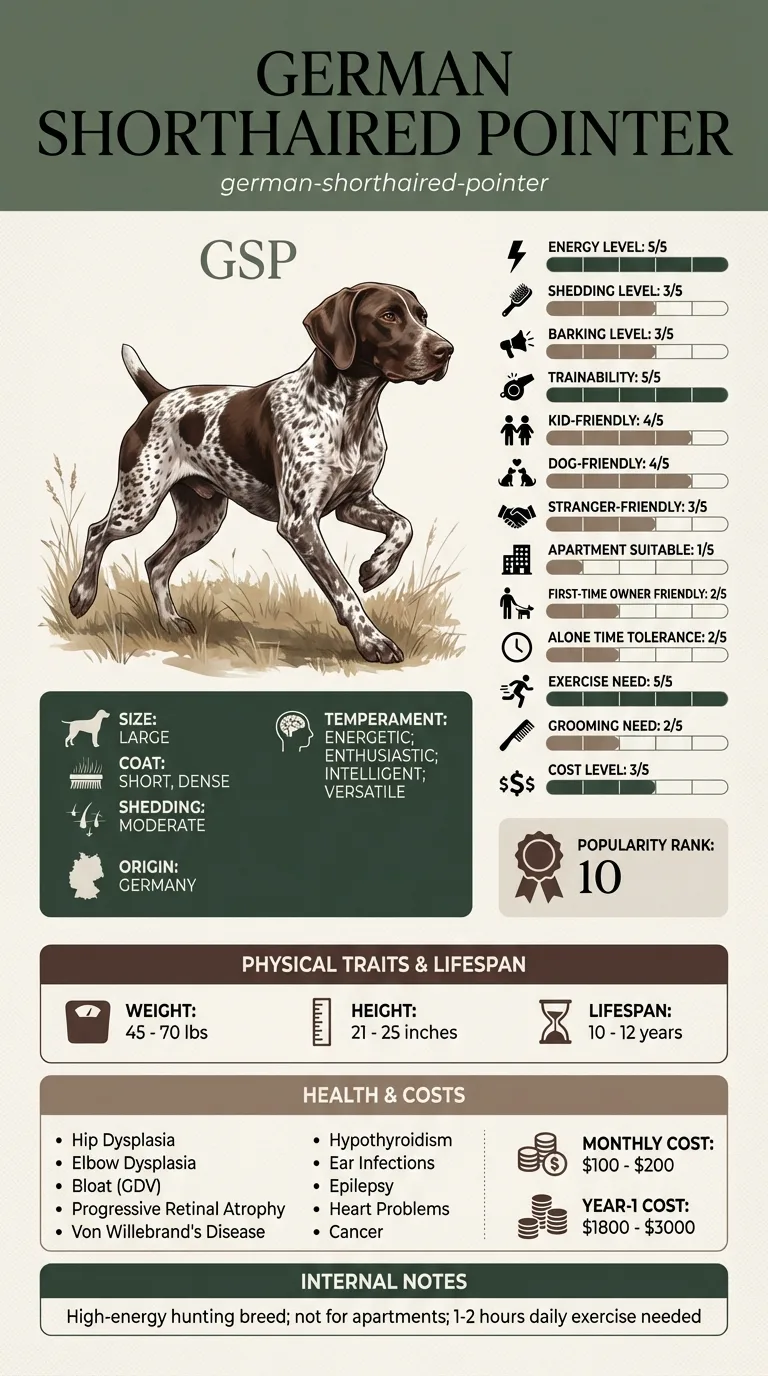
Heart conditions in this breed are not one disease. They span congenital defects present at birth, adult-onset weakening of the heart muscle, mitral valve degeneration in later life, and electrical rhythm disturbances. What unites them is that a conditioned 45 to 70 pound working dog compensates so well that the first sign is subtle: a shorter self-chosen working distance, or one wobble that never repeats.
Cardiac disease is listed among this breed's documented concerns but is not a majority experience. Most German Shorthaired Pointers reach the upper end of their 10 to 12 year lifespan without one. Because the breed ranks around tenth in popularity, owners meet cardiac stories in breed groups more often than the underlying rate suggests.
Heart problems appear on this breed's documented health list, meaning a heritable component runs in some lines and breeder cardiac clearances are worth asking about. Second, the GSP is a purpose-built endurance athlete rated five out of five for exercise need. A heart built for sustained field work carries a large reserve, which delays symptoms and pushes detection toward auscultation and imaging rather than owner observation.
Lifestyle amplifies whatever is already there. GSPs are worked hard in heat, hunted from vehicles after long confinement, and asked for repeated maximal sprints. Excess weight from under-exercise adds constant load. Dogs kept in apartments, which this breed tolerates poorly at a suitability rating of one out of five, swing between long inactive stretches and sudden weekend exertion, and that pattern is exactly what exposes a marginal heart.
Call the same day for fainting, collapse, sudden hind-end weakness, blue or grey gums, or open-mouth breathing at rest. These can signal a dangerously low output state or a serious arrhythmia and are emergencies, not overnight-watch situations. Book within a week for a newly noticed murmur, a sleeping breath rate that has climbed and stayed climbed, a soft cough that is worse lying down, or a distended belly in an otherwise lean dog.
See all German Shorthaired Pointer health problems, which breeds are prone to heart conditions, or the full German Shorthaired Pointer breed guide for temperament, exercise needs and ownership costs.
Expect the diagnostic phase to take two to six weeks: general exam, referral, imaging, plan. If medication is started, most cardiologists reassess at roughly one to three months, then settle into rechecks every three to six months. Congenital defects found in a young dog follow a different clock.
For most cardiac diagnoses here, success is management rather than cure. It looks like a stable sleeping breath rate, a dog that still gets a satisfying daily outing at lower intensity, medication tolerated without appetite loss, and rechecks showing numbers holding rather than climbing. Honest success does not mean the murmur disappears.
Congenital defects are structural problems present from birth. In pointing breeds that usually means a narrowing of the outflow tract below the aortic valve, caught at a puppy exam or a pre-neuter check.
Muscle disease means the pump itself weakens and the chambers stretch. It appears in adulthood, stays silent for a long stretch, and is the category most often behind lost stamina in a middle-aged sporting dog.
Valve degeneration is the thickened, leaky mitral valve that dominates small-breed cardiology. It occurs in larger dogs too, just later and usually less aggressively.
Rhythm disorders are electrical rather than plumbing. The heart may be structurally fine but beat in disorganized bursts, which is why a dog can look perfect on a radiograph and still faint on a walk.
Those four share no treatment, prognosis or monitoring schedule.
This breed sits at the ceiling of the energy and exercise-need scales, needing one to two hours of hard work daily. That conditioning becomes a clinical problem when the heart starts to fail, because an athlete has enormous reserve to burn through before anything looks wrong.
A couch dog with a meaningful drop in cardiac output gets winded on the stairs and the owner books an appointment. A GSP with the same drop simply quarters a field less obsessively and returns to the truck a minute earlier. Owners read that as maturity, or a warm day, or the dog finally settling down at seven.
So stamina is your most sensitive early monitor, and it only works if you track it. A dog that used to breathe normally four minutes after a retrieve and now takes ten has told you something, even without a cough.

Rennie was a seven-year-old GSP who had hunted every autumn of his life. His owner, Marta, noticed nothing wrong. What she noticed was that on the third weekend of the season he stopped working the far treeline and stayed closer, which she put down to a warm October. At his annual exam the vet caught a soft murmur that had not been recorded the year before. Marta almost declined the referral, then remembered a note in her hunting diary from the previous September saying Rennie ran the whole field twice before lunch. That two-line comparison convinced her to book the echocardiogram. The imaging showed early changes in the left ventricle. Rennie went onto daily medication, his hunting was cut to short morning sessions on cool days, and Marta started counting his sleeping breaths every Sunday night.
Key takeaway: In a breed this athletic, the diagnosis arrives through a small change in self-chosen effort rather than a dramatic symptom. Write down what your dog can do while he is healthy.
No. It means cardiac conditions appear often enough to be worth watching for, not that they are inevitable. Most German Shorthaired Pointers live their 10 to 12 years without a significant cardiac diagnosis. The list is a prompt for screening, not a prediction.
It can be. A soft murmur in a lean, athletic, otherwise well dog is sometimes just fast blood flow rather than disease. The reasonable version of not yet includes a plan: a recheck on a set date, and imaging if the murmur gets louder or stamina changes.
Chamber sizes, wall thickness, valve shape, and how much blood the heart moves per beat. That separates a harmless flow murmur from a narrowed outflow tract, and it stages muscle disease before symptoms start.
Sometimes at reduced intensity, and sometimes not at all. A narrowed outflow tract makes maximal sprinting genuinely dangerous, while some early valve changes barely alter what a dog can do. Ask the cardiologist who read the images.
No, and in an outdoor sporting dog it often is not. Kennel-borne infections and inhaled grass awns both cause coughing in GSPs. A cardiac cough tends to be soft, worse after lying down, and paired with faster resting breathing.
Watch the chest rise while your dog is asleep, not merely relaxed, and count for a full minute on several nights to learn the baseline. What matters is the trend: a sleeping rate that climbs and stays climbed is one of the most useful home signals in cardiology.
Usually a slower recovery after hard exercise, not a cough. Track how long your dog takes to stop panting after a run.
Yes. Any collapse or fainting episode warrants a same-day veterinary call, even if the dog is bright and normal within a minute.
Usually yes, but tell the walker the intensity ceiling your vet set and ask them to avoid off-leash sprinting and midday heat.
It shifts emphasis from stamina work to scent games, place training and controlled retrieves, which satisfy a driven dog without demanding maximal effort.
Imaging and the specialist consult are front-loaded, then medication and rechecks. Against typical GSP costs of 100 to 200 dollars a month, it is a meaningful addition.
A one-page prep sheet for this condition: the signs, the questions to ask, what to get priced. Unlocks here.
You get: Vet visit prep sheet
No spam. One-click unsubscribe. See our privacy policy.
Preview page 1 before you decide.