Behavior
Why does this breed struggle with being left alone?
It was bred to work in close partnership with a handler all day, which produces a low natural tolerance for solitude.

Quick answer
Why does this breed struggle with being left alone?
It was bred to work in close partnership with a handler all day, which produces a low natural tolerance for solitude.
This is a breed bred for hours of constant two-way communication with a person. Take the person away for nine hours and some of these dogs simply do not have a script for that.
Owners, often in apartments or working full days away from home, whose GSP is destructive, vocal or unable to settle specifically when left alone, and calm otherwise.
This guide is not medical advice. If your dog shows pain, sudden behavior change, or worsening symptoms, consult a licensed veterinarian.
Some links may be affiliate links. We may earn a commission at no extra cost to you. We only suggest products we believe are helpful for dog owners.
We research and check what we publish, but we do not warrant that any figure, date, price, or statement is accurate, complete, or current, and we accept no liability for any loss, cost, injury, or other harm arising from the use of this site. Use it as one reference among several. You remain responsible for your own decisions and for your dog's care - confirm anything that matters with a licensed veterinarian or another qualified professional before you act on it. Full disclaimer.
Separation anxiety in the German Shorthaired Pointer is closely linked to the breed's low alone-time tolerance rating and its history as a dog developed to work in constant partnership with a handler. It shows up as destruction, house soiling or distress specifically tied to the owner's absence, distinct from ordinary boredom.
Separation-related distress is common across many breeds, but this breed's specific combination of a low alone-time tolerance rating and a low apartment-suitability rating puts it at meaningfully higher risk than many other dogs of similar size and energy.
This breed was developed as a versatile gundog working directly alongside a handler, reading cues and responding to them for hours at a stretch. That history produces a dog whose baseline expectation includes near-constant human engagement, reflected in its low rating for tolerating time alone. Its high trainability also means these dogs form strong, specific associations with routines and departures, which can sharpen anxiety around a predictable trigger like grabbing car keys or putting on shoes.
Small living spaces, rated poorly suited to this breed overall, remove the option of a dog pacing off nervous energy in a way a larger yard might allow. Long, unbroken absences during a standard workday, without a midday break, and an exercise routine that does not come close to the breed's stated one to two hour daily need, both raise the odds that time alone becomes something the dog actively struggles with rather than simply tolerates.
Consider a trainer or veterinary behaviourist for a structured desensitisation plan if basic departure practice at home is not improving things after a few weeks, or if the anxiety is severe enough that the dog cannot settle even with adequate exercise and a positive crate association already in place.
Talk to a vet if destructive behaviour, house soiling or distress when left alone is severe, sudden in onset, or accompanied by self-injury such as damaged nails or teeth from attempting to escape confinement. A vet can rule out a medical contributor and discuss whether anti-anxiety medication alongside behavioural work is appropriate for a more severe case.
See all German Shorthaired Pointer health problems, which breeds are prone to separation anxiety, or the full German Shorthaired Pointer breed guide for temperament, exercise needs and ownership costs.
Mild cases often show improvement within a few weeks of consistent departure practice and adequate exercise. More established or severe anxiety can take several months of structured desensitisation, and for some individual dogs the goal realistically becomes better management rather than complete resolution.
A dog that settles within minutes of departure rather than staying distressed for the duration, with destruction, vocalising and house soiling reduced to occasional rather than routine. For a breed built this closely around its handler, calm tolerance of solitude is a genuine, worthwhile achievement rather than a given.
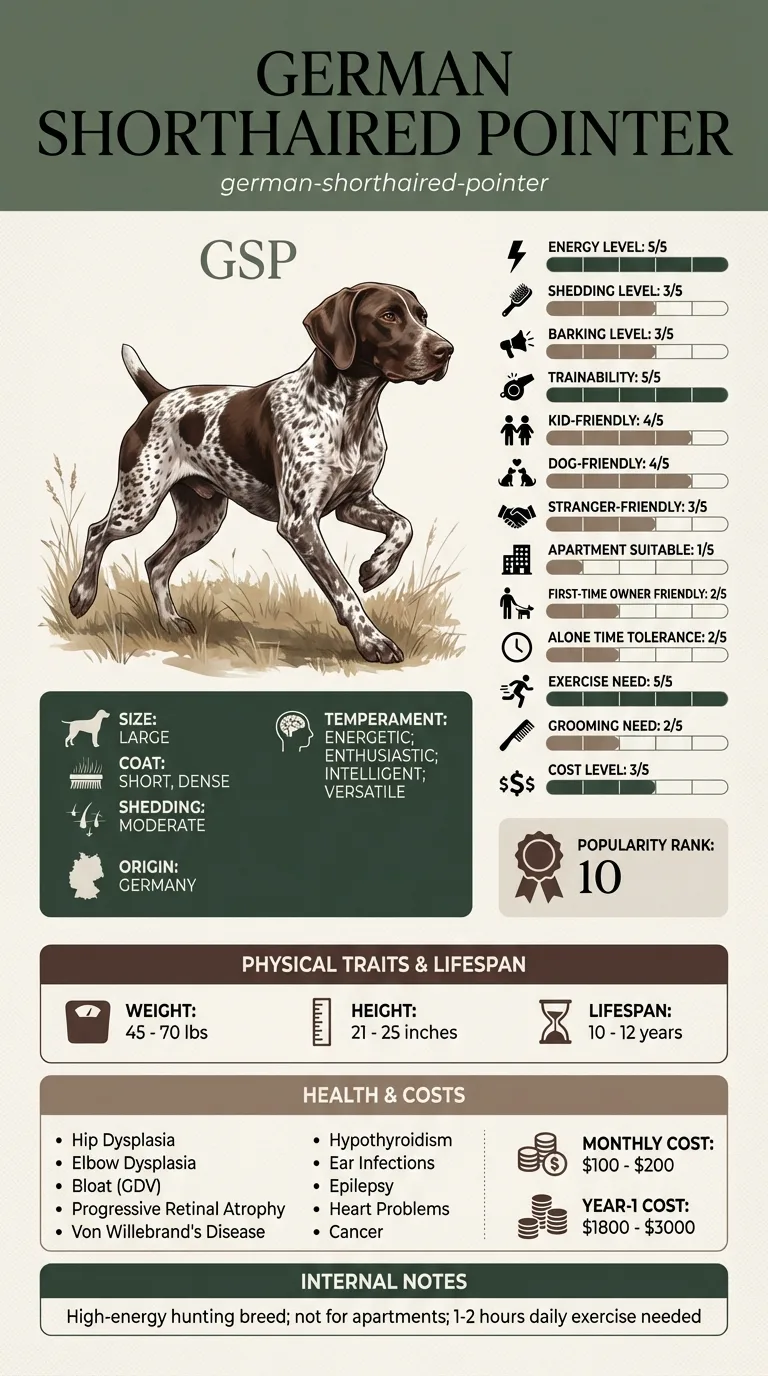
This breed's alone-time tolerance is rated a low two out of five, and its apartment suitability rates lower still at one out of five, a combination that describes a dog poorly matched to long stretches of solitude in a small space. Both ratings trace back to the same trait: this is a versatile gundog bred to work at a handler's side all day, reading subtle cues and responding to them continuously, which produces a dog whose sense of normal includes almost constant human contact.
A companion breed developed for independence tolerates a quiet day home alone without much fuss. A GSP's entire working design assumes a person is present and engaged, and removing that person for a full workday is a bigger departure from what the dog is built for than it would be for many other breeds of similar size and energy.
Boredom and anxiety can look similar at a glance but need different responses.

Naomi adopted Scout into a one-bedroom apartment and worked a standard nine-hour office schedule. Within the first month, the blinds by the front window were shredded twice, and a neighbour mentioned hearing barking that started almost as soon as Naomi left each morning. Camera footage showed Scout calm for the first minute or two, then pacing, panting and eventually attacking the blinds near the door, not randomly around the apartment. Naomi began a structured plan: a hard run before work, a food puzzle timed to start right at departure, and short practice absences on weekends that gradually built toward the length of a workday. She also added two mornings a week at a local dog daycare to break up the week's total alone time. Within two months, camera footage showed Scout settling within ten minutes rather than staying distressed, though Naomi kept the daycare days going as ongoing management rather than a temporary fix.
Key takeaway: The behaviour looked destructive, but the camera showed it was distress, not mischief, and it responded to a plan built around reducing genuine anxiety rather than more scolding after the fact.
No, plenty of GSPs cope well alone with the right preparation and enough exercise beforehand. But the breed's low alone-time tolerance rating means the risk is genuinely higher here than in many other breeds, and prevention matters more.
It helps but rarely solves true separation anxiety on its own. A tired dog settles more easily, but anxiety triggered specifically by the owner's absence needs its own gradual desensitisation work as well.
No. Boredom-driven destruction tends to build gradually and spread around the space; true anxiety often starts within minutes of departure and concentrates at exit points like doors and windows.
Sometimes it helps, but separation anxiety in this breed is usually about the specific human bond, not simply the presence of another living creature, so a second dog is not a reliable fix on its own.
Gradual departure desensitisation, done consistently, often shows meaningful improvement over several weeks, though severe cases can take considerably longer and some dogs never fully match a companion breed's tolerance for long solo hours.
For more severe cases, a vet may discuss anti-anxiety medication alongside behavioural work. This is a veterinary decision based on an individual dog's assessment, not something to start without professional guidance.
It depends on the dog. Some dogs find a properly introduced crate calming; a dog already anxious about being left can find confinement adds to the distress if it was never conditioned to see the crate as a safe space beforehand.
It was bred to work in close partnership with a handler all day, which produces a low natural tolerance for solitude.
Destruction concentrated at doors and exit points, and distress starting within minutes of the owner leaving.
Yes, a tired dog settles more easily, though exercise alone rarely resolves true separation anxiety.
For a breed this poorly suited to solitude, daycare or a midday dog walker is a genuinely useful option for owners working long hours.
It varies by area but is a recurring cost worth budgeting for if your schedule regularly leaves this breed alone for a full workday.
Behaviour changes often start with pain. The prep sheet for this page covers what to rule out, and what to ask.
You get: Vet visit prep sheet
No spam. One-click unsubscribe. See our privacy policy.
Preview page 1 before you decide.