Health
Do German Shorthaired Pointers get IVDD?
Rarely as a breed predisposition. They lack the cartilage abnormality that causes explosive disc rupture in short-legged breeds, and spinal disease is not on their documented health list.

Quick answer
Do German Shorthaired Pointers get IVDD?
Rarely as a breed predisposition. They lack the cartilage abnormality that causes explosive disc rupture in short-legged breeds, and spinal disease is not on their documented health list.
A GSP with a sore back usually has a soft tissue injury or a joint problem referring pain, not a ruptured disc. The exception matters enormously, because it is time-critical.
Owners who searched their dog's back pain and landed in dachshund-focused material that does not fit, and people trying to work out whether a dog that is reluctant to jump is stiff, sore or genuinely neurologically affected.
This guide is not medical advice. If your dog shows pain, sudden behavior change, or worsening symptoms, consult a licensed veterinarian.
Some links may be affiliate links. We may earn a commission at no extra cost to you. We only suggest products we believe are helpful for dog owners.
We research and check what we publish, but we do not warrant that any figure, date, price, or statement is accurate, complete, or current, and we accept no liability for any loss, cost, injury, or other harm arising from the use of this site. Use it as one reference among several. You remain responsible for your own decisions and for your dog's care - confirm anything that matters with a licensed veterinarian or another qualified professional before you act on it. Full disclaimer.
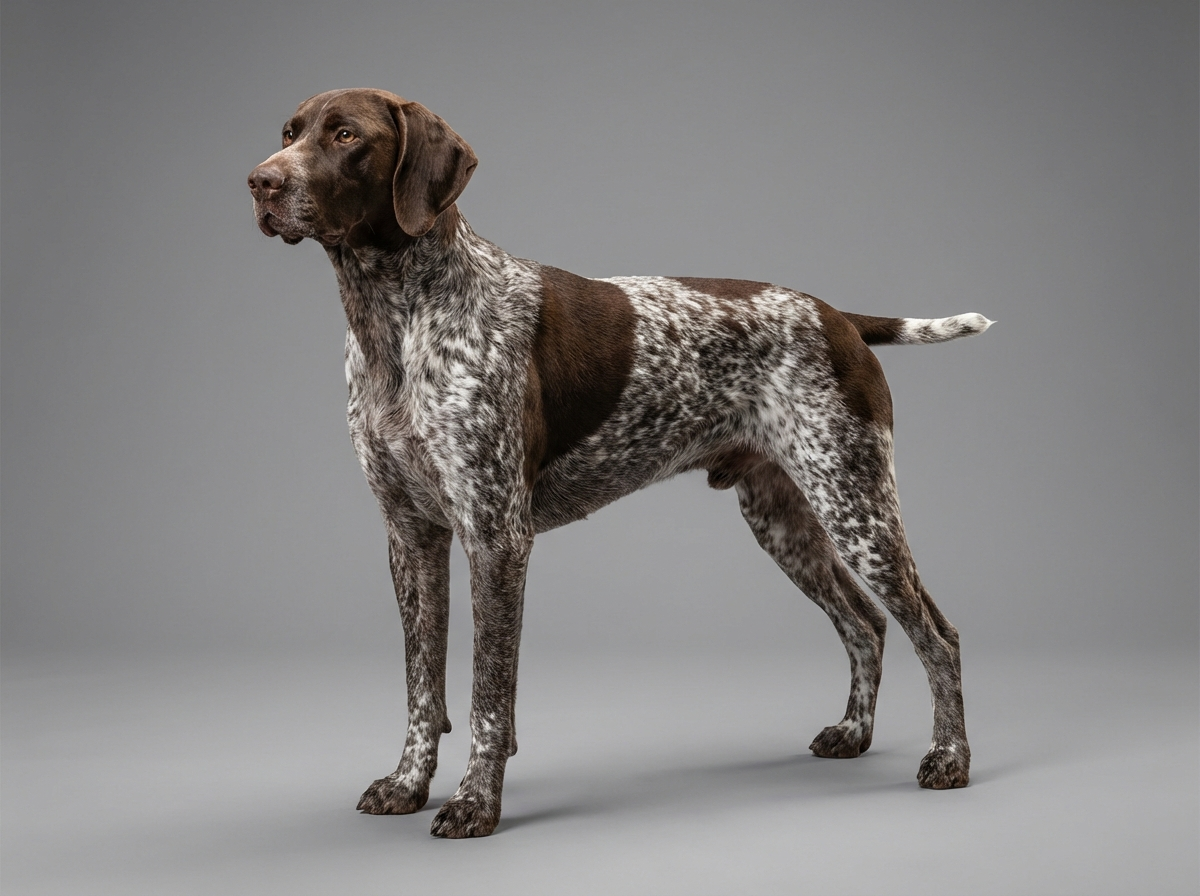
Intervertebral disc disease occurs when disc material presses on the spinal cord, and it is overwhelmingly a disease of short-legged, long-backed breeds carrying an inherited cartilage abnormality. German Shorthaired Pointers are normally proportioned athletic dogs and do not carry that predisposition, and spinal disease does not appear among their documented health issues. When back problems do occur in this breed they are usually muscular, joint-referred, lumbosacral or traumatic, with age-related disc bulging a distant possibility rather than a breed expectation.
Disc disease is uncommon in German Shorthaired Pointers relative to the breeds that dominate the literature on it, and owners who find alarming survival statistics online are usually reading material written about dachshunds. Back pain of some description is far from rare in a hard-working sporting dog, but the great majority of those episodes are soft tissue or joint problems that resolve with proper rest rather than spinal cord compression.
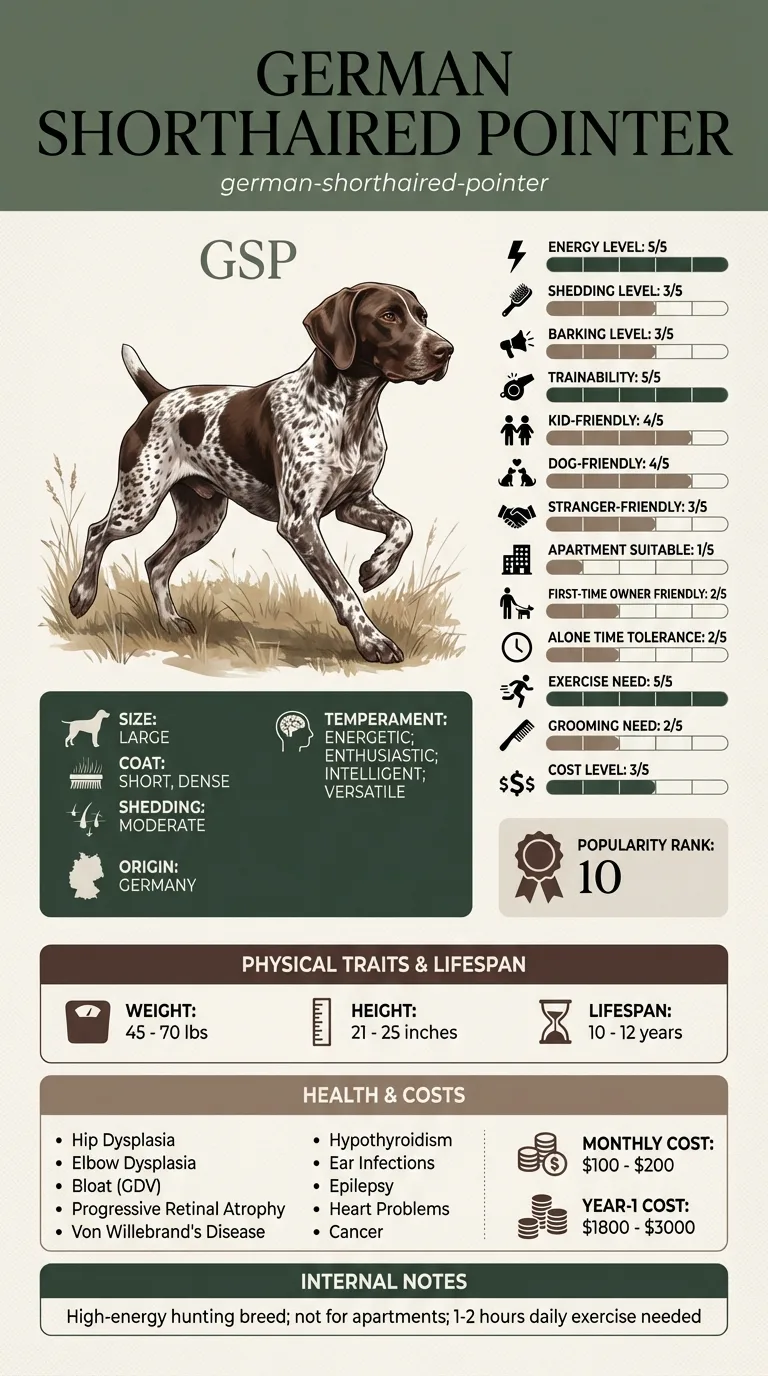
The most important breed fact here is a negative one. German Shorthaired Pointers do not have the disproportionate build or the early cartilage calcification that create genuine disc predisposition, and their documented health list contains no spinal entries. What the breed does contribute is exposure. A 45 to 70 pound dog rated five out of five for both energy and exercise need, worked one to two hours daily through cover, subjects its spine to repeated high-speed loading, sudden direction changes and occasional collisions. Hip dysplasia, first on the breed's documented list, adds a compensatory postural load that concentrates strain in the lower back.
Terrain and habit account for most of the risk. Rutted fields, ditches and wire fences produce the awkward landings and impacts that injure normal spines. Household routine adds a slow contribution: a dog that leaps down from a high tailgate twice a day for eight years accumulates thousands of high-impact loadings. Slippery indoor flooring produces splayed slips that strain the back. Excess weight increases the load on every spinal structure continuously, which is why body condition appears in almost every orthopaedic conversation about this breed.
Treat these as emergencies requiring immediate assessment: inability to stand or bear weight on the hind legs, dragging of the hind feet, loss of bladder or bowel control, or sudden severe back pain with any weakness. Time to treatment materially affects outcome in spinal cord compression, so this is one of the situations where hours matter. Arrange a prompt appointment for hind-paw knuckling, nail scuffing, a wobbly gait, crossing of the back legs, or pain on rising that persists more than a day or two. Book routinely for stiffness that improves with movement, which is more typical of joint than spinal disease. Do not give human anti-inflammatories, several of which are seriously toxic to dogs.
See all German Shorthaired Pointer health problems, which breeds are prone to intervertebral disc disease ivdd, or the full German Shorthaired Pointer breed guide for temperament, exercise needs and ownership costs.
A muscular back strain typically settles over two to four weeks of genuine rest, and relapses almost always trace back to rest that was not genuine. A traumatic disc injury managed conservatively usually needs six to eight weeks of confinement followed by graded rehabilitation. Surgical cases follow a similar or longer arc with a structured programme. Age-related disc change is managed indefinitely rather than resolved.
Success for the common presentations is complete: a dog that returns to full work with a ramp habit and a leaner body condition. Where the spinal cord has been involved, success is measured in function rather than perfection, meaning a dog that walks reliably, controls its bladder, and manages daily life comfortably, even if it retains a slight hind-end wobble on tight turns.
Discs fail in two broad ways, and it is worth knowing which conversation applies to your dog.
The explosive kind involves a disc whose inner core has calcified prematurely because of an inherited cartilage abnormality. Under load it bursts upward into the spinal canal, causing sudden severe compression. This is the classic dachshund and corgi presentation, and it typically strikes young to middle-aged dogs without warning. German Shorthaired Pointers do not carry that cartilage trait.
The gradual kind involves the disc's outer fibrous ring thickening and bulging with age, pressing on the cord slowly over months. It is the pattern seen in larger, normally proportioned breeds, and when a GSP does develop disc-related problems this is the more likely version. It usually presents as progressive hind-limb clumsiness or back pain rather than overnight paralysis.
There is a third route in this breed specifically: acute traumatic injury. A dog that hits a fence at speed, is struck by a vehicle, or falls awkwardly from a tailgate can damage a perfectly normal disc. That is not a breed predisposition; it is an occupational hazard of being a fast dog in rough country.
Before assuming a disc, work through the possibilities that are far more common in an athletic pointing breed.

Fenno, a six-year-old GSP, started standing with an oddly hunched posture and yelped once when his owner, Sunniva, lifted him into the car. She read about disc disease that evening and slept badly. At the clinic the vet spent most of the examination on Fenno's hind limbs rather than his spine, and found a partially torn cruciate ligament in the left stifle. The hunched back was compensation: he had been shifting his weight forward for weeks and had tightened the muscles along his spine as a result. After the knee was managed and a course of rehabilitation strengthened his hind end, the back posture disappeared without anything being done to it directly. Sunniva keeps the phone video she took of his gait that week. In it, the left hind foot barely touches down on the turn, which she had not noticed at all at the time.
Key takeaway: In a normally proportioned athletic breed, back pain is frequently a symptom rather than the diagnosis. Have the hind limbs examined properly before accepting a spinal explanation.
No. They lack the inherited cartilage abnormality that drives disc disease in short-legged breeds, and spinal disease does not appear on their documented health list. Disc problems can still occur through age-related change or trauma, but a GSP with back pain is much more likely to have a muscular, joint or lumbosacral problem.
It is a genuine pain signal that deserves examination, but the cause is more often muscular, lumbosacral or referred from a hip. What raises the concern level substantially is pain accompanied by wobbliness, scuffed nails, crossing of the hind legs, or any loss of coordination, which shifts the question from soreness to spinal cord involvement.
Knuckling of the hind paws so the dog stands on the top of its foot, a wobbly or drunken hind-end gait, scuffing that wears the tops of the nails, crossing of the back legs at speed, and difficulty getting up. Loss of bladder control or inability to move the hind legs is an emergency.
Yes, and more strictly than most owners do. Genuine rest means lead-only toilet breaks and no stairs, jumping, sofas or vehicle leaps, not simply a shorter walk. For a dog rated five out of five for exercise need this requires active management, but half-hearted rest is the most common reason a soft tissue back injury takes months instead of weeks.
A neurological examination localises the problem to a region of the spine, and advanced imaging, usually MRI at a referral centre, confirms what is compressing the cord and where. Plain radiographs can suggest changes and rule out some alternatives but cannot show the spinal cord itself, which is why they rarely settle the question.
Many do, particularly after a traumatic injury in an otherwise sound spine, though return is gradual and guided by rehabilitation rather than by how the dog feels. Dogs with progressive age-related disc change face a different conversation, since the underlying degeneration continues regardless of how well any single episode resolves.
Rarely as a breed predisposition. They lack the cartilage abnormality that causes explosive disc rupture in short-legged breeds, and spinal disease is not on their documented health list.
Muscular strain from hard work in uneven terrain, pain referred forward from a dysplastic hip, or lumbosacral disease. Genuine disc problems are much less common.
Any loss of hind-limb function, dragging feet, inability to stand, or loss of bladder control needs emergency assessment immediately. Time to treatment strongly affects outcome.
Lead-only toilet breaks, no stairs or jumping, and mental work substituted for physical work. Scent games and food puzzles satisfy the brain without loading the spine.
Yes, permanently. A ramp costs little and removes one of the most repeated high-impact spinal loads in a working dog's week.
A one-page prep sheet for this condition: the signs, the questions to ask, what to get priced. Unlocks here.
You get: Vet visit prep sheet
No spam. One-click unsubscribe. See our privacy policy.
Preview page 1 before you decide.