Health
What do patellar luxation grades mean?
Grade one pops out only under finger pressure and returns alone; grade two luxates intermittently by itself; grade three sits out most of the time; grade four cannot be replaced at all.

Quick answer
What do patellar luxation grades mean?
Grade one pops out only under finger pressure and returns alone; grade two luxates intermittently by itself; grade three sits out most of the time; grade four cannot be replaced at all.
Grade one and grade four are the same diagnosis in name only. One is a note in a file; the other is a leg the dog cannot straighten.
Owners who have been given a grade and no explanation of what it predicts, and people weighing whether an operation is genuinely necessary for a dog that seems entirely happy.
This guide is not medical advice. If your dog shows pain, sudden behavior change, or worsening symptoms, consult a licensed veterinarian.
Some links may be affiliate links. We may earn a commission at no extra cost to you. We only suggest products we believe are helpful for dog owners.
We research and check what we publish, but we do not warrant that any figure, date, price, or statement is accurate, complete, or current, and we accept no liability for any loss, cost, injury, or other harm arising from the use of this site. Use it as one reference among several. You remain responsible for your own decisions and for your dog's care - confirm anything that matters with a licensed veterinarian or another qualified professional before you act on it. Full disclaimer.
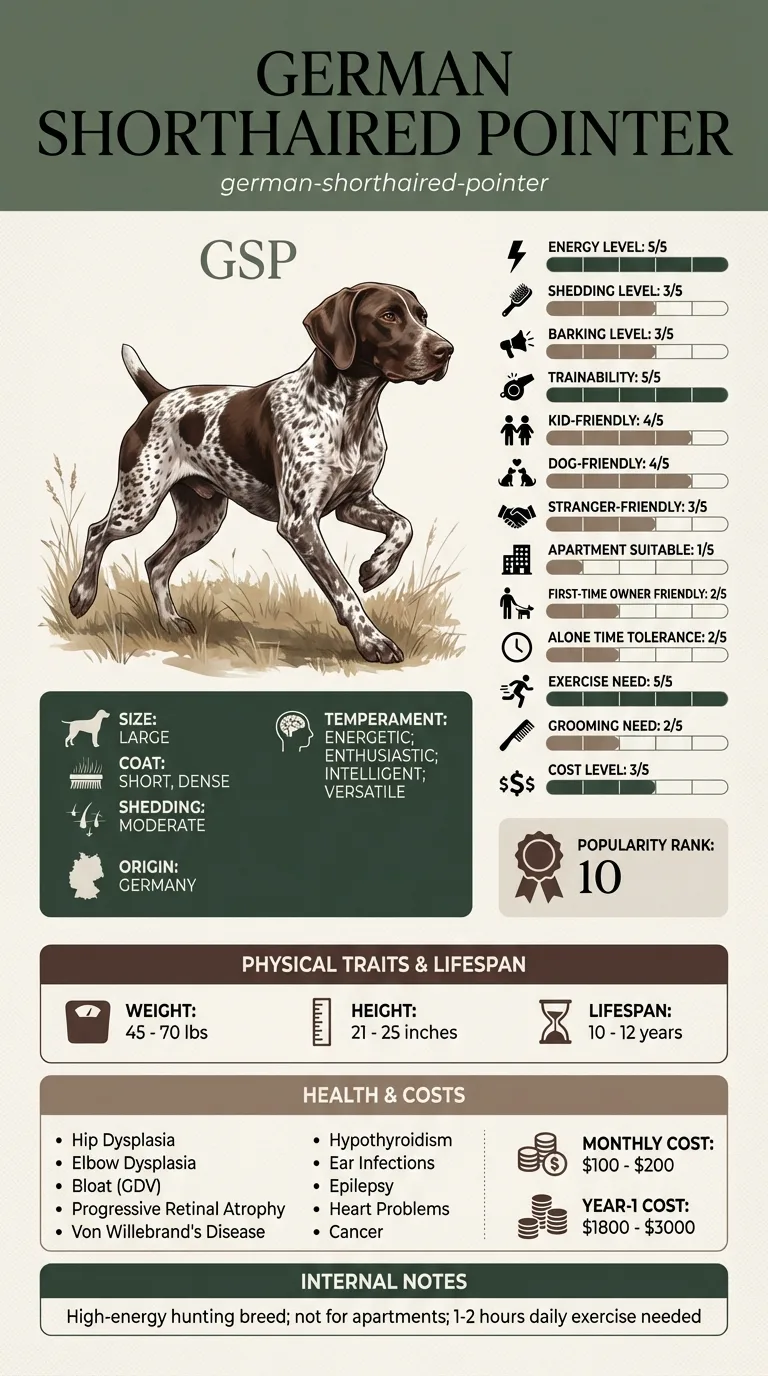
Patellar luxation is graded one to four according to how readily and how permanently the kneecap leaves its groove, and that grade drives every decision that follows. Low grades are monitored; high grades are surgical; grade two is the judgement call, and in a 45 to 70 pound working dog the cumulative cartilage wear argues for deciding sooner rather than later. Kneecap instability is not documented as a German Shorthaired Pointer concern, so a diagnosis here is uncommon rather than expected.
Patellar luxation is among the most commonly diagnosed orthopaedic problems in small breeds and among the least common in large sporting ones. It does not appear on the German Shorthaired Pointer's documented health list. Where it is found in this breed it is more often associated with genuine skeletal deformity than with a simple shallow groove, which tends to place such cases at the more significant end of the grading scale.
Conformation protects this breed and body mass works against it. A straight-limbed, correctly proportioned dog of 21 to 25 inches lacks the angular hind-limb conformation that predisposes small breeds, and no kneecap condition appears among the German Shorthaired Pointer's documented health issues. But a 45 to 70 pound dog rated five out of five for energy and exercise need transmits far greater force through the joint than a small companion dog, so the same anatomical fault that stays silent in a lapdog wears cartilage measurably here. That difference is why grading thresholds for intervention are considered differently in a large working breed.
Activity pattern is the main environmental influence on whether a given grade becomes a clinical problem. Games built on hard pivoting, chase and skidding turns load the knee laterally in a way straight-line running does not. Repeated jumping down from tailgates and furniture does the same in flexion. Slick indoor flooring produces splayed slips that torque the joint. Periods of enforced rest are quietly damaging in a different way, since thigh muscle is lost quickly and rebuilt slowly, and reduced musculature leaves less support holding the kneecap on track.
Seek prompt assessment for a hind leg that is held up and not returning to use, for a visibly swollen knee, or for sudden inability to bear weight, all of which suggest something beyond a transient luxation, most often a cruciate rupture. Book within days for a skip that is becoming more frequent, lameness that persists between episodes, or visible muscle loss over one thigh. Book routinely to have any occasional skip examined and formally graded so you have a baseline for comparison. Do not give human anti-inflammatory medication, several of which are seriously toxic to dogs.
See all German Shorthaired Pointer health problems, which breeds are prone to patellar luxation, or the full German Shorthaired Pointer breed guide for temperament, exercise needs and ownership costs.
Conservative management with weight control and muscle building shows its effect over eight to twelve weeks. Surgical recovery runs eight to twelve weeks of controlled rehabilitation for normal function, extending to three or four months before a working dog returns to full field fitness. Monitored low-grade cases need an annual re-examination. Higher grades operated on late may need ongoing arthritis management regardless of how well the repair itself holds.
After surgery, success is a dog bearing weight evenly, with symmetrical thigh muscle and a normal stride, that has returned to its work. For a monitored low grade, success is a stable grade at annual rechecks with no lameness developing. Success does not always mean the kneecap never moves again, and an occasional skip in a sound, well-muscled, comfortable dog is not evidence that anything has failed.
Grading is done by hand, with the dog relaxed, feeling how the kneecap behaves when pressure is applied and when the leg is flexed and extended.
The decision is driven by clinical signs and grade together, not by the grade alone. A grade one causing nothing is monitored. A grade three or four is almost always surgical, because the dog cannot use the leg properly and the joint is deteriorating continuously.
Grade two is where judgement lives. The considerations are how often it luxates, whether there is lameness between episodes, whether muscle is being lost on that side, the dog's age, and how much work the joint is being asked to do. A 45 to 70 pound dog rated five out of five for exercise need generates far more cumulative cartilage wear than a small companion dog with the same grade, which pushes the argument toward earlier intervention.
Surgery is not one operation but a set of techniques combined to suit the individual anatomy. Deepening the groove so the kneecap has a track to sit in is the central step. Repositioning the point where the main thigh tendon attaches to the shin bone realigns the pull so it no longer drags the kneecap sideways. Tightening or releasing the soft tissue on either side of the joint finishes the job.
What surgery cannot do is undo cartilage already worn away, which is the argument against waiting indefinitely.

If you think your GSP has patellar luxation, the plan is three steps: write down what you have seen and when it started, book a veterinary appointment rather than waiting for the next flare, and take video of the behaviour or symptom before you go — the thing you are worried about rarely happens in the consulting room. Screening in the parents covers hip dysplasia, elbow dysplasia, bloat (gdv).
What the vet visit should produce is a diagnosis and a written plan, not just reassurance: what is being ruled out, what the monitoring interval is, and which signs mean you come back sooner. Ask what the treatment costs across a year rather than per visit, because that is the number that decides whether you are managing this condition or reacting to it.
Between appointments, keep a short log — dates, what you saw, what changed. It is the single most useful thing an owner brings to a follow-up, and for patellar luxation it is often what separates a clear pattern from a guess.
Anouk's four-year-old GSP, Silke, had a grade two luxation on the right that skipped perhaps once a fortnight. Two vets gave the same honest answer: it could reasonably be operated on or reasonably be left. What settled it was a measurement. Her rehabilitation therapist recorded thigh circumference on both sides at each visit. Over five months the right side lost nearly two centimetres relative to the left, despite Silke never looking lame. That loss meant she was consistently avoiding the leg, which no one had been able to see. The surgery was booked. Eleven weeks after the operation the two measurements were within three millimetres of each other, and Silke was back working half days.
Key takeaway: A dog that is not limping can still be unloading a leg. Serial thigh measurements turn a judgement call about grade two into an evidence-based decision.
Generally not. A grade one found incidentally in a dog with no lameness is monitored rather than operated on, with attention to maintaining lean body condition and good thigh muscle. What warrants a recheck is any change: increasing skip frequency, lameness persisting between episodes, or muscle loss on that side.
Yes, particularly in a growing dog where the bones are still forming, and to a lesser extent in an adult where progressive cartilage wear and stretching of the joint capsule allow more movement. This is why grading is repeated rather than recorded once, and why an early low grade is not a permanent reassurance.
Strict confinement initially, then a graded programme of controlled lead walking building over roughly eight to twelve weeks, usually with physiotherapy input. Returning a working dog to full field fitness takes longer than returning a pet to normal life, often three to four months, and rushing that stage is the commonest cause of a poor result.
Bilateral involvement is common, and it can disguise itself. A dog with equal problems on both sides may not limp at all, because there is no sound leg to compare against; instead it moves with a crouched, short-strided hind gait that owners often describe as the dog's normal way of walking.
Yes. Abnormal kneecap tracking alters the mechanics of the whole joint and increases strain on the cruciate ligament, and the two conditions are found together often enough that a knee being examined for one should be checked for the other. In a large athletic breed, cruciate injury is the more likely of the two to occur in the first place.
No. Patellar luxation has a recognised heritable component in the breeds where it is common, and formal patella evaluation is part of breeding screening in many schemes. Even in a breed where the condition is unusual, breeding an affected dog is not advisable.
Grade one pops out only under finger pressure and returns alone; grade two luxates intermittently by itself; grade three sits out most of the time; grade four cannot be replaced at all.
Grades three and four are almost always surgical. Grade two depends on lameness, frequency, muscle loss and workload, and grade one is normally just monitored.
It deepens the groove the kneecap sits in, repositions the tendon attachment on the shin bone to realign the pull, and adjusts the soft tissue on either side.
Roughly eight to twelve weeks of controlled rehabilitation for normal life, and often three to four months before a working dog returns to full field fitness.
Usually yes, with lean body condition and good thigh muscle. Reduce sharp pivoting games in favour of straight-line work and swimming.
A one-page prep sheet for this condition: the signs, the questions to ask, what to get priced. Unlocks here.
You get: Vet visit prep sheet
No spam. One-click unsubscribe. See our privacy policy.
Preview page 1 before you decide.